Banks do not take money on deposit and lend it out. They create it, from nothing, with a few keystrokes, and the entire system depends on you never noticing.
When you deposit $10,000 in cash at JPMorgan Chase, the bank records a liability to you and an asset for itself. Under fractional reserve banking, the Federal Reserve requires banks to hold only a fraction of deposits as reserves. For decades, that requirement sat around 10%, and in March 2020 the Fed dropped it to zero. That means JPMorgan can lend out the full $10,000 you deposited, while still owing you that $10,000 on demand. The borrower who receives that $10,000 deposits it elsewhere. That bank then lends it out again. The same dollars multiply through the system, spawning new purchasing power at each stage without a single additional dollar being printed.
Murray Rothbard called this counterfeiting conducted through respectable institutions, and I think that word fits. If you printed money in your basement and spent it, you would transfer real wealth from later dollar-holders to yourself. Banks do precisely this, they just call the process "credit creation" and charge interest for the privilege of doing it.
The price you pay seems hidden at first. Every new dollar dilutes your "old" dollars. When credit expansion drives a housing boom, as it did between 2003 and 2007, asset prices rise first for the people closest to the new money, the borrowers, the developers, the leveraged speculators. By the time ordinary wages and savings adjust, you have already been taxed by dilution of purchasing power without a single congressman casting a vote.
This system contains the seed of every business cycle. Cheap credit manufactured by banks sends false signals to entrepreneurs, who invest in projects that the real pool of savings cannot support. The boom turns to bust when reality reasserts itself, usually violently, usually on your tab through bailouts.
Fractional reserve banking is state-licensed privilege, enforced by deposit insurance and central bank backstops that socialize the losses while the gains flow upward. This is how the rich become richer, and the poor get poorer, not "capitalism," as economically illiterate politicians like to claim.
Candidates for Prahan, Vic…
Per Brad Cox on FB:
“Wonderful to meet Max Dicks - Prahran candidate , We simply had to have a photo together. Lovely bloke. #OneNation#ai”
This is absolutely legit….😂😂😂😝
I don’t care where the prices of gold,silver, bitcoin the gold miners or MSTR go. I own them unleveraged and I ain’t leaving. I am playing the long game. The Fed can rot in hell and we will win! For clues as to what is happening see Myrmikan’s Weimar chart. Volatility is part of the process. We will dance on the Fed’s grave. I was here in 2015, it was much worse. This too shall pass.
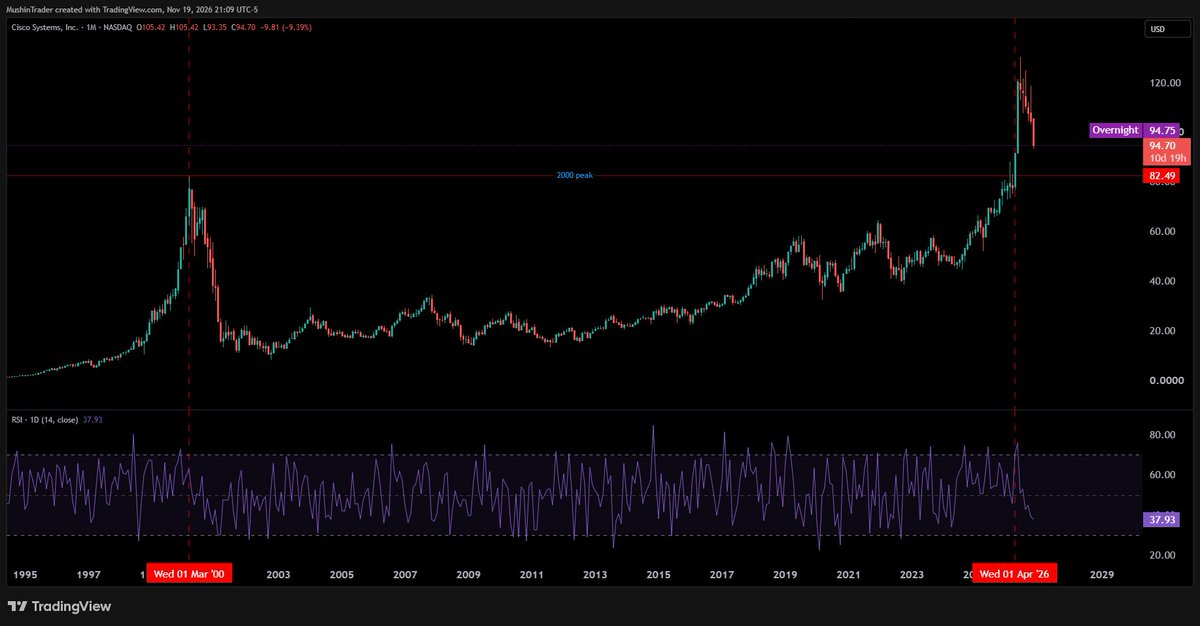
@lhamtil If early investors cannot exit at a profit, they cannot recycle their money into the next thing. Retail has always been the exit. Cisco helped build the internet infrastructure but it took 26 years to make a new high. History rhymes.
Re $ANT if you bought the Cisco top in 2000, it took 26 years to get back into the money. CIsco was building the backbone to the internet and those investors helped fund that build out. Cisco made money throughout that time, but the price didn't recover. There is a lesson here.