Arizona small business owner. Founder of Watch the Watchers News. Tracking surveillance, government data access, and constitutional rights. No writ. No search.
🚨 Exclusive: 300,000+ Plate Reads. 54 ‘Success Stories.’ 798 Agencies? Fourth Amendment Questions Loom as Prescott Valley’s Police Chief May Talk Flock
➡️ What to expect October 1st — and whether a presentation meant to answer questions about Prescott Valley’s ALPR network will end up raising even more.
Read the Report: https://t.co/s1jyIBOnOJ
@NoWritNoSearch@prescottpulse@LPMaricopa@therealDeFlock@bennjordan@RandPaul@ShawnLD8
🚨 Exclusive: 300,000+ Plate Reads. 54 ‘Success Stories.’ 798 Agencies? Fourth Amendment Questions Loom as Prescott Valley’s Police Chief May Talk Flock
➡️ What to expect October 1st — and whether a presentation meant to answer questions about Prescott Valley’s ALPR network will end up raising even more.
Read the Report: https://t.co/s1jyIBOnOJ
@NoWritNoSearch@prescottpulse@LPMaricopa@therealDeFlock@bennjordan@RandPaul@ShawnLD8
This is totally insane, they were illegally pulling people over based on their "pattern of movement" being suspicious.
When police tell you that this is "just taking pictures of a plate", they think you are stupid and aren't informed at all.
With Flock, more tyranny is always just a software update away.
Surveillance company VIDIZMO offers to add facial recognition to Flock cameras
-----
The next time a cop gives a speech at a city council meeting saying Flock cameras are just license plate readers, interrupt him and call him a liar.
We cannot tolerate the gaslighting.
https://t.co/t2Wzub3EKQ
Whoops again, all of these various police departments have access to Flock data without any contract.
What we end up finding is that Flock and other vendors give out "free trials" and MOUs that allow access without any external approval.
Thank you @JensTwoCentsAZ ! We need eyes on Prescott Valley. Oct 1 License Plate Reader (LPR) Presentation - Discussion Only 👈
I pushed hard for more than another sales pitch. What do you think they'll do? 🤨
Working on a major investigation into Flock license plate readers this week and came across this:
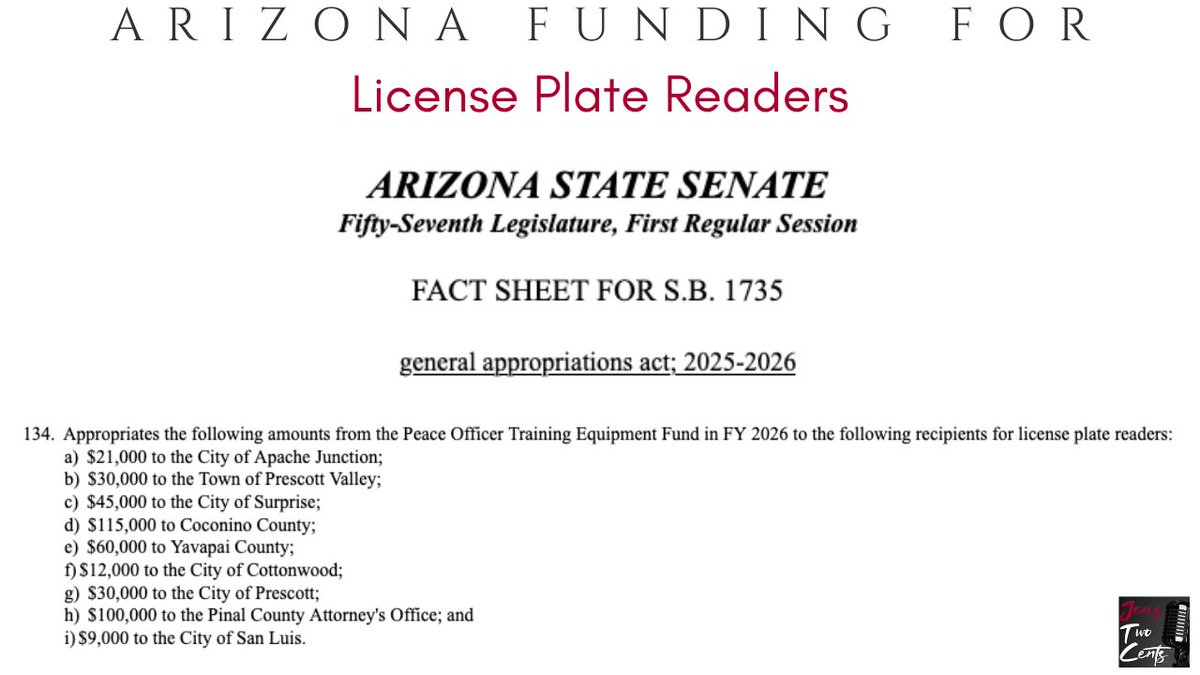
In Arizona’s FY2026 budget, lawmakers approved $422,000 specifically for license plate readers across nine jurisdictions.
The Town of Prescott Valley and City of Prescott each received $30,000 specifically for license plate readers — two communities where citizen-commissioned polling by NextGen has since reported significant public concern about the technology. @NextGenPolling
The Pinal County Attorney’s Office received $100,000 — the second-largest individual appropriation in the FY2026 list — specifically designated for license plate readers.
But in the FY2027 budget, that “license plate readers” language is gone. The same fund continues distributing money to law enforcement agencies — but under other categories and appropriations.
#azleg @NoWritNoSearch
Working on a major investigation into Flock license plate readers this week and came across this:
In Arizona’s FY2026 budget, lawmakers approved $422,000 specifically for license plate readers across nine jurisdictions.
The Town of Prescott Valley and City of Prescott each received $30,000 specifically for license plate readers — two communities where citizen-commissioned polling by NextGen has since reported significant public concern about the technology. @NextGenPolling
The Pinal County Attorney’s Office received $100,000 — the second-largest individual appropriation in the FY2026 list — specifically designated for license plate readers.
But in the FY2027 budget, that “license plate readers” language is gone. The same fund continues distributing money to law enforcement agencies — but under other categories and appropriations.
#azleg @NoWritNoSearch
“Defund the Police 2.0” vs. Privacy: Arizona’s Flock Camera Showdown
Is opposing Flock cameras “Defund the Police 2.0”—or are the privacy concerns serious enough to justify shutting them off?
That divide was on full display across Arizona this week.
In Prescott, Cottonwood and Scottsdale, three meetings in a single day captured just how heated the fight over Flock Safety’s automated license plate readers has become.
One speaker characterized opposition to the technology as “Defund the Police 2.0.”
Meanwhile, Cottonwood Police Chief Brian Freudenthal explains why his department turned its Flock cameras off—and how privacy factored into that decision.
In Scottsdale, the debate continued as residents, law enforcement representatives and political advocates weighed public safety against questions about surveillance, data access and privacy.
And in Prescott, the conversation turned to the Arizona Legislature, including SB 1111 and what could come next in 2027.
New NextGen polling in Paradise Valley, Prescott Valley and Prescott adds another layer to the debate over how Arizona residents view the technology.
Three cities. One day. Very different views on where public safety ends and surveillance begins.
CHAPTERS
00:00 “The influence of artificial intelligence on the technology is also creating some of the issues that the public is concerned with.”
00:24 NextGen polling: Paradise Valley, Prescott Valley & Prescott @NextGenPolling
00:44 2027 legislative update at Prescott City Council
02:46 Arizona SB 1111
03:13 Lobbyist Nick Ponder
05:58 Cottonwood Police Chief Brian Freudenthal explains why the department turned off its Flock cameras
12:18 Scottsdale City Council meeting
12:48 Eric Fowler, Chair of the Maricopa County Libertarian Party @LPMaricopa
13:25 Lottie Kimball, Scottsdale Fraternal Order of Police
14:13 Yvonne Cahill
17:39 Wrap-up
@prescottpulse@PamKirby@MayorBorowsky
“Defund the Police 2.0” vs. Privacy: Arizona’s Flock Camera Showdown
Is opposing Flock cameras “Defund the Police 2.0”—or are the privacy concerns serious enough to justify shutting them off?
That divide was on full display across Arizona this week.
In Prescott, Cottonwood and Scottsdale, three meetings in a single day captured just how heated the fight over Flock Safety’s automated license plate readers has become.
One speaker characterized opposition to the technology as “Defund the Police 2.0.”
Meanwhile, Cottonwood Police Chief Brian Freudenthal explains why his department turned its Flock cameras off—and how privacy factored into that decision.
In Scottsdale, the debate continued as residents, law enforcement representatives and political advocates weighed public safety against questions about surveillance, data access and privacy.
And in Prescott, the conversation turned to the Arizona Legislature, including SB 1111 and what could come next in 2027.
New NextGen polling in Paradise Valley, Prescott Valley and Prescott adds another layer to the debate over how Arizona residents view the technology.
Three cities. One day. Very different views on where public safety ends and surveillance begins.
CHAPTERS
00:00 “The influence of artificial intelligence on the technology is also creating some of the issues that the public is concerned with.”
00:24 NextGen polling: Paradise Valley, Prescott Valley & Prescott @NextGenPolling
00:44 2027 legislative update at Prescott City Council
02:46 Arizona SB 1111
03:13 Lobbyist Nick Ponder
05:58 Cottonwood Police Chief Brian Freudenthal explains why the department turned off its Flock cameras
12:18 Scottsdale City Council meeting
12:48 Eric Fowler, Chair of the Maricopa County Libertarian Party @LPMaricopa
13:25 Lottie Kimball, Scottsdale Fraternal Order of Police
14:13 Yvonne Cahill
17:39 Wrap-up
@prescottpulse@PamKirby@MayorBorowsky
Government cameras across Arizona are quietly photographing your car. But what's being done with the data? We're taking action to find out.
The Goldwater Institute is sending public records requests to cities, towns and universities across Arizona — demanding they come clean about how they’re using this surveillance technology, how long they’re keeping your data, and who they’re sharing it with.
So far, Goldwater has sent requests to Peoria, Prescott Valley, Arizona State University, and the University of Arizona, which have reportedly implemented ALPR surveillance.
Government cameras across Arizona are quietly photographing your car. But what's being done with the data? We're taking action to find out.
The Goldwater Institute is sending public records requests to cities, towns and universities across Arizona — demanding they come clean about how they’re using this surveillance technology, how long they’re keeping your data, and who they’re sharing it with.
So far, Goldwater has sent requests to Peoria, Prescott Valley, Arizona State University, and the University of Arizona, which have reportedly implemented ALPR surveillance.
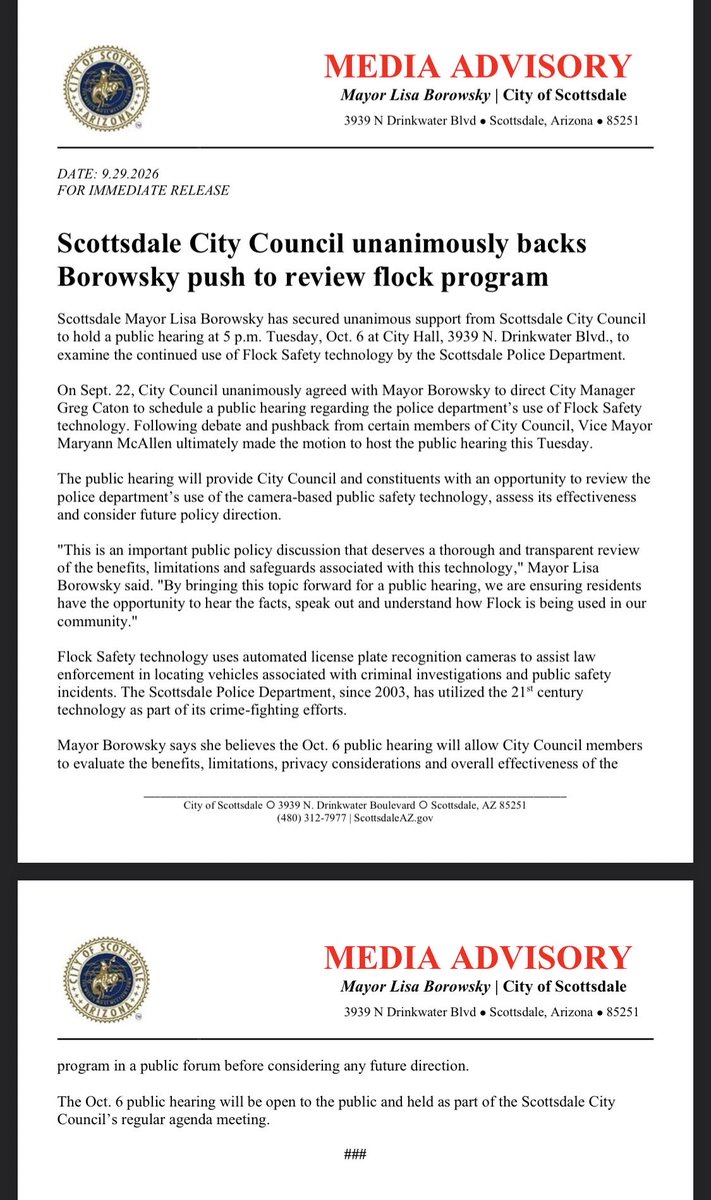
GM - Last night Our Chair was back at Scottsdale again, this time to argue that Flock should finally get put on an agenda so it will finally get a Council vote.
We got the motion passed unanimously!