NOAA provides science, service and stewardship to protect life, property & Earth's natural resources. An agency of @CommerceGov. Join us on Instagram & Facebook
Rain, sleet, snow? Be in the know.
For 24/7 weather forecasts, watches and warnings, follow NOAA's National Weather Service here at:
@NWS
and
@NWSWPC
-- and bookmark https://t.co/x8iKsn3FrK to view a national advisories, watches and warnings map + get your local forecast by inputting your Zip Code or City, State
🌦️🌧️⛈️🌨️🌞
The first true heat wave of the summer will arrive next week across much of the Central and Southern Plains, eventually making its way to the east coast towards the end of the week.
A wet weather pattern will be present over the Red River Valley on Saturday with locally heavy rainfall possible. On Sunday, the heaviest rain will shift eastward to the Mid-Mississippi Valley. Expect total accumulations of 1-3 inches with scattered flash flooding possible
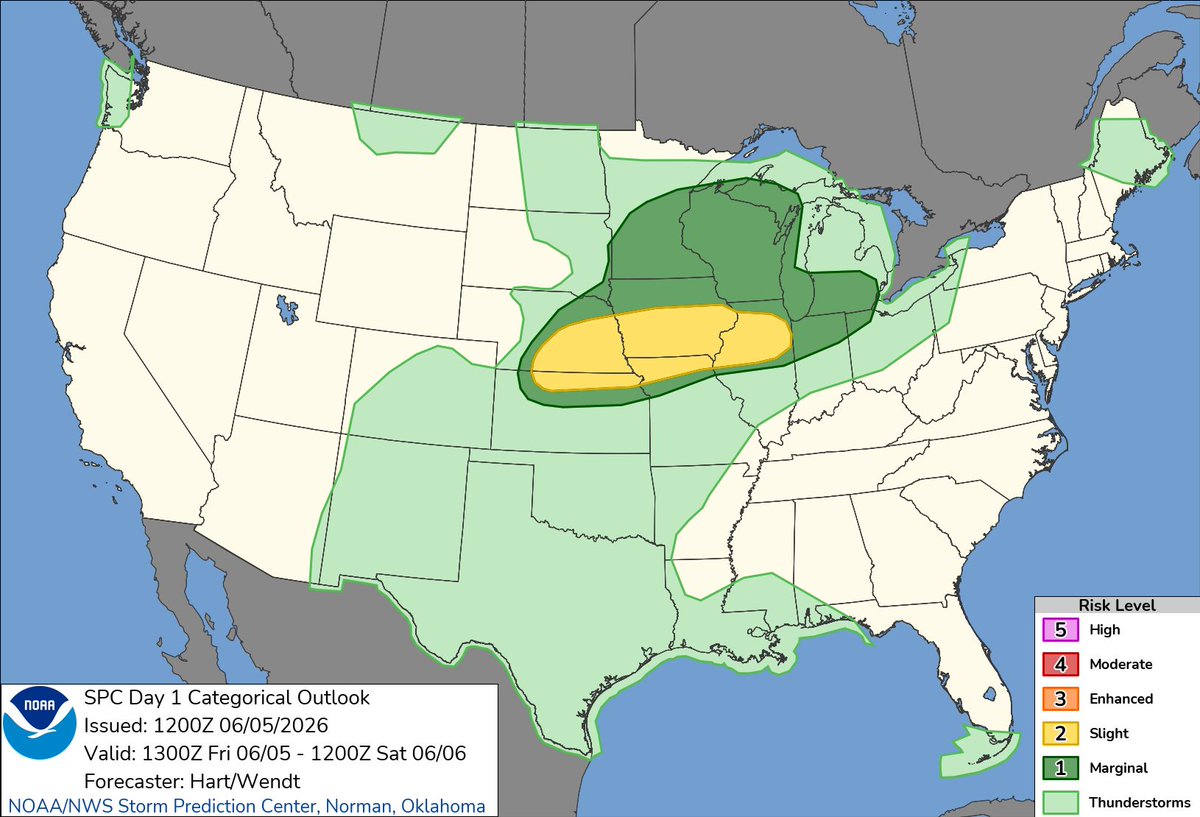
Severe thunderstorms which can bring large hail, damaging winds, and isolated tornadoes will be possible over parts of the central U.S. through this weekend.
Thunderstorms with heavy to excessive rainfall moving from Texas into the mid-Mississippi Valley through this weekend may produce areas of flooding.
Be sure to stay up with the latest forecast at https://t.co/qk3BcVP5M8.
Scattered severe thunderstorms capable of large to very large hail, damaging winds with potentially significant gusts, and perhaps a couple of tornadoes are expected Friday afternoon into night across portions of the central Plains into upper Great Lakes. Thunderstorms with heavy to excessive rainfall may produce flooding over a part of the Midwest Friday. https://t.co/qk3BcVP5M8
There is a Slight Risk (level 2/4) of excessive rainfall over parts of the Middle Mississippi Valley/Central Plains, and Southern Plains on Sunday https://t.co/A3RX3bwD5b
There is a Slight Risk (level 2/4) of excessive rainfall over parts of the Middle Mississippi Valley/Central Plains, and Southern Plains on Friday and over the Southern Plains/Lower Mississippi Valley on Saturday https://t.co/A3RX3bwD5b
June #drought outlook from @NOAA@NWS@NWSCPC
Drought is expected to persist across much of the West & Mid-Atlantic, and develop in the Midwest. Parts of the South & Southwest may see some relief as drought conditions improve or end.
For more: https://t.co/s8Wz6Q9cl6
Next week's outlook (June 9–13) favors above-normal precip from the PNW to the Gulf Coast. The NE leans dry.
Temps: Warm for most of the U.S., with an 80%+ chance of above-normal heat in the Midwest.
https://t.co/mljsjQE3B9 @NOAA#Drought
#DroughtMonitor 6/2: Rain granted some relief in parts of the West & Plains, but Extreme to Exceptional #Drought remains in these regions. Dry conditions rapidly expanded in the Upper Midwest & Great Lakes.
#Drought2026's Footprint: 48.8% of the US
https://t.co/mljsjQE3B9 @NOAA
Severe thunderstorms capable of large to very large hail and damaging winds are possible today from parts of the northern High Plains across northern Nebraska and much of South Dakota. More isolated occurrences of large hail and damaging winds appear possible farther south across portions of the central Plains. https://t.co/qk3BcVP5M8
Showers and thunderstorms continue across much of the Plains and Upper Midwest with heavy rain and severe weather concerns the next few days https://t.co/A3RX3bwD5b
Thunderstorms with large hail, severe wind gusts, and a few tornadoes will be possible this afternoon and evening in parts of the northern Plains into upper Mississippi Valley. Visit https://t.co/VyWINDk3xP for details.
.@NOAA experts say the record-breaking fourth global #CoralBleaching event likely ended in mid-2025 after heat stress impacted 84% of the world’s #CoralReef areas. Scientists are now studying reefs that showed signs of resilience despite the extreme heat exposure.
Although this event appears to have subsided, global heat stress still persists as ocean temperatures remain unusually warm. NOAA is forecasting continued bleaching risks for this summer and fall in the Northern Hemisphere.
Learn more: https://t.co/45rhl3GO7U
#OceanMonth @NOAACoral@CoralReefWatch