Check out my recent interview on The Manufacturing Executive podcast with Joe Sullivan where we discuss where bio-manufacturing is headed, and why it matters for the future of our manufacturing economy, our national security, and our planet. https://t.co/eAONZs56or
Big synbio rebrand underway moving away from ZIRP-era Climate messaging and leaning into American Dynamism themes:
- Reshoring of manufacturing for key chemicals and pharma APIs
- Leveraging US feedstocks
- Enabling new high-performance chemistries for high tech industries
- Closing the Biosecurity gap
For a long time, people have been sold a false choice: climate versus jobs.
Creating jobs while protecting our climate isn't just possible, it's necessary. And now, it's happening.
@robinsonmeyer Confusing that the entire plot of The Muppet Movie centers around humans eating frogs and nobody in this thread wants to eat Kermit. There's hope for humanity yet.
and if just 1% of us start shifting our purchasing power toward greener products, it will shift how manufacturers look at their market. Innovation is also how producers can gain market share, if that appears to be a growing market segment. That's high leverage use of our dollars
The conversation in this episode of Shift Key with @robinsonmeyer and @JesseJenkins and Heatmap's team emphasizes the leverage of our personal purchasing decisions.
https://t.co/sgXTEimWil
if they see that 1% of their sales are being lost to a competitor offering a better product (e.g. greener, biobased, or higher performance), they will notice. They may invest in innovation. They may shift resources toward these growing trends. As consumers, we vote with dollars
.@iMicrobesInc's process converts ethanol and waste carbon dioxide into bio-based acrylic acid.
See how we collaborated with the company to scale up their process: https://t.co/IfcyyX7rlo
Once again, methane emissions are much higher than reported previously. How come it's never *lower* than expected? 🤔
We have to do much better to prevent leakage; methane is too powerful a GHG to allow this to happen.
New study led by @evandsherwin in @NatureEnergyJnl compiles data from nearly one million aerial measurements of methane leaks across major US oil & gas basins, finds leakage ranges from 0.75% in the Marcellus to 9.6% in the Permian. The six-region weighted average is 2.95%, ~3x the rate in EPA's national GHG inventory https://t.co/GAE5Q9V99t
We should 10x energy to drive amazing prosperity everywhere.
Doing this with legacy energy would create enormous externalities. You don’t need climate models to know this. Burning our energy is very limiting.
Clean energy is the only way to begin an age of incredible abundance.
@JPTilsted I enjoyed your thread. I also worry about reducing emissions in petrochemical mfg. Our company is focused on biobased net-zero drop-in chemicals. Would you be able to send me the papers and your dissertation too? Thanks for the work you are doing to highlight the challenge.
It’s not a coincidence that Kamala adopted much more moderate policies when she didn’t have to win a partisan primary first. The political system would be much more functional with the top 4 from a nonpartisan primary continuing on to a general election with ranked choice voting.
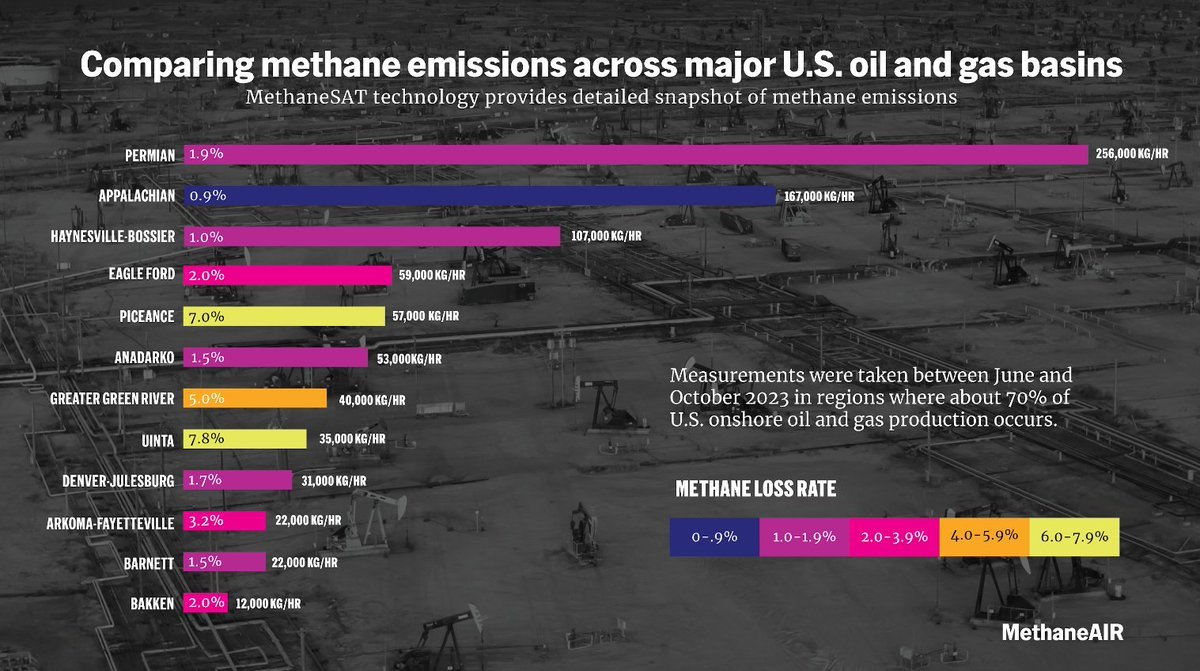
New report from @EnvDefenseFund uses MethaneAIR, a specially equipped jet aircraft, to measure methane leak rates for regions accounting for ~70% of onshore oil & gas production in continental US, showing a wide range of leak rates, from <1% to nearly 8%.
https://t.co/zOrIAIxLfC
@robinsonmeyer@ezraklein@IChotiner Super insightful segment. Not sure if you meant this directly, but it's also an admission of the diminished influence of traditional news sources, a fact that is certainly not lost on those working in fact-based news, with its struggling business model.