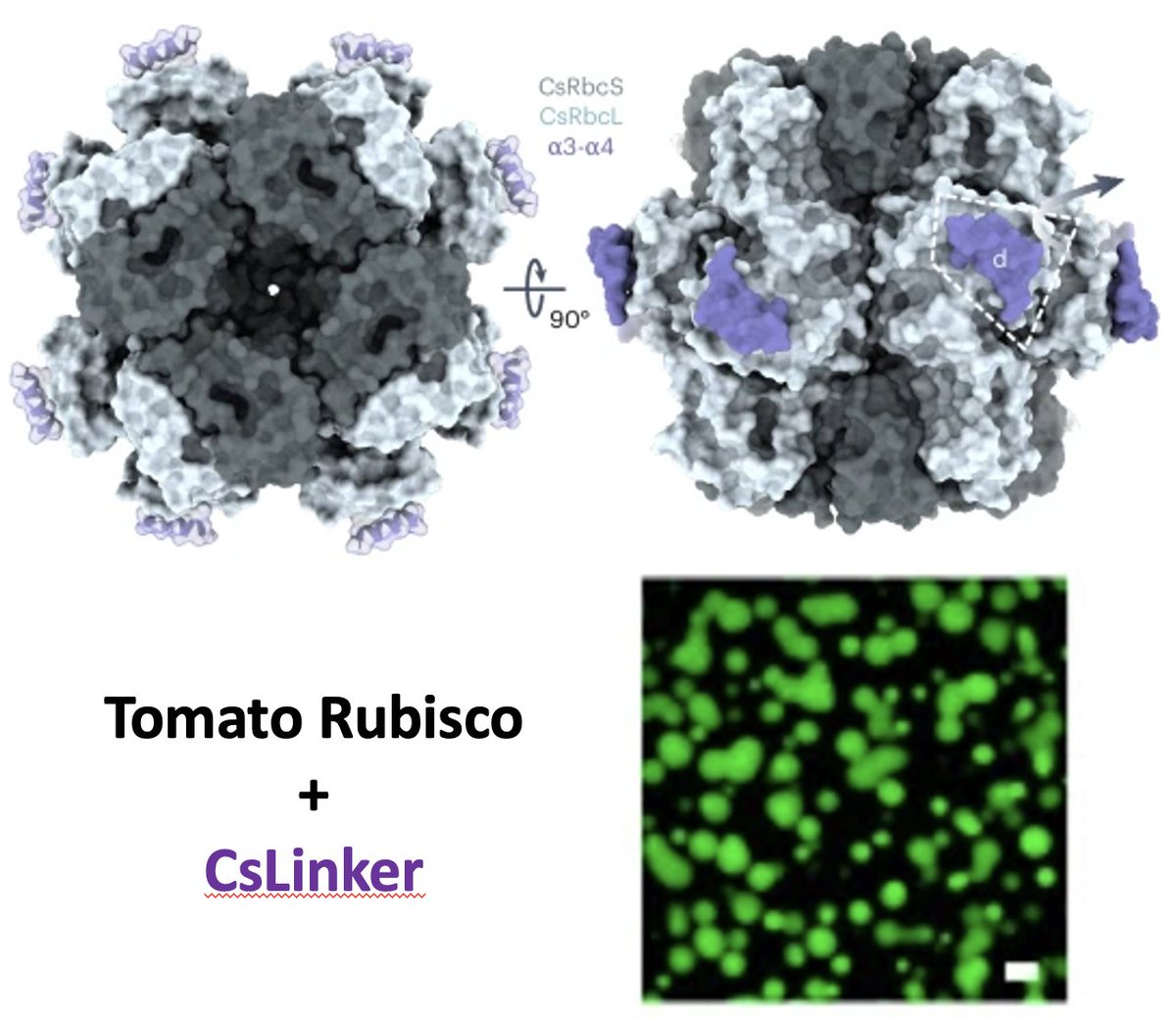
My first @lau_gunn collab with @fern_way research article is out @mplantpcom ! Using SynBio approaches we found a new Rubisco assembly intermediate and successfully express hornwort Rubisco in E.coli. 1/3
https://t.co/j0hLfBspIS
Congrats to the team for this incredibly bizarre and perplexing result. Leaving out a chaperone causes hornwort rubisco to be formed in a stalled folding intermediate...which is substantially _faster_ than the normal fold???
Obituary of Bruce Ames, who developed the Ames test and thus likely saved many lives. Bruce passed away in Berkeley on October 5th.
https://t.co/4V3TOzreyE
@AlexanderRKlotz@fizziksBoris I think that's reasonable. We do see alpha methyl amino acids among other small molecules on meteorites though so I'm not confident. I am confident though that we probably wouldn't see the same 20
@AlexanderRKlotz@fizziksBoris Proteins don't have a mechanism for transmitting information since they can't base-pair like RNA or DNA. The RNA/protein world system "discovered" DNA which transmits information like RNA but was more stable. I tend to think alien life wouldn't have nucleic acids or amino acids
@ZaminIqbal I love this sort of hamming distance but with rearrangement. Could it work for full genomes or viral genomes where rearrangements are also common?
No, you’re not seeing double.
This creature called a sea walnut does indeed have two mouths and two “rear” ends. Yet, it wasn’t born with these double features: Researchers have shown they can make two sea walnuts readily fuse into one body. The finding suggests that this group of animals never evolved immune systems capable of distinguishing self from non-self.
Learn more in #ScienceAdviser: https://t.co/is6gRu3Ehb
It's been so fun watching this story develop, really great to see it out. As each defense system gets understood we get to learn another solution to the problem of bacterial immunity and bacteria never disappoint in their creativity.
How does Hachiman work, and what can it teach us about immunity? Our structural and functional characterization of the Hachiman defense system is online: https://t.co/5IaYbegXAK
Thanks to co-lead @ben_a_adler, @Emy_nim & coauthors at @doudna_lab.
@igisci@UCB_Chemistry @HHMINEWS
🦠🧬Our paper is live @CellCellPress: Genome integrity sensing by the broad-spectrum Hachiman antiphage defense complex
https://t.co/id7uU1YRIe
Through structural, genetic and microbiological approaches, we show that Hachiman degrades DNA… by sensing low integrity DNA.
🧵 Really excited to share our new paper! As species diversify, sex pheromones rapidly change, but how do male mating circuits co-evolve to guide mate choice? A thread on circuit evolution & mating strategy... 1/9
https://t.co/uEy95rGYuI
Well, it seems I am officially a published scientist 🥳🙌🏻👩🏻💻 Thanks @mackinderlab and team for supporting me!
This work on diatom pyrenoids is interesting and exciting - definitely take a look (especially figure 4b 😉)
@CellCellPress
@vsbuffalo This seems very sensitive to how many advisors are counted. If each researcher only has one advisor it's a lot more surprising than if they have two (as is the case for biological parents)
Congrats @yuichi_furuhata and team for streamlining yeast genetic code expansion through OrthoRep-driven evolution of aaRSs. Several evolved aaRSs give high translational efficiency with unnatural amino acids. A neat self-regulating aaRS is also found. https://t.co/GQ3kFz0MqD