Our LLM Applied Scientist German Magai @MetatrolN presents at the 3rd AI For Math Workshop at ICML 2026 (July 11, Seoul): "Evaluating SageMath-Augmented LLM Agents for Computational and Experimental Mathematics" with Pavel Snopov @fin_presented (UT Rio Grande Valley).
Give frontier models a computer algebra system and watch them work like mathematicians: guess, compute, break something, fix it, check the pattern, commit. The size of the payoff had little to do with model strength. What set the winners apart was recovering after a failed call, not raw reasoning.
If you're at ICML 2026, find German on the 11th to chat about agentic reasoning, math, and why more tokens don’t automatically mean more right answers.
Noeon Research is sponsoring both FM 2026 and AIPV 2026 (18–22 May)!
We're excited to be part of the leading scientific forum at the frontier of formal methods and AI verification, and to connect with the community pushing this field forward.
We're hiring → https://t.co/UtTS974YyO
Optimizing compilers do something remarkable: they examine code, consider alternatives, make decisions, and iteratively refine sometimes dozens of passes before executing.
It's reasoning. We just never call it that.
What if optimization and execution are endpoints of a continuum? What happens when you push that boundary to its limit?
At Noeon, we're building systems that explore this limit—developing both the theory and a knowledge representation language grounded in these principles.
Read more in our newest blogpost: https://t.co/mXR63nsNWt
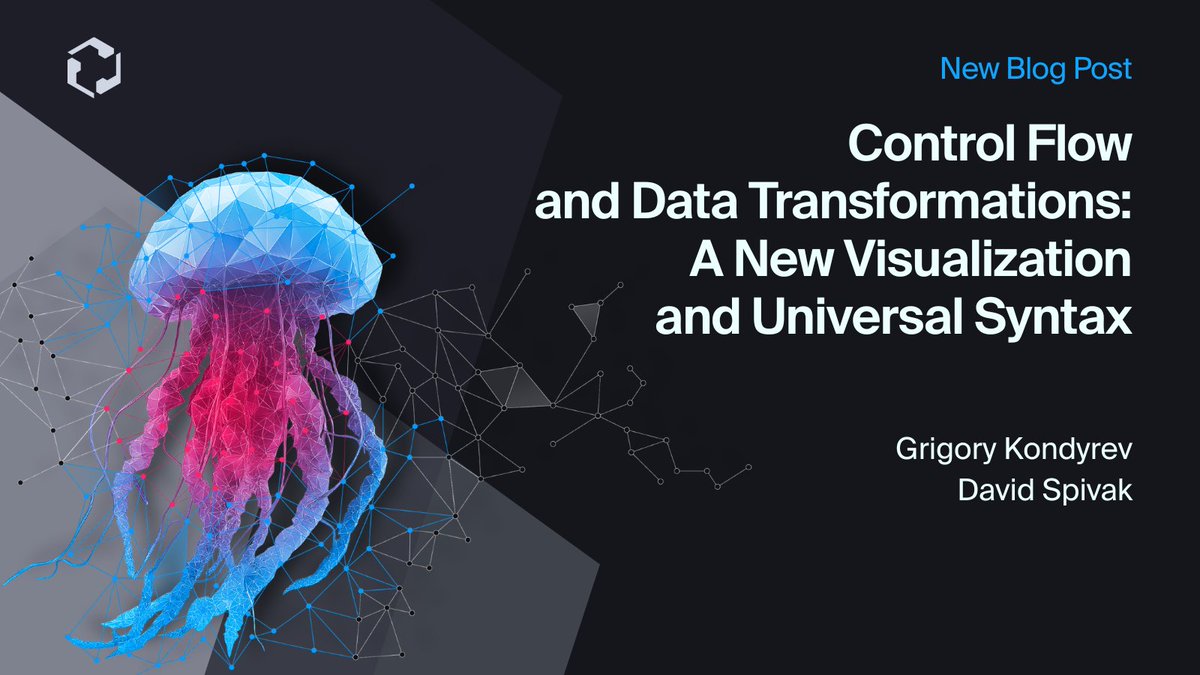
What if you could see why your code breaks?
In our newest blog post, we examine the recent paper published by Noeon's own Grigory Kondyrev and co-authored by David Spivak @david_i_spivak: Int(Poly*)—a unified framework that visualizes the hidden interplay between control flow and data transformations.
Their wiring diagram syntax captures what debugging tools miss: the dynamic relationship between program logic and data handling. As algorithmic agents grow more sophisticated, we need mathematical tools providing provable behavioral guarantees. Int(Poly*) offers exactly that foundation.
Full breakdown here: https://t.co/l6FnyISdSj
Our researcher Grigory Kondyrev coauthored a new paper together with David Spivak @david_i_spivak. "The Compact Double Category Int(Poly*) Models Control Flow and Data Transformations" provides a categorical operad that simultaneously captures the behavior of data and control flow, and shows a number of universal properties involved.
Key contributions include:
-A new wiring diagram syntax modeled by the category Int(Poly*).
-An extension of Int(Poly*) to a compact double category with a factorization system that provides a way to track trajectories of computation.
Find it on arXiv: https://t.co/BTcVM0KyTV
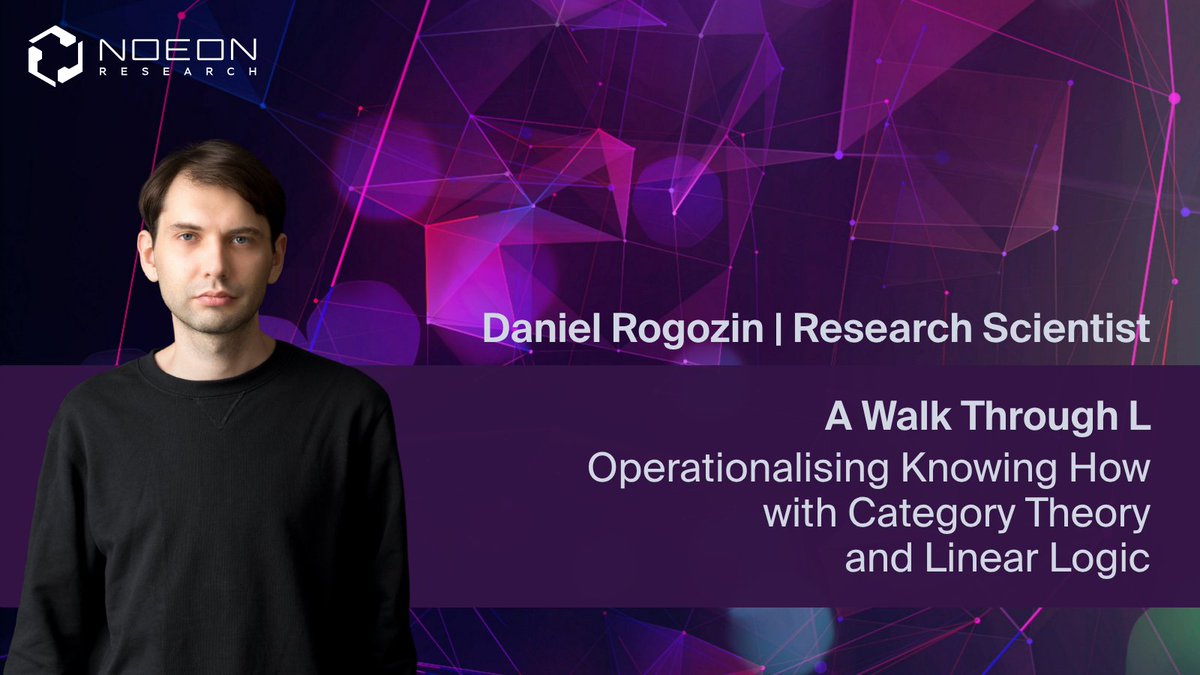
Daniel is presenting a contributed talk on his newest paper at the British Logic Colloquium (Sept 10-12th)!
Read it on ArXiv: https://t.co/4n0ePGcCBA
See you at the University of Manchester, Alan Turing Building 12th September from 12:00 - 12:30!
Our research scientist Daniel Rogozin recently published "A Walk Through L" – an essay on the mathematical foundations of knowledge representation, analyzed through innovative applications of linear logic and category theory.
In his essay, Daniel:
-Suggests Cocteau categories for modelling ontologies
-Challenges current AI approaches with interpretable alternatives
-Connects philosophical epistemology to computational models
Read the essay: https://t.co/UpeNfOdip0
For further reading, check out our original paper, “Sheaf theory: from deep geometry to deep learning” written by Anton Ayzenberg, Thomas Gebhart, German Magai, Grigory Solomadin: https://t.co/pXceHiSjU3
Our Chief Research Coordinator, Anton Ayzenberg is giving a talk on sheaf theory at ESSLLI 2025.
Anton's talk, "Sheaves and Grothendieck topologies in core CS", is part of the workshop dedicated to sheaf theory and its applications. Sheaf theory offers a unified computational framework that bridges syntax, semantics, and statistics─connecting diverse fields from differential equations to large language models. In logic, the category of sheaves over a Grothendieck topology provides the most important examples of topoi. Roughly speaking, Grothendieck sites are "a good place" to do logic.
Join Anton on 6 August – the first day of ESSLLI 2025 – at Ruhr University Bochum, Germany. Learn more: https://t.co/pIK1tdp1p1
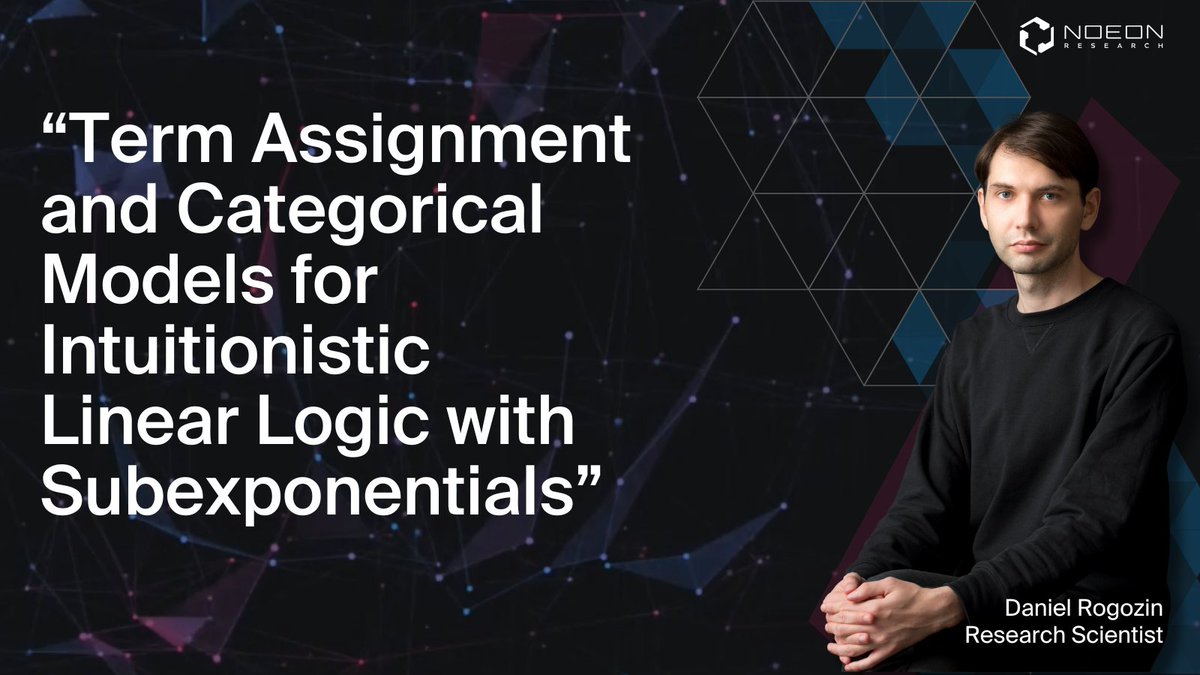
Our Research Scientist, Daniel Rogozin, has published a new paper: "Term Assignment and Categorical Models for Intuitionistic Linear Logic with Subexponentials".
This work represents a significant step toward developing next-generation knowledge representation languages that could transform how intelligent systems process information.
Read it on ArXiv: https://t.co/lK4oqIwITK
#TypeTheory #CategoryTheory #KnowledgeRepresentation #TheoreticalComputerScience #ProofTheory #LinearTypes
Next week, our Research Engineer, Denis Sevostyanov (@newmrdenis) will attend the Conference on Programming Language Design and Implementation
#PLDI2025. He'll be happy to talk with you about Noeon's approach towards an alternative architecture for transparent, white-box reasoning. See you there!
Or read our original paper, “Sheaf theory: from deep geometry to deep learning” written by Anton Ayzenberg, Thomas Gebhart, German Magai, Grigory Solomadin: https://t.co/sHD8WWxkpI
In our newest blogpost, we once more inspect Sheaf Theory as an emerging mathematical concept with useful applications and notable impacts in deep learning. Sheaves shine because they preserve context. They don’t just connect the dots—they tell you why the dots connect the way they do.
This shift is revolutionizing everything from document analysis to molecular dynamics. Read all about it here: https://t.co/1rw3EGbFS8
#MachineLearning #TopologicalDeepLearning #SheafTheory #CategoryTheory #Cohomology #MathMeetsML #AppliedTopology
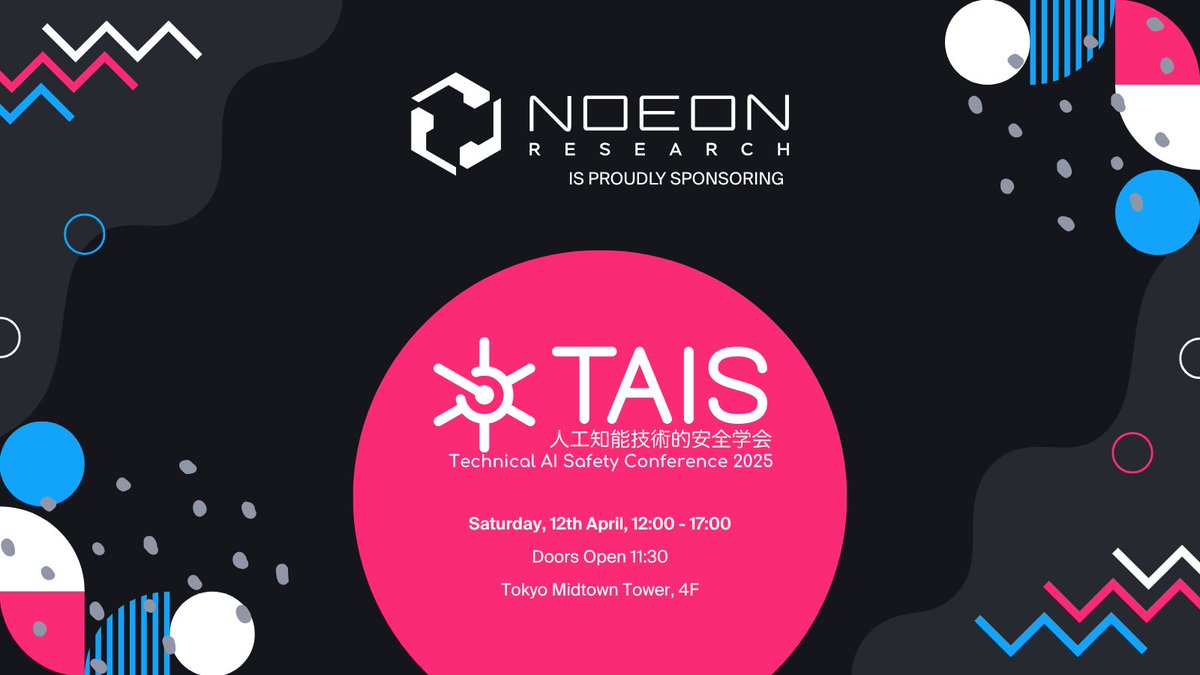
We are proud to back TAIS 2025 happening this Saturday, April 12th, 2025.
The day will be full with poster sessions, and talks by @kanair Ryota Kanai, and @ARGleave Adam Gleave.
Join us and participate in conversations that could help shape a safer future for AI!
Doors open at 11:30: https://t.co/upW0Wa0wYM
We took a deep dive into Sheaves in our latest blog post "Sheaf Theory: From Deep Geometry to Deep Learning": https://t.co/QB5FmAlESj
Recently our researchers Anton Ayzenberg and German Magai (@MetatrolN) in collaboration with Thomas Gebhart at the University of Minnesota and Grigory Solomadin at the University of Strasbourg, wrote an interesting paper on sheaf theory. You can read it here: https://t.co/xSiK3UmqnT
This powerful mathematical framework is helping us build more reliable AI by bridging geometry and ML.
#MachineLearning #TopologicalDeepLearning #SheafTheory #CategoryTheory #Cohomology #MathMeetsML #AppliedTopology #aisafety
Our Research Engineer, German Magai (@MetatrolN), published a Medium article last week providing an overview of “Sheaf theory: from deep geometry to deep learning.” You can read German's breakdown of the recent paper by Ayzenberg, Gebhart, Magai, and Solomadin here: https://t.co/ZrXBsV8t54
Sheaf theory is a special perspective, a point of view from which one can look at different objects, problems and theories. We believe that sheaves have the potential to be a powerful and baseline tool in the field of graph learning. It is more than just a heuristic; it is a conceptual framework that provides a general perspective on the problem of graph representation learning and more.
#SheafTheory #DeepLearning #Mathematics #TopologicalDeepLearning #SheafTheory #CategoryTheory #Cohomology #MathMeetsML #AppliedTopology #AI
@MetatrolN The paper provides a comprehensive overview of sheaf theory applications in deep learning, linguistics, logic, and more.
This work presents a detailed introduction to the math background of sheaf theory and also poses open problems related to applications.
New Paper Alert!
“Sheaf Theory: From Deep Geometry to Deep Learning” — where math reveals blindspots in current ML practices. Our researchers Anton Ayzenberg and German Magai (@MetatrolN) in collaboration with Thomas Gebhart at the University of Minnesota and Grigory Solomadin at the University of Strasbourg, give an overview into sheaf theory, using a nifty new algorithm for computing sheaf cohomology on finite posets (try saying that five times fast).
Read it on Arxiv: https://t.co/xSiK3UmqnT
#MachineLearning #TopologicalDeepLearning #SheafTheory #CategoryTheory #Cohomology #MathMeetsML #AppliedTopology #AI
Our Research Scientist Gregory Gelfond is at @RealAAAI next week--he'll be participating in a panel at the AAAI 2025 Bridge Programme: "Explainable AI, Energy and Critical Infrastructure Systems". Come say "hi"!