Loss of control is now openly acknowledged by heads of states in addition to the leaders of AI companies.
Yesterday I had the pleasure of participating in a high-level meeting at the Élysée convened by President Macron to shape the Paris Call for AI Safety and Security. The Paris Call, which I am happy to support, has been signed by 12 governments (and counting) and 10 companies, including Microsoft, OpenAI and Anthropic.
The declaration is an important step forward, but needs to be strengthened in future multilateral dialogues. My comments, summarized below, identified two key areas to strengthen.
Evaluation Access
The call mentions evaluation eight times. At @farairesearch we conduct independent evaluations for companies and governments, so this focus is heartening. But we and other evaluators continue to have too little time or access to reliably test systems. It is still common for us to have less than a week to test a model, far below the 20 business days recommended in the AEF-1 standard. In addition, systems are getting harder to test. In particular, models know they are being evaluated, and increasingly this changes how they behave. This makes it almost impossible to reliably predict what they will do in deployment through black-box testing alone. Evaluators need to have enhanced access to run experiments on the model, such as inspecting the model’s internals, or conducting further training on the mode to elicit specific capabilities.
Open-Weight Safeguards
The call highlights the benefits of open-weight models for research, innovation and safety while acknowledging the risks posed by bypassing safeguards. Our research heavily depends on open-weight and open-source models and are crucial to maintain. However it is increasingly impossible to ignore the misuse potential. Proprietary model safeguards are still imperfect – we just reported a universal jailbreak to a frontier developer earlier this week – but require significant technical sophistication to exploit. By contrast, open-weight model safeguards are mostly simple to bypass or remove.
Open-weight models inherently have a larger attack surface than closed-weight. It would be unfair to hold them to the same standard, but we should not hold them to a lesser standard: developers, closed and open, should implement state-of-the-art safety practices.
In particular, removing the most harmful content from the data used to train the model shows particular promise, and is an active area of research at https://t.co/9Gn0cPx0Mi.
This technique, called pre-training filtering, has been tested in work by academics and the UK’s AI Security Institute, and was recently used by in Kimi K3.1 to reduce offensive cyber capabilities while maintaining defensive capabilities. Ultimately, models do not need to be trained on specific technical information on how to build chemical or biological agents, or on specific offensive cybersecurity techniques. This poses little benefit and a grave risk to society.
I applaud France for leading on this.
You wouldn't hire someone who lied in an interview, but we tolerate this behavior from AI -- they're so useful and productive the rest of the time! I enjoyed speaking to @ChrisCundy on why we should take this more seriously, how you can detect AI deception, and what developers need to do to address the problem.
Should AI models ever state something they know is false? @ChrisCundy argues for zero tolerance: treat every lie as a bug, as seriously as developers treat preventing chemical weapons misuse. No white lies, no special cases.
Full conversation with https://t.co/CpCOFQPSHr CEO @ARGleave below 👇
🚨 A security patch protects every system that installs it, but it can also give attackers a clue to the vulnerability, putting every unpatched system at risk.
That's the 1-day window. Turning a patch into a working exploit used to take expert reverse engineers days or weeks.
Can AI agents now do it from compiled binaries alone, no source code?
Introducing CyberBinGym 🧵👇
Admittedly I'm biased, but the Frontier Summit was my favorite event of the year, bringing together all the key players in frontier AI risks. It was under Chatham House for candid conversation but we now have a readout sharing the insights for those who couldn't make it. Do check it out!
A new public brief from https://t.co/CpCOFQPSHr's Frontier Summit sets out recommendations for addressing critical frontier AI risks. Over two days in October, senior researchers and decision-makers from frontier AI developers, academia, research orgs, and government AI institutes worked on recursive self-improvement, alignment of internally deployed models, control and operational safety, and CBRN and cyber misuse.
Key suggestions include establishing a shared minimum standard for safe internal deployment, improving channels for sharing incident reports and data on the extent of AI-automated R&D, and coordinating red-teaming of safeguards and monitoring systems across developers, nonprofits, and academia.
Full brief in the reply 👇
Really honored to have our ROGUE benchmark showing the *incorrigibility* of frontier agents a few months *before* the now-famous HuggingFace incident, featured in the NYT!
(and interviewed alongside the father of corrigibility, @So8res, no less!)
Currently evaluations are advisory: there are some regulatory requirements to contract independent testers (e.g. under the EU AI CoP, and SB 813 when it comes into force next summer) but they are not generally blocking on release. The aviation comparison is apt and shifting towards a requirement that a system has a safety case, vetted internally and externally, would be a natural next step for AI.
Loss of control is now openly acknowledged by heads of states in addition to the leaders of AI companies.
Yesterday I had the pleasure of participating in a high-level meeting at the Élysée convened by President Macron to shape the Paris Call for AI Safety and Security. The Paris Call, which I am happy to support, has been signed by 12 governments (and counting) and 10 companies, including Microsoft, OpenAI and Anthropic.
The declaration is an important step forward, but needs to be strengthened in future multilateral dialogues. My comments, summarized below, identified two key areas to strengthen.
Evaluation Access
The call mentions evaluation eight times. At @farairesearch we conduct independent evaluations for companies and governments, so this focus is heartening. But we and other evaluators continue to have too little time or access to reliably test systems. It is still common for us to have less than a week to test a model, far below the 20 business days recommended in the AEF-1 standard. In addition, systems are getting harder to test. In particular, models know they are being evaluated, and increasingly this changes how they behave. This makes it almost impossible to reliably predict what they will do in deployment through black-box testing alone. Evaluators need to have enhanced access to run experiments on the model, such as inspecting the model’s internals, or conducting further training on the mode to elicit specific capabilities.
Open-Weight Safeguards
The call highlights the benefits of open-weight models for research, innovation and safety while acknowledging the risks posed by bypassing safeguards. Our research heavily depends on open-weight and open-source models and are crucial to maintain. However it is increasingly impossible to ignore the misuse potential. Proprietary model safeguards are still imperfect – we just reported a universal jailbreak to a frontier developer earlier this week – but require significant technical sophistication to exploit. By contrast, open-weight model safeguards are mostly simple to bypass or remove.
Open-weight models inherently have a larger attack surface than closed-weight. It would be unfair to hold them to the same standard, but we should not hold them to a lesser standard: developers, closed and open, should implement state-of-the-art safety practices.
In particular, removing the most harmful content from the data used to train the model shows particular promise, and is an active area of research at https://t.co/9Gn0cPx0Mi.
This technique, called pre-training filtering, has been tested in work by academics and the UK’s AI Security Institute, and was recently used by in Kimi K3.1 to reduce offensive cyber capabilities while maintaining defensive capabilities. Ultimately, models do not need to be trained on specific technical information on how to build chemical or biological agents, or on specific offensive cybersecurity techniques. This poses little benefit and a grave risk to society.
I applaud France for leading on this.
If you get hacked, you can no longer hire a cybersecurity firm: they're too busy with 1000 of other AI-enabled attacks. This is what I learned at the Guardrails for Cyber-Capable AI event yesterday at @ParisPeaceForum.
In my intervention, I highlighted that we must use AI to make fundamental improvements to our cybersecurity: porting legacy software to memory-safe and type-checked languages, and formally verifying key components.
This stands in contrast to the current trend of merely automating existing cyber defense. The natural progression, that some are already calling for, is to automate the development of patches and give AI agents administrative privileges to then automatically roll them out in our systems. Removing humans in the loop is a dangerous path. It exposes a new attack surface, with sysadmin AI agents being hijacked by attackers, and increases the risk of loss of control incidents -- it is much easier to take over if you already have root access to every major system!
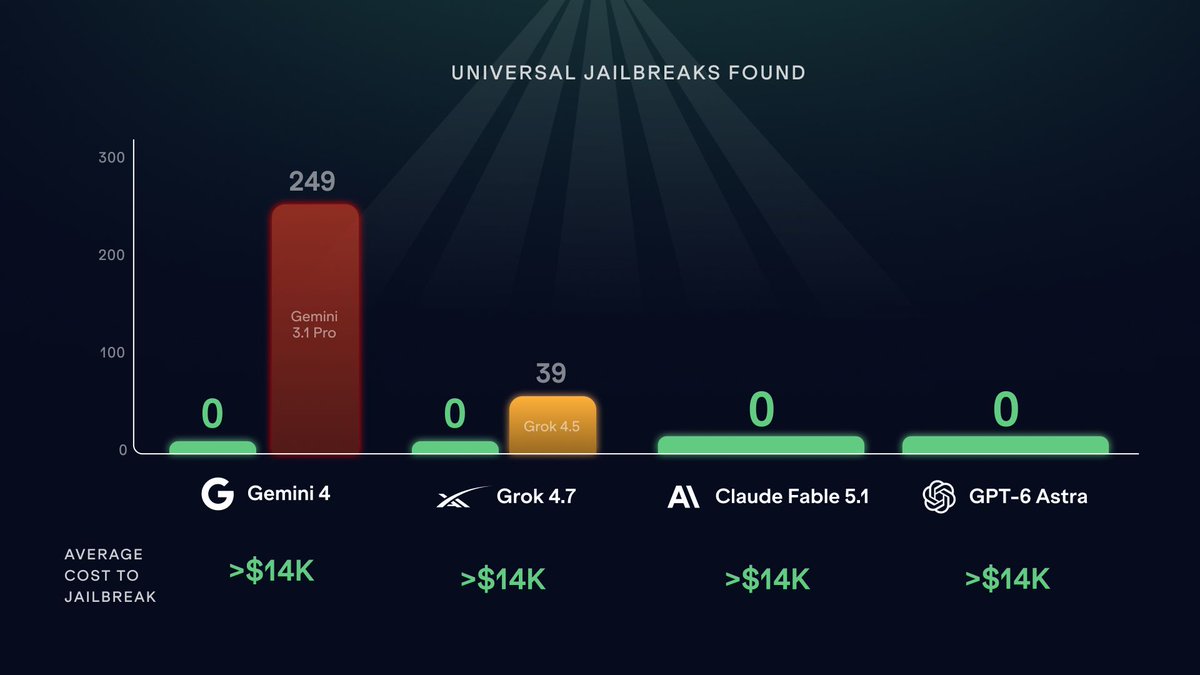
Innovation in safety has resulted in huge improvements in misuse safeguards in the last year. Well done to the developers involved! We can still find jailbreaks in models using more sophisticated techniques but it's gotten a lot harder.
Our AI Security Leaderboard ranks how well frontier models’ safeguards hold up against misuse. All four models tested now clear our Minimal Standard for Safeguards, with zero universal jailbreaks found.
At launch, two broke for under $300 on chemical, radiological, nuclear, explosive, and cyber requests, and their developers have since closed those gaps against the standard.
The standard is built from publicly documented jailbreaks, so it’s a floor: our focused testing continues to uncover more vulnerabilities.
Next update: new models and a revised standard.
A white-box probe outperforms Opus 5.5 black-box monitor at detecting lies at a fraction of the computational cost. Deception probes are pretty much ready for production -- but gap remains when it comes to motivated reasoning.
New paper from our team, Telling FIBS by @OskarJohnH, @afspies, Tigist Diriba, @ARGleave and @ChrisCundy: probes that read a model's activations catch AI agents sabotaging their tasks. They match or beat monitors reading the agent's actions, without needing its reasoning, at a fraction of the cost. And they catch lies a text monitor can't. 1/8
All 11 talks from the CAIRD Workshop, co-hosted with @cbai_ai, are now on YouTube. Among them: Serena Booth on the scoring flaw behind the Hugging Face incident, James Mickens on sandbox escapes that attack the inference engine, and @dhadfielmenell on why post-training can’t fix alignment.
Playlist in thread ⬇️
Charlie's analysis is right but he is nicer than I am - I found myself viscerally angry at multiple points reading this bill. There are some good and sensible parts, but overall this legislation is not remotely close to meeting the moment and I overall think passing it would make us less protected against catastrophic risks than we are under existing law.
Two parts that stand out as particularly infuriating when taken together:
1. Some of the preemption provisions are remarkably far reaching and consequential, and in addition to preempting legislation like SB 53 would also remove general powers that state courts have to enjoin defendants and protect the public. Most outrageously, it has a provision that looks like its intended to stops states from enforcing laws or judicial decrees that "suspend the development, deployment, or internal use of an AI model" to protect their citizens from imminent catastrophic harms. Such powers to block and suspend model deployments would then only reside with the federal government.
2. The federal governments powers to restrict the development, deployment, or internal use of a frontier model has to meet an absurdly high bar.
First, there needs to be an imminent risk of a catastrophic harm (meaning killing more than 50 people or causing more than a billion dollars in damage). But thats not enough! The agency head needs to make a detailed determination with no deference given to show why no alternative would prevent the imminent catastrophe. Next the court is also explicitly told to consider the harms to the developer and other harms from restricting the model, but no considerations in the other direction.
This is absurd! For all of its warning about the potential for AI to cause a catastrophe that kills literally everyone on the planet, Anthropic's proposed federal law likely makes it harder than under existing law for a court to get an order blocking or restricting the development of frontier models? WTF??
There are also a bunch of others things that I would like to see improved - the substantive details of the auditing section and the potential for rule-making on substantive safety standards both come to mind - but I think these stand out as particularly indefensible.
My takeaway from the discussion: we’re not even getting the basics right for AI alignment currently, so it’s hard to know if the alignment failures we’re seeing are because AI is inherently hard to align, or we’re just screwing up all over the place. If we try hard and we still see alignment failures, we should take Oli’s view more seriously and focus on solutions with worst-case guarantees. I’m optimistic that rigorous engineering approaches without scientific breakthroughs will be enough to AGI (maybe not ASI or uncontrolled RSI…), but we won’t know if we won’t try, and right now we’re missing out an empirical signal here.
Oli did a great job laying out the bear case for prosaic AI alignment. I remain more optimistic than him but preparing for the worst-case needs to be part of the portfolio of AI alignment research.
@ARGleave and @ohabryka debate whether current AI safety techniques are enough.
Adam: the Hugging Face incident was an implementation failure, and layered defenses, environment QA, and monitoring could cut P(doom) from ~15% to under 2% up to clearly superhuman systems.
Oliver: current techniques depend on observing failures, so they won't cross the human-to-superhuman gap, and applying them may suppress the warning shots we need.
Catch the full exchange on our Youtube channel ⬇️
New paper: small probes reading a model's own activations catch agent sabotage at 98.8% AUC on SHADE-Arena, ahead of an Opus 5.5 text monitor 📄 https://t.co/ENEHI6lKjK #AgenticAI#AISafety#AIAgents
Come work with me to make AI turn out well! I'm hiring for research leaders, cracked engineers, exceptional project managers and operators. Our mission is simple: make advanced AI systems trustworthy and secure through research breakthroughs and driving industry-wide adoption.
We're hiring, and the mission is making AI safe.
Our team is growing fast, and we need people who want to work on one of the most important problems of our time.
Some of our roles are deeply technical: researchers, red-teamers, and engineers. Others call for a different but equally valuable set of skills: running operations, managing programs, and building our events.
If either sounds like you, apply through the link in the comments, where you'll find these roles and many more.
👉 Know someone who'd be a great fit? Send this their way!