Steve Young says Reggie White was so dominant that he could sack you whenever he wanted and would ask how your family was doing as he helped you up
“Whenever I played Reggie, we had to talk about it all week. Like, what are we going to do? How do we make sure that we have enough people? Where's the 12th person we need to try to take care and help? That was always the conversation because Reggie was the kind of guy that could literally, at the line of scrimmage, just take people and throw them and move them around. And then I was down on the ground.”
“The other thing about Reggie is Reggie was loud. He was all of that size in how he played. As I would drop back to pass, he would rush me, and you could hear him. He was just loud. And so as I'd drop back to pass, I would hear him, and I could hear him getting closer because you knew his proximity. And inevitably he would hit me. And as he hit me, he'd grab me. He was just a mammoth human. He'd grab me, and then he would turn back and fall backwards and let me fall on top. And then he wouldn't let go. He'd kind of hug me. And then he'd say, 'Steve, how you doing?'”
“I still remember. Reggie passed away of sleep apnea. So tragic. Just me saying the story makes me remember him very well. And he's like, 'Steve, how you doing?' I'm like, 'Not so good.' We had made friends as rookies—well, actually as seniors in college. We went to an All-Star game together. He was University of Tennessee, Baptist preacher. Here's this Mormon kid. And so we were just two peas in a pod. My dad helped him find an agent because my dad's a lawyer and he'd helped me, and so they got to be friends.”
“And so he'd have me, and then a few plays later he'd grab me again and pull me over on his back. And he'd be like, 'How's your dad?' And I'd be like, 'Reggie, let's talk after the game. I don't want to talk to you anymore.' Because I felt like he was trying to get to me because he hadn't seen me in a while, to catch up. He was sacking me to catch up.”
“But the reason why I tell you the story is that you've got to understand what it was like to be on the football field in front of 80,000 people. You've got to understand the adrenaline and the money that's paid to the individuals to get a job done. So the intensity would always grow as the game went on, especially as it was more important.”
This man just took the same plastic recorder that used to sound like a dying goose in elementary school and casually started shredding Sultans of Swing on it.
Eyes half-closed, fully committed, fingers flying like he actually practiced this instead of just surviving Hot Cross Buns.
Somewhere a music teacher is watching this and having an existential crisis. The recorder has seen things. It will never be
the same.
James Jamerson's bass on "What's Going On", visualized note by note.
Legend says Marvin tracked him down at a bar that night, and he played it lying flat on the studio floor.
One finger, his '62 Fender Precision Bass, and the rest was history.
Happy Birthday Leonard Marshall
1991 #NFCChampionship
Marshall gets blocked, doesn’t give up and hammers Montana.
“We thought he killed him”
#Giants100#Giants
In case you needed a refresher or lesson on why people think Walter Payton was the greatest RB of all time, here you go.
And before anyone says it, no, I won’t stick to baseball.
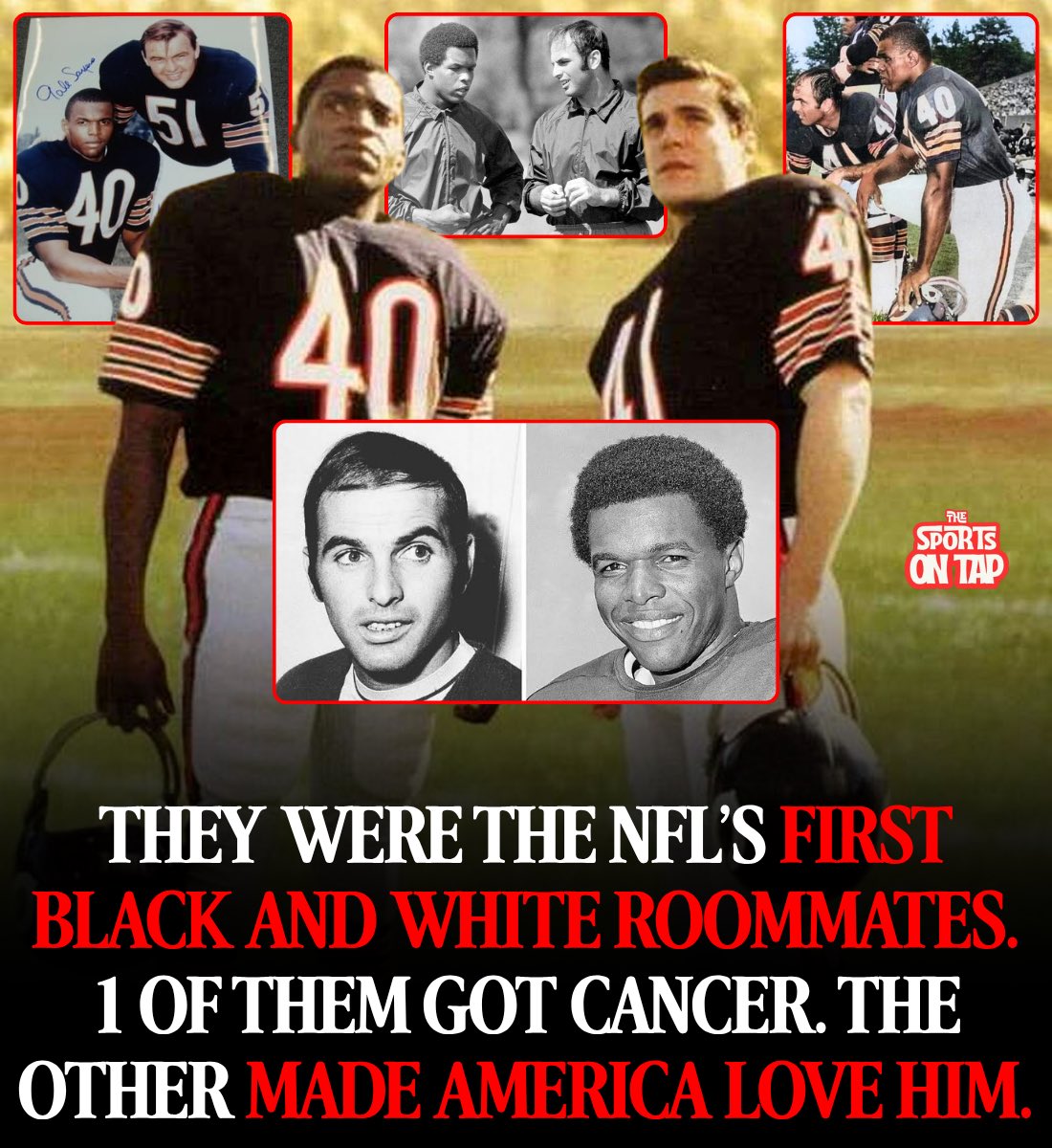
Gale Sayers stood up at an awards dinner, accepted a trophy for courage, and spent his speech talking about somebody else.
"I love Brian Piccolo and I'd like all of you to love him, too."
Brian Piccolo was his roommate, and his best friend. He was fighting cancer. Weeks later, he was gone.
Here is the whole thing.
Sayers was the star. A first round pick out of the Kansas Jayhawks they called the Kansas Comet.
As a rookie with the Chicago Bears he scored 22 touchdowns, a record, and was the unanimous Rookie of the Year. One afternoon he scored six touchdowns in a single game.
Piccolo was the guy nobody drafted. A running back out of Wake Forest who made the team anyway.
They played the same position. They were competing for the same job.
The Bears made them road roommates, and the general manager signed off on it. It was the first time NFL players of different races shared a room on the road.
Nobody was sure how it would go. It went fine. Over time they became best friends.
Then Sayers tore up his knee. Everybody wondered if he would ever be the same.
The guy who pushed him through the rehab was Piccolo. The man whose job he had taken.
Sayers came back the next season and led the entire league in rushing.
Then Piccolo got sick.
He was diagnosed with cancer that had already spread. He was in his twenties with a wife and three little girls.
Sayers stayed with him through all of it. Hospital visits. Phone calls. He was there, every step.
That spring, Sayers was given the George S. Halas Award for courage, for coming back from the knee.
He did not keep it.
He said Piccolo had "the heart of a giant." The whole speech was about Brian, not himself.
And then he finished like this.
"Tonight, when you hit your knees, please ask God to love him."
Less than a month later, Brian Piccolo passed away.
Here is the honest part. There was no comeback. No miracle. Sayers' own knees gave out not long after, and he played just 68 games in his whole career.
But the friendship got bigger than both of them.
The next year, the story became a TV movie called Brian's Song. People still cry at it fifty years later.
Sayers became the youngest player ever voted into the Pro Football Hall of Fame. He passed away in 2020.
Piccolo's widow, Joy, was asked what it is like that people still talk about it all these years later.
"It just amazes me."
Two kids from different worlds got put in the same room by a football team.
One of them made sure the whole country knew the other one's name.
For more stories like this, follow us on any platform @thesportsontap
October 21, 1979
Bill Walsh's First Win as an NFL Head Coach
After seven consecutive losses to begin the season, the future 49ers icon notches his first victory — a 20-15 comeback win over the Falcons at Candlestick.
Christian McCaffrey's grandpa was the fastest man on Earth, and at the 1960 Olympics he was quietly helping the CIA try to flip a Soviet athlete.
That's the family tree behind this jersey swap, and the rest of it is even better.
His name was Dave Sime. He showed up at Duke on a baseball scholarship as a premed kid, taught himself to sprint by reading every track book in the library, and in 1956 he tied the world record in the 100-yard dash. Sports Illustrated called him the world's fastest human and put him on the cover.
At the Rome Olympics he lost the 100 meters in a photo finish and took silver. On that same trip he was working on getting a Soviet long jumper to defect.
Pro baseball teams wanted him and the Detroit Lions drafted him, but he went to med school and spent his career in Miami doing more than 10,000 eye surgeries.
Then his youngest daughter Lisa went to Stanford to play soccer and fell for a wide receiver named Ed McCaffrey. Ed played 13 years in the NFL and won three Super Bowls, the first one with the 49ers.
Ed and Lisa had four boys, and all four played big-time college football. Max played receiver at Duke, the same school where his grandpa set records. Christian was the Heisman runner-up at Stanford. Dylan played QB at Michigan. Luke, the youngest, was a quarterback at Nebraska who transferred to Rice, switched to receiver, and got drafted 100th overall in 2024.
Three of them made the NFL. Christian had played with or against every brother except Luke, which is why he said going into Monday that this game would complete the cycle.
Luke has one thing on his famous brother too. He ran a 4.47 forty at the 2024 combine, and Christian ran a 4.48 back in 2017. So the fastest McCaffrey brother, by one hundredth of a second, is the kid who spent most of college playing quarterback.
The 49ers won 23-17 and Christian punched in two touchdowns. After the whistle Luke was already out of his Commanders jersey while Christian pulled off the one with the captain's C.
The man who said no to the Lions ended up grandpa to three NFL players. He died in January 2016, before any of them had played a down.
ELECTRIC: NFL Films video for San Francisco #49ers QB Brock Purdy is absolutely incredible.
🔥🔥🔥
From Mr. Irrelevant to the #NFL’s all-time passer rating leader and an MVP favorite.
Pretty damn remarkable.
The longest punt return in 49ers franchise history also stood for 30 years as the longest punt return in the history Monday Night Football.
John Taylor's spectacular 95-yard touchdown in the Niners' big win over the Redskins on MNF at Candlestick in 1988