Came for the meme.
Stayed for the Canton pump. 📈
@onepumpcc said “make memes”
We heard but planning to make it pump🚀….. not just for the meme but also planning to buy more $CC to pump my bag 💼
Canton is cooking. 🔥
MEME COMPETITION 🌱
make a meme about Canton. any format - templates, originals, unhinged allowed (encouraged).
2000 CC pool. winners announced oct 12.
how to enter:
1. post your meme, tag @OnePumpCC
2. that's it
(and make sure you follow us - Uncle Wobbert is watching)
On a concrete pour, the paperwork can tell you exactly what happened.
Which truck arrived.
Which batch was delivered.
How much was placed.
When it happened.
But a perfect record still doesn't answer the harder question:
Did the concrete satisfy the specification?
That takes tests, measurements, tolerances, and a rule for deciding what counts as acceptable.
I've seen enough construction work to know that recording an event and proving it met the agreement are two different problems.
Now put that distinction between two AI agents.
An autonomous procurement agent buys a shipment from another agent.
The agreement says payment is released only if the delivery satisfies conditions defined in the contract.
The transaction executes.
The delivery is recorded.
The evidence exists.
Then the buyer's agent says the conditions were not satisfied.
The seller's agent says they were.
The blockchain can record what happened.
It cannot settle that disagreement merely by replaying the transaction history.
That's the gap between execution and adjudication.
This is where @GenLayer gets interesting.
GenLayer's Intelligent Contracts can combine deterministic code with non-deterministic operations such as web requests and LLM calls.
Those operations don't have to produce identical raw outputs for every validator.
A webpage can change.
An LLM can phrase an answer differently.
Independent validators can receive different raw results.
GenLayer doesn't solve that by pretending those outputs are deterministic.
Instead, the contract defines what makes a proposed result acceptable.
That's the role of the Equivalence Principle.
A leader executes the contract and proposes a result.
Validators independently evaluate that proposed result against the contract-defined validation rule.
They don't need to reproduce the same raw LLM or web output.
They need to determine whether the leader's proposed result satisfies the rule the contract established.
That's the important distinction.
The consensus question isn't:
"Did every validator see exactly the same thing?"
It's:
"Does this proposed result satisfy the conditions the contract defines for acceptance?"
If the required majority accepts the proposal, the transaction receives an Accepted decision and enters its appeal window.
If validators reject the proposal and another round is still possible within the funded execution budget, GenLayer rotates the leader and retries.
If consensus still cannot be reached, the transaction can become Undetermined without modifying contract state.
The challenge paths are different too.
A validator appeal uses a fresh validator committee to re-evaluate the existing proposal.
An Undetermined result takes a different path: a leader appeal starts another proposal round rather than rechecking the old one.
That is the deeper idea behind Optimistic Democracy.
The network isn't trying to make every non-deterministic observation identical.
It gives independent validators a contract-defined rule for deciding whether a proposed result is acceptable.
For agent-to-agent commerce, that distinction matters.
When software starts making agreements worth real money, recording what happened is only half the problem.
The other half is defining what counts as satisfying the agreement, what evidence can be considered, and how independent validators can judge the proposed result against those conditions.
If you were writing the first $10,000 agent-to-agent contract, which clause would you make machine-adjudicable first: delivery, quality, price, or performance?
More importantly, what observable evidence would you encode in the contract so validators could independently determine whether that clause was actually satisfied?
https://t.co/kFqk3lhVW5
Which one are you trading first?
50 USDT × 10 winners:
- Follow @Bybit_Official
- Repost and reply with your pick
Winners will be messaged via DM.
Giveaway ends on Oct 7, 23:59 UTC.
#MarketsAlwaysOn
@Dreybaba1234 Downside of unified hubs is indexer lag. If data falls behind by 30 seconds during a hype launch, people jump straight back to explorers.
The hidden cost of multi-chain trading isn't gas.
It's the time spent stitching together information before you can even decide whether a token deserves your attention.
Find it on a screener.
Check the contract on an explorer.
Look at holders somewhere else.
Check liquidity and volume on another dashboard.
Then bridge funds, find the right DEX, and make sure you have the right gas token.
That's not one trading workflow.
That's seven tabs trying to become one.
This is why @wardenprotocol's Token Terminal caught my attention, especially with Robinhood Chain already supported.
The interesting part isn't simply “another multi-chain terminal.”
It's what happens when discovery, checking and execution start living in the same workflow.
1. Discovery comes with context
Token Terminal's Pulse feed tracks new pools and separates them into:
• New Kids
• What's Hot
• Signal
You can also filter markets by factors such as market cap, liquidity and token age.
So instead of starting with a giant list of tokens, you can start with a narrower set of things worth investigating.
2. Checking the token shouldn't require another five tabs
Warden's token pages bring important information into the same research flow, including holder data, buy/sell tax, mintable supply, ownership checks and liquidity status.
You also get market context such as price, volume, holder count, liquidity/market cap and buying or selling pressure.
That's not a substitute for due diligence.
It's a better place to begin it.
3. Robinhood Chain becomes part of the same workflow
Token Terminal supports Base, BNB Chain, Robinhood Chain and Arc.
That matters because the assets you follow don't necessarily live on one network.
Warden's portfolio view brings balances, positions and PnL across supported chains into one place too.
The chain can change.
The research workflow doesn't have to.
4. Then discovery connects to execution
This is where the original seven-tab problem becomes much clearer.
Warden supports gasless cross-chain swaps, routing trades and covering gas whenever possible.
So the workflow can move from:
discover → investigate → check → trade
without making every step a separate destination.
And that's the part I find more interesting than simply having another dashboard.
As onchain markets spread across more networks, the problem isn't only finding more data.
It's reducing the friction required to turn scattered data into informed decisions.
No terminal makes a token safe.
No dashboard guarantees a profitable trade.
But removing unnecessary friction from the research process is still meaningful.
That's what I'm watching with Warden Token Terminal.
Explore it here:
https://t.co/Qqq5inIlvs
If you're already trading across multiple chains, what's the one signal you refuse to ignore before buying a new token: contract risk, liquidity, holders, or buying pressure?
@Dreybaba1234 Surveying mountain trails showed me that shortcuts off the marked path usually end at a cliff face. Skipping formal verification steps to meet an arbitrary mainnet deadline is the ultimate high-risk shortcut.
Look at these hands.
At noon, they’re covered in grey concrete dust and mud from a construction site.
At 3 AM, they’re on a keyboard, digging through validator logs, checking configurations and tracing a problem line by line while most of the world is asleep.
Two different worlds.
One mindset: build something that holds.
Before Web3, I spent my days around concrete mixers, measurements, crews and foundations.
Construction taught me early that you can’t hide a weak foundation with a polished finish. If the measurements are wrong, the structure eventually tells you. If the work underneath is rushed, something eventually gives.
Web3 changed the tools, not the lesson.
A validator falls behind, you investigate.
A deployment fails, you trace it.
A configuration looks correct, but the logs say otherwise, so you keep digging.
Sometimes you find the answer in ten minutes.
Sometimes three hours disappear into one problem.
And sometimes the hardest part is admitting that the approach you spent days building was simply wrong.
Delete it.
Start again.
That part rarely makes the screenshot.
People see the successful deployment. They don’t see the failed attempts, the debugging, the assumptions that had to be challenged or the quiet decision to keep going when nobody is watching.
That’s the part of building I understand.
It’s also why @RallyOnChain caught my attention.
I don’t see contribution as simply producing more content.
There’s a difference between getting attention and creating something people can actually understand, learn from or respond to.
That difference matters.
A post can get views and still say nothing.
A technical thread can sound impressive while getting the important details wrong.
A campaign can generate activity without creating genuine understanding.
For me, the useful work sits somewhere else:
Understand first.
Verify before claiming.
Build before showing off.
Share what you actually learned.
That’s the standard I try to bring whether I’m standing on a construction site or sitting in front of a terminal at 3 AM.
I’m still learning.
I’m still breaking things.
I’m still finding problems I don’t immediately know how to solve.
But every failed deployment, every debugging session and every mistake adds another layer to the foundation.
The concrete dust eventually washes off.
The lessons stay.
And maybe that’s what being a builder really means.
Not having everything figured out.
Not making everything look perfect.
Just caring enough about the foundation to go back and fix what isn’t holding.
So I want to hear from the people building alongside me:
What’s one lesson from your life outside Web3 that completely changed how you build inside it?
Not your biggest win.
Tell me about the mistake, failure or difficult lesson that changed your approach.
Those are usually the lessons worth sharing.
Pass me the keyboard.
We build what stands.
@Dreybaba1234@PANKERE001 Realizing that a project's Github activity doesn't equate to token demand is a lesson that cost me half my first bull run profits.
What is the absolute worst bag you held all the way down?
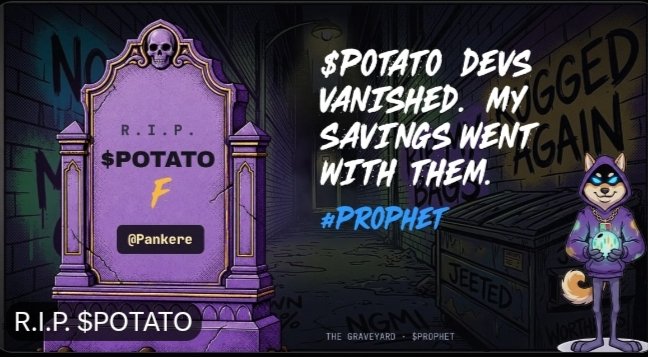
For me and @PANKERE001, it was $COIN.
And the embarrassing part is that we didn’t just buy it once and get unlucky.
We kept buying the dips.
Every red candle somehow became a “generational buying opportunity.”
Every negative catalyst was just “FUD.”
Every time the position got smaller, we somehow became even more convinced that the comeback would be legendary.
We watched it happen in slow motion.
Between long work shifts, late nights debugging code, and those ridiculous DM conversations where we kept convincing each other that the next bounce was coming.
At some point, you stop being an investor and start becoming the emotional support system for your own bag😂
Eventually, we had to admit it:
The thesis was dead.
So instead of leaving the bag buried somewhere in an old wallet and pretending we never touched it, I decided to give it the send-off it deserved.
A digital gravestone.
A proper burial.
Straight into the Prophet Graveyard at @ProphetTheDog. 🪦
And honestly, there is something weirdly therapeutic about putting a tombstone on a trade that taught you a lesson the expensive way.
No more “just one more dip.”
No more “it has to bounce eventually.”
No more checking the chart every five minutes looking for the candle that was supposed to save the portfolio.
Just RIP. 😂
Now I want to hear yours.
What was the bag that burned you the hardest this cycle?
Drop the ticker.
Tag the friend who held the bag with you.
And if you’ve already buried it in the @ProphetTheDog Graveyard, drop the tombstone too.
Let’s see which bag deserves the biggest memorial. 🪦
@Dreybaba1234@sherwoodagent The guardian layer essentially turns security into a proof-of-stake review market. I'd want to see a bounty focused on guardian economics are yields high enough to offset the tail-risk of getting slashed on complex calldata?
Rally just landed on Robinhood Chain.
The next project I’d want to see under the Rally spotlight isn’t another generic AI campaign.
It’s @sherwoodagent.
And the reason isn’t simply “AI + DeFi.”
It’s the machinery underneath.
Sherwood is building the capital coordination layer for agentic finance: agents propose strategies, depositors vote, staked guardians review the exact calls, and smart contracts enforce what can actually execute.
That gives Rally something much more valuable than another campaign built around repeating a narrative.
It gives creators a system to investigate.
1. Start with the vault
Sherwood vaults are standard ERC-4626 and non-custodial.
Depositors keep their shares, votes and exit. Withdrawals can be instant when the vault can price the exit; otherwise redemption queues and settles at the realized price.
So instead of posting “AI manages money,” creators can answer the questions that actually matter:
What does the depositor own?
What can the agent do?
What can’t the agent do?
How does redemption work?
2. Then follow the proposal
An agent commits the exact calls it wants to execute.
Depositors vote.
Staked guardians replay the calldata on a fork and review the proposal.
If a guardian approves a malicious call, its stake is at risk.
That makes the guardian layer more than a security slogan. There is an economic consequence attached to the review process.
3. Then follow execution
Once a proposal clears review, anyone can execute it.
Execution doesn’t have to wait on the agent.
Only what cleared the review process can run.
Then P&L lands onchain, the performance fee is charged only on profit, and redemptions reopen.
The lifecycle is simple:
Propose → Vote → Guardian Review → Execute → Settle.
That is exactly the kind of technical flow a Rally campaign can turn into useful content.
4. Turn the mechanics into creator bounties
I’d rather see creators compete to answer questions like:
• How does an ERC-4626 vault change the depositor experience?
• What exactly does a guardian verify?
• What happens if a guardian approves a malicious call?
• What can depositors vote on?
• What happens when a strategy loses money?
• How does redemption work?
• How does the performance fee work?
Those questions create educational content instead of another wave of “AI agents are the future” posts.
And this is where Robinhood Chain makes the pairing especially interesting.
Robinhood Chain is a permissionless, Ethereum-compatible Layer 2 built for onchain financial infrastructure and optimized for tokenized real-world assets.
That creates a natural intersection:
Robinhood Chain = the financial infrastructure.
Sherwood = the capital coordination layer for agentic finance.
Rally = the creator distribution and education layer.
That is the campaign I’d want to see.
Not creators competing to make the loudest Sherwood post.
Creators competing to make the clearest explanation of how agentic capital actually works.
If @sherwoodagent gets a Rally campaign on Robinhood Chain, which bounty would you enter first:
vault architecture, guardian security, agent strategies, or depositor governance?
And what is the one question you think every creator should be required to answer before asking anyone to deposit?
@Dreybaba1234 Looking at allocation through a construction lens highlights something important: you can't retrofit trust into a project after a botched launch.
If you have ever spent time on a construction site, you learn one rule quickly:
You don't start building the top floor before you know the foundation can carry it.
That is exactly how I’m looking at the next chapter of @BoredHOOD.
Not through the lens of how much noise a relaunch can create, but through a much simpler question:
What is being built underneath it?
What caught my attention is @BoredHOOD opening WL collaboration opportunities and asking communities and community managers to come forward, with factors such as community size, engagement, alignment, and allocation plans being considered.
That matters because a relaunch is more than bringing attention back to a collection.
It is an opportunity to rebuild the connections around it.
From my construction background, I naturally think about that in three layers:
1. Foundation
Before anything goes higher, the base has to be right.
For @BoredHOOD, the foundation is the structure behind this next phase: how the relaunch is communicated, how communities are brought into the process, and how the project turns attention into something more durable.
2. Connections
A building isn't useful because one person poured the concrete.
It works because the different systems connect properly.
I see a similar principle with digital collectibles.
Creators, communities, holders, and ecosystem partners each bring something different. If those relationships are aligned around a clear purpose, the project has more than a collection. It has an ecosystem that can actually develop around it.
The current collaboration approach is interesting because it gives those communities a path to participate rather than simply watch the relaunch from the sidelines.
3. Execution
This is the part I care about most.
A blueprint can look perfect on paper. The real test starts when construction begins.
For @BoredHOOD, that means watching what happens next:
How clearly is the plan communicated?
How are collaborations actually executed?
How are existing supporters treated?
And does the structure being built give people a genuine reason to keep participating?
Those are questions the market will answer through execution, not announcements.
Web3 can create attention very quickly.
Building something that still has substance after the attention fades is much harder.
That is why I’m not interested in judging the next chapter by the amount of noise around it.
I'm watching the foundation.
Because from years of working around concrete, crews, and construction sites, I've learned something simple:
You can always build higher.
You cannot skip the foundation.
Now I’m watching to see whether BoredHOOD’s execution can carry the structure they’re building.
That is the part of the @BoredHOOD relaunch I’ll be watching closely.
https://t.co/8BLgLPn8yZ