When humans and AI collaborate, what should uncertainty quantification look like?
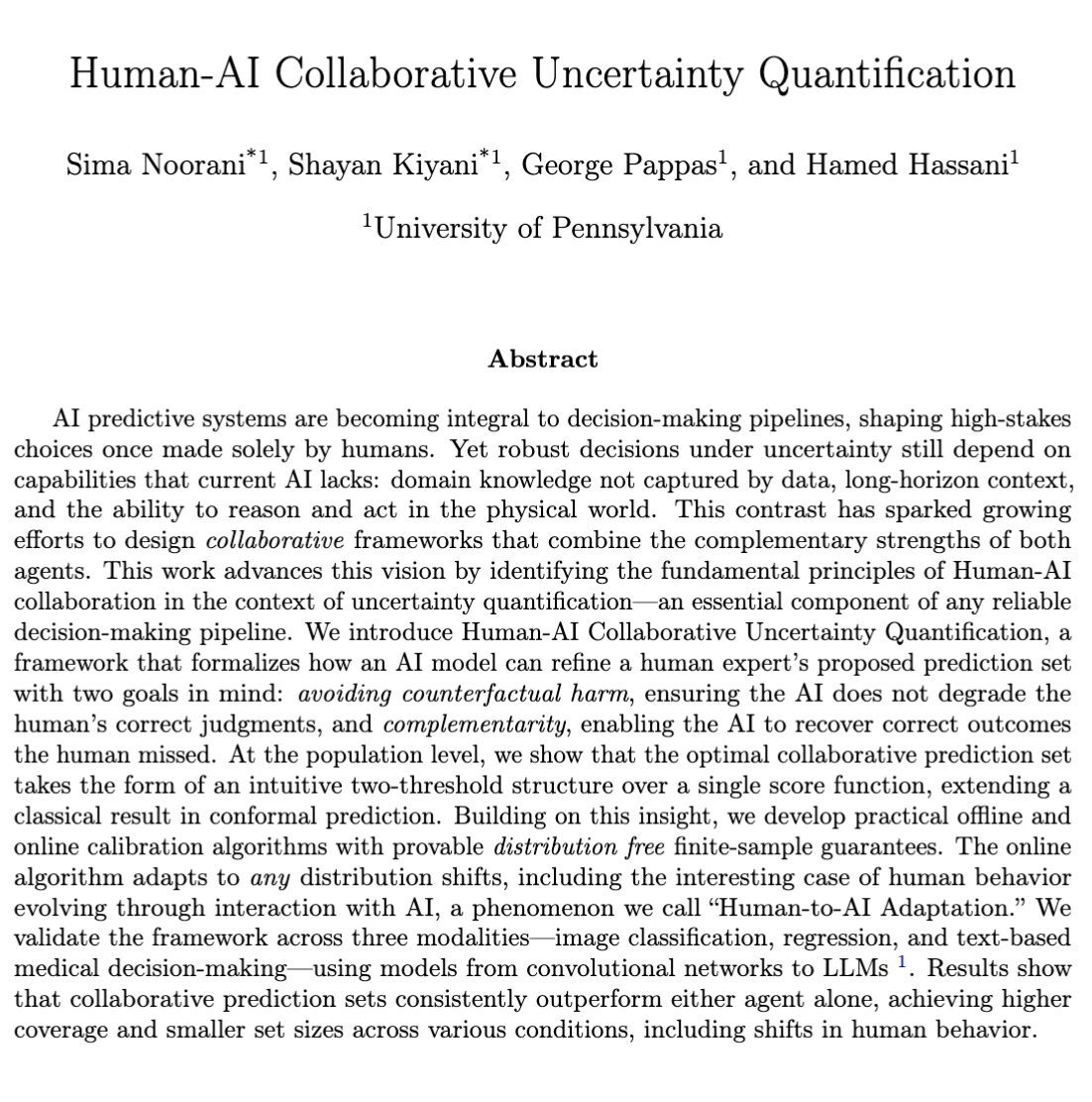
Our new paper proposes two principles---no counterfactual harm and complementarity---and gives distribution-free guarantees without assumptions on the task, AI model, or human behavior.
I’ll be giving a talk on this work at INFORMS today!
If you’re attending INFORMS, come check it out! The talk will be at Moscone South 302 (Level 3), as part of the session “Bridging Uncertainty Quantification and Decision Making,” starting at 11:00 AM.
How do you know if an AI agent's next action is correct?
Often, you don't! Even defining correctness at each step can be ambiguous, let alone collecting such labels at scale!
Yet many model routing methods rely on exactly these correctness labels to decide when to call a stronger model.
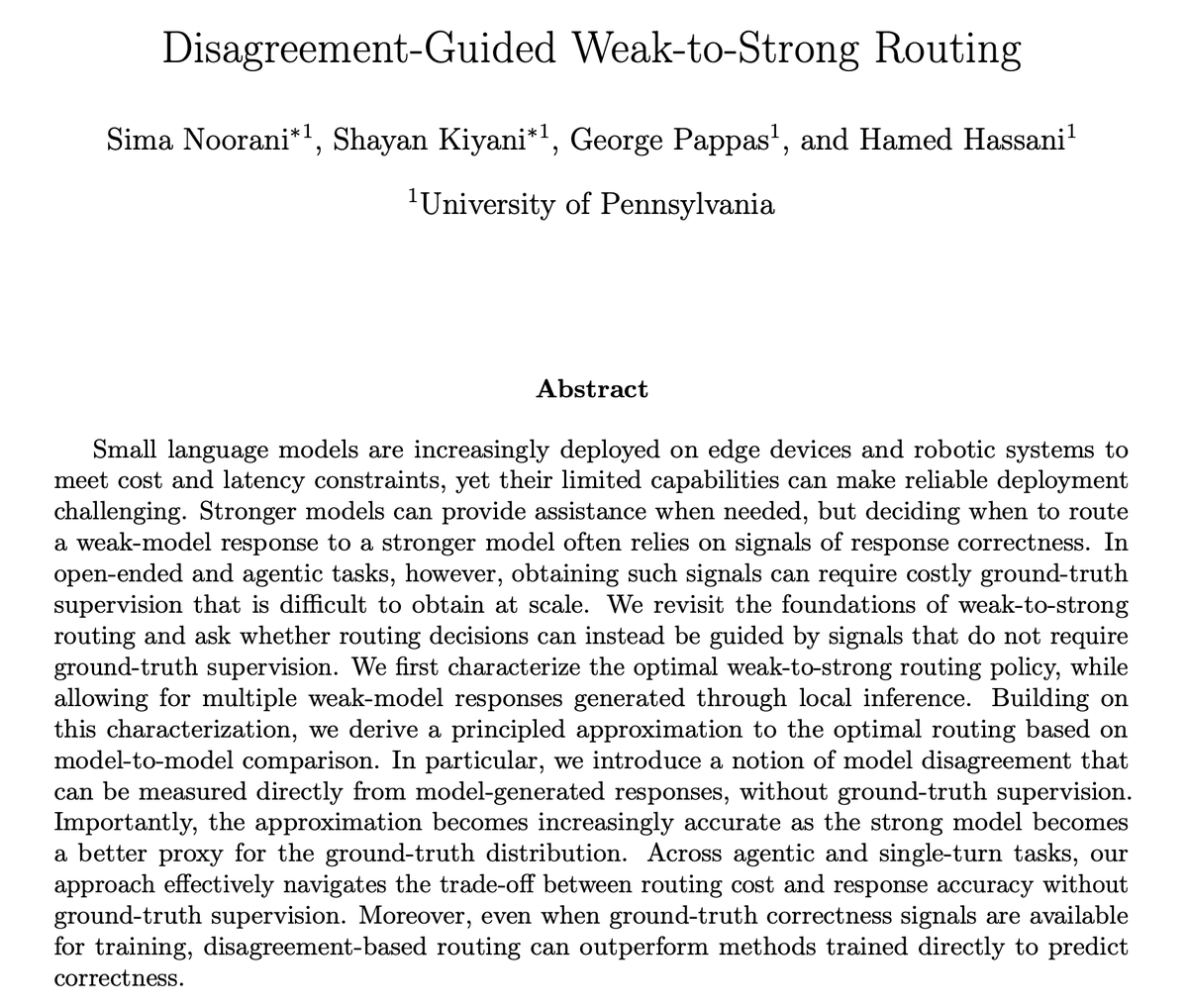
In our new paper, we show how to approximate optimal routing signals without correctness labels with a practical and scalable approach based on model disagreement!
But does it work in practice?
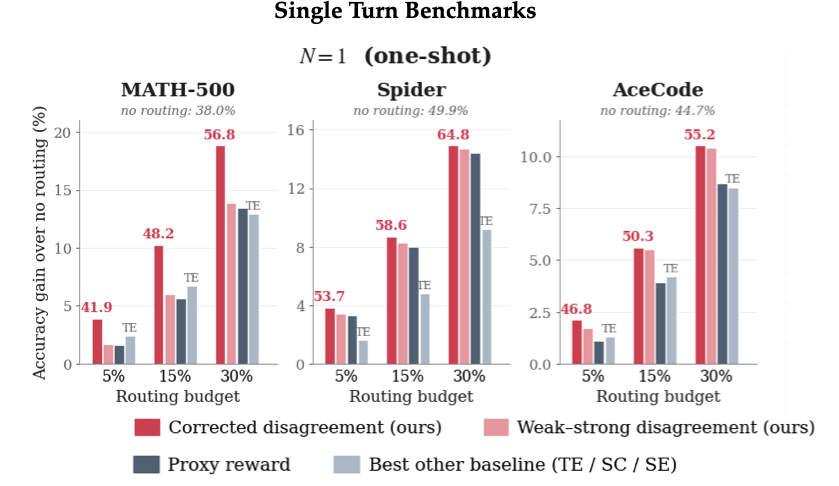
We test action-level routing in AI agents (WebShop, BFCL) and single-turn tasks (MATH-500, Spider, AceCode). Our learned corrected disagreement scores outperform label-free baselines and, on single-turn tasks, even routers trained with correctness labels!
When humans and AI collaborate, what should uncertainty quantification look like?
Our new paper proposes two principles---no counterfactual harm and complementarity---and gives distribution-free guarantees without assumptions on the task, AI model, or human behavior.
With 50k+ ICLR submissions and a limited reviewer pool, it feels like we need something between “all-human” and “all-LLM” reviewing.
A simple direction: orchestrate the review process between humans and AI, aiming to preserve the reliability of human judgment while retaining the speed and scalability of LLMs.
We’ve been thinking more broadly about this kind of weak/strong verification setup, so perhaps a timely moment to take a look: https://t.co/VGdUBHjqGB
I am at @icmlconf in Seoul and will be presenting these three works:
• Human-AI Collaborative Uncertainty Quantification
Tue Jul 7, Poster Session 2 — Hall A, poster 3614
(Also selected for a spotlight talk at the Agentic UQ workshop on Sat Jul 11 in CONF ROOM E1 - E4.)
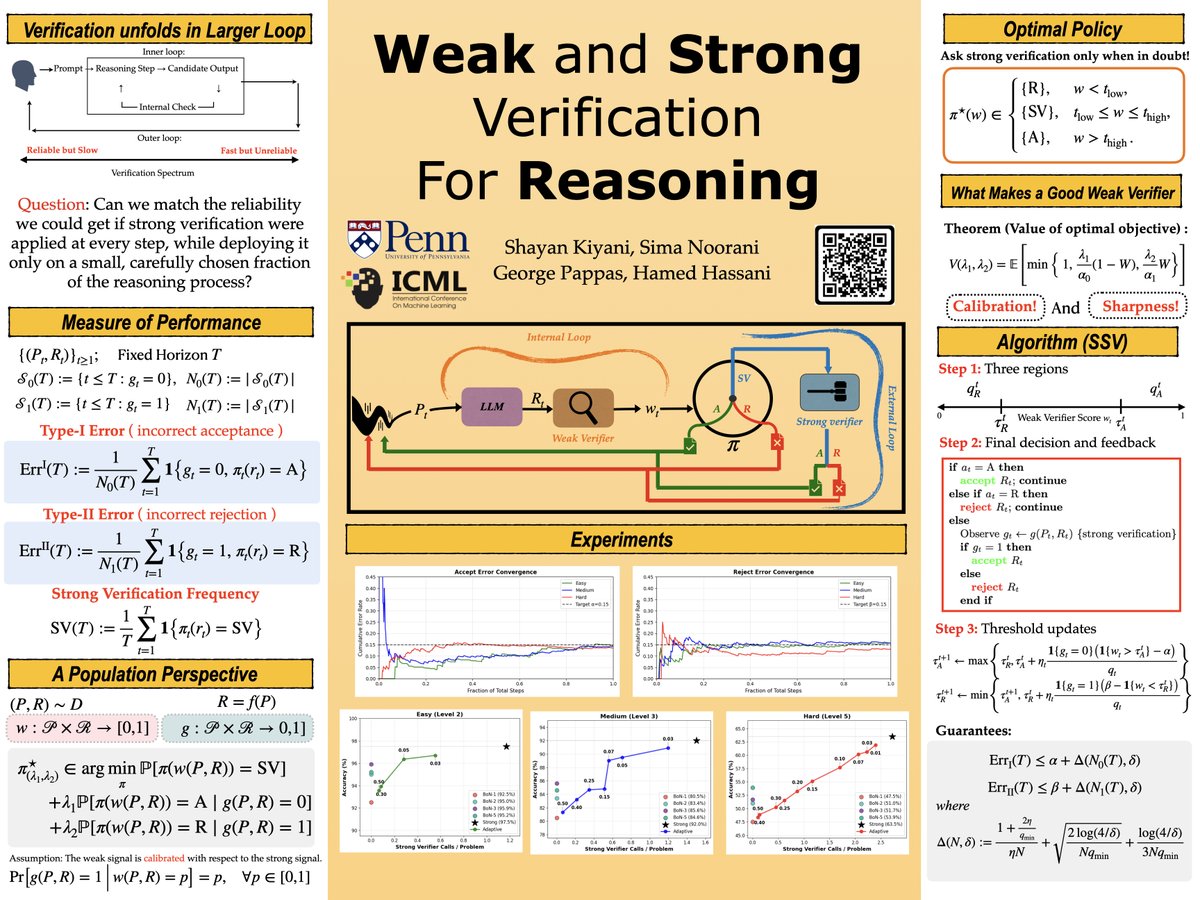
• When to Trust the Cheap Check: Weak and Strong Verification for Reasoning (Spotlight)
Wed Jul 8, Poster Session 4 — Hall A, poster 710
• Multiround Human-AI Collaboration with User-Specified Requirements
Thu Jul 9, Poster Session 7 — Hall A, poster 3603
Come say hi if you want to chat about any of these works, or in general about human-AI collaboration, uncertainty quantification, verification, or related ideas!!! :)
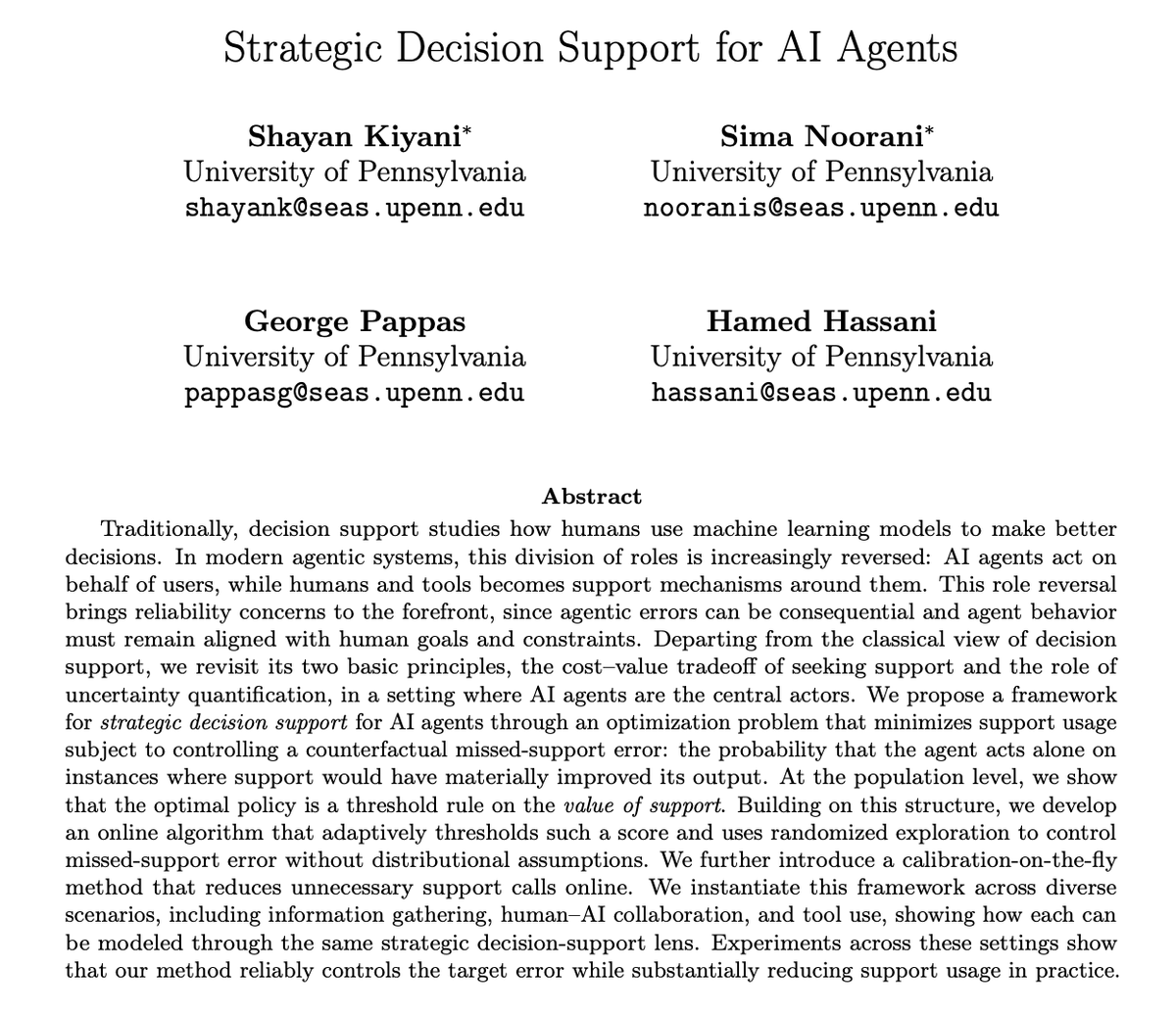
Excited to share our new paper: Strategic Decision Support for AI Agents.
Traditionally, decision support asks how AI can help humans make better decisions.
But in agentic systems, the roles are reversing: AI agents act on behalf of users, while humans, tools, and external information become support mechanisms around them.
This raises a new question:
When should an AI agent act alone, and when must it seek support to avoid consequential errors or misalignment with downstream intent?
Very exciting direction. But I think evaluating human+AI math systems purely by final accuracy misses a key aspect: how good the collaboration actually was.
A finer-grained, human-centered evaluation should track, over interactions:
1) Counterfactual harm: does the agent distract/mislead the mathematician from good ideas, computations, refinements, or intuitions they would have reached correctly alone?
2) Complementarity: does the agent genuinely add value on the instances where the human is stuck, overlooking something, or making an error?
This is what makes a true co-mathematician.
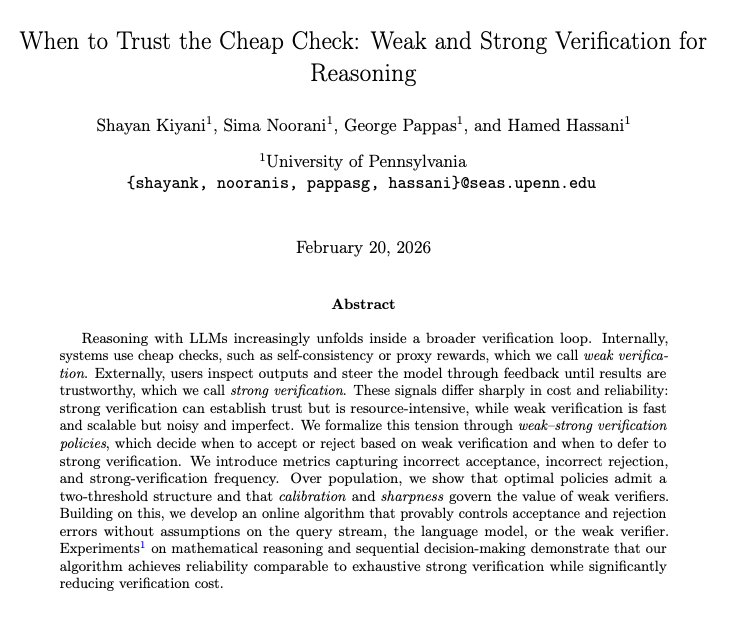
If reliable verification is expensive, then intelligence is partly the art of spending it wisely.
Reasoning with LLMs increasingly unfolds through weak (fast but noisy) and strong (reliable but costly) verification. The question is: how should we orchestrate the two?
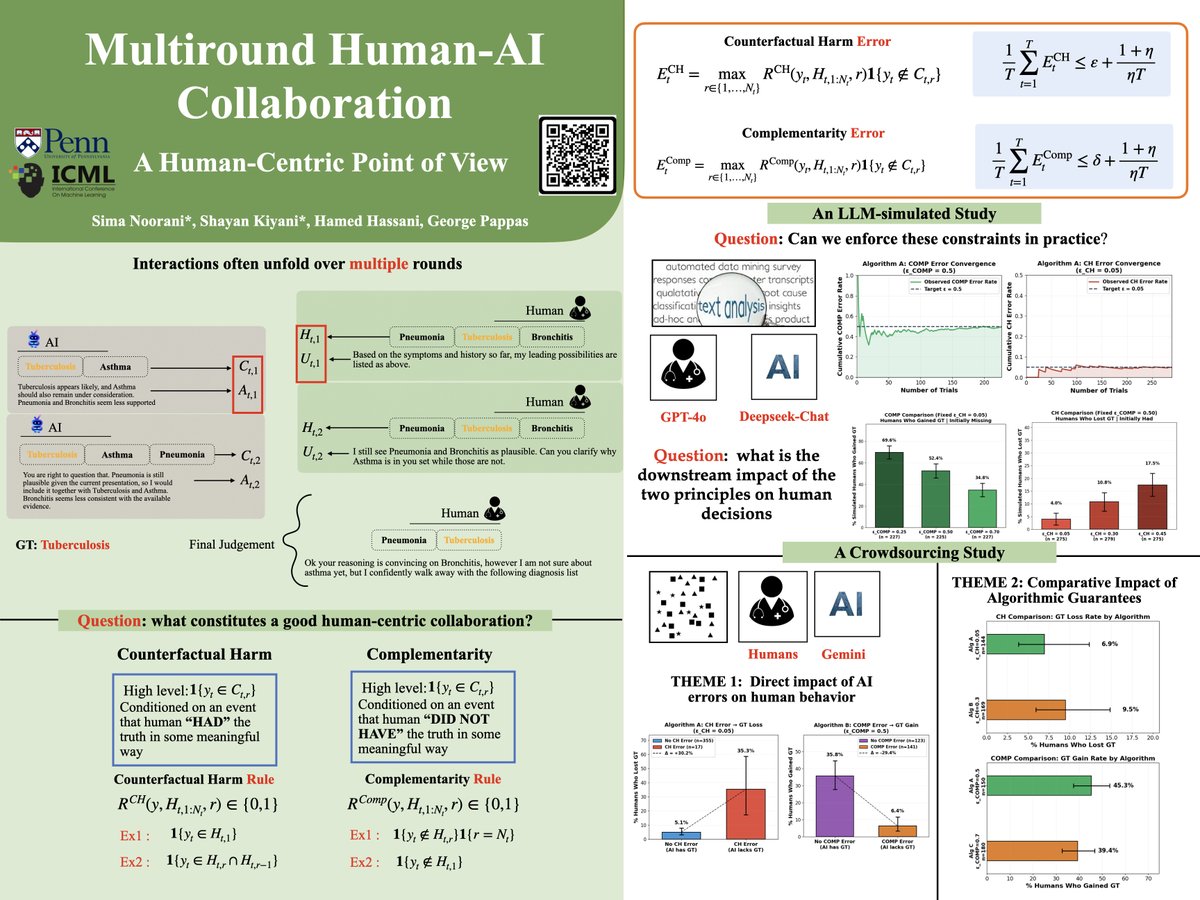
In real-world multi-round human–AI interactions, the human decides whether to engage, how long to continue, and how much to trust the AI, while bearing accountability for the final outcome.
How should these interactions be designed to incentivize human engagement in a principled way?
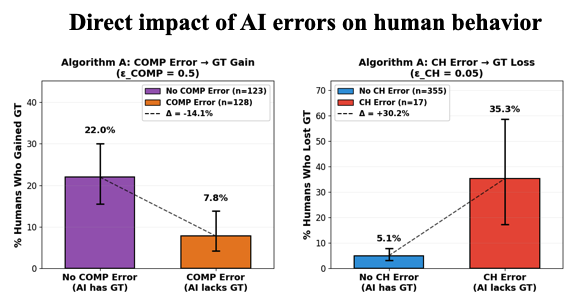
Empirically, we study the framework in both LLM-simulated interactions and a real human crowdsourcing study, and show that enforcing these two principles leads to predictable shifts in downstream human decision quality.
This validates that these human-centric principles serve as practical levers for steering multi-round HAI collaboration dynamics.