I find it a bit inaccurate when they say "AI solved RH", as if it pulled it out of thin air.
300+ years of "human mathematics data" have gone into the models to solve these kinds of problems. We probably couldn’t train a model to solve RH with the math data from up to 150 years ago (around the time RH was proposed).
And think of someone like Friedrich Gauss, who made insane contributions to mathematics without even having access to a simple calculator!
The crazy thing is, though, the data we have to this date was enough!
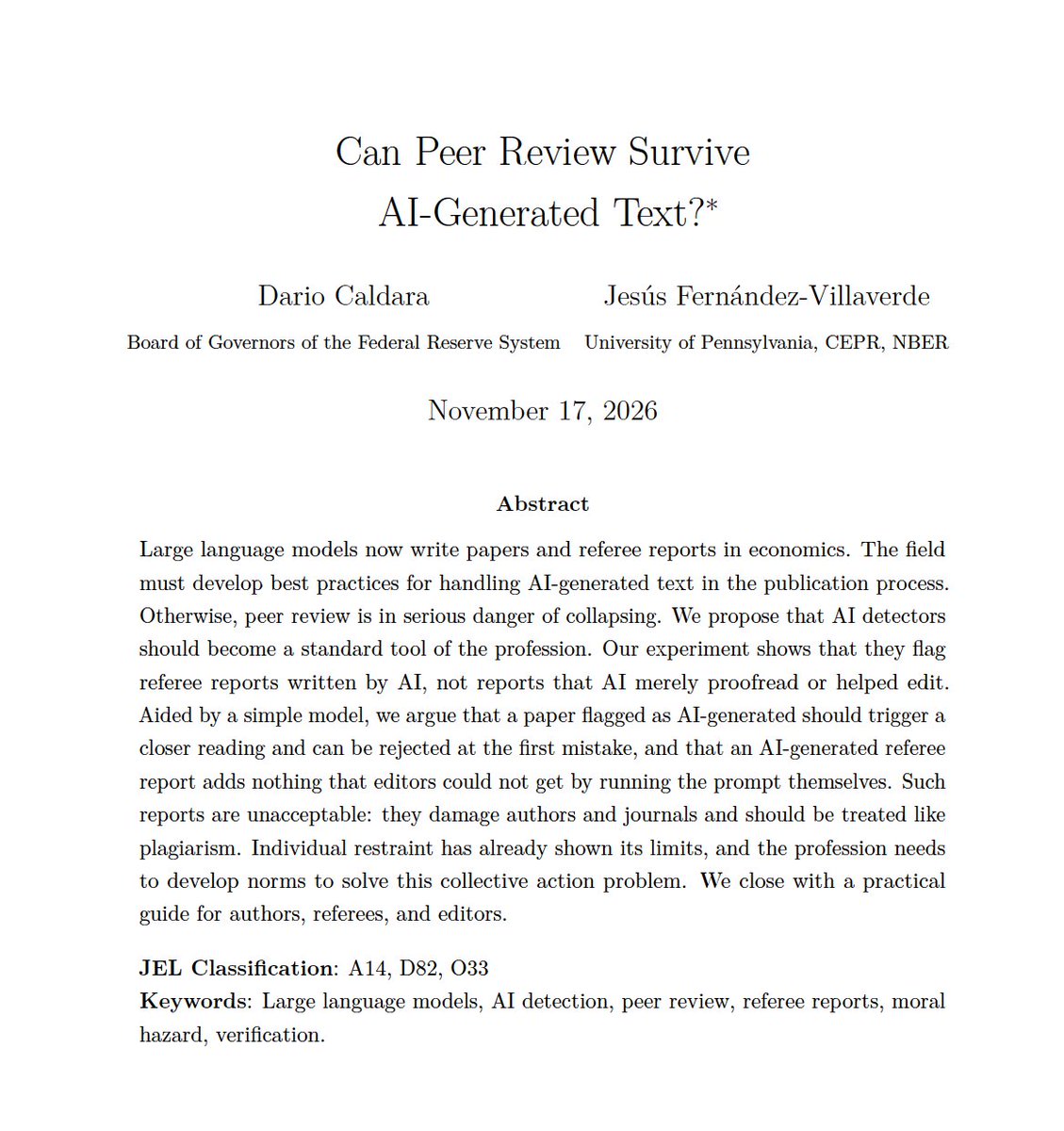
I am sharing a new paper today with Dario Caldara: “Can Peer Review Survive AI-Generated Text?”
https://t.co/lufwMLCu0L
Dario and I, as editors, are increasingly getting papers submitted to our journals that are 99 percent AI-generated. Even worse, we are also receiving many AI-generated referee reports, both as editors and, more frustratingly, as authors.
And we cannot emphasize this enough: the real problem is not that the papers and reports were AI-generated; it is that no one had done the thinking behind them, and you can so easily tell. The papers were eminently forgettable, and the referee reports were disappointingly uninsightful. We have seen too many reports of the form: “The paper is well-written and addresses an important problem. However, the authors should consider additional baselines.”
This deluge of AI-generated text puts peer review in jeopardy: journals will be flooded with low-quality submissions, economists will decline requests to referee papers or routinely use AI to referee them, and which papers get published will become less and less linked to their quality.
We do not want to defend the status quo entirely. Peer review is slow, many reports are poor, and editors (including us!) make bad calls all the time. Still, well-executed peer review remains the best system we have for assessing each other’s work and advancing the profession. AI could improve peer review if used deliberately for that purpose, for instance, to check proofs and code. That is not what we are seeing.
The difficulty is that readers, including editors and referees, cannot see how AI was used. As a result, in practice, the burden of verification shifts from the author to the reader.
Since we reject this shift, Dario and I did what economists always do when something bothers us: we wrote a paper.
So, what do we do in it? First, we check whether AI detectors such as Pangram get this right: is a referee report flagged as AI-generated indeed AI-generated? Or is Pangram just flagging proofreading and editing? No. We run an experiment with 25 referee reports from the pre-AI era. Proofreading and editing do not trigger AI-generated flags. Only when we ask the LLMs to substantially rewrite the referee report or to generate a new report do we get the AI-generated flags. Pretty compelling evidence, if I may say so.
Second, we build a theoretical model to explore who should bear the burden of verification: the author or the reader? (Yours truly always enjoyed the courses on the rules of evidence in law school; yes, as Billy Wilder would say, nobody is perfect.)
The answer is that it is much more efficient for the author to do it, because the author can verify at a much lower cost and only needs to do it once (rather than each reader repeatedly). Before AI, the authors more or less had to verify the results, even if only because they had to type them in. This was not perfect (and all papers ever published in economics probably have at least one mistake). But the problem is that, with AI, the author does not even need to read the text. Or can just skim it. Writing is thinking, and without writing there is usually not much thinking.
So, a paper flagged as AI-generated is prima facie evidence that the author has not verified it. Should this lead to an automatic rejection? No. But there should be a zero-tolerance policy for serious mistakes. The first serious mistake we find in the paper, and it is out! In comparison, for a non-flagged paper, a serious mistake is something that the editor might determine it can be fixed in a revision.
We are stricter with referee reports. There is absolutely no point in the referee generating a report using an LLM. As an editor, I can do that directly and save myself the trouble of asking you for it. Now, of course, you can use the LLM to help you with the report (if the journal allows it! Many journals do not allow you to upload the paper to an LLM, and you need to follow the rules). For example, you can use the LLM to search for existing results in the literature.
But peer review is not about finding one sentence that is not entirely precise or a slightly sloppy mathematical proof. Referees are asked: “Is this idea important despite its flaws?” And, relatedly: “Is the paper a good fit for the journal in terms of quality and focus?” That judgment is the task for which you are selected as a subject expert.
We also propose that journals require that, before a paper is submitted, the author submit it to an LLM using an approved prompt and include the LLM report and a discussion of what was and was not fixed. That way, the referee would not need to check (or at least not check so carefully) every technical detail, and they could focus on the big picture: Is this a good paper? Is this a good fit for this journal? What is fundamental for this paper to become publishable at this journal?
Anyway. The paper has many other arguments, and we try to be nuanced. So, before ferociously typing the first complaint that crosses your mind, would you consider reading it? Chances are that we have already discussed your objection. We have been thinking about this for a long time.
But by all means, leave good comments!
I’ll be giving a talk on this work at INFORMS today!
If you’re attending INFORMS, come check it out! The talk will be at Moscone South 302 (Level 3), as part of the session “Bridging Uncertainty Quantification and Decision Making,” starting at 11:00 AM.
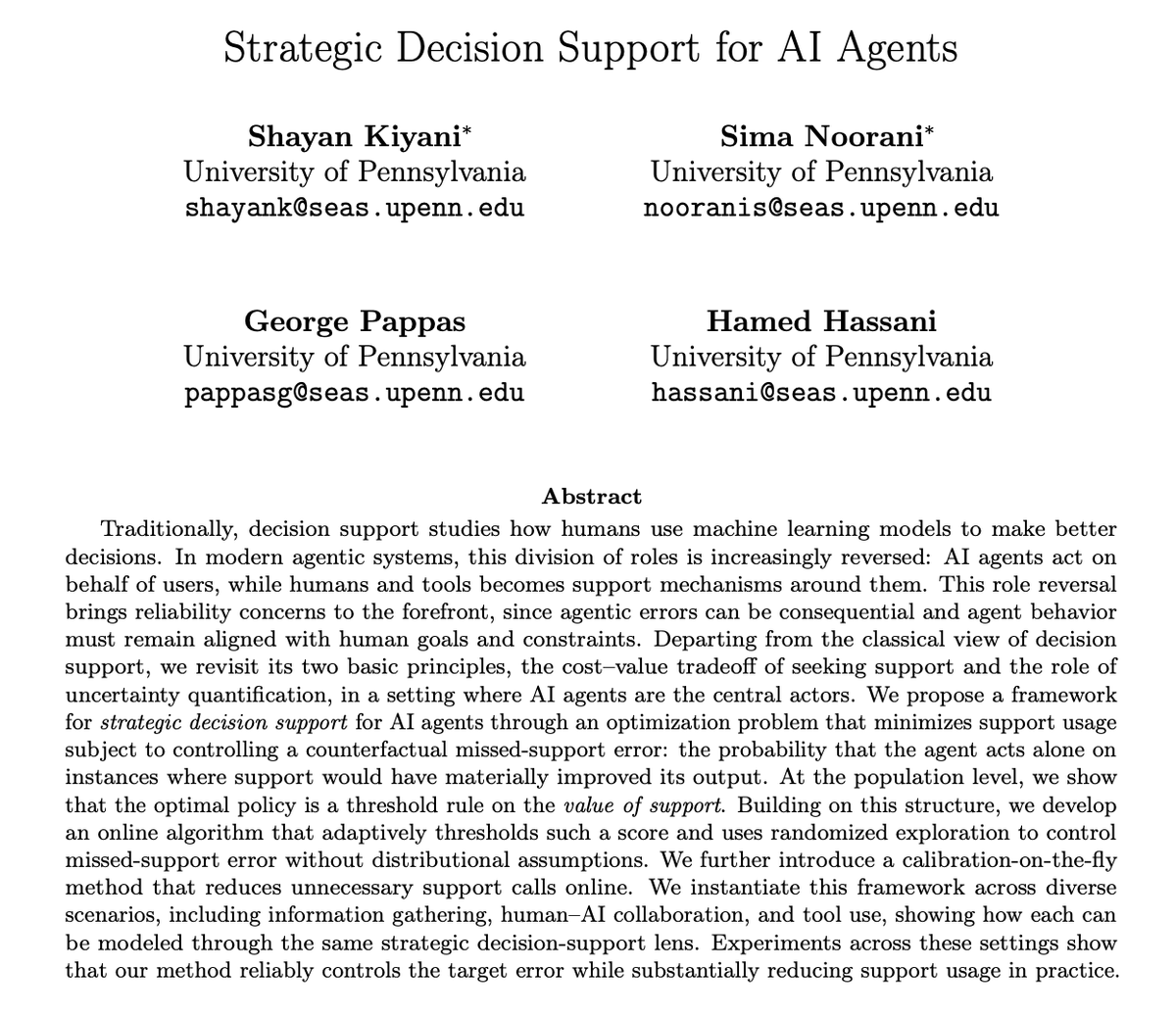
Excited to share our new paper: Strategic Decision Support for AI Agents.
Traditionally, decision support asks how AI can help humans make better decisions.
But in agentic systems, the roles are reversing: AI agents act on behalf of users, while humans, tools, and external information become support mechanisms around them.
This raises a new question:
When should an AI agent act alone, and when must it seek support to avoid consequential errors or misalignment with downstream intent?
How do you know if an AI agent's next action is correct?
Often, you don't! Even defining correctness at each step can be ambiguous, let alone collecting such labels at scale!
Yet many model routing methods rely on exactly these correctness labels to decide when to call a stronger model.
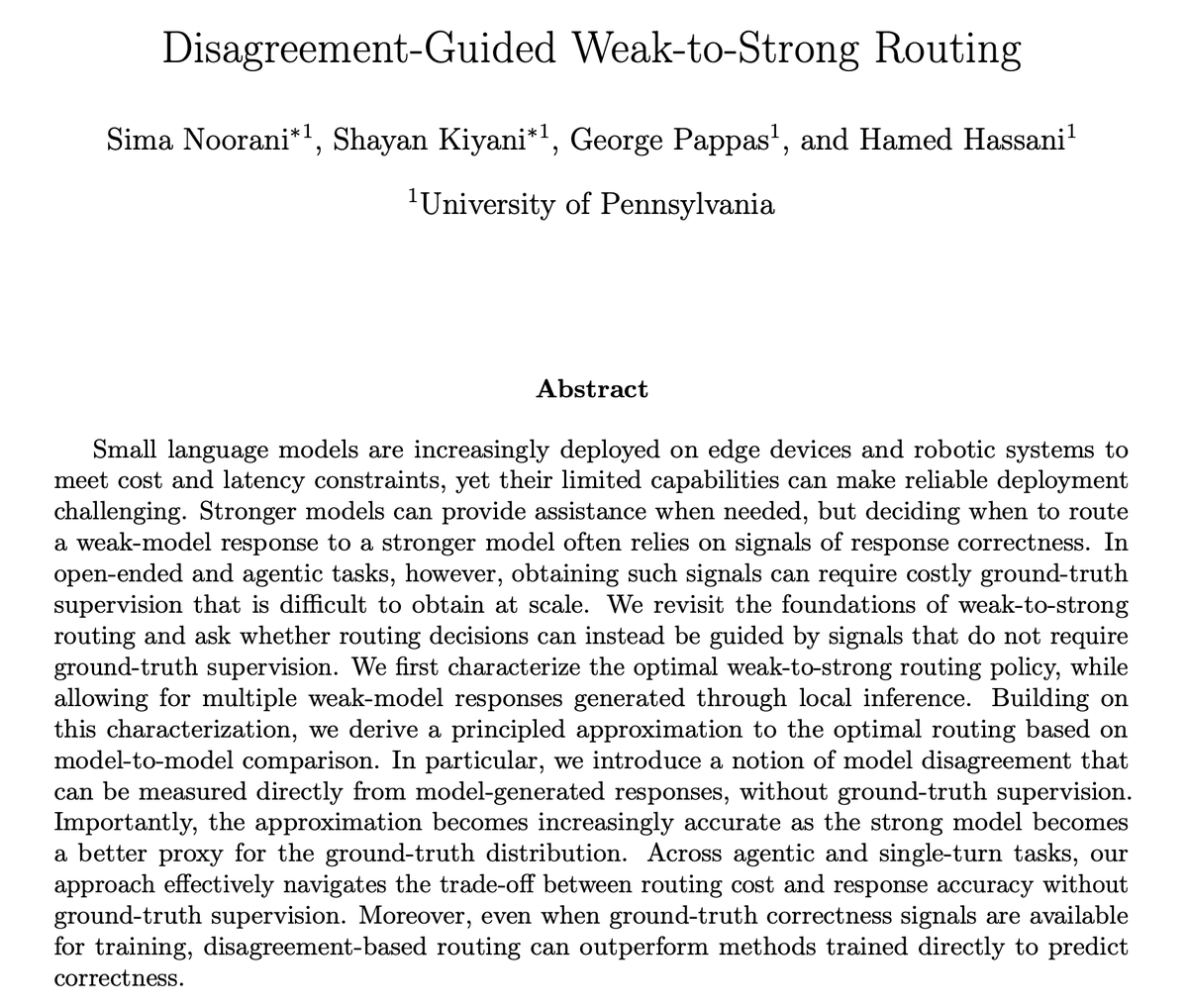
In our new paper, we show how to approximate optimal routing signals without correctness labels with a practical and scalable approach based on model disagreement!
Maybe a bit late, but I wanted to comment on this: I think the AI boom made people forget what a PhD was meant for. Now it's going back to its original purpose: not short-term profit, but long-term research that might not have a practical use for another 10 or 20 years -> Backprop existed decades before the deep learning boom.
A PhD isn't for everyone, and that's okay. Industry may suit you better if you want to build something useful now, or academia if you believe in a problem industry doesn't care about yet. The AI boom made a PhD look like preparation for an industry job, but that was never its main purpose.
Couldn't agree more!
To add to it:
You can do a PhD on Human + AI Collaboration / the role of human intelligence going forward. This way, you will be actively working on building an understanding of what stresses you the most. Also, if your research helps us figure out the role of humans, then in the unlikely worst case, where humans end up having little contribution to the things that matter, you can say, “I told you so.”
Students sometimes ask me if it still makes sense, in this accelerating age, to pursue a PhD in AI.
Perhaps counterintuitively, I think it's a great time to do so.
I wrote up some thoughts on this here: https://t.co/RRqGR0qi1R
That is kind of the whole point of the paper I attached. You DO NOT NEED to trust the AI agent doing the verification. Instead, you should have an inspection policy that can control the error without the need of checking everything. To do that, the idea is to leverage progressive randomization. Put it very simply, you check a bunch randomly, given the number of errors you found, you decide to check more or less (again randomly) for the next batch. If you tune the details correctly, particularly if you give your randomness a bit of structure, this can achieve the best of both worlds. As scalable as agents, as reliable as expert humans.
That is kind of the whole point of the paper I attached. You DO NOT NEED to trust the AI agent doing the verification. Instead, you should have an inspection policy that can control the error without the need of checking everything. To do that, the idea is to leverage progressive randomization. Put it very simply, you check a bunch randomly, given the number of errors you found, you decide to check more or less (again randomly) for the next batch. If you tune the details correctly, particularly if you give your randomness a bit of structure, this can achieve the best of both worlds. As scalable as agents, as reliable as expert humans.
With 50k+ ICLR submissions and a limited reviewer pool, it feels like we need something between “all-human” and “all-LLM” reviewing.
A simple direction: orchestrate the review process between humans and AI, aiming to preserve the reliability of human judgment while retaining the speed and scalability of LLMs.
We’ve been thinking more broadly about this kind of weak/strong verification setup, so perhaps a timely moment to take a look: https://t.co/VGdUBHjqGB
I am at @icmlconf in Seoul and will be presenting these three works:
• Human-AI Collaborative Uncertainty Quantification
Tue Jul 7, Poster Session 2 — Hall A, poster 3614
(Also selected for a spotlight talk at the Agentic UQ workshop on Sat Jul 11 in CONF ROOM E1 - E4.)
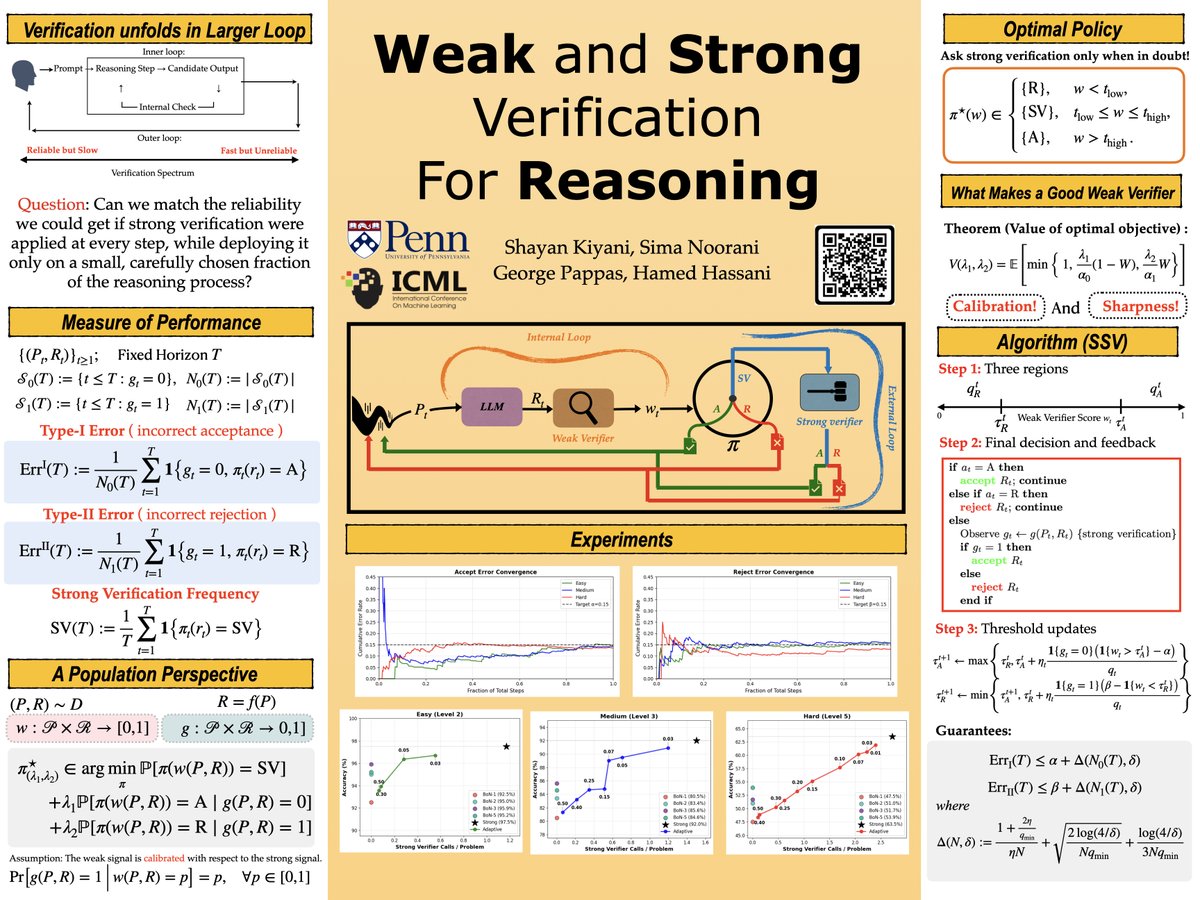
• When to Trust the Cheap Check: Weak and Strong Verification for Reasoning (Spotlight)
Wed Jul 8, Poster Session 4 — Hall A, poster 710
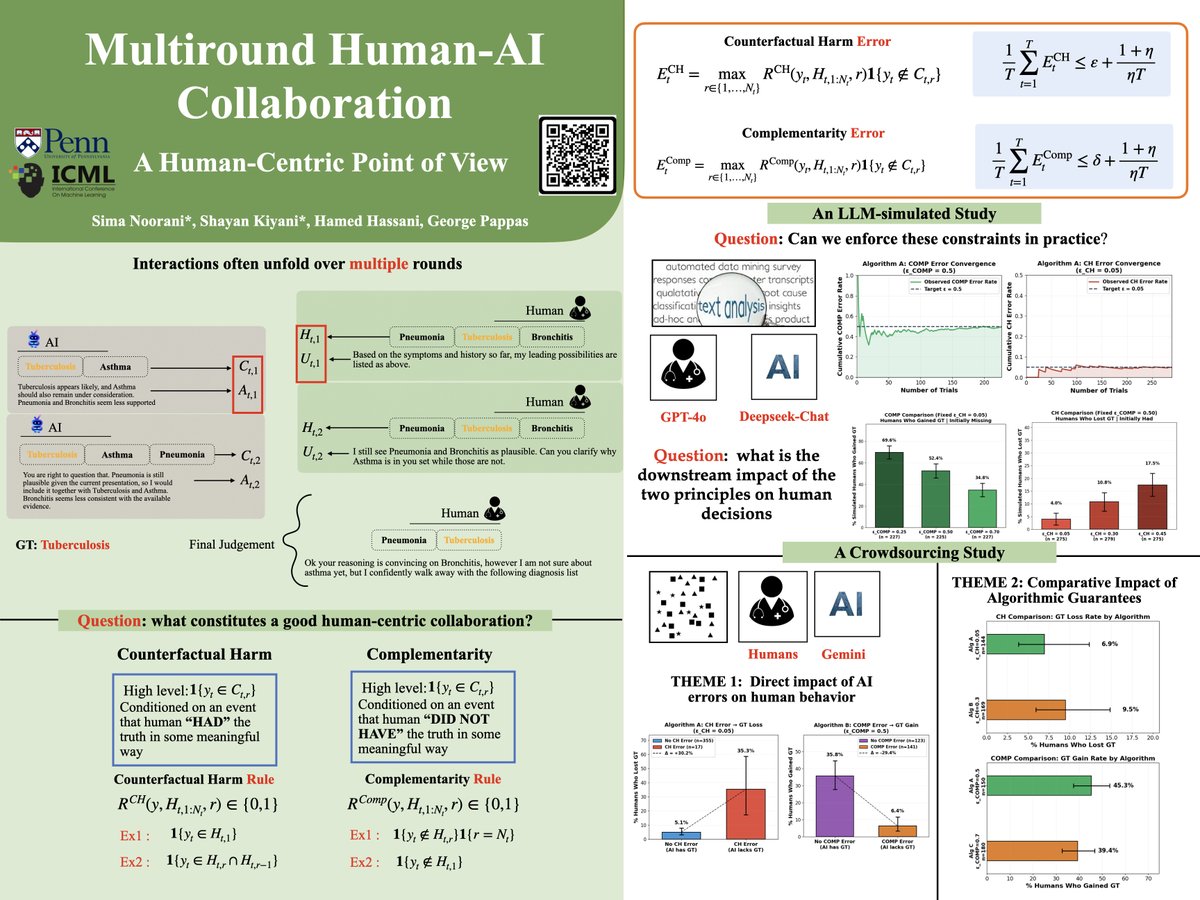
• Multiround Human-AI Collaboration with User-Specified Requirements
Thu Jul 9, Poster Session 7 — Hall A, poster 3603
Come say hi if you want to chat about any of these works, or in general about human-AI collaboration, uncertainty quantification, verification, or related ideas!!! :)
Excited to share our new paper: Strategic Decision Support for AI Agents.
Traditionally, decision support asks how AI can help humans make better decisions.
But in agentic systems, the roles are reversing: AI agents act on behalf of users, while humans, tools, and external information become support mechanisms around them.
This raises a new question:
When should an AI agent act alone, and when must it seek support to avoid consequential errors or misalignment with downstream intent?
The takeaway: AI agents need a principled oversight layer for deciding when to seek decision support.
Letting LLMs make this call on their own can be unreliable: the right choice depends on both the agent’s capability and the value of support in each context.
Our framework learns this trade-off over time and applies across diverse agentic settings.
Very exciting direction. But I think evaluating human+AI math systems purely by final accuracy misses a key aspect: how good the collaboration actually was.
A finer-grained, human-centered evaluation should track, over interactions:
1) Counterfactual harm: does the agent distract/mislead the mathematician from good ideas, computations, refinements, or intuitions they would have reached correctly alone?
2) Complementarity: does the agent genuinely add value on the instances where the human is stuck, overlooking something, or making an error?
This is what makes a true co-mathematician.
The future of Math is mathematicians and AI agents working together.
Very pleased to introduce @GoogleDeepMind's AI co-mathematician: a multi-agent system designed to actively collaborate with human experts on open-ended research mathematics.
Mathematicians testing the agent across areas as diverse as group theory, Hamiltonian systems, and algebraic combinatorics have reported impressive results.
In autonomous mode evaluation on the rigorous FrontierMath Tier 4 problems, AI co-mathematician scored an unprecedented 48% — a new high score among all AI systems evaluated.