🌌☀️ Latest news from the past, present and future of the Sun ☀️🌌
Please find here a short illustrated summary of our recent work with @ASachaBrun, @AStrugarek and collaborators.
Thanks to Eyrun Thune for her help!
https://t.co/eoLUODZ0fC
This offers a new pathway to interpret high-resolution solar observations — and suggests that small-scale shock dynamics play a central role in chromospheric jet formation. See animations here: https://t.co/elFXjwf2Td
“Shock-induced magnetic reconnection driving Ellerman bomb emission and a spicule” by Sand et al. (2026, A&A). It presents a novel physical mechanism linking photospheric shocks, magnetic reconnection, and dynamic solar spicules. 📄 https://t.co/fqWxIfckJk
Rather than requiring flux emergence or large-scale reconnection drivers, shock-induced compression of current layers can both trigger EBs and launch type II spicules via reconnection outflows: providing a causal physical link between the two phenomena.
All together:
➡ ~66% of quiet-Sun chromospheric mechanical heating comes from shocks + current sheets
➡ ~13% arises where both overlap
➡ Compression heating is key.
Chromospheric heating is inherently multi-process.
New paper's out!
How is the quiet-Sun chromosphere heated?
Using a 3D Bifrost simulation, we track shocks and current sheets in space and time, and quantify how they deposit energy into heat.
👇 Main results below
Published in A&A
https://t.co/edmpy5h2PN
Higher up, the balance shifts.
As plasma-β drops in the upper chromosphere, current sheets become the dominant heating sites, powering most of the ohmic dissipation even though they occupy a small fraction of the volume.
New paper day! 🔥 George Cherry et al. use the Most Significant Frequency decomposition to investigate shocks, jets, and swirls in the Sun's atmosphere. The contribution of 3.5 and 5 mHz signals is up to 50% of the overall wave power. Published in A&A: https://t.co/WbBpbTuYDE
L’état de l'Atlantique est une dinguerie. Un rail de cyclones de la Floride a l'Europe!
L'intensification de #Milton est une dinguerie.
👇Probabilité d’occurrence du niveau de pression (couleur). Autour de 1 chance sur 200 localement mais c'est la structure spatiale qui est ouf
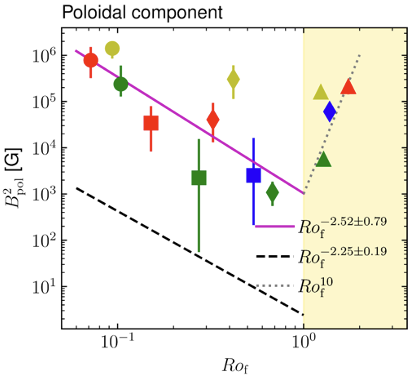
Our new paper on beta Hydri connects the critical Rossby number for the onset of Weakened Magnetic Braking with a threshold for large-scale organization by the stellar dynamo.
Check out this nice illustration produced by @astrowright, then read the paper! https://t.co/FDhCX9eUde
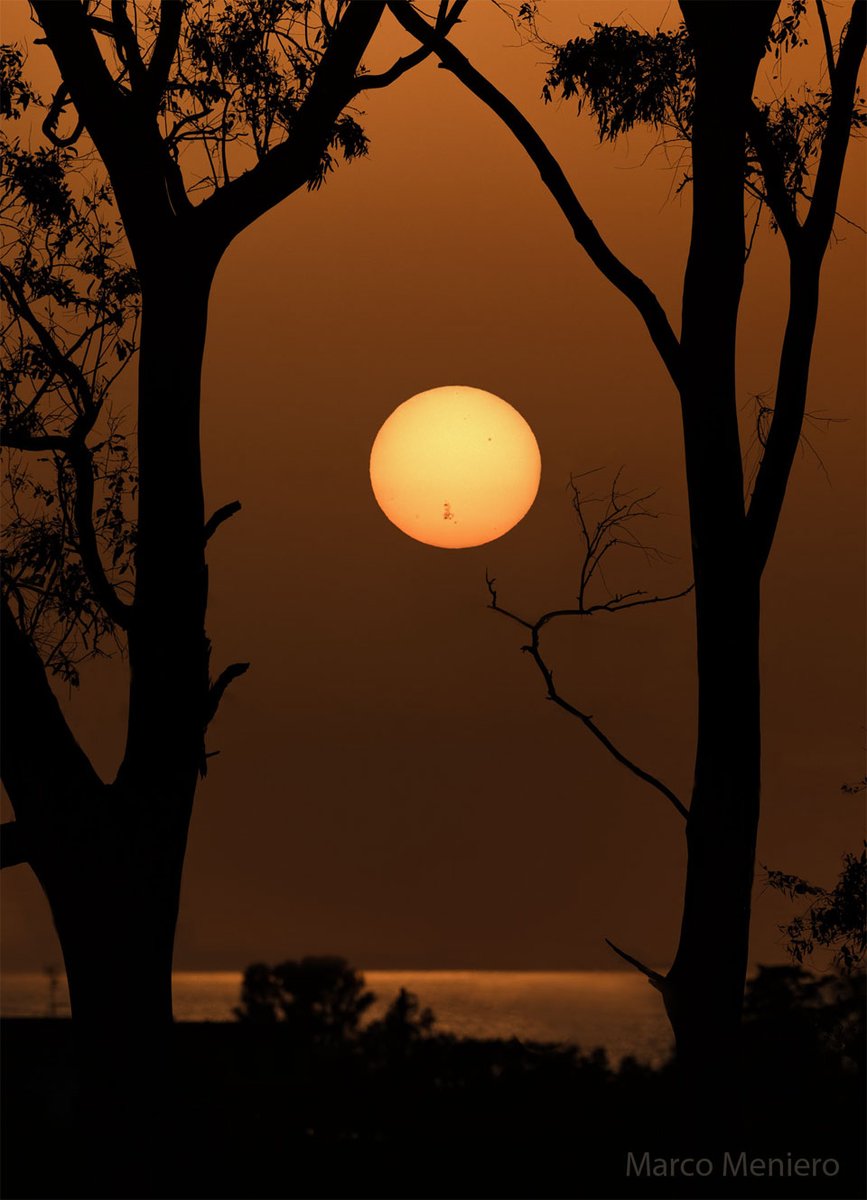
It was larger than the Earth. It was so big you could actually see it on the Sun's surface without magnification. It contained powerful and tangled magnetic fields as well as numerous dark sunspots. Labelled AR 3664, it developed into one of the most energetic areas seen on the Sun in recent years, unleashing a series of explosions that led to a surge of energetic particles striking the Earth, which created beautiful auroras. And might continue. Although active regions on the Sun like AR 3664 can be quite dangerous, this region's Coronal Mass Ejections have not done, as yet, much damage to Earth-orbiting satellites or Earth-surface electrical grids. Pictured, the enormous active region was captured on the setting Sun a few days ago from Civitavecchia, Rome, Italy. The composite image includes a very short exposure taken of just the Sun's surface, but mimics what was actually visible. Finally, AR 3664 is now rotating away from the Earth, although the region may survive long enough to come around again.
Image Credit & Copyright: Marco Meniero
Watch Juno zoom past Jupiter. NASA's robotic spacecraft Juno is continuing on its now month-long, highly-elongated orbits around our Solar System's largest planet. The featured video is from perijove 16, the sixteenth time that Juno passed near Jupiter since it arrived in mid-2016. Each perijove passes near a slightly different part of Jupiter's cloud tops. This color-enhanced video has been digitally composed from 21 JunoCam still images, resulting in a 125-fold time-lapse. The video begins with Jupiter rising as Juno approaches from the north. As Juno reaches its closest view -- from about 3,500 kilometers over Jupiter's cloud tops -- the spacecraft captures the great planet in tremendous detail. Juno passes light zones and dark belts of clouds that circle the planet, as well as numerous swirling circular storms, many of which are larger than hurricanes on Earth. As Juno moves away, the remarkable dolphin-shaped cloud is visible. After the perijove, Jupiter recedes into the distance, now displaying the unusual clouds that appear over Jupiter's south. To get desired science data, Juno swoops so close to Jupiter that its instruments are exposed to very high levels of radiation.
Video Credit & License: NASA, Juno, SwRI, MSSS, Gerald Eichstadt; Music: The Planets, IV. Jupiter (Gustav Holst); USAF Heritage of America Band (via Wikipedia)
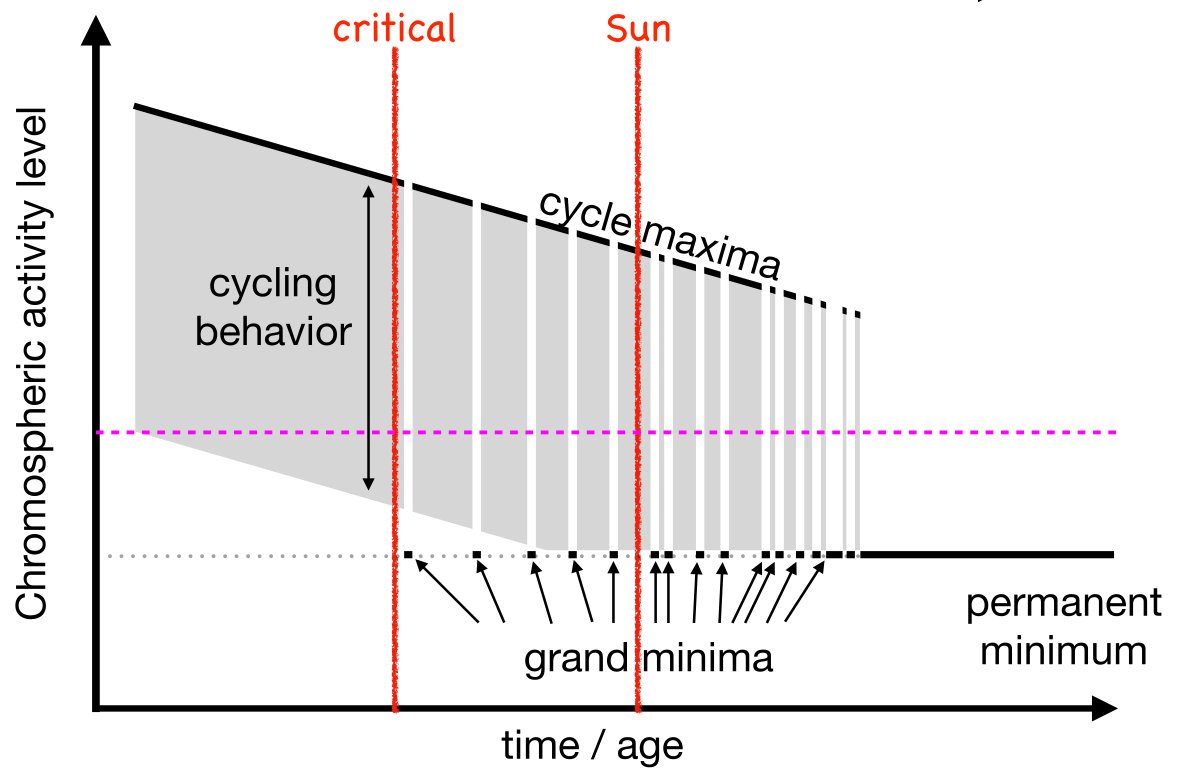
Finally, as stars continue to age, they may undergo a rotational transition towards an anti-solar DR state. This would modify the dynamo once more, which could lose its cycle, build a stronger large-scale field and revive the spin-down.
Exciting news! Our work on solar-type star dynamos' Magnetochronology is now published. Explore the study, aiming to place the Sun in its stellar context, there: https://t.co/FoURuW4FMZ
Also find a illustrated summary here:
Then, we find that the magnetic field may reach a minimum amplitude at a transition Ro~1. Stars may undergo here a weakening of their wind braking, with what could appear to be a stall in their spin-down.