ESA Research Fellow at ESTEC. Investigating the Sun's magnetic activity, solar wind connection science, and the spin-down of Sun-like stars. Prev. CEA, Exeter.
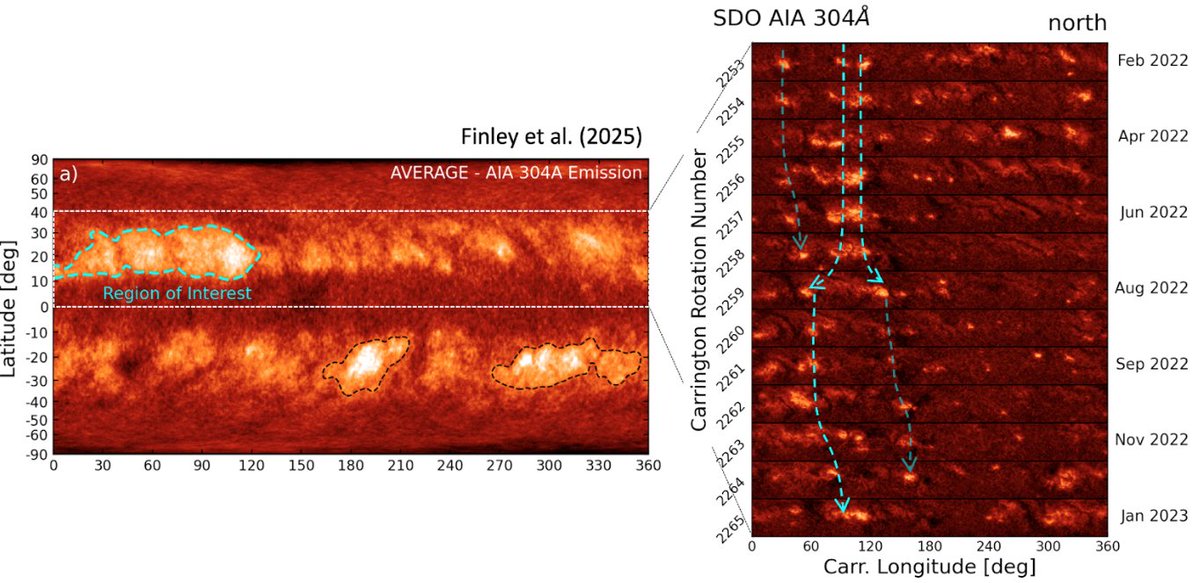
Solar Orbiter Nugget @esascience about our recent active region nest study. We used Solar Orbiter as a far side observer from April to October 2022 to survey magnetic activity over the entire solar surface. This shed light on the nesting of active regions: https://t.co/LwBJl6cd8r
A great review of the proposed mechanisms for switchback formation in the solar wind. These strong deflections in the local magnetic field are ubiquitous close to the Sun and have been linked to the heating and acceleration of the solar wind. https://t.co/7aVBbRd8vK
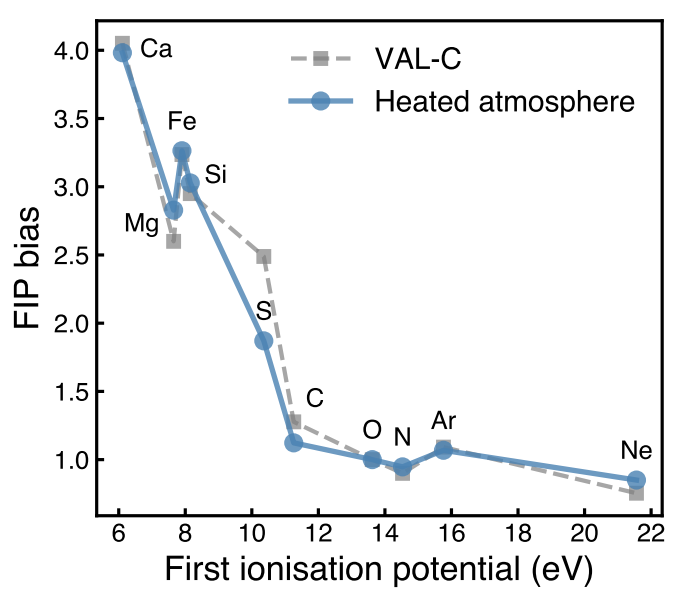
The FIP effect remained consistent between the two atmosphere profiles. However, changes to the acoustic flux and increases in choromspheric turbulence could suppress fractionation, leading to variability in the FIP effect within flaring loops.
New paper day! To et al. studied the elemental fractionation in coronal loops with FIPpy, comparing the First Ionisation Potential (FIP) effect produced in an initial VAL-C chromosphere versus a heated chromosphere following impulsive nanoflare-like events https://t.co/gSp3mdD6wT
3️⃣ solar prominence eruptions captured by Proba-3️⃣
This animation resulted from ASPIICS observing the Sun during an active period on 21 September 2025, with one image taken every five minutes, capturing three prominence eruptions in five hours.
🔗 https://t.co/in0CGkmqpu
@esascience@esaoperations@isro@NASA
Are you (or do you know of) an undergrad with an interest in solar physics? Check out the Leiden/ESA Astrophysics Program for Summer Students. Myself, Andy To and Henrik Eklund invite you to come work with us at ESTEC on "Catching the Solar Wind in Action" https://t.co/yoSiX8gGKQ
New paper day! 🔥 George Cherry et al. use the Most Significant Frequency decomposition to investigate shocks, jets, and swirls in the Sun's atmosphere. The contribution of 3.5 and 5 mHz signals is up to 50% of the overall wave power. Published in A&A: https://t.co/WbBpbTuYDE
It took 10 years to trace Weakened Magnetic Braking back to it's root cause (the collapse of the global stellar dynamo), but next week at #AAS247 you can hear me explain how we did it in less than 10 minutes! Thursday, January 8th at 10:10am in room 222C. https://t.co/EJIqTNvYKk
🔭 Until now, observing the inner regions of the Sun’s enigmatic atmosphere – the corona – was close to impossible.
🛰️🛰️☀️ The satellite duo making up our Proba-3 mission fills this observation gap by creating artificial solar eclipses in orbit.
🔗https://t.co/dpIf7zEy8m
Side project day! NASA's Parker Solar Probe (PSP) has been exploring the near-Sun enviroment since the start of solar cycle 25. Now passing maximum activity, how has the shape and size of the Sun's Alfvén surface evolved since? https://t.co/RaaJElhRCH (1/5)
The Alfvén radius is linked to the solar wind mass and magnetic flux. The wind magnetisation parameter (~ratio of mag/mass flux), is used to understand this scaling. Our results follow the trends from MHD wind simulations, but had an offset due to 3D effects and turbulence. (5/5)
Side project day! NASA's Parker Solar Probe (PSP) has been exploring the near-Sun enviroment since the start of solar cycle 25. Now passing maximum activity, how has the shape and size of the Sun's Alfvén surface evolved since? https://t.co/RaaJElhRCH (1/5)
The evolution of the coronal magnetic field during the solar cycle, strongly influenced the magnetic connectivity of PSP. Near minimum, the wind measured by PSP originated closer to the Sun's poles. Towards maximum activity, wind sources moved towards the active latitudes. (4/5)
New paper day! Metcalfe et al. review the evidence for weakened magnetic braking by homogenizing the stellar parameters from previous studies that constrained the wind braking of stars with observed magnetic fields and x-ray fluxes (proxy for mass-loss): https://t.co/nAlZyPvlks
Looking at this swirling feature in the solar atmosphere, revealed that the viscous heating along the swirl boundary was linked with the breakdown of coherent oscillations in the swirl. This method provides a new pathway to investigate wave activity in the solar atmosphere. (4/4)
New paper day! 🔥 George Cherry et al. develop the Most Significant Frequency/Wavenumber method for detecting wave activity in realistic magnetohydrodynamic simulations of the Sun's atmosphere. Published in A&A: https://t.co/60XHhDNJOM (1/4)
Using this approach, horizontal slices of a realistic solar atmosphere were decomposed into their most significant frequencies. A biproduct of this method, the highest frequency bin highlights dissipation/shocks. This is especially clear at swirl boundaries. (3/4)
A gorgeous prominence eruption that took place this morning. This animation shows the benefit of EUV imagers with larger fields of view. SUVI on GOES was designed and built by the team I belong to.