The left now hates @elonmusk, but they forced him to buy an overpriced asset that he then used to save free speech and democracy as we know it. Thanks @elonmusk!
When the left complains that Elon owns X and has too much power, it's hilarious to remember that THEY FORCED HIM TO BUY IT! He tried to back out and they literally took him to Delaware court and forced the sale. They legally forced Elon to destroy them! 😂
A rate increase cannot cure an oil shortage, but it can weaken employment, suppress investment, worsen the housing shortage, and increase debt-service costs.
What an incredibly stupid idea.
Warsh Fails the Oil-Shock Test
An oil shock is not a monetary-policy failure. It is a tax imposed by producers abroad, a supply disruption, or both. The Federal Reserve cannot drill another barrel, reopen a shipping lane, or make gasoline cheaper by raising the cost of a mortgage.
Yet Kevin Warsh’s response to the current energy-price surge suggests that he would do exactly what the Fed has too often done: hike into a supply shock, sacrifice the interest-rate-sensitive economy, and call the resulting contraction a victory over inflation.
That is a dangerous misreading of both the facts and history.
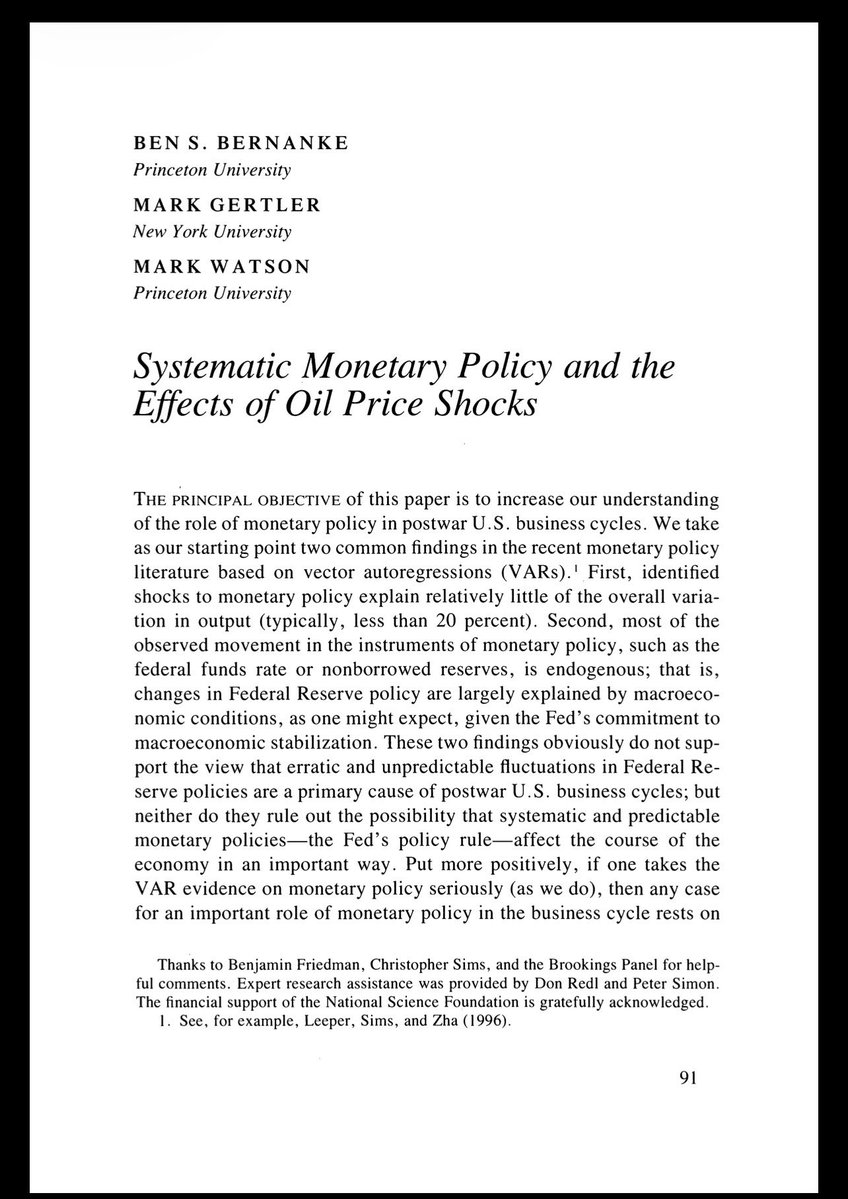
In their landmark 1997 paper, Ben Bernanke, Mark Gertler, and Mark Watson found that much of the economic damage following postwar oil-price shocks stemmed not from oil itself, but from the Fed’s systematic response higher interest rates. Oil was the trigger. Monetary tightening was the amplifier. Their work does not say that central banks should disregard inflation. It says they must distinguish an inflationary regime from a one-time jump in a key relative price.
That distinction is central today. A rise in energy costs can lift headline inflation and strain household budgets without producing a self-sustaining inflation process. The relevant questions are whether expectations are becoming unanchored, whether wage growth is accelerating in response, and whether price increases are spreading broadly through core services and goods.
If expectations remain anchored and there is no persuasive evidence of durable second- or third-round effects, a rate hike would be an act of economic vandalism. It would not lower the price of oil. It would simply add a credit shock to an energy shock.
Housing, commercial real estate, construction, autos, durable goods, and business investment have already borne the brunt of restrictive policy. These are not abstract lines on a Bloomberg terminal. They are the sectors where rate hikes become layoffs, cancelled projects, unaffordable homes, and weaker capital formation.
Warsh is as bad as Powell: both mistake a rigid response to headline inflation for credibility.
Warsh reacted to Wall St prediction market.
Warsh is making a policy decision based on what geopolitical events could be. Again classic mission creep.
Wall Street may cheer, of course. The Bloomberg bros crowd always admires the theater of a central banker promising resolve. But that is a Hall of Mirrors markets congratulating themselves for embracing a policy that may validate a fashionable narrative while weakening the underlying economy.
The test of a Fed leader is not whether he can raise rates. Anyone can raise rates. The test is whether he can change the reaction function when the facts demand it: recognize a supply shock, protect credibility without chasing oil prices, and avoid turning transitory inflation into a recession.
Warsh failed that test. Investors should take note.
https://t.co/nGq6qGsPgE
CHAMATH: “My mom calls me and she's like, ‘What is this whole civilizational death thing?’ I don't know how to explain it to her.”
JENSEN: “We shouldn't, because it's made up … Somebody has to take accountability for all of the stupid predictions that were made.”
Good news: a Judge struck down New York's massive “Climate Superfund" cash grab.
The state tried to fine fossil fuel companies $75 billion for PAST ... LEGAL emissions.
How did they calculate $75B? They didn’t.
Here’s what the activists and conniving pols tried to do:
If you're long META, you gotta have your head examined.
Meta has the worst capital-allocation record of any major American technology company over the past decade. Not one of the worst. The worst. And the reason is simple: Meta founder and CEO Mark Zuckerberg.
Meta isn’t really a public company. Yes, the public owns most of the economic interests, but it doesn’t have any actual control. Zuckerberg has retained complete control over the company through super voting stock. Nobody can stop him.
That might have been a good idea if Zuck was Steve Jobs. But he isn’t. Instead, he’s proven to be the very worst CEO in tech. Especially when it comes to capital allocation.
In October 2021, Zuckerberg changed the company's name from Facebook to Meta Platforms and staked its future on something no one had ever heard of… and no one has ever used: the “metaverse.” Since then, Meta’s Reality Labs segment has produced roughly $13 billion of cumulative revenue against roughly $88 billion of cumulative operating losses. That is $88 billion of shareholder money that vaporized on Oculus headsets, Horizon Worlds, and augmented reality (“AR”) glasses.
And what’s even worse is that the losses continue to accelerate.
Reality Labs lost:
2019: $4.5 billion
2020: $6.6 billion
2021: $10.2 billion
2022: $13.7 billion
2023: $16.1 billion
2024: $17.7 billion
2025: $19.2 billion
And these losses aren’t the only massive errors in judgment.
In 2021, with the stock at an average price of $323, Meta spent $44.5 billion buying back its own shares. The next year, the stock fell to $93 per share. Had Meta simply waited one year, the same $44.5 billion would have retired an additional 118 million shares.
At today's price, that is another $65 billion of value transferred from continuing shareholders to selling shareholders – because management insisted on buying at the top.
Add it up. Between the metaverse and the peak-price buyback, Meta destroyed roughly $150 billion of shareholder capital in a five-year window. And that is before you count the stock-based-compensation leak. The diluted share count only fell 11.6% despite $174 billion (!) of gross repurchases since 2017.
No goodwill impairments. No board accountability. Zuckerberg's super voting stock makes sure of it. Which brings us to artificial intelligence (“AI”).
Meta's 2025 capex was $69.7 billion – 34.7% of revenue. The most aggressive single-year capital investment in the company's history. But that’s not even half of the real spend. The real spending is being hidden in “off-balance-sheet” deals so big and so brazen they would make Enron blush.
Here’s one example.
Meta disclosed in its 2025 annual report a 20% interest in a Louisiana data-center venture formed in October 2025. Meta's maximum loss exposure: $45.95 billion. How could 20% of an entity formed less than a year ago be worth $250 billion?
And wait, who really owns this data center?
Meta's auditor, Ernst & Young, designated “accounting for a variable interest entity” – aka, this data center deal – a critical audit matter in the 2025 annual report. It said its determination of which entity was the primary beneficiary was “especially challenging due to the significant judgment required.” In other words… we think Meta is lying about this deal.
Moody's, in a February 23, 2026, opinion, wrote that Meta's accounting “is not in line with the expected economics of this transaction,” called its disclosure “opaque,” and warned it stood ready to make a “quantitative debt adjustment.”
You can't say that investors haven't been warned. You can't say Meta's management team hasn't shown you exactly how they waste tens of billions, every year. And you can't say the auditor and the rating agency haven't already flagged the off-balance-sheet structure.
But it is extraordinary that investors have not yet begun to punish the stock and demand Zuck’s resignation.
Just wait. They will.
Meet MI Democrat Senate nominee Abdul El-Sayed’s sister
This is what she thinks of the U.S.
She’s also a professor at @UChicago.
Why is @UChicago employing this radical lunatic who wants America to burn?
Charlie Munger: "I always liked the story of P.J. O'Rourke, who said, 'The last Communist dictator of Albania was a pure Communist.
He threw out the Russian embassy because they'd lost the pure faith. Then he kicked out the Chinese Communists because they'd lost the pure faith.
Finally, he was only comfortable with two places in the world. One was the Communist dictator of North Korea and the other was the English department at Yale.'" 🤣
"There is a lot of extreme craziness in some of the liberal arts — and they select people who share their craziness."
(Caltech || 2008)
“Higher taxes will not reduce the deficit, except for a brief interval. They will simply increase government spending. That is the lesson taught by past experiences.”
— Milton Friedman
Now do the math on how much @elonmusk will save by owning his own fab and manufacturing his own chips. TSMC’s GMs are 65%. Most fabless chip company GMs are 50-75%. The chips that go into space will also need special materials, which is very expensive. Bringing everything in house will lower costs by 65 to 90%.
A key stat that every environmentalist who is serious about solving climate change should know:
The US Navy has put into operation over 400 nuclear reactors without a single failure that resulted in any radioactive release.
That is equivalent to the entire total number of civilian reactors deployed worldwide, but the Navy’s reactors are literally deployed in BOATS IN THE WATER, that continually move, rock, get shot at, etc.
There are non-trivial engineering challenges, but the core reality is that safe, clean, abundant nuclear is a matter of political will, intelligence, and organizational culture.