If there is one good thing that can come out of having my health issues exposed to the world, it’s raising awareness for complex chronic conditions like POTS, MECFS, Long Covid or EDS. 🧵
https://t.co/nNkKjGAHZm
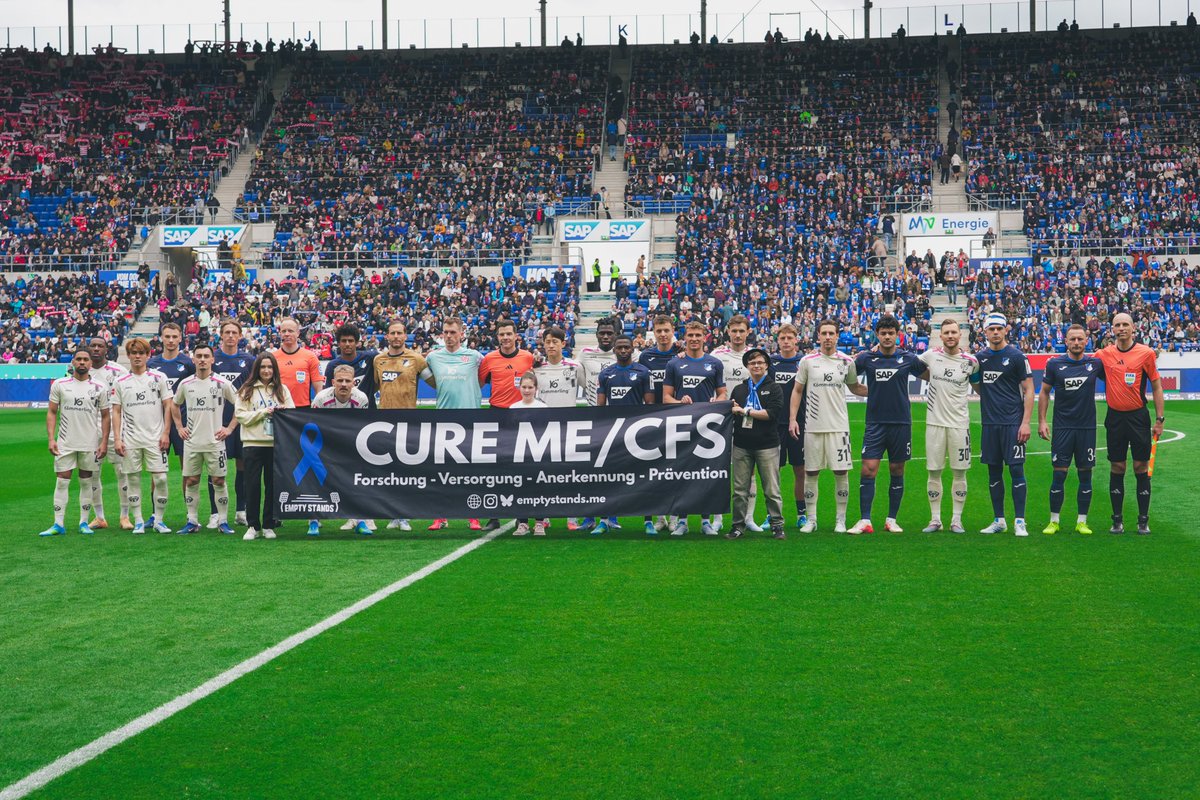
In the Bundesliga match between @tsghoffenheim and @1FSVMainz05, players and referees gathered on the pitch before kickoff with a clear message: CURE ME/CFS!
Another powerful and successful campaign by https://t.co/XAHdFn0GHs
Hey @JacobTref,
Congratulations on stepping into your new role tackling some of the hardest problems in medicine.
There is one condition I strongly encourage you to put on your radar early: Myalgic Encephalomyelitis / Chronic Fatigue Syndrome (ME/CFS).
ME/CFS is one of the most severe and neglected chronic diseases that is not rare. In its worst forms, patients are completely bedridden, unable to tolerate light, sound, or human interaction. Quality of life is among the lowest of any illness.
Despite all this, research funding has historically been extremely low relative to disease burden, largely due to long-standing mischaracterization and bias, including the fact that many patients are women.
ME/CFS sits at the intersection of immunology, neurology, and metabolism, involving complex multi-system dysfunction. This is exactly the kind of problem where AI can have an outsized impact by integrating complex data and uncovering hidden leads.
Please take a closer look. Your involvement could make an extraordinary difference to millions affected.
Thank you 🙏
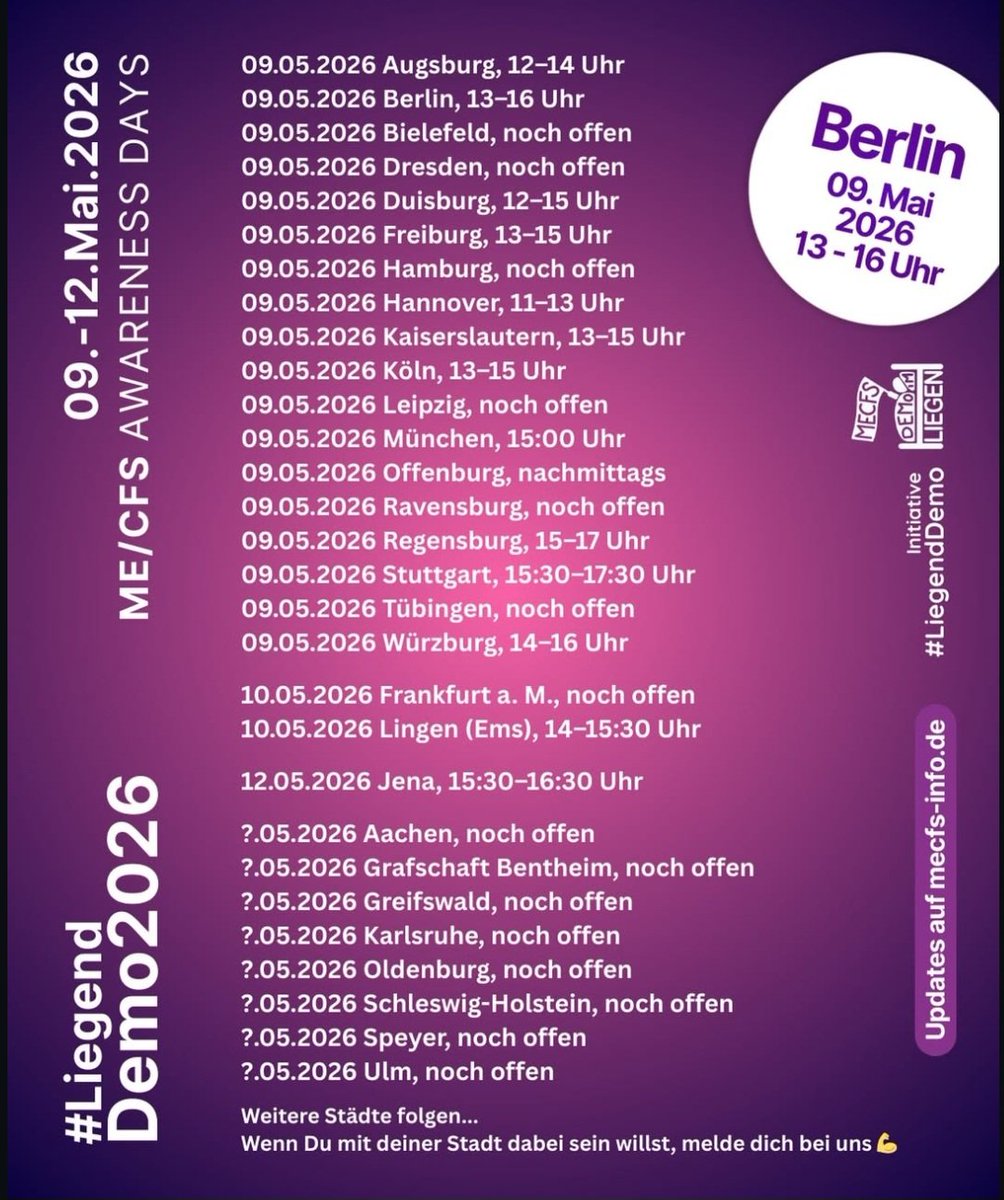
This is the list of demonstrations in Germany around ME/CFS Awareness Day in May, more cities will follow.
It shows how large and impactful ME/CFS activism in Germany has become.
We would love to see more cities around the world join the protests.
🔹️#LiegendDemo Awarness Days Update🔹️
🔸️Info: Grafschaft Bentheim ist am 09.05.2026
Weitere Städte folgen...
Wenn du mit deiner Stadt dabei sein willst, dann melde dich bei uns! 💪
Live Updates auf https://t.co/VRC70EuqAx
The NIH Director, @DrJBhattacharya, indirectly calling out MDs worldwide for failing to recognize, among other conditions, ME/CFS is certainly a step in the right direction. Paraphrasing him: unless you’re an amazing doctor who is honest and compassionate, you will want to move on to the next patient.
Incredible work by @MECFSResearch. This demonstrates that meaningful ME/CFS research infrastructure can be built, and scaled with private funding. There is definitely still room to grow in Germany, and successes like these need to be replicated across Europe.
Es wäre äußerst wichtig, dass auch in der Schweiz eine spezifische ME/CFS-Research-Stiftung bzw. Charity gegründet wird. Falls es jemanden gibt, der dieses Thema ernsthaft angehen möchte und dafür vielleicht noch Startkapitalhilfe benötigt, bitte melden. Danke! 🙏
The national decade for post-infectious disease in Germany is an important step. But it is nowhere near sufficient to solve ME/CFS. If the US, Japan, China, the UK, and the EU as a whole do not massively scale up, the outlook remains somewhat bleak. That's why we still and urgently need far more private funding, for both biomedical research and political advocacy.
One of the bigger opportunities for progress in ME/CFS research lies in the creation of independent national research charities.
In particular, larger European countries as well as initiatives in China, Japan, and India appear especially important, as these regions hold a significant amount of currently dormant and/or growing scientific (and capital) potential. Other regions are, of course, also relevant.
If anyone with a reasonable chance of success and a background that makes such an effort credible requires seed funding to establish such an ME/CFS research charity, they are welcome to contact me directly.
“Dad, I can’t live like this, please kill me.”
These are the words of a child in Germany severely affected by ME/CFS.
We urgently need more research, better care, and proper recognition of this disease — in Germany and worldwide.
https://t.co/whKWZppPwN
During this reflective holiday season, we call on everyone to pull together.
Just €5 a month can make a real difference: many small contributions create a strong foundation for #MECFS & #LongCovid research – for >1.5 million people affected. 🎄🎅 👉 https://t.co/d3GY6ebaMG
ME/CFS Fellowships 2026 – now open!
6-month research stays with up to €40,000 per fellowship (total €200,000), co-funded by the WE&ME Foundation & WWTF. Deadline: February 3, 2026, 2:00 PM.
More infos: https://t.co/tHgbhSNEif
If Germany invests 50 million/year into ME/CFS research, proportional GDP scaling would imply the following annual budgets for the other top EU economies: France ~34M, Italy ~25M, Spain ~18M, Netherlands ~13M, Poland ~9M, Belgium ~7M, Sweden ~6.5M, Austria ~5.5M, Denmark ~4.5M.
Germany has taken a massive step for ME/CFS and other post-infectious diseases. The government is pledging 500 million Euro over the next ten years for biomedical research that finally investigates the actual causes of these illnesses. Is it enough to solve the problem? No. Is it the first genuinely good step? Yes. It is an order of magnitude more funding in Germany than we had five years ago and twice the NIH budget when it was at its miserable peak. It is also a massive success for German advocacy.
This shows that Germany and Europe can be true thought leaders. They can be proud of this, because it sends a strong signal for medical research and development across Europe. Austria, although its institutional funding is structured very differently and cannot be as focused at its much smaller scale, is already moving in a good direction (more good news to come!) and this signal will help to increase funding even further. Germany, the Netherlands, Austria and Europe as a whole will be leading the way at least until the US found its swagger again.
But, obvioously, there is still a long road ahead. Education, awareness and advocacy must keep pushing, and we must not become complacent. This is a big win but only the beginning, really.
Amazing powerful protest for ME/CFS(and long covid) in from of Germany's ministry of research. Body bags symbolize patients left without medical help and research for their condition. LC ME advocates, take notes. Humanitarians take a look at yourselves and ask why are you absent.
The “psychologisation” of ME/#CFS has been part of the problem as we’ve said before and, sadly, will keep having to say. As a psychologist, it’s especially important to be clear and amplify: every year, science confirms more — this is a biological illness. https://t.co/u3Kgmp0FQ2
The @DecodeMEstudy proves it: Well-designed, well-funded research can advance our understanding of ME/CFS, uncover its biomedical roots and pave the way to better diagnosis and treatments.