Breaking it down beyond headlines.
Open-source news | Credits to original reports
Politics • Geopolitics • Elections
Likes ≠ Endorsements | Reposts for awarenes
🚨 West Bengal Set to Become Eastern India's Gujarat, ₹19,000 Crore to be Invested for Development of its Ports
West Bengal is on the verge of a major economic transformation as the Ministry of Ports, Shipping and Waterways has announced an investment pipeline of over ₹19,000 crore to develop the state's maritime infrastructure over the next five years.
The ambitious plan aims to modernize ports, expand inland waterways, strengthen logistics networks, boost shipbuilding, and accelerate industrial development across eastern India. At the heart of this strategy is West Bengal's unique geographical advantage, serving as the natural gateway for trade from Bihar, Jharkhand, Uttar Pradesh, Assam, and the wider Northeast to global markets.
In another significant development, the West Bengal government has revived its long-delayed deep-sea port project. After years of uncertainty surrounding the proposed Tajpur Port, authorities have identified a new location at Dadanpatrabar, just 11 kilometers away. The new site offers over 1,700 acres of state-owned land, removing many of the land acquisition challenges that stalled the original project.
The proposed deep-sea port is expected to become West Bengal's third major port after Kolkata and Haldia, while also addressing the limitations faced by larger vessels at existing facilities.
Together, these initiatives form a crucial part of India's broader Eastern Maritime Corridor strategy, aimed at strengthening connectivity with Southeast Asia, East Asia, and Russia. Experts believe the investments will boost manufacturing, agriculture, riverine trade, exports, and logistics across eastern India.
If executed successfully, the twin projects could transform West Bengal into the maritime and logistics hub of eastern India—much like Gujarat emerged as India's premier port-led growth engine on the western coast.
🚨Al Jazeera's Narrative Problem Exposed Again
A recent survey revealed that Israel views India more positively than any other nation in the world. That should have been the headline.
Instead, Al Jazeera chose a different route. Rather than focusing on the growing strategic partnership, strong people-to-people ties, and India's rising global image, the report quickly shifted toward familiar political narratives about Prime Minister Narendra Modi and "Hindu nationalism."
The result was a story that appeared less interested in explaining why India-Israel relations are thriving and more interested in fitting the development into a pre-existing ideological framework.
When a major international survey delivers a clear message, journalism should report the finding, not bury it beneath political commentary. The real story is that India and Israel share unprecedented goodwill and cooperation. Al Jazeera's attempt to redirect the conversation only raises fresh questions about its editorial priorities.
When facts don't fit the narrative, the narrative becomes the story.
#UnmaskingMedia #UnmaskingAlJazeera
🚨Operation Lotus in Nepal? India's Diplomatic Message to Balendra Shah After Anti-India Rhetoric
Nepal's political circles are buzzing with one question: Is India quietly playing its own version of "Operation Lotus" in Kathmandu?
The question gained traction after Nepal's ruling party's Chief Rabi Lamichhane received an unusual extremely warm welcome in New Delhi. What makes this development significant is that Lamichhane was not on an official state visit. Yet, he held high-level engagements with India's top leadership, including Prime Minister Narendra Modi, Nitin Nabin and S. Jaishankar. Such treatment is rarely extended without strategic intent.
The visit came just as Nepal Prime Minister Balendra Shah found himself at the center of controversy following remarks widely perceived as anti-India. His statements triggered diplomatic unease, political backlash within Nepal, and forced clarifications from Kathmandu that his views did not represent official government policy.
Instead of engaging in a public war of words, India appears to have chosen a different strategy.
By rolling out the red carpet for Rabi Lamichhane, India may have sent a subtle but unmistakable message: anti-India politics may generate headlines, but constructive engagement earns influence.
For decades, India and Nepal have shared an open border, deep civilizational ties, economic interdependence, and people-to-people connections unmatched anywhere in South Asia. Any Nepali leader seeking long-term political success must ultimately work within this geopolitical reality.
That is why Lamichhane's reception has sparked intense debate. Was this merely a diplomatic courtesy, or a calculated signal that New Delhi is willing to invest in Nepal's next generation of leadership?
Many observers believe the latter.
India understands that governments change, but national interests remain constant. Rather than reacting emotionally to provocative rhetoric, New Delhi appears to be strengthening ties with leaders who see India-Nepal relations as a partnership rather than a political punching bag.
This is why some in Nepal are calling it "Operation Lotus", not because India is engineering a political change, but because it is demonstrating who it considers a reliable partner for the future.
Whether that interpretation is accurate or not, one thing is clear: the grand reception for Rabi Lamichhane was far more than a routine diplomatic event. It was a strategic message delivered without a single public rebuke.
And in diplomacy, the most powerful messages are often the ones that never need to be spoken aloud.
🚨Operation Lotus in Nepal? India's Diplomatic Message to Balendra Shah After Anti-India Rhetoric
Nepal's political circles are buzzing with one question: Is India quietly playing its own version of "Operation Lotus" in Kathmandu?
The question gained traction after Nepal's ruling party's Chief Rabi Lamichhane received an unusual extremely warm welcome in New Delhi. What makes this development significant is that Lamichhane was not on an official state visit. Yet, he held high-level engagements with India's top leadership, including Prime Minister Narendra Modi, Nitin Nabin and S. Jaishankar. Such treatment is rarely extended without strategic intent.
The visit came just as Nepal Prime Minister Balendra Shah found himself at the center of controversy following remarks widely perceived as anti-India. His statements triggered diplomatic unease, political backlash within Nepal, and forced clarifications from Kathmandu that his views did not represent official government policy.
Instead of engaging in a public war of words, India appears to have chosen a different strategy.
By rolling out the red carpet for Rabi Lamichhane, India may have sent a subtle but unmistakable message: anti-India politics may generate headlines, but constructive engagement earns influence.
For decades, India and Nepal have shared an open border, deep civilizational ties, economic interdependence, and people-to-people connections unmatched anywhere in South Asia. Any Nepali leader seeking long-term political success must ultimately work within this geopolitical reality.
That is why Lamichhane's reception has sparked intense debate. Was this merely a diplomatic courtesy, or a calculated signal that New Delhi is willing to invest in Nepal's next generation of leadership?
Many observers believe the latter.
India understands that governments change, but national interests remain constant. Rather than reacting emotionally to provocative rhetoric, New Delhi appears to be strengthening ties with leaders who see India-Nepal relations as a partnership rather than a political punching bag.
This is why some in Nepal are calling it "Operation Lotus", not because India is engineering a political change, but because it is demonstrating who it considers a reliable partner for the future.
Whether that interpretation is accurate or not, one thing is clear: the grand reception for Rabi Lamichhane was far more than a routine diplomatic event. It was a strategic message delivered without a single public rebuke.
And in diplomacy, the most powerful messages are often the ones that never need to be spoken aloud.
🚨Gujarat Launches Massive Crackdown on Illegal Bangladeshi as Per the Operation Delta Hunt, 500+ Got Caught
India's battle against illegal infiltration has entered a new phase, with Gujarat launching what is being described as its largest-ever coordinated operation against suspected illegal Bangladeshi immigrants.
Named Operation Delta Hunt, the statewide crackdown has already produced significant results within its first 24 hours. According to state authorities, more than 500 suspected illegal Bangladeshi migrants have been detained,
What makes the operation notable is not just its scale, but its methodology. Gujarat Police has deployed a combination of human intelligence, technical surveillance, telecom data analysis, local verification drives, and document authentication checks to identify suspected infiltrators. Major urban and industrial centers, including Ahmedabad, Surat, Rajkot, Vadodara, and several districts across the Saurashtra region, have emerged as key focus areas.
However, Operation Delta Hunt is not limited to identifying illegal migrants alone. Investigators are also scrutinizing the networks that allegedly facilitate their stay by providing housing, employment, forged documents, identity records, and communication services without proper verification. The operation aims to dismantle the entire ecosystem that enables illegal residency rather than merely detaining individuals.
🚨India to Make Its Largest-Ever indigenous Drone Procurement of $2 Billion, Pakistan In Deep Shock!
India is preparing to make its biggest drone acquisition ever, with a procurement program worth over $2 billion aimed at rapidly expanding the country's tactical drone capabilities.
India's planned procurement focuses primarily on tactical-class drones, systems designed for intelligence, surveillance, reconnaissance, loitering munitions, logistics support, and precision battlefield strikes.
The significance of the program extends far beyond military capability. The procurement is expected to be largely driven by INDIAN MANUFACTURERS, providing a major boost to the country's indigenous drone ecosystem. India already has more than 600 drone and drone-component manufacturers, including major defence firms and emerging startups working across surveillance, strike, and autonomous systems.
What makes the program particularly important is its emphasis on scale. Modern warfare increasingly relies on attritable systems, platforms that are effective, affordable, and expendable when necessary. The lessons from Ukraine have demonstrated that large numbers of low-cost drones can inflict disproportionate damage on far more expensive military assets, from tanks and artillery to sophisticated air-defence systems.
The planned acquisition is expected to be completed on an accelerated timeline of 18 to 24 months, reflecting the urgency with which India is pursuing next-generation battlefield capabilities. Alongside tactical drones, India is also investing in larger unmanned platforms, advanced surveillance systems, and AI-driven command-and-control networks.
🚨India to Make Its Largest-Ever indigenous Drone Procurement of $2 Billion, Pakistan In Deep Shock!
India is preparing to make its biggest drone acquisition ever, with a procurement program worth over $2 billion aimed at rapidly expanding the country's tactical drone capabilities.
India's planned procurement focuses primarily on tactical-class drones, systems designed for intelligence, surveillance, reconnaissance, loitering munitions, logistics support, and precision battlefield strikes.
The significance of the program extends far beyond military capability. The procurement is expected to be largely driven by INDIAN MANUFACTURERS, providing a major boost to the country's indigenous drone ecosystem. India already has more than 600 drone and drone-component manufacturers, including major defence firms and emerging startups working across surveillance, strike, and autonomous systems.
What makes the program particularly important is its emphasis on scale. Modern warfare increasingly relies on attritable systems, platforms that are effective, affordable, and expendable when necessary. The lessons from Ukraine have demonstrated that large numbers of low-cost drones can inflict disproportionate damage on far more expensive military assets, from tanks and artillery to sophisticated air-defence systems.
The planned acquisition is expected to be completed on an accelerated timeline of 18 to 24 months, reflecting the urgency with which India is pursuing next-generation battlefield capabilities. Alongside tactical drones, India is also investing in larger unmanned platforms, advanced surveillance systems, and AI-driven command-and-control networks.
Global Brokerages See Strong Growth Runway Across Adani Group Businesses
Leading global brokerages have reaffirmed their positive outlook on the Adani Group, highlighting its record infrastructure investments, disciplined capital allocation, and long-term growth strategy across ports, airports, logistics, energy, and real estate.
According to Jefferies, the Group remains optimistic about India’s infrastructure growth story and its role in nation-building. A major focus is the rising demand for energy infrastructure, driven by the rapid expansion of AI and data-intensive industries. The Group reported a record capital expenditure of ₹1.55 lakh crore in FY26 while maintaining a disciplined financial structure.
Cantor Fitzgerald maintained its Overweight rating on Adani Ports and raised its target price to ₹2,178 from ₹1,719. The brokerage stated that Adani Ports continues to evolve as a compounding infrastructure platform, with domestic ports remaining the earnings backbone while international ports, logistics, and marine services emerge as key growth drivers.
Jefferies also highlighted Adani Airports as a multi-layered growth opportunity. Beyond passenger traffic growth, the brokerage sees significant upside from non-aero revenues, real estate development, and AI-driven digital initiatives, which could potentially drive 10–12 times growth in non-aero earnings over the next decade.
Meanwhile, HSBC described the Group’s Dharavi redevelopment project as one of Asia’s most ambitious urban transformation initiatives. The project aims to rehabilitate 125,000 homes while creating a smart city, multimodal transport hub, and major commercial district, unlocking approximately 130 million square feet of development potential near Mumbai’s central business district.
The assessments underscore growing confidence among global financial institutions in the Adani Group’s long-term infrastructure and development strategy.
🚨Al Jazeera's Agenda Journalism Exposed Once Again
The recent coverage of a complaint filed by the Hind Rajab Foundation against an Israeli tourist in India has once again raised questions about Al Jazeera's editorial priorities. A complaint is not a conviction. Yet the network chose to elevate an unproven allegation into a major international story, despite the absence of any judicial finding or established guilt.
This is not the first time Al Jazeera has faced accusations of pushing a narrative rather than presenting a balanced picture.
Al Jazeera has been repeatedly questioned on its coverage of the Israel-Hamas conflict, where allegations of selective reporting and omission of context have frequently surfaced. The network has also been criticized by governments and media watchdogs in several countries for presenting highly politicized interpretations of sensitive geopolitical events.
During multiple Middle East crises, Al Jazeera has faced accusations of amplifying narratives aligned with Qatar's foreign policy interests. Several Arab nations, including Saudi Arabia, the UAE, Bahrain, and Egypt, cited the channel's coverage as one of their major grievances during the 2017 diplomatic dispute with Qatar.
The pattern critics point to is simple: allegations are amplified, context is minimized, and stories that fit a particular narrative receive disproportionate attention. The latest case involving an Israeli tourist in India appears to follow that same template.
Journalism is supposed to distinguish between accusations and facts.
A complaint is not a conviction. But Al Jazeera's decision to spotlight this case once again raises serious questions about whether the network is reporting the news, or attempting to shape it.
#UnmaskingMedia #UnmaskingAlJazeera
🚨DRDO’s Secretive High-Caliber Bomb Test Sparks Speculation About India’s Next-Generation Strike Capability
In a rare departure from its usual practice of publicizing technical details, India’s Defence Research and Development Organisation (DRDO) has successfully tested a high-caliber bomb at the Terminal Ballistics Research Laboratory (TBRL) range in Ramgarh, Panchkula, Haryana. The test, conducted on May 31 in the presence of senior Indian Air Force officials, has attracted significant attention precisely because of the secrecy surrounding it.
Unlike most missile and weapons trials where specifications such as range, weight, guidance systems, and operational roles are disclosed, DRDO revealed only one detail: the weapon tested was a “high-caliber bomb.” No information was provided regarding its weight, aircraft compatibility, guidance package, or intended mission profile.
The lack of details has fueled intense speculation among defence analysts. TBRL, one of India’s premier research facilities, specializes in warhead design, blast-effect studies, penetration testing, fragmentation analysis, and advanced explosive technologies. A test conducted at such a facility naturally points to a weapon designed for demanding battlefield roles.
Experts have drawn attention to the extensive safety measures implemented before the trial. Residents of nearby villages were instructed to remain indoors, while authorities established a two-kilometer safety zone around the test site. Officials also warned that bomb fragments could reach altitudes of up to 1.5 kilometers. Such precautions suggest the weapon carried a substantial explosive payload, leading some observers to estimate that it may belong to the 500–1,000 kilogram class of aerial bombs.
The presence of Indian Air Force personnel has further intensified discussions about the bomb’s intended role. Many defence observers believe the weapon could be linked to India’s efforts to develop indigenous deep-strike and bunker-busting capabilities. While DRDO has not confirmed this, recent global conflicts have highlighted the growing importance of precision-guided munitions capable of destroying hardened underground facilities, military bunkers, and fortified infrastructure.
Analysts note that even if the current weapon is not a dedicated bunker buster, modifications such as hardened steel casing, delayed-action fuzes, and specialized penetrating warhead designs could transform it into one. Such capabilities have become increasingly important as modern warfare places greater emphasis on attacking heavily protected targets.
The test also aligns with India’s broader push to modernize its air power. Over the past few years, DRDO has accelerated work on smart anti-airfield weapons, long-range glide bombs, precision-guided munitions, air-launched cruise missiles, and advanced missile systems. Simultaneously, the organization has demonstrated progress in hypersonic technologies, including hypersonic glide vehicles and cruise missile concepts.
If the new bomb enters service and is integrated with platforms such as the Sukhoi Su-30MKI, Dassault Rafale, and the future HAL AMCA, it could significantly enhance India’s indigenous strike capabilities. Such a development would also reduce dependence on imported precision-guided munitions and strengthen the country’s self-reliance in critical defence technologies.
Perhaps the most notable aspect of the test is DRDO’s deliberate silence. By withholding technical details, India has left analysts and potential adversaries guessing about the weapon’s true capabilities. In an era where strategic ambiguity can be as valuable as technological advancement, the secrecy surrounding this high-caliber bomb may itself be part of the message.
🚨As BrahMos Went Global, Turkey Suddenly Changed Its Tone, Begs India For Normalisation
For years, Turkey had no hesitation in backing Pakistan on issues that directly concerned India. From raising Kashmir at international forums to openly aligning with Pakistan's positions, Turkey rarely showed concern about how its actions were perceived in India.
But something has changed.
Today, Turkish officials are speaking a very different language. They are emphasizing friendship with India, highlighting that the two countries share no border, no historical hostility, and no direct conflict. The message is simple: Turkey wants good relations with India.
The timing is not a coincidence.
What has changed is not Turkey's geography or history. What has changed is India's strategic leverage.
The global rise of the BrahMos missile has transformed India's defence diplomacy. What was once seen as a powerful indigenous weapon is now becoming a strategic instrument that can reshape regional military balances. From the Indo-Pacific to the Mediterranean, countries are showing interest in acquiring Indian defence systems.
That is precisely what is causing concern in Turkey.
With reports of growing defence cooperation between India and Cyprus, and the possibility of BrahMos strengthening Greece's deterrence capabilities, Turkey suddenly finds itself facing the prospect of Indian military technology appearing in its own strategic neighbourhood.
For Turkey, this is no longer about South Asia. It is about the Eastern Mediterranean, where maritime disputes and competing territorial claims have already created tensions with Greece and Cyprus. A BrahMos-equipped deterrent in the region would significantly complicate Turkey's military calculations.
The message reaching Turkey is clear: actions have consequences.
India is no longer limiting its response to diplomatic statements. It is increasingly using defence exports, strategic partnerships, and geopolitical influence to build relationships with countries that matter in key theatres around the world.
The result is a dramatic shift in perception. Nations that once assumed India would absorb provocations without responding are discovering that New Delhi now possesses new tools of influence, and it is willing to use them.
Turkey's recent outreach reflects that new reality. As BrahMos goes global, India's strategic reach expands far beyond its borders, forcing countries to reconsider assumptions they once took for granted.
The fear is not just about a missile.
It is about the emergence of an India that can shape regional power balances thousands of kilometres away.
🚨As BrahMos Went Global, Turkey Suddenly Changed Its Tone, Begs India For Normalisation
For years, Turkey had no hesitation in backing Pakistan on issues that directly concerned India. From raising Kashmir at international forums to openly aligning with Pakistan's positions, Turkey rarely showed concern about how its actions were perceived in India.
But something has changed.
Today, Turkish officials are speaking a very different language. They are emphasizing friendship with India, highlighting that the two countries share no border, no historical hostility, and no direct conflict. The message is simple: Turkey wants good relations with India.
The timing is not a coincidence.
What has changed is not Turkey's geography or history. What has changed is India's strategic leverage.
The global rise of the BrahMos missile has transformed India's defence diplomacy. What was once seen as a powerful indigenous weapon is now becoming a strategic instrument that can reshape regional military balances. From the Indo-Pacific to the Mediterranean, countries are showing interest in acquiring Indian defence systems.
That is precisely what is causing concern in Turkey.
With reports of growing defence cooperation between India and Cyprus, and the possibility of BrahMos strengthening Greece's deterrence capabilities, Turkey suddenly finds itself facing the prospect of Indian military technology appearing in its own strategic neighbourhood.
For Turkey, this is no longer about South Asia. It is about the Eastern Mediterranean, where maritime disputes and competing territorial claims have already created tensions with Greece and Cyprus. A BrahMos-equipped deterrent in the region would significantly complicate Turkey's military calculations.
The message reaching Turkey is clear: actions have consequences.
India is no longer limiting its response to diplomatic statements. It is increasingly using defence exports, strategic partnerships, and geopolitical influence to build relationships with countries that matter in key theatres around the world.
The result is a dramatic shift in perception. Nations that once assumed India would absorb provocations without responding are discovering that New Delhi now possesses new tools of influence, and it is willing to use them.
Turkey's recent outreach reflects that new reality. As BrahMos goes global, India's strategic reach expands far beyond its borders, forcing countries to reconsider assumptions they once took for granted.
The fear is not just about a missile.
It is about the emergence of an India that can shape regional power balances thousands of kilometres away.
🚨DRDO’s Secretive High-Caliber Bomb Test Sparks Speculation About India’s Next-Generation Strike Capability
In a rare departure from its usual practice of publicizing technical details, India’s Defence Research and Development Organisation (DRDO) has successfully tested a high-caliber bomb at the Terminal Ballistics Research Laboratory (TBRL) range in Ramgarh, Panchkula, Haryana. The test, conducted on May 31 in the presence of senior Indian Air Force officials, has attracted significant attention precisely because of the secrecy surrounding it.
Unlike most missile and weapons trials where specifications such as range, weight, guidance systems, and operational roles are disclosed, DRDO revealed only one detail: the weapon tested was a “high-caliber bomb.” No information was provided regarding its weight, aircraft compatibility, guidance package, or intended mission profile.
The lack of details has fueled intense speculation among defence analysts. TBRL, one of India’s premier research facilities, specializes in warhead design, blast-effect studies, penetration testing, fragmentation analysis, and advanced explosive technologies. A test conducted at such a facility naturally points to a weapon designed for demanding battlefield roles.
Experts have drawn attention to the extensive safety measures implemented before the trial. Residents of nearby villages were instructed to remain indoors, while authorities established a two-kilometer safety zone around the test site. Officials also warned that bomb fragments could reach altitudes of up to 1.5 kilometers. Such precautions suggest the weapon carried a substantial explosive payload, leading some observers to estimate that it may belong to the 500–1,000 kilogram class of aerial bombs.
The presence of Indian Air Force personnel has further intensified discussions about the bomb’s intended role. Many defence observers believe the weapon could be linked to India’s efforts to develop indigenous deep-strike and bunker-busting capabilities. While DRDO has not confirmed this, recent global conflicts have highlighted the growing importance of precision-guided munitions capable of destroying hardened underground facilities, military bunkers, and fortified infrastructure.
Analysts note that even if the current weapon is not a dedicated bunker buster, modifications such as hardened steel casing, delayed-action fuzes, and specialized penetrating warhead designs could transform it into one. Such capabilities have become increasingly important as modern warfare places greater emphasis on attacking heavily protected targets.
The test also aligns with India’s broader push to modernize its air power. Over the past few years, DRDO has accelerated work on smart anti-airfield weapons, long-range glide bombs, precision-guided munitions, air-launched cruise missiles, and advanced missile systems. Simultaneously, the organization has demonstrated progress in hypersonic technologies, including hypersonic glide vehicles and cruise missile concepts.
If the new bomb enters service and is integrated with platforms such as the Sukhoi Su-30MKI, Dassault Rafale, and the future HAL AMCA, it could significantly enhance India’s indigenous strike capabilities. Such a development would also reduce dependence on imported precision-guided munitions and strengthen the country’s self-reliance in critical defence technologies.
Perhaps the most notable aspect of the test is DRDO’s deliberate silence. By withholding technical details, India has left analysts and potential adversaries guessing about the weapon’s true capabilities. In an era where strategic ambiguity can be as valuable as technological advancement, the secrecy surrounding this high-caliber bomb may itself be part of the message.
Al Jazeera’s Manufactured Headline? A Complaint Turned Into International “Breaking News”
A complaint filed by the Hind Rajab Foundation against an Israeli tourist in Himachal Pradesh has suddenly been elevated into an international headline by Al Jazeera. The reality, however, appears far less dramatic than the coverage suggests.
The Hind Rajab Foundation has merely submitted a complaint demanding action against an Israeli reservist it accuses of involvement in military operations in Gaza. Filing a complaint is a routine legal process and does not automatically imply guilt, arrest, or even the initiation of formal proceedings by Indian authorities.
Yet, Al Jazeera chose to frame the development as a major international story, prominently highlighting demands for the individual's arrest and portraying the matter as a significant diplomatic or legal issue. The coverage creates the impression that India is actively pursuing the case, despite there being no public indication of any such action by Indian authorities.
What raises further questions is the near-total absence of the story from major Indian and international news outlets. If this were truly a major legal or geopolitical development, it would likely have been widely reported across mainstream media. Instead, the story remains largely confined to the complaint itself and the organizations promoting it.
The episode once again highlights how selective amplification can shape public perception. A private organization's complaint has been transformed into a "developing story," generating headlines far bigger than the underlying facts currently justify.
Rather than reporting a concrete legal development, Al Jazeera appears to be amplifying an activist-driven narrative, giving a routine complaint the appearance of an international crisis. The distinction between a filed complaint and an actual legal action is crucial—and blurring that line risks misleading audiences about what has actually happened.
#UnmaskingMedia #UnmaskingAlJazeera
🚨Adani Records India's Highest-Ever Corporate Capex as Infrastructure Push Accelerates
The Adani Portfolio has reported the highest annual capital expenditure ever undertaken by an Indian corporate, investing ₹1.53 lakh crore ($16.1 billion) in FY26. The massive investment drive highlights the scale of India's ongoing infrastructure expansion, with nearly 80% of the spending directed towards energy, utilities, transport, and logistics.
The group's asset base has now grown to ₹7.85 lakh crore ($82.2 billion), reflecting an aggressive expansion cycle across critical sectors. At the same time, operational performance remained strong, with EBITDA reaching a record ₹94,834 crore ($10 billion), up 5.6% year-on-year. Core infrastructure businesses contributed 87% of total earnings, underlining the portfolio's focus on long-term nation-building assets.
Several major projects became operational during the year, including 5.1 GW of renewable energy capacity, battery energy storage systems, Navi Mumbai International Airport, the Guwahati terminal, the Ganga Expressway, and a new copper smelter. These projects are expected to become significant drivers of future revenue and cash flow.
Despite the unprecedented investment cycle, the group maintained financial discipline. Net Debt-to-EBITDA stood at 3.3x, below its guidance level of 3.5x, while cash reserves rose to ₹55,852 crore. Borrowing costs also declined from 9% two years ago to 7.8%, supported by stronger credit ratings.
The FY26 performance signals a new phase of growth for the Adani Portfolio, with large-scale investments aimed at strengthening India's energy security, logistics network, transportation infrastructure, and industrial capacity over the coming decades.
K. Annamalai is NOT going anywhere.
He has NOT given any 5 pages resignation.
And He is NOT at all upset with the CENTRAL LEADERSHIP
BUT YES HE IS VERY UPSET WITH THE STATE LEADERSHIP
K. Annamalai claims that most of the BJP leaders in Tamil Nadu are COMPRISED by DMK and AIDMK. And no one from the state supports him.
HM Amit Shah has assured him that this will be FIXED and has called BJP TN president Nainar Nagendran to visit Delhi ASAP.
RSS is also backing K. Annamalai and currently Annamalai is waiting in Delhi to meet PM Modi to discuss TN 2029 election strategy.
Food for thought:
Any political party need a huge amount of money to run. Thalapathy Vijay has an asset of more than 600 crores plus he was a solid backing from ...... (do I need to mention)
On the other hand, Annamalai is a nationalist and no one would fund a nationalist, plus he doesn't have that kind of weath. So where will he go apart from BJP and RSS
The Horror Underground: Why the Voices of Terror Victims Must Be Heard
Terrorism leaves behind far more than physical destruction. Its deepest impact is often psychological, targeting communities, families, and entire societies with fear and trauma. The OpEd by Suresh Goel, The Horror Underground, highlights this overlooked reality and underscores the importance of documenting the experiences of victims who are too often forgotten once the news cycle moves on.
Drawing attention to the report Silenced No More, the article argues that recording testimonies and evidence of atrocities is essential for justice, accountability, and historical truth. Terror groups seek not only to kill but also to erase the stories of those they target. Preserving these voices is therefore an act of resistance against terror itself.
The lessons resonate strongly with countries such as India and Israel, both of which have endured devastating terrorist attacks. By ensuring that victims are heard and their experiences documented, societies can challenge attempts to distort facts, deny crimes, or normalize violence.
The OpEd serves as a reminder that justice begins with truth, and truth begins by listening to those who have suffered. The voices of terror victims must not be lost to silence.
#HearTheirVoices #SilencedNoMore
https://t.co/w9sCvFCFFT
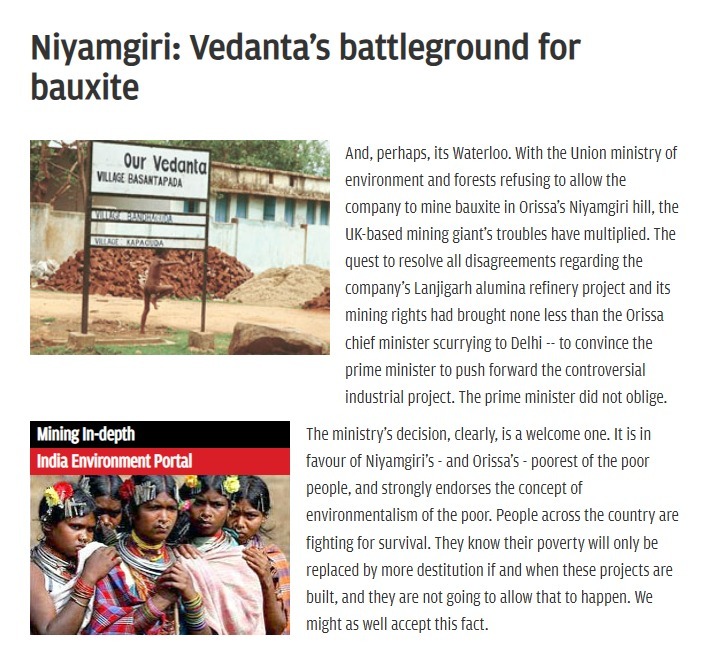
From Anti-Vedanta Campaigns to Defending Vedanta: A Political U-Turn?
The ongoing dispute over Vedanta's mining projects in Odisha's Sijimali region has exposed a striking political contradiction. For more than a decade, many Congress leaders, left-wing activists, environmental groups, and sections of the media portrayed Vedanta as a symbol of corporate excess, environmental damage, and the exploitation of tribal communities. Today, some of the same voices appear eager to defend the company.
The contrast is difficult to miss. Rahul Gandhi himself campaigned against Vedanta's mining plans in Odisha during the Niyamgiri movement. Tribal communities opposed the company's proposed bauxite mining project, arguing it threatened their land, livelihoods, culture, and sacred sites. In 2013, all 12 gram sabhas consulted under Supreme Court directions unanimously rejected the project, effectively halting Vedanta's plans.
The Niyamgiri controversy was not an isolated case. Vedanta has faced repeated criticism over environmental concerns, mining disputes, and community opposition. The Sterlite Copper plant in Tamil Nadu became one of India's most controversial industrial projects, culminating in the 2018 protests and subsequent closure of the facility. Similar concerns have been raised over mining projects in Odisha, including those in Sijimali and Kodingamali, where tribal groups continue to resist large-scale extraction activities.
Given this history, the sudden effort by sections of the Congress ecosystem to portray Vedanta as a victim appears politically motivated rather than rooted in any reassessment of the company's record. The environmental, social, and governance concerns once highlighted so aggressively have not disappeared overnight.
What has changed is the political context. Vedanta is no longer being viewed primarily through the lens of its own controversies. Instead, it has become a convenient instrument in a broader political battle centered on attacking the Adani Group.
The irony is unmistakable. A company that was once routinely presented as a cautionary example of corporate misconduct is now receiving support from many of the very voices that built campaigns around opposing it. The facts surrounding Vedanta have not fundamentally changed; the political target has.
That contradiction raises an obvious question: if Vedanta was once considered a symbol of everything wrong with corporate India, what explains its sudden transformation into a company worth defending? The answer seems less about Vedanta itself and more about the shifting priorities of political narratives.