Fred Rogers met with a child psychologist every week for 22 years to build his show. She shaped everything: every script, prop, and song. The whole point was to give a child's nervous system time to slow down. In 1984, a single regulatory decision ended all of it.
The psychologist was Dr. Margaret McFarland, who co-founded the Arsenal Family and Children's Center alongside Benjamin Spock and Erik Erikson. She and Rogers understood that the prefrontal cortex in children, the part of the brain that controls impulse, emotion, and attention, takes decades to fully develop. At the start of every episode, Rogers tied his sneakers and changed his sweater while children settled in. Those pauses were intentional, designed to help a child's nervous system shift into a calmer, more focused state.
What ended it had nothing to do with child development science. In 1984, Reagan's FCC chairman Mark Fowler abolished the advertising limits that had protected children's programming from commercial pressure. Toy companies moved within months. Between 1984 and 1985, cartoons tied to toy lines increased by 300%, from a handful of shows to more than 40 animated series. In almost every case, the toy was designed first. The cartoon was built to sell it.
Researchers later put numbers to what parents were already noticing. A 2011 study in Pediatrics from the University of Virginia tested 60 four-year-olds across three groups: one watching SpongeBob, which cuts scene every 11 seconds; one watching a slow PBS show, which cuts scene every 34 seconds; and one drawing. Nine minutes later, all three took tests on attention, impulse control, short-term memory, and problem-solving. The SpongeBob group scored significantly worse across every measure.
In the 1970s, children began watching television around age 4. Research from pediatrician Dimitri Christakis found that by 2009, the average age of first screen exposure had dropped to 4 months, as the content got faster and the audience got younger. Researchers separately found that each additional hour of daily screen time at ages 1 or 3 raised the risk of attention problems at age 7 by 9%.
Diagnosed 14.5 years ago with an aggressive and deadly breast cancer, refused chemotherapy, radiotherapy and all drugs in favour of the full Gerson therapy. My ectopic heartbeats healed, my eyesight healed my psoriasis on my scalp healed my plantar fasciitis, amazing.
The 7-second cold wrist rinse was tested on 3,000 soldiers after combat simulations.
Cortisol dropped 52% within 90 seconds. Heart rate fell an average of 22 beats per minute. The Navy classified the protocol in 2009 and kept it secret until 2023.
The mechanism is radial artery cooling. Your inner wrists have the thinnest skin and the largest surface-to-volume ratio for blood vessels. 7 seconds of cold water cools the blood passing to your brain, which signals your hypothalamus to downregulate stress instantly
You've splashed cold water on your face. You've taken cold showers. Both work, but they're inconvenient.
The SEAL protocol takes 7 seconds, requires no undressing, and can be done at any sink. Soldiers used it before night missions to fall asleep fast.
The military classified this because a free 7-second stress fix would reduce demand for combat stress medication ($400M annually).
The 2023 declassification came after a FOIA lawsuit filed by a veteran.
The fix: run cold tap water over your inner wrists for 7 seconds. Both wrists. Do it when you feel a stress spike.
Within 90 seconds, your heart rate will drop. No shower, no ice.
Just 7 seconds.
You are not allowed to notice that every western country opened its borders at the same time, pushed the same ideology at the same time and is experiencing the same demographic shift at the same time.
Just a coincidence. Move on.
Pediatricians are really upset that they now have to explain vaccines to parents... and they are angry that they have to... start learning for themselves.
Can't make it up.
I'm feeling better and better every day for the hard stances I've taken.
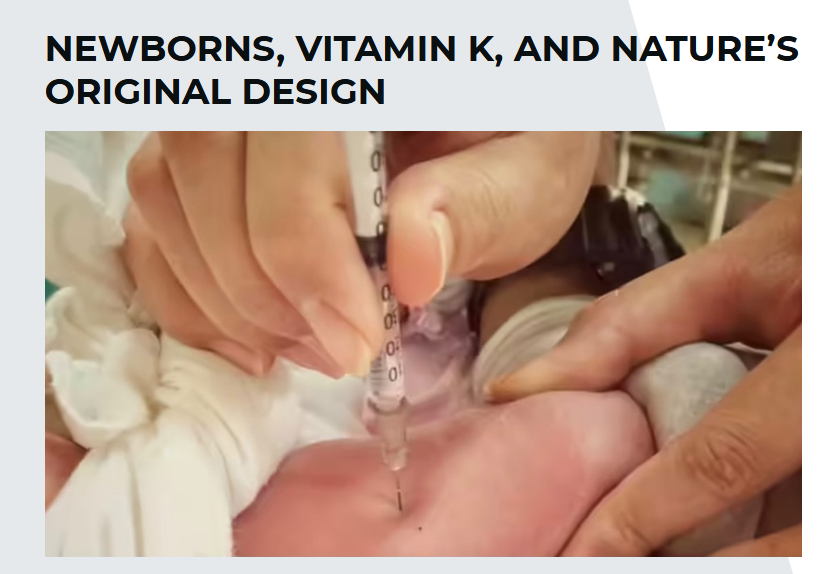
🖊️New editorial out now: "Newborns, Vitamin K, and Nature’s Original Design" - a deep look at the routine vitamin K shot given to newborns in hospitals.
"Despite man’s repeated attempts to override it, nature, in all of its magical wonder, very rarely makes mistakes. Nevertheless, the moment a newborn baby emerges into the world, that innate sentiment is swiftly escorted out of the hospital room. In this case, a nurse leans in and firmly, perhaps semi-sweetly, declares, “We need to give your baby a vitamin K shot.” There is no pause, no room for debate, and very little time for question. It’s protocol, after all. And just like that, in the first precious minutes of life, a newborn child receives its first medical intervention. Why? Because your baby, they insist, is born deficient in vitamin K, in clotting ability. To them, it is necessary and no big deal."
Key points from the piece:
🍼Newborns naturally have low vitamin K at birth: It doesn't cross the placenta easily, the gut starts sterile (no production yet), and early breast milk has low levels. This is universal across mammals—not a defect, but part of the womb-to-world transition.
🍼The shot prevents vitamin K deficiency bleeding (VKDB), rare overall, but often tied to multifactorial issues like gut flora delays, maternal health, antibiotics, or nutrition, not random.
🍼The injection is synthetic (not food-derived like from greens), in a base with polyethylene glycol and polysorbate 80; carries FDA black box warning for severe allergic reactions.
🍼Nature's timeline: Vitamin K rises gradually as gut microbiome develops and produces K2, aligning with breastfeeding adaptation.
This is about restoring nuance to newborn care: Biology by design vs. one-size-fits-all intervention.
Read the full editorial by @ChelleWards and @tracybeanz here: https://t.co/4eiZbzraeI
What are your thoughts? Does the natural low level at birth change how you view the standard practice, or do the prevention stats outweigh concerns? Reply or quote below; bookmark for reference as this topic comes up in birth planning.
A ProPublica headline claimed that parents refusing the vitamin K shot at birth are causing a rise in infant bleeding deaths. The federal data tells a different story.
We begin with why parents are asking questions in the first place. The vitamin K injection's own package insert carries a black box warning for fatal hypersensitivity reactions, including anaphylaxis, following intramuscular and intravenous administration.
A second warning in the same insert flags aluminum toxicity, noting the product contains aluminum that may reach toxic levels in newborns with impaired kidney function.
These are the concerns driving the conversations, not fringe misinformation. The ProPublica piece cited over 700 newborn deaths from intracranial bleeding in 2024 and attributed a meaningful portion to vitamin K refusal, sourcing the claim to unnamed medical specialists and a single anonymous CDC official.
The HighWire's science team went directly to CDC WONDER, pulled ICD-10 code P52 for non-traumatic intracranial hemorrhage in newborns, and graphed the numbers.
From 2017 through 2023, the trend moves downward, from around 319 deaths to around 271. A 2025 study tracking vitamin K refusal rates over the same period shows refusals trending slightly upward.
When the two datasets are plotted together, rising refusals correspond with falling deaths, the opposite of what ProPublica's framing suggests. The CDC does not yet have 2024 data, so it is unclear where ProPublica's 700 figure comes from.
The more important question is whether the shot is the only option. A Cochrane Collaboration review found no evidence of a difference in clotting outcomes between oral and intramuscular vitamin K, with the caveat that a single oral dose produces lower plasma levels at two weeks and one month compared to the injection.
A three-dose oral schedule, however, produces higher plasma vitamin K levels than the single intramuscular dose at both two weeks and two months.
A study from Denmark covering over 7,800 births found zero cases of vitamin K deficiency bleeding when a weekly oral prophylaxis protocol was followed.
The 2021 literature review reaches the same conclusion: oral and intramuscular vitamin K are both effective for preventing hemorrhagic disease of the newborn, with no significant difference between them, provided the oral regimen is completed.
Oral vitamin K is contraindicated for premature newborns, infants with liver disease or gut absorption problems, and infants whose mothers are on warfarin or enzyme-inducing drugs.
For everyone else, the research supports it as a viable alternative to the injection. Parents who have declined both and attempted to leave the hospital have, in some cases, faced calls to child protective services, and ICAN's legal team receives calls about these situations regularly.
I’m seriously starting to think that the childhood vaccination schedule isn’t about preventing illness in children, but simply to make them chronically sick and therefore lifelong customers of Big Pharma.
JUST A REMINDER…
A genuinely deadly pandemic doesn’t require 24/7 advertising to remind you it exists.
Real pandemics don’t need marketing campaigns and endless propaganda…
But psychological operations do.
8-12 people die from Hantavirus every year in the United States, compared to ~350,000 people who die from medical error. But sure, let's freak out over Hantavirus.
Good gracious.
If you got a free donut for taking an experimental shot in a Walmart parking lot on the advice of a computer guy with no medical degree — who once slipped antibiotics in his wife’s drink to hide the STD he caught from an underage Russian sex worker on Epstein Island — you’ve permanently forfeited the right to lecture anyone about “sources” or vaccines.