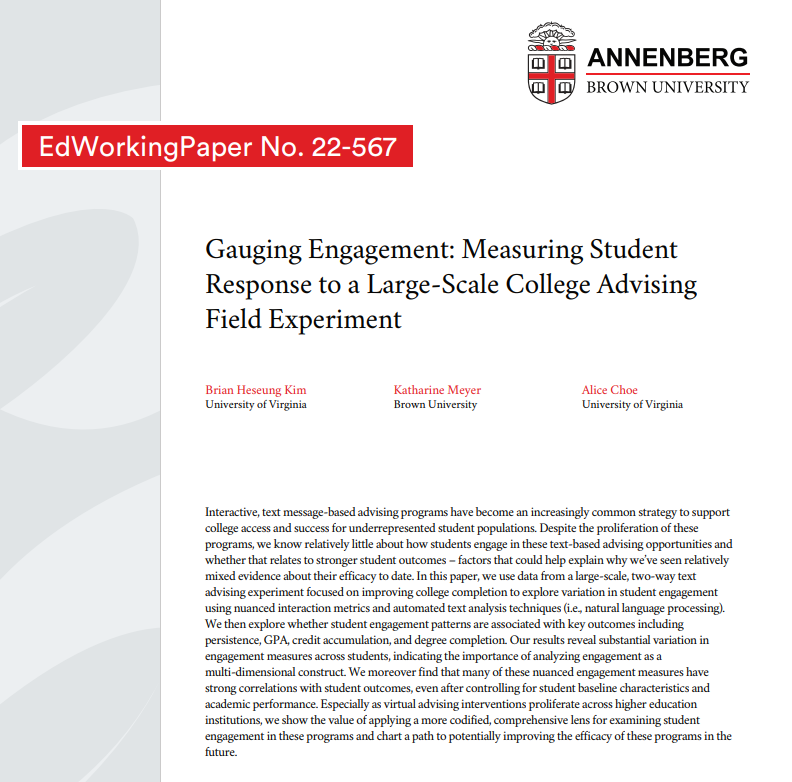
🚨 ICYMI: New paper explores student engagement in the Nudges to the Finish Line nudging intervention 🚨
@brhkim@katharinemeyer@alicedchoe move beyond usual student engagement measures (e.g. ever replied) and add nuance using novel natural language processing (NLP) techniques.
🚨 New(ish) WP on student engagement with text-based nudge campaigns!
“Gauging Engagement: Measuring Student Response to a Large-Scale College Advising Field Experiment” with @brhkim and @alicedchoe (cc: @Nudge4Solutions@AnnenbergInst)
LINK: https://t.co/Hs3hZiZlFq
~3% of adults w/ some credits
could easily re-enroll in fields of study from which they could reasonably expect a sizable
earnings premium from a degree. https://t.co/97Vsp5CSLZ https://t.co/OvdtDZG0NP @GoldieStandard @JoshuaSGoodman @dynarski @jscottclayton @JeffDenning
Data suggests that there are millions of adults with some college credits but no degree or credential. Can we get them back into the classroom? https://t.co/CYcWOyf1VG
Millions of adults have some college credits but no degree. In a NEW @eepajournal paper, @kelliannbird, Ben Castleman, Brett Fisher, and @btskinner explore why more adults don’t return to finish their degrees @uva@UF https://t.co/zARqKAIlKM
Enjoyed this opportunity to highlight the terrific partnership work with @BKLYNlibrary I and the @Nudge4Solutions team have been able to do these past few years thanks to the @HeckscherFnd (via @NextCityOrg)
https://t.co/62YpG62Yyq
Alright folks, we're now well underway with development on our job recommendation algorithm for community college grads (see thread👇) and are ready to share our first progress update. Lots of challenges and lessons learned - would love your thoughts!
https://t.co/gXwlkFLq9F
Partnering with @Nudge4Solutions, we piloted a series of nudges that increased the persistence rates of adult students at two community colleges in Tennessee.
If scaled, this work holds promise for positively impacting millions of adults across the U.S. https://t.co/Rjsz59ljFU
We encourage college leaders to critically invest whether they are getting sufficient return from their predictive analytics investments, and to pressure vendors to provide greater transparency about the accuracy and stability of their models.
We estimate colleges incur an average cost of ~$4,700 per each additional student correctly identified as at risk of not graduating when they invest in private-market predictive analytics software. Is this the best use of scarce resources to promote student success?