Nunchux is live at https://t.co/PyrPtRRa64!
We’re building the frontier of multimodal generative AI inference: fast, affordable, high-quality serving for image, video, and world models.
Our Modelverse brings 30+ image, video, and avatar models behind one API. Use Nunchux-optimized models in Radical Speed and Radical Value tiers, alongside partner APIs. More models are on the way.
We’re opening access through the waitlist now. New accounts get $10 in credits.
Read our launch blog: https://t.co/JxekjGqfaG
Three paths to faster video attention: compute the same interactions more efficiently, compute fewer in full, or change how information is mixed. Here’s a visual guide. 👇
Thanks to Nunchux AI and collaborators for VC-Attention, bringing training-free low-bit acceleration to MiniMax-H3, with better fidelity than SageAttention2 in the B200 evaluation.
The approach balances speed and fidelity: V-Smooth reduces value quantization error, while ExpCast-FP8 makes softmax faster through approximation.
Excited to see the community keep building on H3. Could combining low-bit computation with sparse methods like Sol-Attn push efficiency further? We’re looking forward to seeing that explored.
Introducing VC-Attention: fast and accurate low-bit attention without retraining.
On MiniMax-H3, VC-Attention speeds up attention by 1.6× on B200 and 1.5× on B300 over FlashAttention-4, with better fidelity than SageAttention2. It also works with existing sparse attention methods.
Two key innovations:
• V-Smooth reduces value quantization error.
• ExpCast-FP8 speeds up softmax.
Nunchux Attention, our proprietary extension, pushes the speedup to 1.9× on B200 and 1.8× on B300.
Blog: https://t.co/k0wDVujvBB
Technical Report: https://t.co/wMWfga6m73
Joint work by researchers at MIT, CMU, UC Berkeley, Stanford, and NVIDIA.
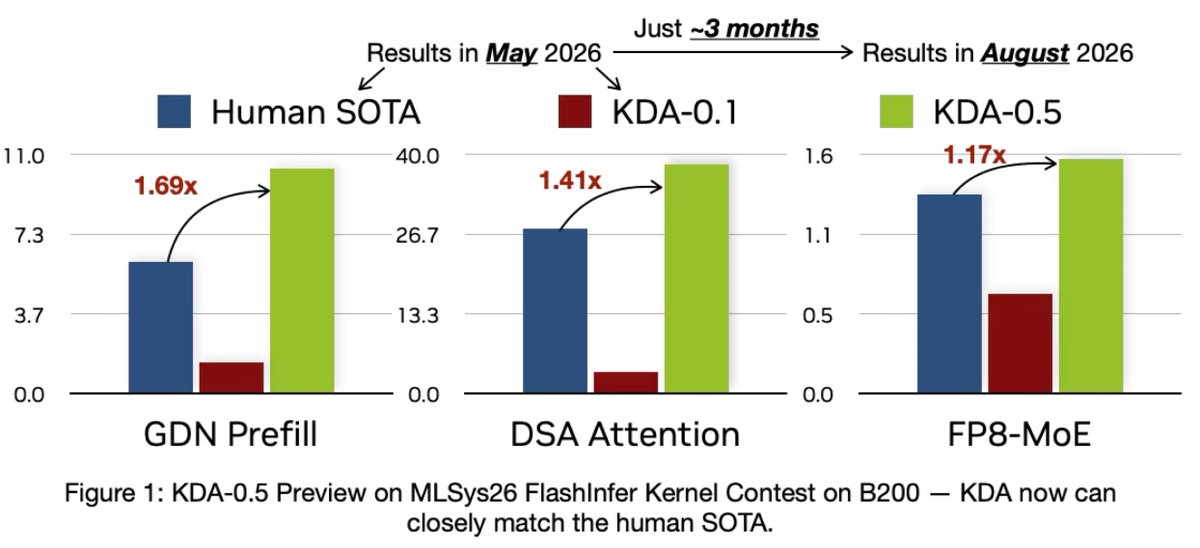
⚡️ We are excited to share updates from KDA-v0.5 (kernel design agents). Our latest Cute-DSL kernels can beat the human winners at FlashInfer Kernel Contest by 16%~69%! An amazing progress in just 3 months!
- GDN prefill: 1.69x Speedup over Kachua
- DSA attention: 1.41x Speedup over Dogacel
- FP8 MoE: 1.17x Speedup over Team Wombat
Humanize2 Flame Chase: https://t.co/p6ny6AQ5cg
Results and Reproduction: https://t.co/LxNtOvHrqN
MLSys 2026 Contest: https://t.co/wlDnDvmAnm
KDA-v0.5 achieved this by integrating the Cute-DSL primitive, better workflows (humanize1 -> humanize2), updated kernel-wiki (self-evolved), and better profiling skills (IKET). The results are achieved by the flame chase flow from humanize2 – using gpt-5.6-sol and fable-5 to iteratively optimize . We have released the kernels for validation and more details will come soon!
By the KDA Team: Dongyun Zou, Yixin Dong, Junxian Guo, Changye Li, Yahui Cui, Zihao Ye, Junru Shao, Zijian Zhang, Sihao Liu, Song Bian and Ligeng Zhu.
Nunchux AI (https://t.co/sAHxMqhcJo) comes out of stealth today.
Ten years ago at Berkeley, we spent whole nights on a Titan X in Theano, trying to make iGAN, pix2pix, and CycleGAN real-time so creators could see the results the moment they asked for them.
Image models now cost about 10,000x more to run. Video is another two orders of magnitude beyond that. The reason for speed has not changed. Every attempt is a question, and the answer changes the next question. Latency decides whether the result arrives while the idea is still yours. Cost decides how many questions you get to ask. Quality decides whether the answers were worth asking for.
So we are building fast, cheap, and high-quality multimodal inference for every developer and enterprise, and we are building with researchers from MIT, CMU, and Berkeley, along with engineers who have shipped at AMD, NVIDIA, and Snowflake.
We are now opening access through the waitlist. New accounts get $10 in credits.
@ComfyUI is now the first and only commercial license distributor for @MiniMax_AI's generative media models.
MiniMax open weights have been downloaded through Comfy close to 20 million times. Not one of those downloads paid the lab a cent.
That is the open-weight problem. Training frontier models is expensive. Adoption is not revenue. If open models are going to keep pace with the biggest closed labs, the labs need a way to get paid.
So we built the bridge. Enterprises, studios, and agencies license through us. The labs get incentive to keep researching. Independent creators keep building exactly as they do now, funded by the organizations with budgets.
A license only gets you the model. Our Forward Deployed Creatives embed with your team, train LoRAs on your style, build production workflows in your environment, and leave your people able to run and extend all of it. What they build is yours to keep.
MiniMax is where we start, not where we stop.
My assertion is that open-weight labs that survive the next two years will not be the ones with the best benchmarks. They will be the ones that solve distribution to paying customers first.
Try for Free | Request a License today ⬇️
Your gaming PC can now serve frontier models at interactive speed using official checkpoints without extreme quantization!
Qwen3.6 35B → 8GB RTX 4060 laptop @ 39 tok/s
DeepSeek-V4-Flash 284B → RTX 5090 desktop @ 22-25 tok/s
GLM-5.2 753B → RTX PRO 6000 workstation @ 15 tok/s
Run your claude code or codex now with frontier model for $0
Meet FreeToken 🧵
Comfy MCP is now local and open-source!
The #1 ask after Comfy Cloud MCP shipped in June.
Your agent sees your actual install. So every node, custom nodes included, and every model on disk. It fetches files, starts your instance, gets a workflow to the point where it runs.
It is now the easiest way to help with your local Minimax H3 workflows!
Cloud MCP still does everything it did. Tell your agent where a job goes, or let it decide.
🎬 Long video generation is bottlenecked by KV-cache memory. We fixed it.
Presenting QuantVideoGen @ #ICML2026:
⚡ ~7× smaller KV cache @ INT2
💾 ~85% less memory
🔧 No fine-tuning, no weight changes
📍 Poster: Thu Jul 9, 2026. 5:00 PM -6:45 PM KST · Hall A #4603
My wonderful co-author Xingyang Li will be presenting our papers. Come say hi!
🔗 https://t.co/86VaMWq70v
New blog post: The Forgetting Wall in Video and World Models
Long-horizon video generation is not just limited by compute. It is limited by how much of its own past the model can afford to remember.
I wrote about why long videos drift, why KV cache becomes the memory bottleneck, and why compression is a key direction for future video/world models.
https://t.co/ORp0ma4P2m
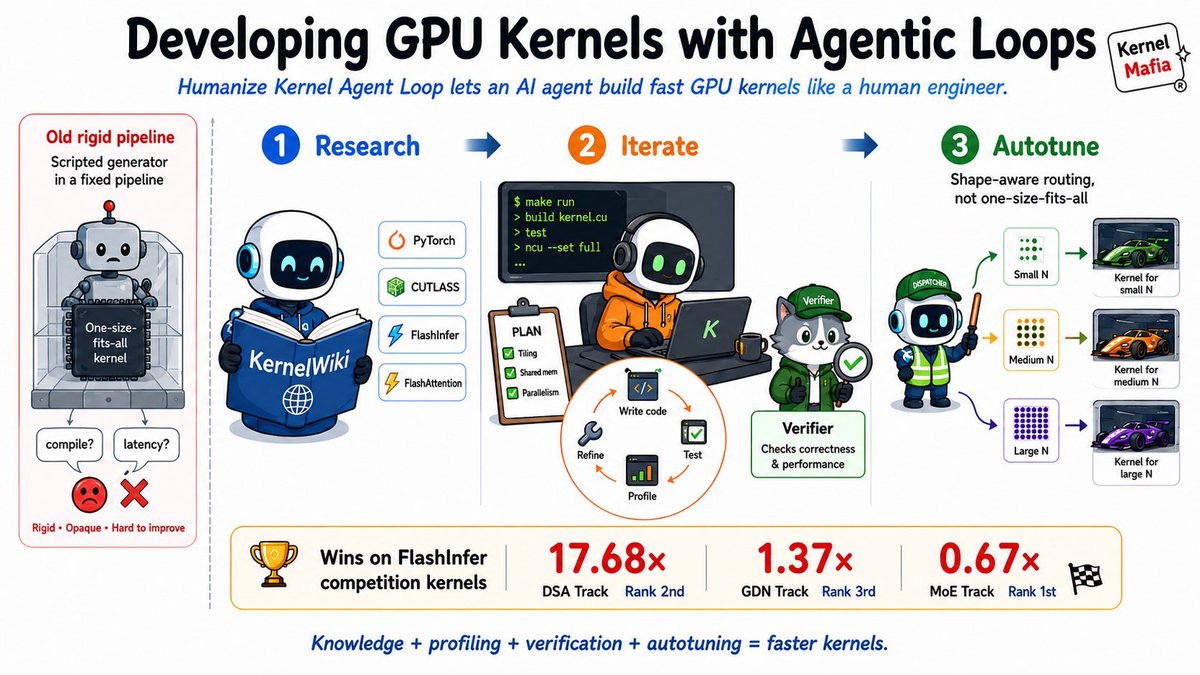
Excited to share the KDA: Kernel Design Agents that powers HAN Lab Kernel Mafia top ranking #1~3 kernels at Kernel Contest🚀🚀🚀
Thanks to agents, everyone can be a "kernel bro" in 2026: By adapting the KDA, the team ranked #1 in MoE, #2 in DSA, and #3 in GDN in the Pure Agent track at MLSys FlashInfer Kernel Contest – especially given the fact that the main participant (dongyun zou) has only written ~400 LoC triton and 0 lines of CUDA in 2026.
The core philosophy here is to leverage Humanize (the best harness framework) to let the agent run autonomously for as long as possible. By minimizing human involvement and input, and placing full trust in the agent, we can achieve kernel performance that nears SOTA levels.
HAN Lab Mafia Solution to MLSys’26 Kernel Contest: https://t.co/XAcPFUUpVR
KDA Github: https://t.co/FKPFMjmq2x
Excited that our paper StreamdiffusionV2 received the Best Research Paper Award at #MLSys26!
🚀Video generation is quickly moving from demos to production-facing workloads. It is no longer a turn-based pipeline but should be a streaming pipeline to interact with users.
📖Our project page: https://t.co/ItuO5zc6hT and paper: https://t.co/fmz2irYIm1
👂Come join the talk if you are interested in streaming video generation. Our talk will be at the Research Track Oral Presentation: Best Paper Session on Tue 8:45AM at #MLSys26 , I will talk about how we attacked the efficiency and quality challenges. Hope to see you there!
❤️Huge thanks to all authors! This work would not have been possible without the incredible effort from the entire team. Big shout out to Tianrui Feng, Zhi Li, @Andy_ShuoYang , @HaochengXiUCB, @lmxyy1999 , @lvminzhang , @xiuyu_l , Keting Yang, @ZiqiPeng, @songhan_mit , @magrawala, @KurtKeutzer , and @cumulo_autumn
Really exciting to see KV-cache compression getting attention.
A similar bottleneck shows up beyond LLMs: for world models and autoregressive long-video generation, KV cache can quickly dominate memory and limit long-horizon consistency.
Our recent work, Quant VideoGen, explores training-free 2-bit KV-cache quantization for video diffusion models, achieving up to 7.0× KV memory reduction with <4% latency overhead.
Link: https://t.co/SH6FXXTGxL
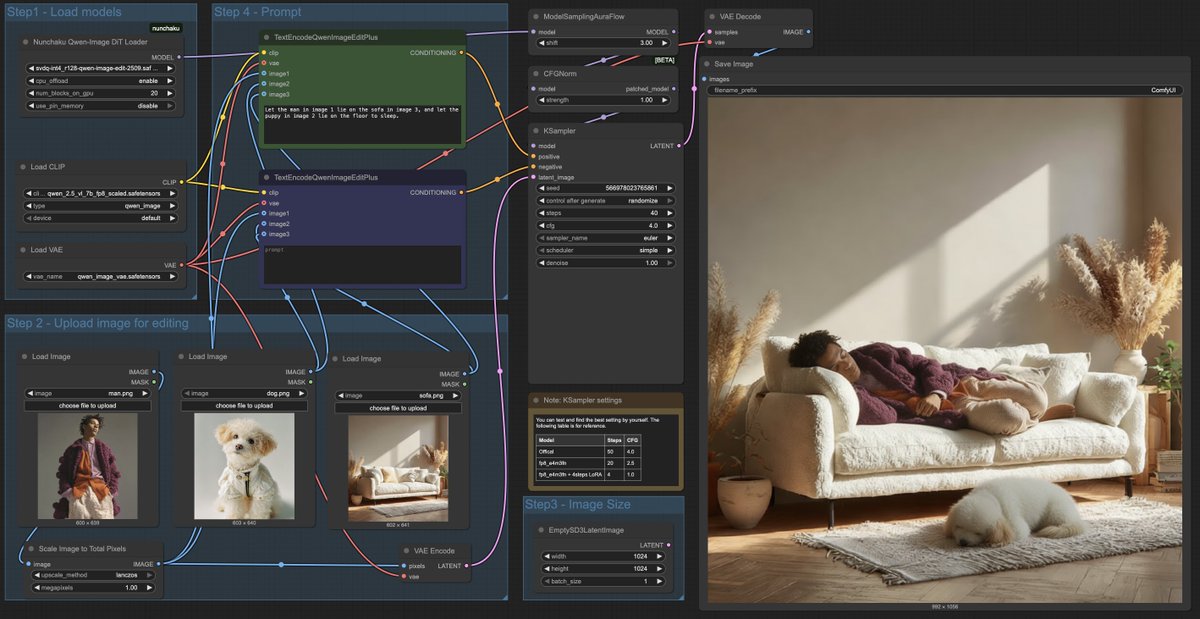
The Nunchaku team is just making Qwen-Image-Edit fly. ⚡️
They've dropped quantized versions of the 2509 model, and the big news is the pre-fused Lightning models. We're talking 4-step and 8-step edits.
This is a must-grab for anyone who wants high-speed, low-VRAM image editing.