Today we're sharing new breakthrough results for Pearl, our foundation model for protein–ligand cofolding.
The OpenBind Consortium recently released the first public structure-affinity benchmark for molecular AI, evaluating six prominent cofolding models on the EV-A71 2A protease. We ran our full Pearl system against the same target.
Zero-shot, with no binding-site information and no tuning, the Pearl system reaches 78% on OpenBind's primary success criteria, far ahead of every cofolding model tested by OpenBind. We also assessed a stricter sub-1 Å accuracy threshold, which is more relevant for real-world R&D usage – the Pearl system’s success is still 60%, versus 1–27% for the other models.
What matters most to us: this is the same system setup our scientists use on live drug discovery programs, not a benchmark-specific configuration.
Thanks to the OpenBind Consortium for building a rigorous public benchmark, and to @NVIDIAHealth for the support on optimizations that enabled model scaling.
(1/2) Want to train KANs at scale?
Now UKAN!
Introducing Unbounded Kolmogorov-Arnold Networks (UKANs) and the GPU-accelerated warpKAN library. Traditional KANs struggle with bounded grids and computational inefficiencies. UKANs address this by using a novel coefficient-generation model to dynamically generate B-spline coefficients for unconstrained functional approximation. The library also provides Warp kernels for conventional KANs.
Key benefits:
⚡️ Delivers a 3-30x speedup compared to vanilla torch KANs
📉 Reduces memory usage by up to 1000x to enable large-scale training
🎯 Matches or surpasses the accuracy of KANs across regression, classification, and generative tasks
The "Healthy Taiwan" initiative is setting a global standard for healthcare.
🏥 Foxconn and top medical centers are partnering with NVIDIA to tackle clinician shortages using AI workforces and live Nurabot nursing robots.
#NVIDIAGTC
Read the release ⬇️ https://t.co/afdIQLFV5q
We're adopting the Linux Foundation’s OpenMDW framework across our open model families.
This helps make open model licensing simpler and more consistent at scale.
A single legal framework across models, code, documentation, and data helps reduce friction for developers and enterprises building with open source.
What does GPU acceleration mean for patients?
🏥Earlier diagnoses, faster treatment decisions and more targeted therapies.
Minutes, not hours: NVIDIA Parabricks on RTX PRO 4500 Blackwell Server Edition drastically accelerates whole-genome analysis, saving critical time for life-saving decisions in oncology and the NICU.
Accelerated discovery: OpenFold3 shrinks protein structure prediction from years to just hours, fast-tracking the journey from target identification to viable therapeutics.
Genomic analysis that once took hours now takes minutes — and the compute enabling that shift just got significantly more powerful.
Explore how the NVIDIA BioNeMo Platform, including NVIDIA Parabricks, on the NVIDIA RTX PRO 4500 Blackwell Server Edition is transforming precision medicine.
Compared to NVIDIA L4, RTX PRO 4500 Blackwell delivers:
⚡ ~2x faster genomic analysis (fq2bam, Minimap2, Deepvariant)
⚡ 9.6x faster sequence alignment (Smith-Waterman)
⚡ 2.3x faster protein structure prediction (OpenFold3)
Read the full breakdown ➡️ https://t.co/23zm6pI5VU
(2/2)
1⃣ 33x faster image generation
MAISI-v2 cuts inference from 1,000 steps to just 30 - whole-body coverage, any anatomy, one model.
2⃣ The world's largest open-source brain MRI dataset
MR-RATE: 700K+ volumes from 83K+ patients, paired with radiology reports. Now powering NV-Generate-MR-Brain.
3⃣ One command to get started
Open-source code, pretrained weights, royalty-free on RTX GPUs. Plug into your pipeline and go.
Already used by researchers for lung cancer classification, prostate lesion detection, MR-to-CT synthesis & brain tumor generation.
🔗 Get started https://t.co/BaiY3Vgvbz
(1/2)
🚨 Data scarcity is the #1 blocker in medical imaging AI.
We built the open-source fix.
NV-Generate-CTMR synthesizes realistic 3D CT & MRI volumes at scale - with paired segmentation masks - so you can train more robust models without touching real patient data.
👏 Congrats to Genesis Molecular AI and Incyte - their collaboration unlocks new value from pharma data to power high-impact drug discovery. Their collaboration accelerates training and fine-tuning of leading foundation models for small-molecule-protein structure prediction, including Pearl built by Genesis and NVIDIA.
Our AI partnership with @Incyte has taken a major step forward and is now one of the most ambitious AI-pharma collaborations.
Here's how the partnership is growing:
➡️ $120M upfront consideration ($80M cash + $40M equity investment in Genesis), plus recurring research funding, potentially up to several billion dollars in contingent milestone payments, and royalties
➡️ Incyte's proprietary experimental data will help train the next generation of foundation models in GEMS (Genesis Exploration of Molecular Space)
➡️ At least five new collaboration targets, with options for more
AI for drug discovery just hit a new milestone. By pairing our AI platform with Incyte’s best-in-class drug development engine and proprietary data, we’re building a flywheel to accelerate the discovery of novel medicines, helping us get new drugs to patients who need them.
Full announcement: https://t.co/1IyrkSAhuc
(1/3) 🚨New RNA-seq alignment preprint
The team at NVIDIA (Fadel Berakdar, Tong Zhu, @mehrzadsamadi, Pankaj Vats) and Genentech (Thomas D. Wu) just showed how targeted ML can upgrade traditional genomics pipelines with DeepSAP.
(2/3)
1️⃣ Hybrid Architecture: It combines fast transcriptome-guided mapping with a Transformer-based model to resolve difficult splice junctions
2️⃣ High Accuracy: The model hits over 97% accuracy on splice-junction predictions in its benchmark evaluations
3️⃣ Beating the Baselines: It outperforms several widely used aligners, proving that ML adds the most value when targeted at specific bottlenecks
(3/3)
📚 https://t.co/kb7D4d1cNw
Based on the 2026 @AnnualReviews of Biomedical Engineering piece ‘Federated Learning in Healthcare: From Research to Real-World Deployment’ by @SpyridonBakas, @XiaoxiaoLi8, Prashant Shah, and Holger R. Roth.
(1/3) We don’t need more data in one place - we need better ways to learn from data that can’t move.
That’s where federated learning in healthcare is finally getting real.
(2/3)
🏥 Train shared models across hospitals without sharing raw patient data
🌐 Tackle non-iid data, system heterogeneity, and robust aggregation across sites
🔐 Add secure aggregation + differential privacy because FL alone ≠ guaranteed privacy
📊 Learn from real deployments in imaging, EHRs, and outcome prediction, not just simulations
🛠️ Treat governance, infra, and MLOps for FL as core research problems, not afterthoughts
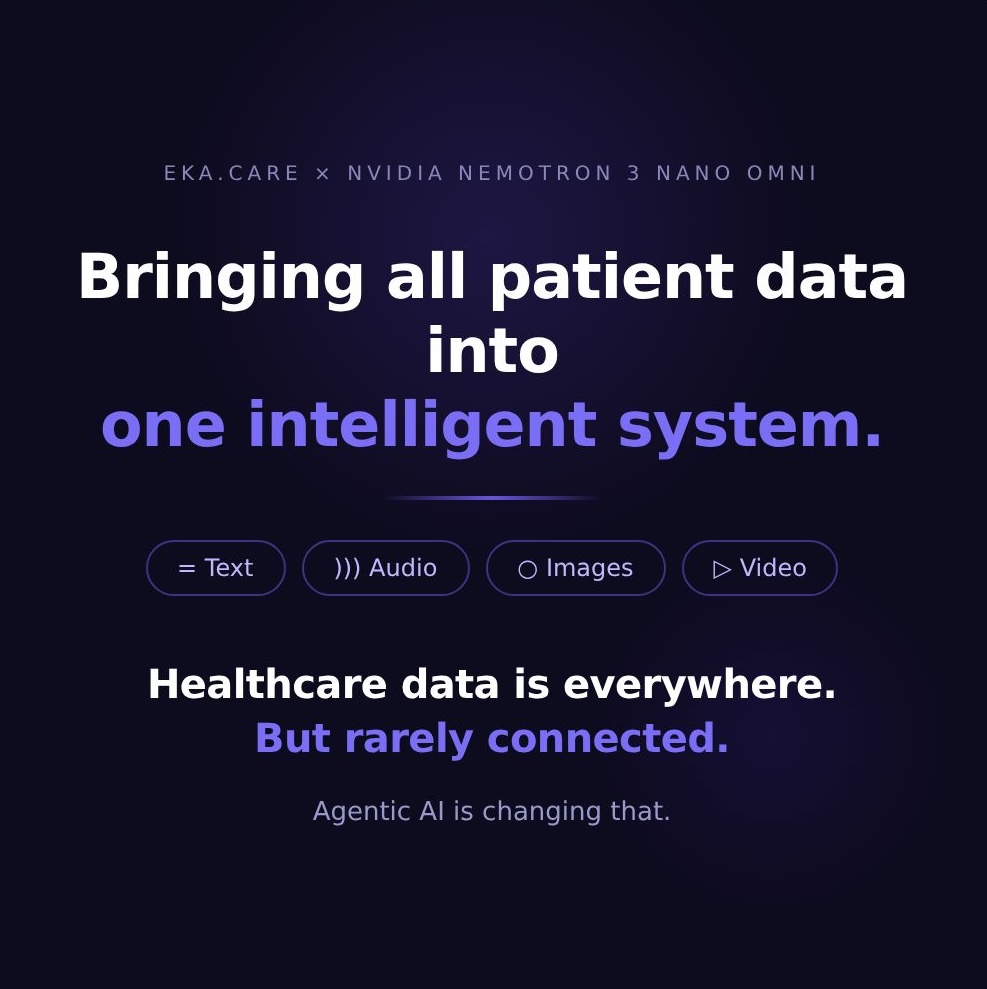
Grateful to @NVIDIAAI for early access to Nemotron 3 Nano Omni.
Healthcare data is everywhere; rarely connected. Exploring Agentic multimodal AI to unify text, audio, images & video for India-scale care.
Read More: https://t.co/7Yziaaw8Ix
#EkaCare#NVIDIA#NemotronOmni