Catch it at the first user, not the four-hundredth.
A new user’s bank link fails, the agent says “try again later,” and nothing shows up in the logs. Watch a team find the bug and fix it before anyone else hits it, with Agent Learning Services and Agent Data Services, launching today.
@aapakari@MiniMax_AI Neither, @aapakari. Those are MiniMax’s own reported results, not runs on our infrastructure. The $0.15 / $0.60 per 1M tokens is the Serverless price, and Dedicated Inference is billed per GPU-hour. 📊
.@MiniMax_AI reports 73.67% on DeepSWE and 72.5% on AutomationBench-AA, which it calls the best result among open models.
M3.1 Flash is now on DigitalOcean Serverless Inference and Dedicated Inference. $0.15 input, $0.60 output per 1M tokens. https://t.co/bgaUkN6yIU
@MiniMax_AI Congrats on the launch! M3.1 Flash is live on DigitalOcean Serverless and Dedicated Inference too, at the same $0.15 / $0.60 per 1M tokens. 🚀https://t.co/bgaUkN76ys
Over 90% of input tokens agents send us are tokens the model has already seen.
Prompt Caching is now available on DigitalOcean Serverless Inference: cached input at up to 90% off, time to first token up to 80% faster, no code changes. Cache affinity keeps hit rates on flagship models at 85–95%+. https://t.co/RyqnlPMoKV
This week’s PHP2Shell disclosures and the AI-assisted attacks involving ConnectWise show how quickly the security equation is changing. In some cases, attackers reached privileged cloud access in under three hours.
As we give agents the ability to execute code, call APIs and use credentials, we need enforceable boundaries around every action. Which systems can they access? Where can they send data? What happens when they exceed their permissions?
My view: those controls belong in the infrastructure, outside the agent’s own reasoning loop.
That’s why I’m excited that @digitalocean is supporting @nvidia's OpenShell Reference Architecture. It brings together Vera Rubin for inference, Vera CPUs and OpenShell for agent execution, and BlueField-4 DPUs running NVIDIA Sentry for independent monitoring and policy enforcement in silicon.
An agent’s effective permissions matter as much as its model’s capabilities. Building an AI-native cloud means taking responsibility for both.
Read NVIDIA’s announcement
https://t.co/1JVFpbOErh
@JayaGup10 and @ashugarg make an important argument here: agents create an expanding execution workload around inference.
My view: this changes the architecture of the cloud itself.
An agent’s task can outlive its process, its model connection, and the person who started it. The infrastructure has to preserve progress, authority, and context across all three.
Durable execution goes deeper than keeping a sandbox alive. An agent needs to pause, checkpoint, fork, and resume. But restoring a microVM doesn’t establish whether an external transaction committed. If a tool times out after submitting a payment, blindly replaying the step can duplicate the payment.
You need recorded step outcomes, idempotency where supported, and reconciliation when the result is uncertain. Recovery semantics become part of the agent architecture.
Model routing and execution placement are coupled.
The cheapest model endpoint can become expensive if switching to it requires resending a long history, rebuilding a warm KV cache, or moving context across regions.
A router should consider model capability, queue time, cache state, data location, and the probability of completing the task. A locally cheaper decision can make the whole trajectory more expensive.
That’s why inference, runtime, and data placement need to be designed together.
A sandbox isolates code. Every tool invocation also needs to establish whose authority the agent is exercising, which action is permitted, and whether approval is required.
Broker credentials at invocation, enforce policy outside the model, and connect the action to the session’s audit trail. Forking an agent should never silently expand its permissions.
Production traces should feed a tested improvement loop.
Connect model calls, tool responses, state changes, human corrections, and outcomes in one trace. Turn recurring failures into evaluation cases. Replay candidate fixes in simulations before changing production behavior.
That gives execution history a second purpose: evidence for improving the next run.
The economic objective follows directly: minimize total cost per successful task, including inference, active compute, persistent state, failed attempts, and recovery.
More capable models can support longer tasks and more parallel work. Falling token prices can therefore expand demand for the infrastructure surrounding each call.
At @DigitalOcean, we’re building around that entire loop: think, act, remember, improve. Open harnesses and models, governed execution, durable state, and customers retaining control of their accumulated intelligence.
The agent’s full lifecycle is becoming the unit of AI Native cloud's architecture.
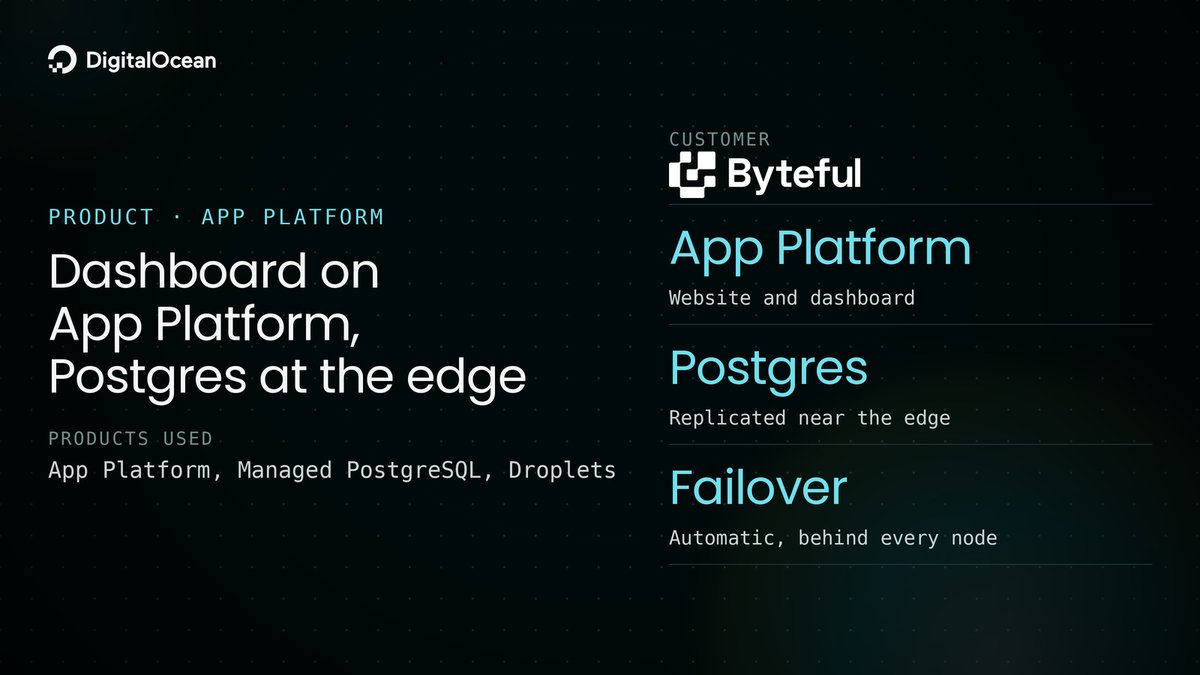
@PicapLatam@ProbablyDatabot@byteful hosts its website and dashboard on App Platform, with managed Postgres replicated near the edge and automatic failover behind it. https://t.co/SSA7Pq1mir
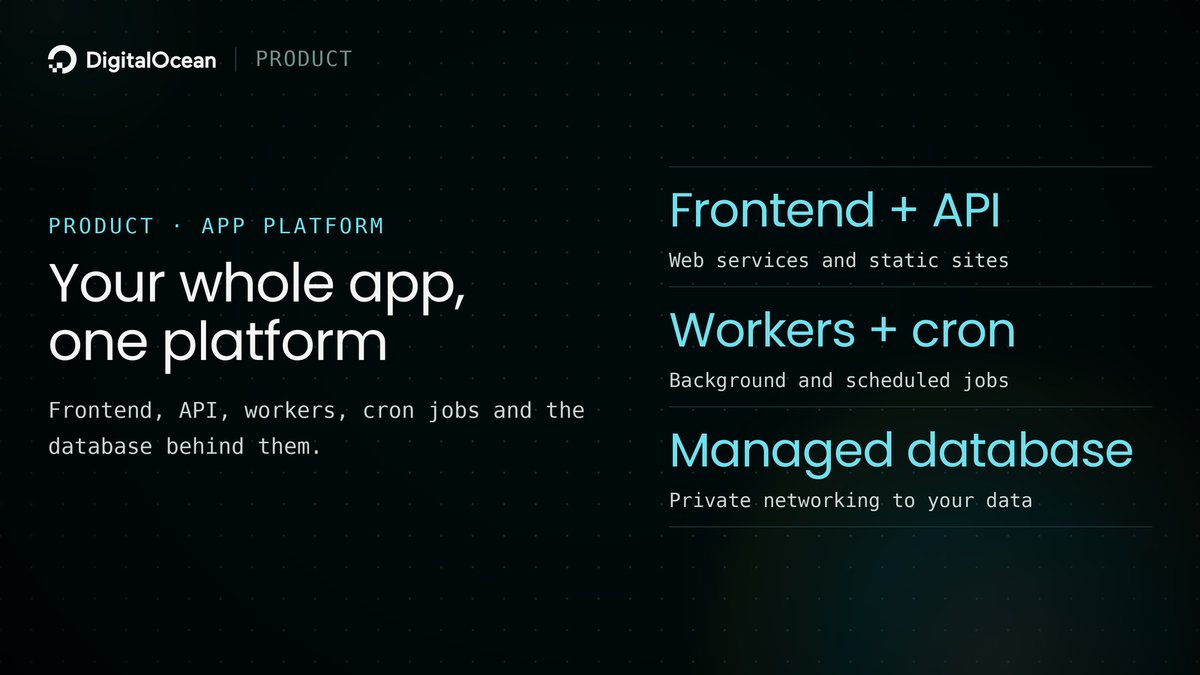
App Platform runs your whole app: frontend, API, workers, scheduled jobs, and the database behind them, with AI a function call away. One bill, private networking between services and data.
Successful teams building on it: https://t.co/0GA8U7wcTT 🧵
@PicapLatam@ProbablyDatabot ConfirmOk uses App Platform workers to place daily check-in calls to seniors and send alerts when someone doesn’t respond. Code deploys from GitHub, and Insights shows CPU, memory and request volume. https://t.co/3aDYSZiL5e
@dabernathy89 Thanks for the feedback. We’re passing it to the teams involved. If you run into any trouble with the redeploy, send us a DM or open a ticket here: https://t.co/2Wgmvb4Uo1