I’m hiring on my team at OpenAI for Research Engineer / Scientist and Software Engineer roles.
I believe one of the most important questions for future AI systems is: how do we train them to help people over time?
We work on that through RLHF, post-training, reward modeling, long-horizon evals, and the data infrastructure behind personalized multimodal AI.
If you care about human flourishing and serious research, links in comments.
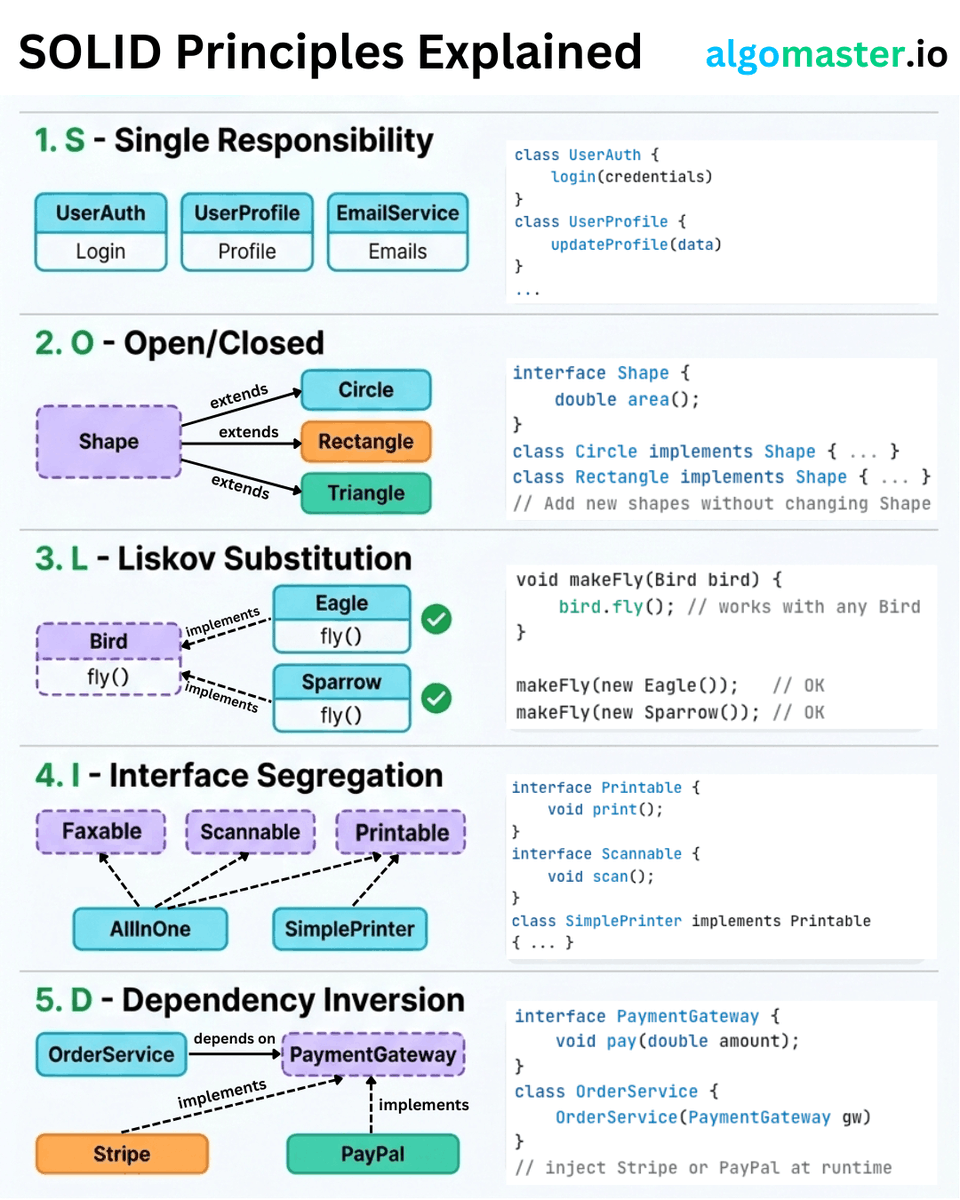
SOLID Principles Explained with Clear Examples:
𝐒 - 𝐒𝐢𝐧𝐠𝐥𝐞 𝐑𝐞𝐬𝐩𝐨𝐧𝐬𝐢𝐛𝐢𝐥𝐢𝐭𝐲 𝐏𝐫𝐢𝐧𝐜𝐢𝐩𝐥𝐞
A class should have only one reason to change.
- Example: Instead of one giant User class that handles authentication, profile updates, and sending emails, split it into UserAuth, UserProfile, and EmailService.
𝐎 - 𝐎𝐩𝐞𝐧/𝐂𝐥𝐨𝐬𝐞𝐝 𝐏𝐫𝐢𝐧𝐜𝐢𝐩𝐥𝐞
Classes should be open for extension but closed for modification.
- Example: Define a Shape interface with an area() method. When you need a new shape, just add a Circle or Triangle class that implements it.
𝐋 - 𝐋𝐢𝐬𝐤𝐨𝐯 𝐒𝐮𝐛𝐬𝐭𝐢𝐭𝐮𝐭𝐢𝐨𝐧 𝐏𝐫𝐢𝐧𝐜𝐢𝐩𝐥𝐞
Subtypes must be substitutable for their base types without breaking behavior.
- Example: If Bird has a fly() method, then Eagle and Sparrow should both work anywhere a Bird is expected.
𝐈 - 𝐈𝐧𝐭𝐞𝐫𝐟𝐚𝐜𝐞 𝐒𝐞𝐠𝐫𝐞𝐠𝐚𝐭𝐢𝐨𝐧 𝐏𝐫𝐢𝐧𝐜𝐢𝐩𝐥𝐞
Don't force classes to implement interfaces they don't use.
- Example: Instead of one fat Machine interface with print(), scan(), and fax(), break it into Printable, Scannable, and Faxable. A SimplePrinter only implements Printable.
𝐃 - 𝐃𝐞𝐩𝐞𝐧𝐝𝐞𝐧𝐜𝐲 𝐈𝐧𝐯𝐞𝐫𝐬𝐢𝐨𝐧 𝐏𝐫𝐢𝐧𝐜𝐢𝐩𝐥𝐞
High-level modules should not depend on low-level modules. Both should depend on abstractions.
- Example: Your OrderService should depend on a PaymentGateway interface, not directly on Stripe or PayPal.
The real power of SOLID is not in following each principle in isolation. It's in how they work together to make your code easier to change, test, and extend.
♻️ Repost to help others in your network
This is not about agents being bad at greenfield. It is about what "greenfield" actually means when you hand it to an agent.
On an existing codebase, the agent has constraints. Naming conventions, folder structure, existing patterns. It reads them, follows them, stays in line. The codebase acts as a living spec.
On greenfield, the agent has zero constraints. So it invents them. Every function call becomes an opportunity to create a new abstraction layer. Every feature gets its own pattern. You end up with 5 different ways to handle errors because the agent optimized each one locally without seeing the bigger picture.
The fix is not "write better prompts." The fix is to recognize that architecture is the one thing you cannot delegate. You need to lay down the first 500 lines yourself, define the patterns, set the boundaries. Then the agent has something to follow.
Based on my experience, the wall you hit is not a model limitation. It is the compound cost of architectural decisions nobody made explicitly.
We’re hiring.
Looking for AI developers, prompt engineers, and AI builders to join us.
Starting salaries around $100k+ / year depending on experience.
If you’re building cool things with AI, we want to talk.
Keep an eye on us for updates - our careers page is coming soon.
A conventional narrative you might come across is that AI is too far along for a new, research-focused startup to outcompete and outexecute the incumbents of AI. This is exactly the sentiment I listened to often when OpenAI started ("how could the few of you possibly compete with Google?") and 1) it was very wrong, and then 2) it was very wrong again with a whole another round of startups who are now challenging OpenAI in turn, and imo it still continues to be wrong today. Scaling and locally improving what works will continue to create incredible advances, but with so much progress unlocked so quickly, with so much dust thrown up in the air in the process, and with still a large gap between frontier LLMs and the example proof of the magic of a mind running on 20 watts, the probability of research breakthroughs that yield closer to 10X improvements (instead of 10%) imo still feels very high - plenty high to continue to bet on and look for.
The tricky part ofc is creating the conditions where such breakthroughs may be discovered. I think such an environment comes together rarely, but @bfspector & @amspector100 are brilliant, with (rare) full-stack understanding of LLMs top (math/algorithms) to bottom (megakernels/related), they have a great eye for talent and I think will be able to build something very special. Congrats on the launch and I look forward to what you come up with!
My favorite way to learn is now uploading a bunch of source material to AI and then doing this:
“Help me understand this paper step by step. Go from high level (simple explanations) to incredibly low-level, detailed technical explanations until I understand it. Do not advance without confirming that I understand each step with a quiz question first.”
It has not failed me once. It’s very enjoyable and easy to pause and restart.
Most engineers learn system design backwards.
They jump to Kubernetes before they understand what a network packet even does.
Here’s the order that actually makes you dangerous:
1. Networks first
HTTP. TCP. DNS. Latency vs throughput.
This is the part nobody studies.
This is like trying to bench 300lbs without learning to squat.
2. Databases second
SQL vs NoSQL, indexes, replication, and partitioning.
If you can’t reason about data -> you can’t reason about scale.
3. Caching
Redis, CDNs, TTLs, eviction policies.
70% of scaling wins come from avoiding queries.
4. Queues & Streams
Kafka, RabbitMQ, SQS.
This is how you decouple timelines and handle spikes without blowing up servers.
5. Load Balancing
Round robin vs least connections vs consistent hashing.
You understand how to scale horizontally without chaos.
6. Build 5 classic designs yourself
- URL shortener
- Rate limiter
- Chat app
- Feed system
- Notifications
7. Read real-world post-mortems
Real learning is failure exposure.
You see what broke. You see WHY.
You don’t become good at system design by memorizing diagrams.
You become good by understanding the physics of distributed systems.
Latency. Durability. Throughput. Availability. Cost.
Those 5 forces rule everything.
The best engineers I know delete more code than they write
Junior engineers add features. Senior engineers remove complexity
Every line of code you write is a liability. It needs to be maintained. It can break. It adds cognitive load to anyone who reads it later
The best pull requests I've seen in the last year? Half of them deleted more than they added. Someone refactored three classes into one. Someone replaced 200 lines of custom logic with a library function. Someone removed an entire abstraction layer that wasn't pulling its weight
Deletion is a skill. You have to know what's safe to remove. You have to understand the system well enough to see what's redundant, over-engineered, or just wrong
Next time you open a file, ask: what can I remove?
The best code is the code you don't write
Word Embeddings in LLMs
✓ Word Embeddings are the foundation of how Large Language Models (LLMs) understand meaning in text.
✓ They convert discrete tokens (words, subwords, or characters) into continuous numerical vectors that capture semantic relationships , enabling models to reason about meaning, similarity, and context.
→ What Are Word Embeddings?
✓ A word embedding is a high-dimensional vector that represents a word in numerical form.
✓ Words with similar meanings are positioned close to each other in the embedding space.
✓ Example:
→ “King” and “Queen” are close in meaning.
→ Vector relationships capture logic such as King - Man + Woman ≈ Queen.
→ Why Embeddings Matter in LLMs
✓ LLMs cannot interpret raw text — they require numerical inputs.
✓ Embeddings translate text into a mathematical space where linguistic patterns become learnable.
✓ They allow models to:
→ Recognize synonyms and analogies.
→ Understand word relationships and context.
→ Generalize knowledge across unseen text.
→ How Word Embeddings Are Generated
✓ Each token (from tokenization) is mapped to an embedding vector using a learned embedding matrix.
✓ The model learns optimal embeddings during training by adjusting vector values to minimize prediction errors.
✓ Over time, semantically similar words develop similar vector orientations.
→ Contextual vs Static Embeddings
1. Static Embeddings
✓ Same vector for a word regardless of context.
✓ Used in early models like Word2Vec, GloVe, and FastText.
✓ Example: The word “bank” has one embedding whether it refers to a riverbank or a financial bank.
2. Contextual Embeddings
✓ Meaning changes dynamically based on surrounding words.
✓ Powered by Transformers and Self-Attention in LLMs.
✓ Example: “bank” in “I deposited money at the bank” differs from “The boat reached the bank.”
✓ Modern models like GPT, BERT, and T5 generate context-sensitive embeddings at every layer.
→ Embedding Space Properties
✓ Semantic Proximity: Similar words → similar vector positions.
✓ Linear Relationships: Encodes analogies like Paris - France + Japan ≈ Tokyo.
✓ Cluster Formation: Words group by topic, tone, or usage patterns.
✓ Dimensionality: High-dimensional (often 512–4096) to capture nuanced meaning.
→ Positional & Learned Embeddings in LLMs
✓ LLMs not only use token embeddings but also positional embeddings, allowing the model to know where a token appears in a sequence.
✓ Combined → Input Embedding = Token Embedding + Positional Encoding.
✓ This ensures the model understands both what the word means and where it occurs.
→ Tip
✓ Word embeddings transform text into rich numerical meaning representations.
✓ Static embeddings capture general meaning, while contextual embeddings evolve with sentence structure.
✓ LLMs rely on these high-dimensional embeddings to connect language, logic, and knowledge seamlessly.
📘Grab this ebook to Master LLMS:
https://t.co/DBXPEOcHrI
AI Agent Architectures
1. Introduction
→ AI agents are autonomous systems designed to perceive their environment, reason about it, and take actions to achieve specific goals.
→ The architecture defines how these agents sense, think, and act.
2. Core Components of an AI Agent
→ Perception Module → collects data from the environment through sensors or APIs.
→ Knowledge Base → stores learned facts, rules, and representations.
→ Reasoning Engine → interprets data, makes decisions, and predicts outcomes.
→ Action Module → executes decisions or communicates with external systems.
→ Learning Module → updates the agent’s knowledge through feedback or new experiences.
3. Types of AI Agent Architectures
a) Reactive Architectures
→ Based on direct stimulus-response mechanisms.
→ No internal memory or model of the world.
→ Fast and efficient but limited in reasoning capability.
→ Example → Behavior-based robotics or simple chatbots.
b) Deliberative Architectures
→ Build and maintain an internal model of the environment.
→ Use symbolic reasoning and planning.
→ Example → Knowledge-driven expert systems.
c) Hybrid Architectures
→ Combine reactive speed with deliberative reasoning.
→ Use layered structures → reactive at the bottom, deliberative at the top.
→ Example → Autonomous vehicles or intelligent assistants.
d) Learning Architectures
→ Use machine learning to adapt behaviors.
→ Capable of improving over time with new data.
→ Example → Reinforcement learning agents in gaming or trading.
4. Common Models in AI Agent Design
→ BDI Model (Belief-Desire-Intention) → simulates human-like reasoning with goals and plans.
→ Layered Model → separates perception, reasoning, and action into distinct layers.
→ Blackboard Architecture → multiple components share knowledge through a common data space.
→ Subsumption Architecture → higher layers control or suppress lower-level actions for priority management.
5. Communication and Coordination
→ Agents often interact in multi-agent systems (MAS).
→ They use protocols to cooperate, compete, or negotiate.
→ Example → Distributed AI in swarm robotics and smart grids.
6. Key Design Considerations
→ Scalability → how the agent performs under large workloads.
→ Robustness → ability to handle unexpected input.
→ Adaptability → learning and modifying strategies dynamically.
→ Transparency → explainable reasoning for trust and accountability.
7. Real-World Applications
→ Intelligent personal assistants → Alexa, Siri, Google Assistant.
→ Autonomous systems → drones, self-driving cars.
→ Financial trading bots → adaptive decision-making systems.
→ Smart healthcare → AI agents for diagnosis and treatment recommendations.
8. Future Directions
→ Integration with Large Language Models (LLMs) for reasoning and communication.
→ Multi-agent collaboration for complex environments.
→ Ethical frameworks for responsible decision-making.
→ Edge-deployed agents for real-time intelligence.
Grab this AI Agent Handbook to become a pro:
https://t.co/sv0fSvM3JV
Tokenization Strategies for LLMs
✓ Tokenization is the first and most critical step in processing text for Large Language Models (LLMs).
✓ It converts raw human language into smaller, machine-readable units called tokens, which serve as the building blocks for model understanding.
→ What Are Tokens?
✓ A token can represent a word, part of a word, character, or even punctuation mark.
✓ Example:
→ Sentence: “Machine learning is powerful.”
→ Tokens: [“Machine”, “learning”, “is”, “powerful”, “.”]
✓ The exact tokenization method depends on the model’s architecture and training data.
→ Why Tokenization Matters
✓ LLMs cannot process raw text directly — they understand only numbers.
✓ Tokenization bridges this gap by mapping words to unique numerical IDs.
✓ The strategy used affects:
→ Model accuracy and efficiency.
→ Vocabulary size and generalization.
→ Handling of unseen or rare words.
→ Common Tokenization Strategies
1. Word-Level Tokenization
✓ Splits text by spaces or punctuation.
✓ Example: “AI changes everything.” → [“AI”, “changes”, “everything”, “.”]
✓ Simple and human-readable but leads to large vocabulary sizes and poor handling of new words.
2. Subword Tokenization
✓ Breaks words into smaller, meaningful pieces (subwords).
✓ Balances between full words and characters, helping models handle unknown or rare terms.
✓ Common techniques:
→ Byte Pair Encoding (BPE): Merges frequently occurring character pairs into subwords.
→ WordPiece: Used in BERT; builds a vocabulary based on word frequency and likelihood.
→ Unigram Language Model: Used in SentencePiece; selects subwords probabilistically for optimal segmentation.
✓ Example: “Unbelievable” → [“Un”, “believ”, “able”]
3. Character-Level Tokenization
✓ Treats every character as a token.
✓ Example: “AI” → [“A”, “I”]
✓ Advantage → Handles any text or symbol without unknown tokens.
✓ Drawback → Long sequences and slower training.
4. Byte-Level Tokenization
✓ Converts text into byte representations (0–255 range).
✓ Used by models like GPT-2 and GPT-3 to handle all languages and symbols uniformly.
✓ Example: “ChatGPT” → Encoded as a sequence of bytes rather than letters or words.
✓ Extremely flexible, enabling multilingual and domain-agnostic capabilities.
→ Modern Hybrid Approaches
✓ Many modern tokenizers combine multiple strategies for better balance.
✓ Example → GPT models use byte-level BPE, combining byte-level robustness with subword efficiency.
✓ These hybrid methods allow models to:
→ Process any text input (code, symbols, emojis).
→ Maintain compact vocabularies.
→ Achieve efficient memory and speed performance.
→ Tip
✓ Tokenization converts human text into structured numerical input.
✓ Word-level → simple but limited.
✓ Subword-level → efficient and widely used.
✓ Character/byte-level → flexible and robust.
✓ Modern LLMs rely on byte-level BPE or SentencePiece for language versatility and scalability.
📘 Master LLMs using this ebook:
https://t.co/DBXPEOcHrI
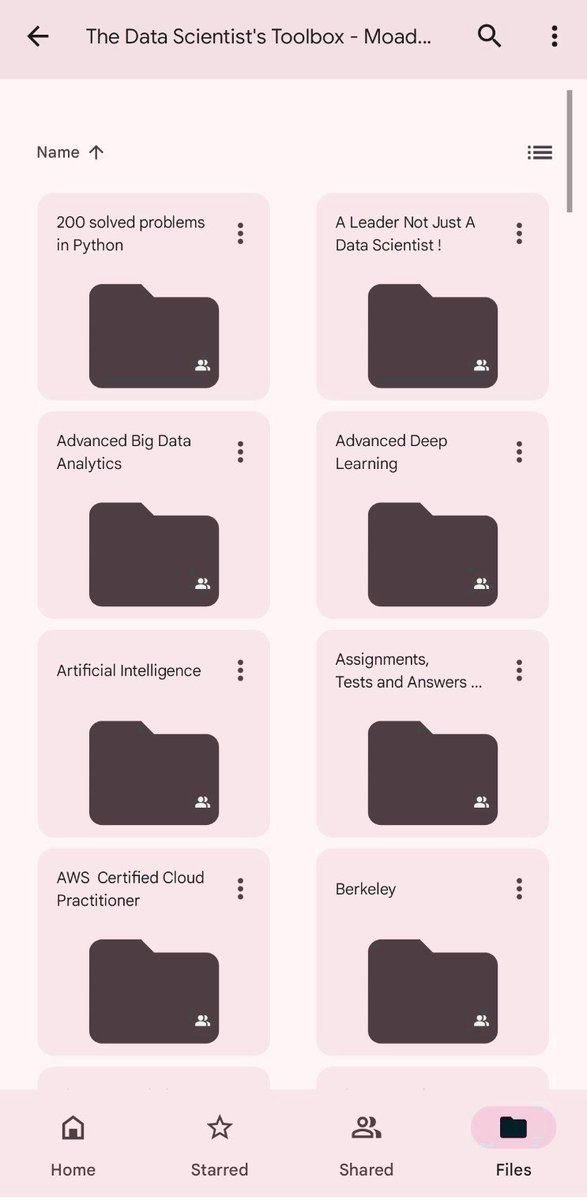
𝐀𝐥𝐥 𝐏𝐚𝐢𝐝 𝐂𝐨𝐮𝐫𝐬𝐞𝐬 (𝐅𝐫𝐞𝐞 𝐟𝐨𝐫 𝐅𝐢𝐫𝐬𝐭 2500 𝐏𝐞𝐨𝐩𝐥𝐞)😍👇
1. Artificial Intelligence
2. Machine Learning
3. Cloud Computing
4. Ethical Hacking
5. Data Analytics
6. AWS Certified
7. Data Science
8. BIG DATA
9. Python
10. MBA
11. Excel and many more...
(48 Hours only ⏰)
To get-
1. Follow me (So, that I can DM)
2. Like and Retweet
3. Reply " All "
𝗢𝗻𝗲 𝗦𝗲𝗰𝗿𝗲𝘁 𝘁𝗼 𝗕𝗲𝗰𝗼𝗺𝗲 𝗮 𝗚𝗿𝗲𝗮𝘁 𝗦𝗼𝗳𝘁𝘄𝗮𝗿𝗲 𝗘𝗻𝗴𝗶𝗻𝗲𝗲𝗿
We've all heard the saying, "Practice makes perfect." But when it comes to software engineering, the real growth happens outside of the 9-to-5 grind.
You can become a good software engineer through daily work assignments and on-the-job experience.
However, the path to true greatness lies in what you do after work hours.
The harsh reality is that workplace projects often involve constraints, deadlines, and compromises (read Scrum and Jira :).
You may only sometimes have the luxury to explore cutting-edge technologies, experiment with novel approaches, or dive deep into complex problem-solving.
This is where your projects and self-driven learning come into play.
After work, you can stretch your skills, explore new territories, and tackle challenges that challenge your curiosity.
It's an opportunity to learn at your own pace, make mistakes without consequences, and push the boundaries.
So, if you aspire to become a great software engineer, don't limit your growth to the office walls.
Dedicating time after work to personal projects, contributing to open-source initiatives, attending meetups or conferences, or playing with new languages or libraries is crucial.


![e_opore's tweet photo. Tokenization Strategies for LLMs
✓ Tokenization is the first and most critical step in processing text for Large Language Models (LLMs).
✓ It converts raw human language into smaller, machine-readable units called tokens, which serve as the building blocks for model understanding.
→ What Are Tokens?
✓ A token can represent a word, part of a word, character, or even punctuation mark.
✓ Example:
→ Sentence: “Machine learning is powerful.”
→ Tokens: [“Machine”, “learning”, “is”, “powerful”, “.”]
✓ The exact tokenization method depends on the model’s architecture and training data.
→ Why Tokenization Matters
✓ LLMs cannot process raw text directly — they understand only numbers.
✓ Tokenization bridges this gap by mapping words to unique numerical IDs.
✓ The strategy used affects:
→ Model accuracy and efficiency.
→ Vocabulary size and generalization.
→ Handling of unseen or rare words.
→ Common Tokenization Strategies
1. Word-Level Tokenization
✓ Splits text by spaces or punctuation.
✓ Example: “AI changes everything.” → [“AI”, “changes”, “everything”, “.”]
✓ Simple and human-readable but leads to large vocabulary sizes and poor handling of new words.
2. Subword Tokenization
✓ Breaks words into smaller, meaningful pieces (subwords).
✓ Balances between full words and characters, helping models handle unknown or rare terms.
✓ Common techniques:
→ Byte Pair Encoding (BPE): Merges frequently occurring character pairs into subwords.
→ WordPiece: Used in BERT; builds a vocabulary based on word frequency and likelihood.
→ Unigram Language Model: Used in SentencePiece; selects subwords probabilistically for optimal segmentation.
✓ Example: “Unbelievable” → [“Un”, “believ”, “able”]
3. Character-Level Tokenization
✓ Treats every character as a token.
✓ Example: “AI” → [“A”, “I”]
✓ Advantage → Handles any text or symbol without unknown tokens.
✓ Drawback → Long sequences and slower training.
4. Byte-Level Tokenization
✓ Converts text into byte representations (0–255 range).
✓ Used by models like GPT-2 and GPT-3 to handle all languages and symbols uniformly.
✓ Example: “ChatGPT” → Encoded as a sequence of bytes rather than letters or words.
✓ Extremely flexible, enabling multilingual and domain-agnostic capabilities.
→ Modern Hybrid Approaches
✓ Many modern tokenizers combine multiple strategies for better balance.
✓ Example → GPT models use byte-level BPE, combining byte-level robustness with subword efficiency.
✓ These hybrid methods allow models to:
→ Process any text input (code, symbols, emojis).
→ Maintain compact vocabularies.
→ Achieve efficient memory and speed performance.
→ Tip
✓ Tokenization converts human text into structured numerical input.
✓ Word-level → simple but limited.
✓ Subword-level → efficient and widely used.
✓ Character/byte-level → flexible and robust.
✓ Modern LLMs rely on byte-level BPE or SentencePiece for language versatility and scalability.
📘 Master LLMs using this ebook:
https://t.co/DBXPEOcHrI](https://pbs.twimg.com/media/G4HNn4HXQAAD1Us.jpg)




![e_opore's tweet photo. Tokenization Strategies for LLMs
✓ Tokenization is the first and most critical step in processing text for Large Language Models (LLMs).
✓ It converts raw human language into smaller, machine-readable units called tokens, which serve as the building blocks for model understanding.
→ What Are Tokens?
✓ A token can represent a word, part of a word, character, or even punctuation mark.
✓ Example:
→ Sentence: “Machine learning is powerful.”
→ Tokens: [“Machine”, “learning”, “is”, “powerful”, “.”]
✓ The exact tokenization method depends on the model’s architecture and training data.
→ Why Tokenization Matters
✓ LLMs cannot process raw text directly — they understand only numbers.
✓ Tokenization bridges this gap by mapping words to unique numerical IDs.
✓ The strategy used affects:
→ Model accuracy and efficiency.
→ Vocabulary size and generalization.
→ Handling of unseen or rare words.
→ Common Tokenization Strategies
1. Word-Level Tokenization
✓ Splits text by spaces or punctuation.
✓ Example: “AI changes everything.” → [“AI”, “changes”, “everything”, “.”]
✓ Simple and human-readable but leads to large vocabulary sizes and poor handling of new words.
2. Subword Tokenization
✓ Breaks words into smaller, meaningful pieces (subwords).
✓ Balances between full words and characters, helping models handle unknown or rare terms.
✓ Common techniques:
→ Byte Pair Encoding (BPE): Merges frequently occurring character pairs into subwords.
→ WordPiece: Used in BERT; builds a vocabulary based on word frequency and likelihood.
→ Unigram Language Model: Used in SentencePiece; selects subwords probabilistically for optimal segmentation.
✓ Example: “Unbelievable” → [“Un”, “believ”, “able”]
3. Character-Level Tokenization
✓ Treats every character as a token.
✓ Example: “AI” → [“A”, “I”]
✓ Advantage → Handles any text or symbol without unknown tokens.
✓ Drawback → Long sequences and slower training.
4. Byte-Level Tokenization
✓ Converts text into byte representations (0–255 range).
✓ Used by models like GPT-2 and GPT-3 to handle all languages and symbols uniformly.
✓ Example: “ChatGPT” → Encoded as a sequence of bytes rather than letters or words.
✓ Extremely flexible, enabling multilingual and domain-agnostic capabilities.
→ Modern Hybrid Approaches
✓ Many modern tokenizers combine multiple strategies for better balance.
✓ Example → GPT models use byte-level BPE, combining byte-level robustness with subword efficiency.
✓ These hybrid methods allow models to:
→ Process any text input (code, symbols, emojis).
→ Maintain compact vocabularies.
→ Achieve efficient memory and speed performance.
→ Tip
✓ Tokenization converts human text into structured numerical input.
✓ Word-level → simple but limited.
✓ Subword-level → efficient and widely used.
✓ Character/byte-level → flexible and robust.
✓ Modern LLMs rely on byte-level BPE or SentencePiece for language versatility and scalability.
📘 Master LLMs using this ebook:
https://t.co/DBXPEOcHrI](https://pbs.twimg.com/media/G4HNn40XcAAqXaS.jpg)