Programming is the art of abstraction, of understanding how to compose smaller ideas into bigger ones, of how to understand the automation of a larger system by understanding the rules that automate smaller ones and understanding how to combine them.
Working on the Git Merge conf videos and watching @nasamuffin's excellent SHA-256 talk, I was again filled with the dread of Git 3.0's upcoming hashing default switch.
I wrote up why I feel this is a huge mistake and why I think it shouldn't be done:
https://t.co/h8rZtP97tL
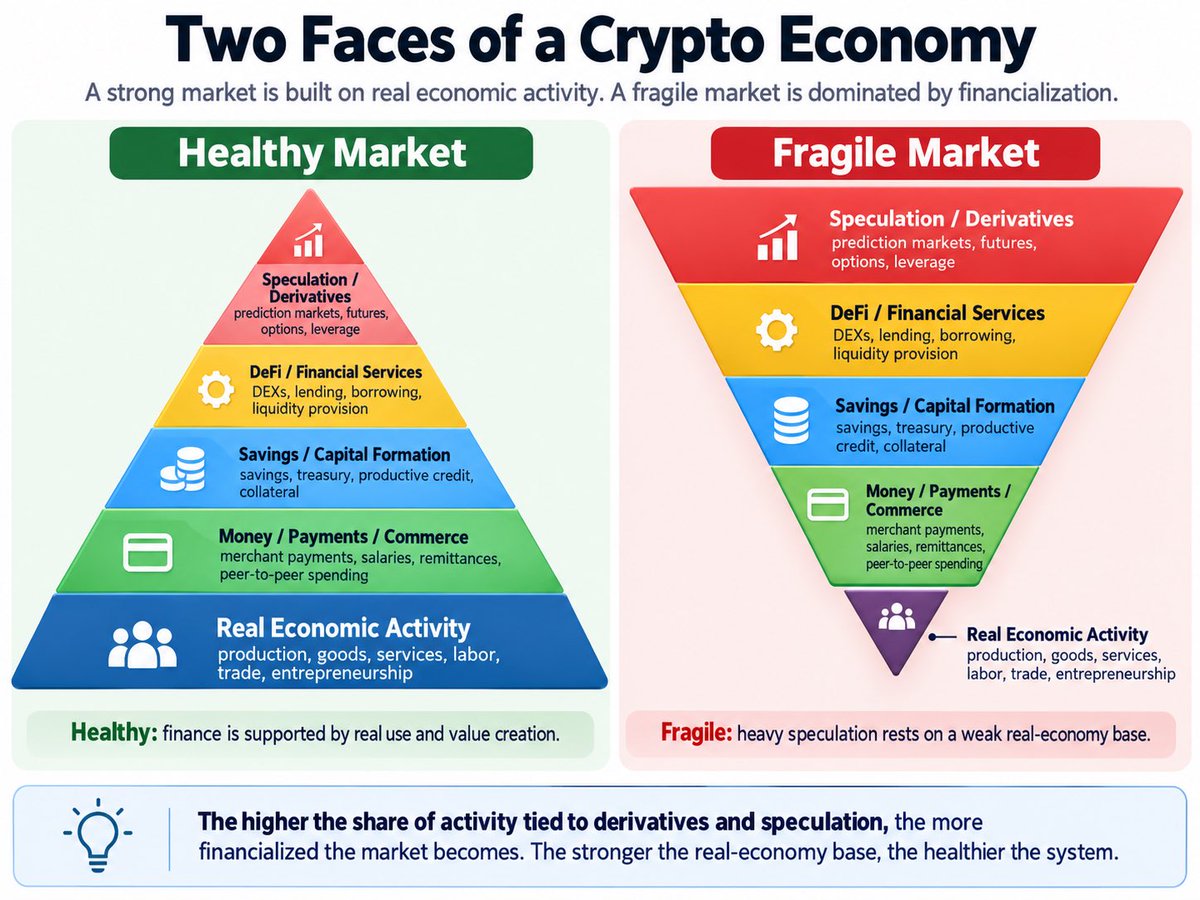
I think one way to understand why so many crypto projects eventually fall apart is to look at the shape of the economy around them.
A healthy crypto economy should look like a pyramid.
At the bottom is real economic activity: people producing things, selling services, paying workers, buying goods, running businesses, sending remittances, and using the currency in everyday transactions.
On top of that come payments, savings, lending, exchanges, liquidity markets, derivatives, prediction markets, and the rest of the financial layer.
There is nothing wrong with those things. A real economy needs finance.
The problem is that a lot of crypto projects end up building the pyramid upside down.
There is a huge amount of trading, staking, yield farming, leverage, derivatives, speculation, and token activity, while the amount of actual economic activity underneath remains tiny.
The token gets traded, staked, wrapped, borrowed against, put into another protocol, and used to earn yet another token.
But who is actually buying things with it? Who is getting paid in it? What businesses depend on it? What useful services are being exchanged?
Often, not much.
That is why these ecosystems can look enormous during a bull market and still be very fragile. Most of the activity is financial activity feeding on more financial activity.
And sometimes this is not even an accidental outcome. It is the design. Some projects are built around creating a narrative, attracting liquidity, pumping a token, and giving early participants a way to extract money from those who arrive later. There was never much intention to build a real economy underneath it.
This is where Bitcoin Cash is different.
The $BCH culture has always been unusually focused on the bottom of the pyramid.
Peer-to-peer electronic cash. Merchant adoption. Low-cost payments. Remittances. People actually spending BCH. Businesses accepting it. Building wallets, payment processors, point-of-sale systems, marketplaces, and other tools that make BCH useful outside an exchange.
And importantly, this is not just an aspiration. Progress has already been made.
There are communities where BCH is used for everyday commerce. There are merchants accepting it. There are companies building payment infrastructure around it. There are stablecoins, tokens, smart contracts, DEXs, lending projects, and other financial tools beginning to develop on top of that payment layer.
So BCH does not need to abandon DeFi or financial innovation. Quite the opposite. Those layers can make the ecosystem much more useful.
But the culture of BCH already understands something that much of crypto seems to have forgotten:
the financial layer should sit on top of an economy, not pretend to be the economy.
That is why I think Bitcoin Cash is particularly well positioned to build the first pyramid.
We should keep growing the base: more merchants, more users, more salaries, more services, more business activity, more machine payments, more real things being bought and sold using BCH.
Then let the financial layer grow with it.
DEXs, lending, prediction markets, derivatives, stablecoins, tokenized assets — all of these have a place. But their long-term value is much stronger when they are serving a growing economy underneath them.
Bitcoin Cash is not starting from zero here.
The culture is already pointed in that direction. The infrastructure is being built. Real-world adoption, while still small relative to what it could become, already exists.
The challenge now is to make that base much, much bigger.
Because the strongest crypto economy will not be the one with the most elaborate financial engineering.
It will be the one with the most real economic activity underneath it.
Ursula von der Leyen announced this week that everyone in the EU must use the official EU age verification app to verify their age before they can log into or post on social media and other digital services.
As an expert in online child safety, I'm here to expose the disinformation in each von der Leyen's statements. See below.
🇪🇺 The EU Kids Act is a pretext designed to enforce mandatory digital identity verification on everyone in Europe. The proposed legislation applies to any digital service featuring feeds, user generated content, or messaging:
Social media networks, video platforms, online gaming services, AI tools, and media streaming apps like Spotify. (@TimSweeneyEpic)
Under the proposal, digital services must enforce age restrictions across strict tiers. Tech companies must mandate age verification across all accounts to enforce these tiers legally.
When Australia introduced its social media ban, the government conceded it failed because platform level age checks weren’t reliable. They now reject age estimation as inadequate and shifted to demanding "robust" age checking.
💡 If you eliminate every unproven estimation method, you’re left with exactly 1 functional mechanism: identity verification. There's not other way to ensure age checking is "robust".
No government wants to admit citizens must prove their real identity just to access apps and basic streaming services like Spotify, so they hide behind the ambiguous phrase "robust age checking". This language is now used across Australia, the US, and Ireland to mandate identity checks while avoiding the public backlash of calling it what it is. I will research to see where else it’s being used.
Below is what Ursula von der Leyen told the European Parliament in Strasbourg along with my analsyis:
🇪🇺 "Today, much of this power has been taken out of the hands of parents... What our children need is time... But when a child has a smartphone, all of this is taken away."
💡 This framing falsely presents smartphones as uncontrollable. Apple and Google built free OS controls into iOS and Android settings, covering virtually every smartphone on the market.
These controls achieve every legitimate safety objective without collecting personal data or processing state credentials.
💡 Millions of parents use these parental controls to enforce screen time curfews, block app installations, and restrict communication.
💡 These settings operate at the device level. Teens can't bypass them when protected with a passcode.
To bypass this technical reality, the European Commission uses public grief to shut down logical analysis:
🇪🇺 "Day and night, parents see the costs, loss of sleep, anxiety, even self-harm, and in a growing number of cases, even fatal tragedies… a 14-year-old girl living in Belgium who took her life exactly one month ago, victim of bullying online... Honourable members, enough is enough."
💡 Citing personal tragedies replaces software engineering facts with emotional rhetoric. State laws and age gates don’t alter human behaviour or prevent online harassment. Regulators exploit grief to pass surveillance legislation without explaining how the underlying software mechanisms operate.
The Commission outlines specific age tiers to restrict access:
🇪🇺 "In sum, no social media under the age of 13. No personal account under the age of 15. That means from 13 to under 15, only mini accounts set up and supervised by parents or guardians with limited features and time restriction to one hour a day. And between 15 and 18, safe design will be an obligation for the platforms."
💡 Enforcing age tiers forces tech companies and service providers to rebuild their architecture around total access control. The must disable self-service account creation, purge unverified accounts, build supervised parental workflows, strip algorithmic feeds, and enforce strict session cutoffs.
💡 Social networks operate on open interaction algorithms that inherently expose people to unvetted content. Because software can’t dynamically filter these risks for minors, tech companies must block access for everyone until a person proves their real identity.
💡 It’s not just about social networks. They want the same bans for almost everything, including games and stream services. Even Spotify because it’s possible for customers to message people.
The Commission claims its proposed zero knowledge proof app protects personal privacy:
🇪🇺 "Age will be verified using EU certified tools like our age verification app. This app is built on zero knowledge proof. That means that the platform only learns one single thing, and that's whether you're old enough to allow access or not."
💡 This framing describes what an app or service receives while hiding what everyone must give up. A zero knowledge proof provides a mathematical confirmation, but that confirmation requires an authoritative issuer. Before the app generates a proof, a state approved entity must verify the person's real identity.
The Commission frames this shift as a victory against tech corporations:
🇪🇺 "I am aware that many perceive the power of Big Tech as overwhelming and impossible to roll back. I disagree... So we do not accept this. We are reversing the burden of proof. Now platforms will have to prove to us that they are safe. Because this is not about our minors accessing social media. It is about when and how we allow social media to access our minors."
💡 Social networks don’t access children; parents hand smartphones to children. Reversing the burden of proof forces everyone to verify their identity.
The European Commission confirmed the broader scope of this mandate:
🇪🇺 "We also know that not only minors are at risk. Addictive design, for example, are harming everyone. This is why we need a wider framework too, the Digital Fairness Act that we will propose in autumn."
🚨 Child safety is merely the initial wedge. The Digital Fairness Act expands state mandated identity verification to adults across all online services. Binding real identities to online activity permanently eliminates pseudonymous access, private communication, and democratic accountability.
🚨 Senior state officials and regulators know their demands have nothing to do with child safety. They work closely with tech companies and understand that iOS and Android already provide complete authority to restrict devices locally without collecting personal data. State officials deliberately ignore well established parental controls because they keep internet access under family control. Child safety is a public pretext.
🚨 Governments and regulators use child safety to establish mandatory identity verification across every app and digital service, eliminating online anonymity. When tech companies and state agencies link every social media post, private message, search term, geographic location, and financial transaction to a verified identity, they create a permanent digital dossier on every citizen with a global social graph that makes Cambridge Analytica look like a 2nd grade school science project.
💡 Binding people’s identity to daily activity enables predictive behavioural modelling too. By feeding identity data into automated predictive AI, governments, intelligence agencies, law enforcement, and tech companies move beyond surveillance past behaviour. They can map political affiliations, predict individual actions, flag dissent before it occurs, and control public opinion at scale. Eliminating online anonymity ends free speech, private communication, and democratic accountability.
As Larry Ellison stated at Oracle’s Financial Analyst Meeting in 2024:
"Citizens will be on their best behaviour, because we’re constantly recording and reporting everything that’s going on".
🙏🏻 Share this to expose how governments use child safety as a false pretext to force mandatory digital identity verification on everyone.
https://t.co/euLnd0qfhK
Try to buy a prepaid sim on @KPN website in order to get myself a phone number, am required to fill in my phone number on the checkout page.
Someone did not think this through...
Dear CoinEx Community,
Today, I am announcing that CoinEx will cease operations and begin an orderly wind-down.
First, what matters most: your assets are safe. CoinEx’s reserve ratio exceeds 100%, and every user asset is fully backed and available for withdrawal. Withdrawals are open starting today and will remain open until December 22, 2026. Certain tokens may take slightly longer to process while funds are moved between cold and hot wallets, but every withdrawal request within the withdrawal period will be honored and processed.
CoinEx officially went live on December 22, 2017. Exactly nine years later, on December 22, 2026, the platform will be formally closed. Nine years is a long time in crypto. Together, we lived through multiple bull and bear cycles, witnessed the rise and fall of countless projects, and watched many of our peers leave the market in one form or another.
After much reflection, I have come to accept a hard truth. CoinEx did not become one of the industry’s leading exchanges, and the security and compliance risks of running a crypto exchange have become increasingly difficult to contain. Revenues can decline, responsibility does not. Carrying unlimited risk for limited revenue is no longer a rational choice. That said, CoinEx has survived nine years in one of the most volatile and unforgiving industries, weathered every storm, and is leaving intact, and with dignity. We may not have won the race, but we are finishing with honor.
On CET: CoinEx will buy back CET at its initial listing price of 0.005 USDT per token, with no cap on quantity. To every CET holder who has supported us over the years, thank you. CET represents your belief in CoinEx and, for many of you, your belief in me personally. I am sorry that we were not able to create the long-term value we once hoped CET would deliver. The least we can do now is bring that chapter to a responsible conclusion.
I did seriously consider selling CoinEx. Ultimately, I decided against it. Users entrusted their assets to CoinEx because they trusted the platform and, in many cases, trusted me personally. I did not feel that handing the platform and that trust to a new owner was the right way to end this journey. A clean ending is the right ending.
Nine years, millions of users. I did not turn CoinEx into the “great” exchange I once hoped it would become. But I can give it a decent ending: making sure users can withdraw their assets in full, giving my employees a dignified farewell, and providing CET holders with a clear and responsible conclusion. This is the best ending I can give CoinEx.
To everyone who traded with us, built with us, and stood by us through the hardest days of this market, thank you. It has been a privilege to walk this road with you.
To the CoinEx team, thank you for building this platform with me, for carrying it across every cycle, and now for seeing it through to the very last day.
For detailed arrangements, please refer to the official announcement: https://t.co/E27wSecpug
Thank you all for nine years of trust.
Haipo Yang
Sept 15, 2026
@Scavacini777 Maybe faith based technology-choices always end up meeting reality.
The LN idea is too fragile and costly for people to keep supporting with real money forever. Real money that slowly bleeds away, until someone just steals all of it in one go.
@BitcoinCashOG of the last... 20 projects that came to Bitcoin Cash, practically all are actually also about extracting value from people.
I mean, even decentralized paying a central designer (of tech) is still about extracting value.
This is a cultural (mis)value, it pervades all.
Philosophy professors, as most that don't do but teach, are just ok-ish at feeling where the consensus goes and they try to front-run it.
So the scare-mongering on AI we've seen in the last week is cause to "have an opinion" for such a person.
It should not surprise anyone that a university professor ends up picking the side of oversight, regulation and more control. As that is the basis of his job and the concept of schooling in the 21st century.
The real questions should be around how these things always end up enriching government and friends-of-goverment-officials. Because AI "pause" means more regulations, which means more oversight and thus some new company that specializes in this stuff but is under "control" of government agencies.
And that is always going to end up being just another legal way to steal from the people. Probably by making products more expensive.
8 years imo. In 2018 someone spun up a Lightning node labeled “Roger Ver.” Other public nodes simply did not open channels to it. A screenshot of the isolated node circulated, and many Lightning supporters treated it as a joke. Ver’s response was that this demonstrated Lightning enables financial exclusion in a way the base layer does not: on-chain, any miner can include a valid transaction; on Lightning, participation depends on other nodes choosing to peer with you.
Charlie Lee and others countered that the operator had “censored himself” by using that name and that refusing a channel is ordinary voluntary association, not protocol-level censorship.
Later filtering fights (inscriptions/“spam,” OFAC-aware pools, Knots policy, and the latest proposal to make certain miners’ outputs unspendable) follow the same pattern. Critics who said second-layer routing and policy filters would create exclusion points were dismissed; years later the same camps are arguing over explicit consensus blacklists.
@kzKallisti Make extra sure they create small patches so you can simply reject stuff that makes no sense. Don't argue WHY something doesn't make sense. Just don't use it.
@SpadesHQ@TheDesertLynx my "most likely scenario" is still that the CIA meeting triggered the hunt for Satoshi by the US goverment which ultimately lead to his death.