Community is becoming even more important in crypto.
Our community team at @hypepartners built a 190k+ member Discord in 2 months.
Here’s how we managed to maintain positive sentiment while scaling to 500k+ weekly messages.
We launched the server in August 2025, exploding to 64,000 members in just one week. Organic campaigns, narrative-led messaging, and active moderation allowed us to scale quickly. We did not use low-quality tactics like questing platforms or InfoFi.
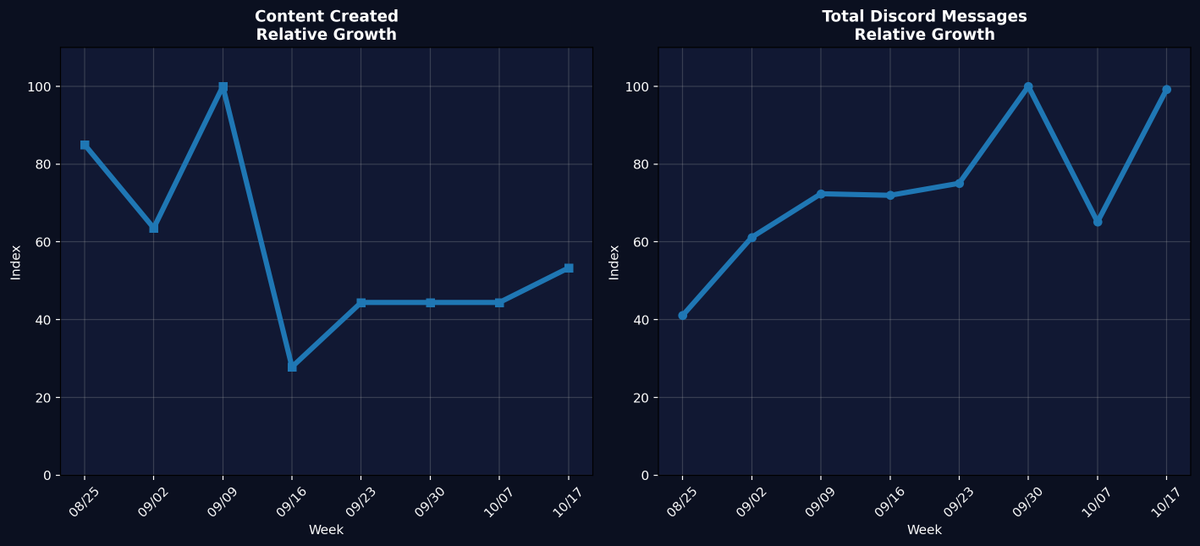
Growth really accelerated in late September, hitting a peak of 506,000 messages in a single week.
The biggest spike came from a curated UGC-based campaign.
Community members were asked to create original, high-quality content explaining the product in their own words (threads, visuals, suggestions, short explainers) and submit it for review. We manually curated submissions, highlighted the strongest ones inside the community, and assigned visible roles to selected contributors.
Results:
A clear jump in weekly messages(+2M total messages in September,
Strong repeat participation(+32k content in September)
And faster onboarding driven by peer-generated explanations instead of moderation prompts.
It worked because the contribution converted into status, not XP or volume. Quality was rewarded and noise was filtered.
Engagement scaled with size; we consistently saw 200k-300k weekly messages even months after the initial hype.
Thanks to our feeder campaigns and community-owned campaigns & programs, we managed to keep sentiment positive every single week despite the massive influx of users.
Our team has been managing the server for the last 6 months.
First post in a while. Expect more to come.
KOLs are still the first thing every project asks for.
I've lost count of the calls where a founder comes in with a marketing brief and it's basically one line: "we need KOLs." Not a strategy. Not a distribution plan. KOLs. It's the most requested service at @hypepartners by a mile and it's what most projects think marketing is.
And I get it. You see other projects trending, you see the big accounts posting about them, and you assume that's the whole game. It's part of it. But how you engage KOLs matters more than most teams realise, and it should never be the only thing you're doing.
So here's how I'd think about it.
How to actually work with KOLs
Most of the pain in this space comes from how deals are structured, not from the creators themselves.
If an agency takes a percentage of your spend, your incentives are broken from day one. The more you spend, the more they make. They have zero reason to negotiate hard on your behalf, and every reason to inflate budgets. You will overpay and you'll never know by how much.
If an agency only works from their own roster, you're not getting the best creators for your project. You're getting the creators they have deals with. That's their inventory problem being sold to you as a curated network. The right KOL for a DeFi protocol targeting sophisticated traders is not the same as the right KOL for a consumer app, and no fixed roster covers the whole market.
Then there's hidden fees. Undisclosed margins baked into creator rates, "management fees" stacked on top, kickbacks from the KOLs themselves. If you can't see exactly what the creator is being paid versus what you're paying, walk away.
The alternative is working with a neutral agency. One that isn't taking a cut of spend, isn't pushing a roster, and can analyse the entire market to find the creators that actually align with your project. That's how we run it at Hype: transparent rates, negotiate the best deals we can get, and pick from everyone, not just whoever we have a relationship with. It sounds obvious but it's shockingly rare.
KOLs are one piece of a distribution strategy
This is the bigger point. Even done perfectly, KOLs are one channel. If that's your whole plan, you are not doing the basics of cost efficient distribution.
The projects doing distribution properly right now are stacking channels, and the common thread across the ones that work is UGC, not brand accounts.
Reddit. Real community growth, not a brand account posting announcements into the void. Crypto Twitter is a bubble; Reddit is has a huge amount of crypto community discussion, and it's indexed heavily by Google and every AI model. Posts and comments from real users build karma and compound for years. A brand account gets ignored or nuked by mods. Users talking about you doesn't.
Shortform video. TikTok, Instagram Reels, YouTube Shorts. This is how content is consumed now. And again: UGC massively outperforms brand accounts. A polished brand video does a fraction of the numbers that dozens of creators posting daily content will do. The algorithm doesn't care about your logo. It cares whether people watch, and new accounts are rewarded with better push to satisfy user dopamine.
The play is volume. Hundreds of videos per month, at a cost per view that makes a single big KOL deal look mad.
Putting it together
Use KOLs for what they're good at: credibility, narrative, reaching a specific audience through a voice that the audience trusts. Pick them carefully, buy them transparently, work with someone neutral who can target the whole market.
Then complement them with high-volume UGC distribution: Reddit communities, shortform video, a mix of real people making real content AND AI generated content. We've seen it with numerous clients now that AI SFV content outperforms a lot of real content. UGC is where massive views are found at a cost that is negligble when compared to KOLs, and it's the part almost everyone skips because it's harder than wiring money to ten influencers.
KOLs get you trusted attention. UGC gets you major distribution. You need both, and most projects are missing half the opportunity.
Reddit is new SEO.
Let me give an example using just one client:
- We made a client with zero visibility, even though limited resources and documentation, visible in their category.
- Despite it being a highly competitive category, within two months we got them to rank as the 2nd suggestion on ChatGPT, the 3rd suggestion on Claude, and the 1st suggestion on Gemini.
- The posts and comments we made for the subreddit launch and alpha launch generated over 50k impressions.
- We received many technical questions and forwarded them to the team to help improve the product, thereby attracting active, engaged users.
Reddit is the new SEO. If you don’t want to miss the train, reach out to @ashnichrist. Let’s take a look together!
AI Search (AEO) has had a crazy week...
My team was getting 24hr citations from Reddit, with 1M+ impressions /mo (for brand awareness & lift).
Some things we learned:
- Reddit was nearly wiped as a source in ChatGPT
- Business websites dominate Gemini citations (60%)
- Brands in ChatGPT's search queries get mentioned 33× more
- OpenAI publishing partners get 48% more ChatGPT citations
- JavaScript could be hiding your website from LLMs
- ChatGPT ads are expanding to 31 European countries
I'm tired just looking at it lmfaooo
Reddit is still very useful for Gemini, Perplexity, etc. If your users are still big on Google (common in the anti-AI crowd) you should prob still target Reddit
But even for Gemini, we've discovered a better lever to increase AI visibility:
Optimizing your website.
What is this.. 2015 SEO again? Business websites earn 60% of Gemini citations.
The new AEO stack (we are working on this, DM if you need help):
Your website, YouTube UGC, LinkedIn / Medium, PR, podcast appearances, review sites, gitHub, etc.
All of this depends on category. And creating great information on each of these channels.
And the biggest lesson...
AI Search is volatile. It will change dramatically, probably for a while.
This is pretty common and normal for new marketing tactics.
We are all figuring it out together :)
@Ugbuericsam Yeah. Even if your product is the best, and you run very cool money prize campaigns you still need distribution.
You are a big zero without it
I posted every day for 30 days. Here are the results.
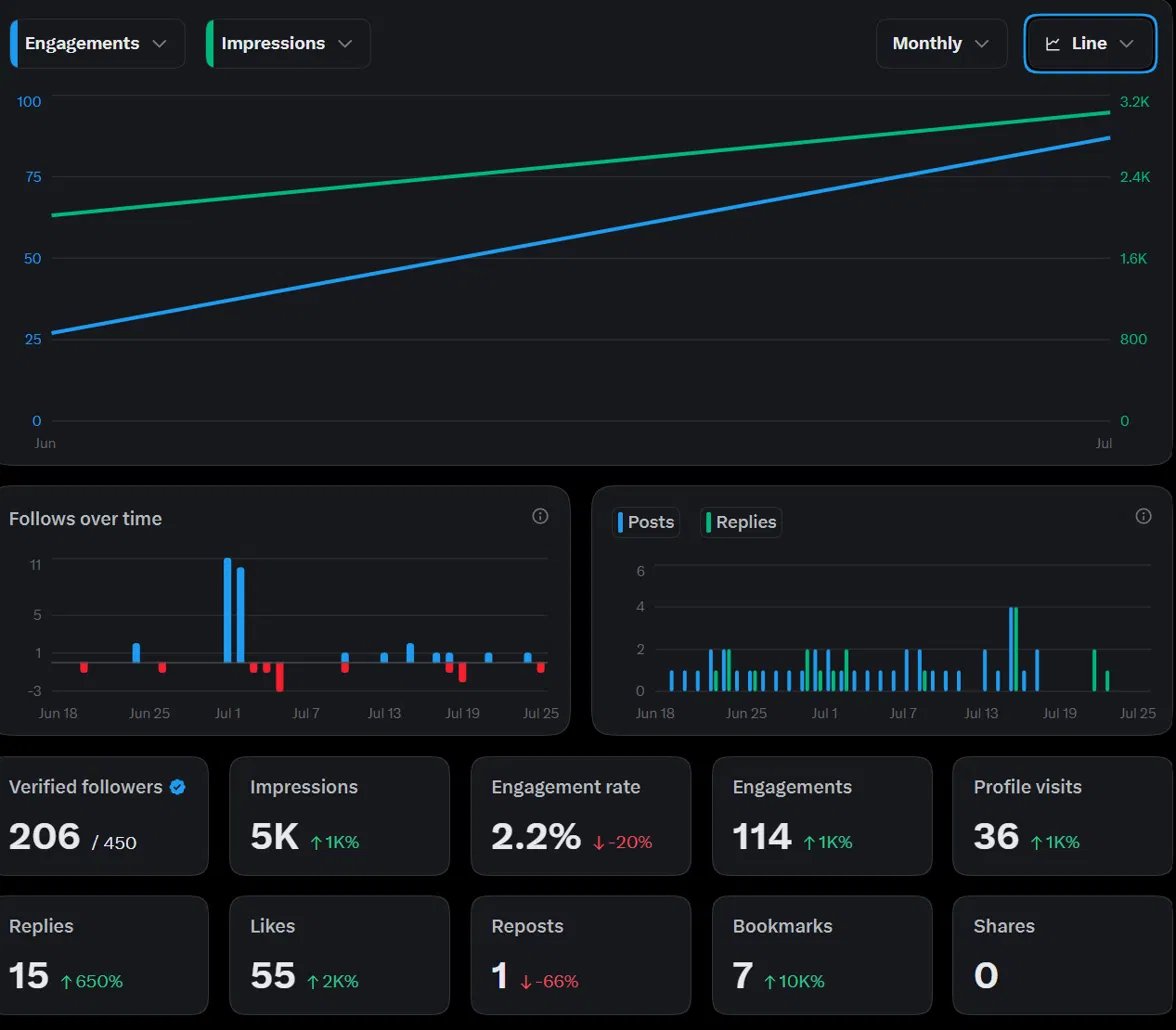
X: impressions up to 5K, engagements up over 1000%, replies up 650%, bookmarks up over 10000%. Engagement rate down 20%, reposts down 66%, shares at zero.
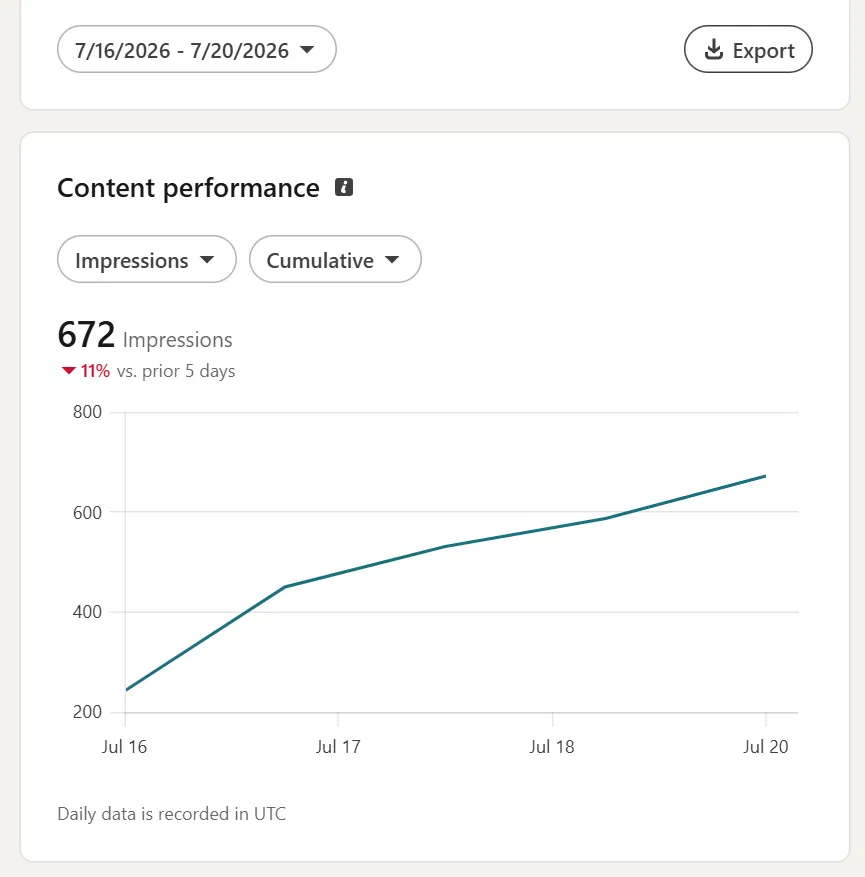
LinkedIn: 672 impressions, 74% out-of-network, 400 members reached. 8 total engagements, mostly reactions.
Reach compounds fast with consistency. Getting people to reshare is the harder problem, and that's next.
Many people say web3 marketers can't even survive in web2. The opposite is true: we learned web2's next skill set earlier, under harder conditions.
The take going around is that we never built real foundations, no CAC dashboards, no CRM flows, no funnel discipline, so we'll be exposed in a normal company. That's backwards. The skills web3 forced on us are exactly the ones web2 is now paying a premium to find.
Consider what the environment demanded. We grew products to millions of users with no paid channels, because ad restrictions kept media spend off the table for most of a decade. Growing without spending is the hardest thing in marketing, and it's becoming the norm everywhere as ad costs rise and attribution decays. Activation wins you the next quarter but brand and narrative are what drive long-term growth, and teams that only optimize the funnel hit a ceiling. We've been living on the brand-and-narrative side out of necessity.
We also learned to translate deep tech into something normal people care about, because founders here are engineers
and every project starts as a wall of jargony AI, fintech and dev-tools company is shortof right now.
Community is the clearest gap in our favour. leading tribes back in 2008 and web2 mostlyleft it as theory, while Andrew Chen's whole book on the cold start problem is basically a16z trying to systematise what we already did on instinct. We built believers across Telegram, Discord, Reddit and every micro-platform going, a
discipline web2 mostly never touched, yet "c2 buzzword precisely because they can'treliably do it. We can.
We're not ahead of everything. Consumer product marketing is a real weakness, and over-reliance on one channel was a real problem. But even those came with transferable lessons, like selling trust with no finished product to point at, which is exactly what fintech branding needs.
The deeper point is where marketing is heading. Every cycle automates the mechanical layer and raises the value of
judgment Programmatic didn't kill media buy and made strategy worth more. Mark Ritson has spent years saying the mechanical craft gets commoditised while diagnosis, strategy and positioning become the scarce skill, and Rory Sutherland makes the same case from the psychology angle, that what survives automation is
judgment, taste and a real read on what peop the same now, and the "foundations" peoplekeep listing are the first things it eats. What survives is judgment, narrative, taste, speed and community, the forced exact skill set we've been to learn the whole time.
And if you're the kind of marketer who keeps reinventing yourself, where you sit barely matters. Marketing is a restless craft, an itch you never really scratch. The tools are accessible now and easy to pick up, and learning a new one takes days, not months. What actually is a strategy you can pull out of them.
So flip the question. It isn't whether web3 marketers can survive in web2. It's how fast web2 realizes what it needs
we already know.
A gamified onboarding flow beat a straight giveaway roughly three to one on 30-day retention across every test I've run.
The giveaway spikes fast and decays fast. The onboarding flow builds slower but the members who complete it stick around at a rate the giveaway cohort never matches.
A giveaway rewards joining, an onboarding flow rewards understanding what the community actually is. Retention correlates with the second thing, not the first, and most acquisition budgets are still spent entirely on the first.
The ambassador program mistake I see most often isn't the reward structure, it's letting everyone apply to the same single track.
A generic ambassador bucket forces a writer, an event host, and a moderator to compete against a single rubric that fits none of them well. Splitting into tracks before launch, not after the first complaint, is the fix.
Any system that scores unlike things on one scale will systematically undervalue whichever type of contribution doesn't map cleanly onto that scale. The fix is almost never a better scale, it's separate scales.
Here are the @moonpay intern 101:
- Post daily
- Post money giveaways
- Farm the trends
- “We are so back”
- Reply tweets
- Visit tags and engage
- Post some technical stuff
- Partnership or amplification posts
- Don't hesitate to retweet
- Don’t hesitate to post frequently
Ty