⚡️INSIGHT: GRAYSCALE NAMES 5 DEFI TOKENS WITH “REAL VALUE”
Grayscale listed $HYPE, $AAVE, $UNI, $SKY and $MAPLE for SOLID relative value based on fundamentals.
DeFi protocols have generated nearly $25 BILLION in fees since 2023, with $UNI and $HYPE standing out for returning almost 100% of earnings to holders.
Etherealize Team Commentary on Token Terminal's Ethereum Q1 2026 Report
The headline tension this quarter was Ethereum mainnet hitting record usage levels while transaction fees fell. Ethereum is deliberately scaling the network at the expense of near-term fee capture, betting that cheaper blockspace unlocks far more demand (and eventually network revenue) in the long run.
Token Terminal's Ethereum Q1 2026 Report shows that bet is working. On a year-over-year basis, monthly active users rose 85.9%, transaction count is up 81.5%, and throughput climbed 81.7%.
This is Jevon's paradox at work, and we expect the increase in total network demand to more than make up for lower fees, similar to how the semiconductor industry generates several orders of magnitude more revenue today than it did in 1975, when Intel co-founder Gordon Moore observed that the number of transistors on a microchip doubled roughly every two years.
Furthermore, the scaling payoff is still ahead of us with the Glamsterdam upgrade targeting a more than 3x increase in the gas limit in Q3 and Ethereum's roadmap guiding to 10,000 TPS and a "fast L1" with finality in seconds by 2029.
We agree with BlackRock CEO Larry Fink who wrote in December that "tokenisation today is roughly where the internet was in 1996—when Amazon had sold just $16m worth of books."
The consensus at the time was that Amazon was a money-losing online bookseller propped up by an internet bubble. However, Jeff Bezos saw that the internet was going to transform retail and optimized for network effects and economies of scale, rather than near term profits. Ethereum is making a similar tradeoff to cement its position as the settlement layer for global finance.
The other lesson worth drawing from the Internet is that open, permissionless networks tend to beat closed ones. In 1995, Bill Gates published The Road Ahead predicting digital commerce would run on proprietary corporate networks he called the "Information Superhighway" rather than the open internet. Microsoft was building MSN. AOL, CompuServe, and Prodigy ran walled gardens with millions of paying subscribers. France's Minitel had more users than the entire web until late 1996. They all lost. No serious company would build on top of a network controlled by a competitor, and perhaps more importantly, no corporation could keep pace with permissionless innovation indefinitely.
We have seen this play out again and again: Linux out-built proprietary Unix, the open web displaced corporate walled gardens; Wikipedia displaced Britannica. Each time, the proprietary alternative had the early lead — a more focused product, larger marketing budgets, business development teams — and each time that lead eroded after the open system crossed a threshold of accumulated contribution, tooling, and credible neutrality.
We are now seeing this theme play out in financial infrastructure, and this report's data is evidence that Ethereum has crossed the threshold with dominant market share in every metric that matters.
The institutions building tokenized finance are choosing Ethereum not out of ideology but because the liquidity, composability, and institutional precedent are already there. As this report highlights, Ethereum holds 79.2% of active DeFi loans across the top five chains, 61.8% of stablecoins, 73.0% of tokenized funds, and 84.0% of tokenized commodities.
Every new tokenized asset deepens the liquidity that pulls in the next one, and a neutral substrate is the only equilibrium that holds because large players will never agree to settle on a competitor's infrastructure. Furthermore, institutions are realizing that privacy, permissioning, KYC, and transfer restrictions can all be implemented on Ethereum through privacy-preserving environments and permissioned token standards without surrendering access to public liquidity; the reverse (bolting public liquidity and an open application ecosystem onto a closed chain) is not possible.
The institutional momentum, if anything, has accelerated since quarter-end. In May alone, BlackRock filed for two more tokenized funds, JPMorgan launched JLTXX as its second tokenized money-market fund on Ethereum, and Fidelity International launched FILQ, a Moody's AAA-rated dollar liquidity fund, as an ERC-20. In the world of stablecoins, the Japan Blockchain Foundation's yen stablecoin EJPY will launch on Ethereum, and a twelve-bank European consortium (including BNP Paribas, ING, UniCredit, and BBVA) is preparing a regulated euro stablecoin.
The internet looked impossible in 1990 and inevitable by 2005. If Fink is right about where tokenization sits on that curve, the next few years could be some of the most exciting in Ethereum's history. And as we argued in our Productive Money report, network fees give ETH an intrinsic value floor, while the bull case is ETH absorbing the ~$30+ trillion monetary premium held by gold and Bitcoin given its superior monetary attributes. ETH doesn't need exorbitant fees to win.
Starkscan is here.
A new explorer and data API for the Starknet ecosystem.
Explore transactions in the UI, or query structured Starknet data through the API and CLI.
Ethereum is getting harder to value.
After Dencun, fees collapsed, but network usage kept growing. Our latest research by Luke Nolan (@eazygambit) introduces a 5-year sum-of-parts framework for ETH, combining cash flows, monetary premium, and network effects.
Base case: ~$4,935 by 2031. @ethereum
More here: https://t.co/etA5emEOAN
At the start of 2026, the Fidelity Digital Assets Research team outlined the trends shaping digital assets. Six months in, the picture is clearer—but the story is evolving.
Read our mid-year review: https://t.co/lIcnaGzQPB
The greatest mistake in crypto isn't bad timing. It's touching a position you should have held forever.
In this episode of The Journeyman, I lay out how I invest in crypto and the rules I wish I'd followed from day one. As ever, please enjoy!
🚨 Stop blaming the Ethereum Foundation for ETH's price action. It’s 2026, and that narrative is mathematically dead.
Here is the reality check: Ethereum secures a $250 billion economy, yet the EF holds a microscopic 0.16% of the supply. Let's put that into perspective. Corporate whales like Tom Lee's Bitmine currently sit on roughly 4.37% of all ETH.
That means a single corporate entity holds 27 times more Ethereum than the Foundation itself.
If you think the EF is obligated to pump your bags, you fundamentally misunderstand Ethereum.
Their initial mission—building the core software—was completed in 2022. They were never designed to be the "eternal steward" footing the bill for the entire ecosystem forever.
It is time to stop relying on the EF to do it all. Ethereum needs a new heavy-hitting entity—a massive fund, institution, or organization with real skin in the game—to step up and directly represent the financial interests of ETH holders.
Let the EF protect the tech. Let the real whales protect the price.
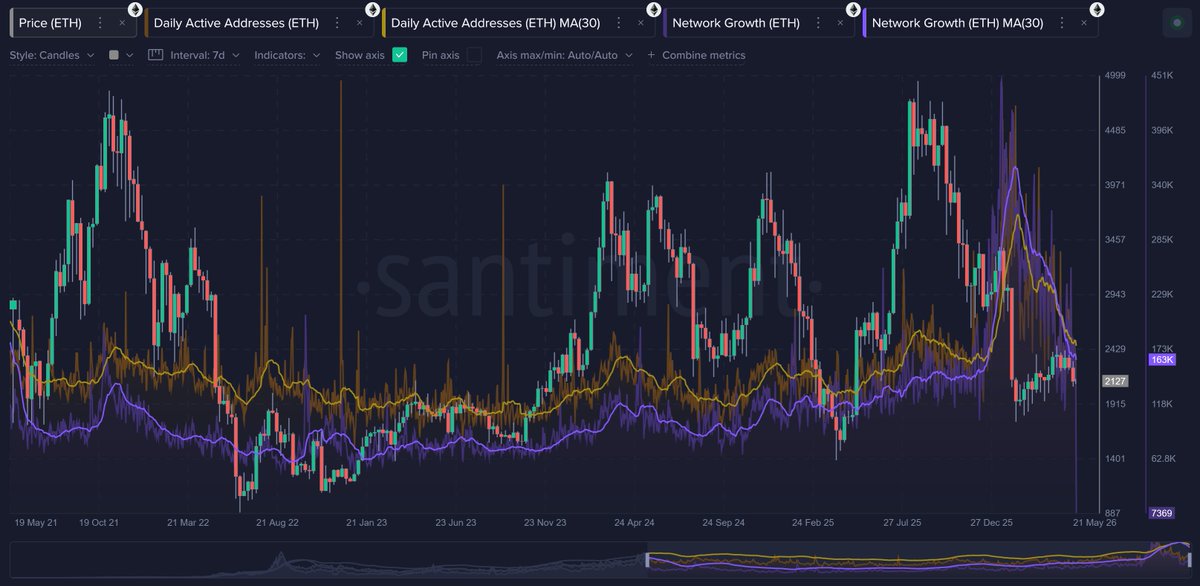
📉 Ethereum sentiment has flipped hard, and retail has jumped from crypto’s #2 market cap quickly. ETF outflows, Foundation exits, slowing network growth, and nonstop bearish narratives have traders questioning $ETH like never before. Here’s our take. 👇
https://t.co/RDpVPbdIZs
Ukraine has been crypto-native for years 🇺🇦
Now Kraken is officially here.
24/7 access to crypto, payments, and tokenized equities — plus lower fees, rewards, and exclusive offers for the Ukrainian community.
Це лише початок. Слава Україні!
🔥Tether is accumulating gold at a pace that rivals central banks:
Tether purchased 6.5 tonnes of gold in Q1 2026, bringing total holdings to a record 132 tonnes.
Over the last 6 quarters, Tether has purchased ~73 tonnes of gold in total, surpassing China's central bank purchases of ~49 tonnes over the same period by nearly +50%.
Tether's gold holdings have more than DOUBLED over the last 12 months.
In 2025, Tether acquired more gold than every central bank except Poland.
Tether is now competing directly with central banks for gold.
In 2010, Gavin Andresen built the original Bitcoin Faucet. It gave away 5 BTC at a time, distributing 19.7k BTC in total, helping bootstrap Bitcoin’s early holders.
We’re borrowing the same idea for strkBTC.
The Faucet will open in 48 hours.
Register: https://t.co/byGTQ7OANN
Claude Code x TradingView is the best AI trading quant of all time.
Gone are the days of AI slop market analysis - AI is now better at technical analysis than you.
Here's how you can turn Claude Code into your expert trading quant (in <5 minutes):
Step 1. Ensure you have these requirements:
• Claude Code - installed on your computer (this is what talks to TradingView)
• Node.js 18+ - installed on your computer (the MCP server runs on this)
• TradingView Desktop app - downloaded from https://t.co/1YkJpaCU8L
• A valid TradingView subscription (paid plan for real-time data)
Step 2. Open Claude Code and run the following prompt to connect the TradingView MCP:
"Install the TradingView MCP server. Clone and explore https://t.co/k1Ql1o0CYi, run npm install, add to my MCP config at ~/.claude/.mcp.json, and launch TradingView with the debug port."
Step 3. Health check
Restart Claude Code, and paste this prompt:
"Use tv_health_check to confirm TradingView is connected."
If correctly connected, Claude Code should respond with a confirmation.
Step 4. Start prompting
Claude Code now has access to your ENTIRE TradingView environment
Your charts, your technical analysis, alerts - everything.
Use this prompt to turn Claude Code into your personal market analyst:
"Act as an elite quantitative trader and technical analyst with full access to my TradingView environment.
Analyze the current market structure for [ASSET] on the following timeframes: 5m, 15m, 1H, 4H, 1D.
Use my existing indicators, drawings, and chart context to:
Identify the current trend and market regime (trending, ranging, accumulation, distribution)
Mark key support and resistance levels based on price action and liquidity
Identify liquidity pools, stop clusters, and likely areas of manipulation
Analyze momentum using RSI, MACD, and volume where available
Detect any chart patterns (breakouts, consolidations, deviations, etc.)
Evaluate confluence across timeframes
Then provide:
A clear directional bias (bullish, bearish, neutral)
The highest probability trade setup right now
Exact entry, stop loss, and take profit levels
Risk-to-reward ratio
Invalidation point (what would prove this analysis wrong)
Finally:
Explain your reasoning step-by-step in plain English.
Avoid generic statements. Be decisive.
If no high-quality setup exists, explicitly say “no trade” and explain why."
This is an EXTREMELY powerful setup - make sure to save this post so you don't forget it.






![milesdeutscher's tweet photo. Claude Code x TradingView is the best AI trading quant of all time.
Gone are the days of AI slop market analysis - AI is now better at technical analysis than you.
Here's how you can turn Claude Code into your expert trading quant (in <5 minutes):
Step 1. Ensure you have these requirements:
• Claude Code - installed on your computer (this is what talks to TradingView)
• Node.js 18+ - installed on your computer (the MCP server runs on this)
• TradingView Desktop app - downloaded from https://t.co/1YkJpaCU8L
• A valid TradingView subscription (paid plan for real-time data)
Step 2. Open Claude Code and run the following prompt to connect the TradingView MCP:
"Install the TradingView MCP server. Clone and explore https://t.co/k1Ql1o0CYi, run npm install, add to my MCP config at ~/.claude/.mcp.json, and launch TradingView with the debug port."
Step 3. Health check
Restart Claude Code, and paste this prompt:
"Use tv_health_check to confirm TradingView is connected."
If correctly connected, Claude Code should respond with a confirmation.
Step 4. Start prompting
Claude Code now has access to your ENTIRE TradingView environment
Your charts, your technical analysis, alerts - everything.
Use this prompt to turn Claude Code into your personal market analyst:
"Act as an elite quantitative trader and technical analyst with full access to my TradingView environment.
Analyze the current market structure for [ASSET] on the following timeframes: 5m, 15m, 1H, 4H, 1D.
Use my existing indicators, drawings, and chart context to:
Identify the current trend and market regime (trending, ranging, accumulation, distribution)
Mark key support and resistance levels based on price action and liquidity
Identify liquidity pools, stop clusters, and likely areas of manipulation
Analyze momentum using RSI, MACD, and volume where available
Detect any chart patterns (breakouts, consolidations, deviations, etc.)
Evaluate confluence across timeframes
Then provide:
A clear directional bias (bullish, bearish, neutral)
The highest probability trade setup right now
Exact entry, stop loss, and take profit levels
Risk-to-reward ratio
Invalidation point (what would prove this analysis wrong)
Finally:
Explain your reasoning step-by-step in plain English.
Avoid generic statements. Be decisive.
If no high-quality setup exists, explicitly say “no trade” and explain why."
This is an EXTREMELY powerful setup - make sure to save this post so you don't forget it.](https://pbs.twimg.com/media/HHmjVwYa0AAubBu.jpg)


