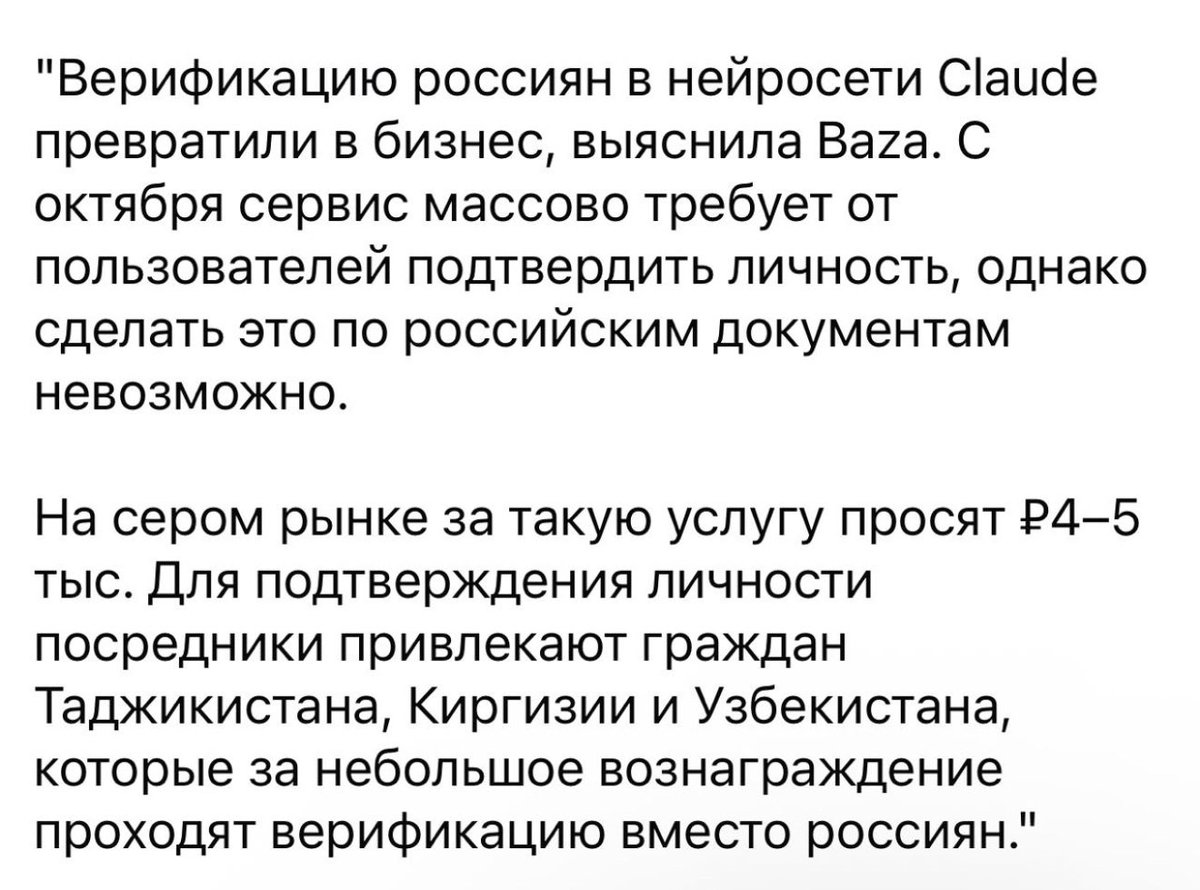
Russian users are reportedly paying 4,000–5,000 rubles to get accounts on Claude verified. According to the Russian outlet Baza, brokers recruit people in Tajikistan, Kyrgyzstan and Uzbekistan to pass identity checks on behalf of users whose Russian documents aren’t accepted.
It’s a familiar pattern from export controls. Once access to a technology is restricted, intermediaries can make money by putting someone else’s name on the transaction.
For AI companies, the question is how to enforce access rules after an account has been verified. An identity check can confirm who submitted the documents. Who actually uses the account afterward is a separate question.
Let me get this straight: we rushed AI along without regulating safeguards in order to stay ahead of China and at the same time, we sold China the very chips they’d need to get ahead of us. Smells of profit, corruption and perhaps worse.
In this short interview with The Sun, I explain what’s happening in Ukraine as our anti-corruption bodies take on mafia-style corruption networks with links to Russia’s FSB. Russia has an interest in tarnishing Ukraine’s image abroad. So do people in Ukraine who belong to these networks. They’re trying to protect themselves by portraying genuine Ukrainian corruption investigations as some geopolitical pressures. https://t.co/MPwnCIvax5
Canada is the fourth-biggest contributor to PURL, which funds these Patriot interceptors that the Pentagon is delaying. Ottawa should be asking questions about why our aid for Ukraine is being blocked. https://t.co/SOxt6Kj82a
Dan Driscoll, former US Secretary of the Army: Ukrainian battle software Delta surpasses any technology the US armed forces currently possess.
It took 10 years and a near-ban to win official adoption in August 2025. — BBC Ukraine. 1/
Trump will do everything he can to pressure Ukraine to surrender and make more Ukrainians killed. Because US is a democracy he needs to be stopped from doing this.
FT Exclusive: The delivery of anti-ballistic interceptors, which the US had agreed to supply to Ukraine and are being paid for by Kyiv’s western allies, has been held up by defence secretary Pete Hegseth, according to people familiar with the matter https://t.co/O7VoeFRc2X
Pete Hegseth is under fire over his failure to release potentially lifesaving weapons to Ukraine as Donald Trump cozies up to Russia. https://t.co/cKSgu5gmFY
The European Commission has confirmed that Ireland will be obliged to enforce a reporting mechanism on Aughinish Alumina requiring the company to provide regular and detailed information about its exports of alumina to Russia
https://t.co/6os9wT12bA
These survey results show opposition among Germans to providing military aid to Ukraine. I believe that opposition reflects the impact of Russia’s large-scale information war against Europe, waged online and rooted in the real world. Europe was woefully unprepared for these hybrid attacks. The campaign is now shaping how people think, persuading them that Europe can abandon Ukraine to Russia without facing any consequences. What would actually happen? Russia would come for them next. Getting Europeans to overlook that danger was the goal of the campaign all along.
I’ve spent 5+ years monitoring Russia’s involvement in North Africa, and just as long trying to get U.S. policymakers to care about why it matters.
Here are my two cents on Ukraine’s decision to strike Russian assets in Libya: 🧵
These three accounts, which play an important role in exposing Russian interference in Western politics, have been suspended - @vatniksoup_pt@vatniksoup_ua@P_Kallioniemi
No reason has been given for the suspension.
This is all the more concerning given that the owner of X is a key participant in Russia's influence network, and that Starshield use is restricted in Russian occupied parts of Ukraine.
Cc @vatniksoup
It's actually the other way around. It's not Kaja who has parochialism. She understands Russian threat that has a direct threat not only to the eastern flank of Europe, but to Europe as a whole. Whereas other conflicts that you mentioned, these are conflicts that we should care about, but they are not a direct threat to your life and existence in Europe.
Actually beyond the pale.
The NYC-based People's Forum (funded by the same CCP-connected multimillionaire whose wife leads CODEPINK) has been raising millions to support the Russian-backed brutal dictatorships in Burkina Faso, Niger, and Mali.
https://t.co/wCcOlk2wkM
Dear Eidtors, I am a Polish writer and investigative journalist and I see your article contains serious factual omissions. In February 2026 I spent weeks working through the Department of Justice release of the Epstein files: emails, texts, calendars, tickets, visa applications and bank transfers. The results were published by Gazeta Wyborcza and, in English "'Russia can get out in front': Epstein's advice to Putin: (https://t.co/kQzSvtepa0).
Your piece offers readers a conclusion: that Reuters found no evidence Epstein worked for Russian intelligence or acted on behalf of the Russian government while leaving out the most consequential Russian threads in the files. Besides my own work, these threads were reported in February 2026 by CNN, the Kyiv Independent, Meduza and UnHerd.
Your article does not mention the following:
Vitaly Churkin. In the files I counted eleven meetings between Epstein and Russia's ambassador to the UN in 2015–2016, some of them with Ehud Barak or Peter Thiel present. In June 2018, weeks before the Helsinki summit, Epstein wrote to Thorbjørn Jagland that Churkin "understood Trump after our conversations" and suggested that Sergei Lavrov could "get insight on talking to me." Neither Churkin nor Lavrov appears in your article. The 2016 campaign. The files show an August 2016 lunch at Epstein's home with Churkin, Barak and Tom Barrack, a senior adviser to the Trump campaign, and an October 2016 scheduling email headed "Churkin? Thiel?" five weeks before the election.
Oleg Deripaska. Your article says only that a meeting was sought through Peter Mandelson in 2010, that Reuters could not determine whether the two men met, and that associates believed Epstein exaggerated the connection. The DOJ files show more than that. In 2010, Epstein and his colleagues sought help with a visa from Oleg Deripaska; later, there was even talk of hiring his assistant. The files contain a scan of a passport with a visa from 2015. His British friend Peter Mandelson, the Labour Party politician, was also close to Deripaska, as an email from 2010 shows: "will oleg either be in paris, thurs till sunday , or moscow next week." They document Epstein's dealings concerning Deripaska over several years, with Mandelson acting as his channel. In 2018, a month after the US Treasury sanctioned Deripaska, the investor Jide Zeitlin thanked Epstein for his "thoughts re Deripaska," and Epstein forwarded the exchange to Steve Bannon. Senator Sheldon Whitehouse has stated on the Senate floor that the files indicate Epstein had dealings with Deripaska, whom the Treasury has identified as a money launderer for Putin. Most importantly, there is the flight to Deripaska. Once, Epstein flew from Beijing to Abakan in Siberia, Irkutsk, then to Moscow and St. Petersburg (August, we don't know what year). Near Abakan, he stopped in Sayanogorsk, which is where “Mr. D.”, or Deripaska as he is referred to in emails with friends, comes from. The trip is rather touristy, but Epstein also holds meetings, and in Moscow talk was of visiting the Kremlin "with inside." Your article does not mention this trip. Treating this relationship as a rumour that Epstein inflated misrepresents the record. Epstein's trips to Russia. Your article states twice that the 2002 trip was one of "only two known" visits Epstein made to Russia. This is not an omission but a factual error. In the DOJ files, Epstein's visa applications list trips to Russia between 2002 and 2007. In 2002 Epstein flew his own plane with Ghislaine Maxwell first to Japan and then to Novosibirsk, where Bill Clinton boarded and flew with them to Khabarovsk. The files also contain tickets to Moscow in October 2012, a New York–Moscow flight on 27 April 2018 with a return on 8 May, and a last trip to Moscow in April 2019, two months before his death. His calendar further shows the Beijing–Abakan–Irkutsk–Moscow–St Petersburg journey described above, and alerts for flights to Moscow, Novosibirsk and Yekaterinburg. Your own article reports that Epstein held Russian visas for much of the period from 2002 to 2019, which sits uneasily with the claim that he went there only twice. This statement should be corrected.
Sergei Belyakov. Your article presents him only as a deputy economy minister and the organiser of the St Petersburg forum. It omits that, according to TASS, he graduated from the FSB Academy in 1999. It also omits what the files show: that he approached Epstein about sanctions after the annexation of Crimea; that at a meeting at Epstein's home on 19 June 2014 the two discussed a BRICS currency and what Epstein called a "BRIC coin"; that Belyakov later helped Epstein with a Russian visa; and that in July 2015 Epstein arranged for him to meet Peter Thiel.
"Sputnik" and the financial system. In 2013–2014 Epstein used Jagland as a channel to pitch Putin a plan for Russia to "leapfrog" the West by reinventing the global financial system, including a Russian alternative to Bitcoin that he called “Sputnik”. For a story about why Epstein courted Russia, this is a central motive, not a footnote.
The 2017 FBI memo. The DOJ release includes an FBI memo recording a 2017 meeting with a confidential informant, who described Epstein as Vladimir Putin's "wealth manager," that is, as someone handling the Russian president's money. This document was reported by Meduza in February 2026 and discussed in my article. Your article does not mention it at all. It does not mention the FBI, any FBI memo or any FBI source. The informant's claim is unverified: I could not confirm it elsewhere in the files, and it should be presented with that caveat. But an investigation that tells readers it found "no evidence" that Epstein acted for the Russian state cannot simply ignore a US federal law enforcement record alleging that he managed Putin's assets. At a minimum, readers should have been told that the memo exists, what it says, and what Reuters did to test it.
Steve Bannon and Europe. Between 2017 and 2019 Epstein advised Bannon on expanding his political project into Europe, and in 2018 told him that Jagland was meeting Lavrov and Putin.
Your article presents itself as the product of extensive research: interviews with more than two dozen people and a review of "hundreds of pages" of Justice Department records, flight logs, court filings and emails. The DOJ release runs to more than three million files. What is missing from your article is not peripheral detail. It is the material that is essential to understanding Epstein's relationship with Russia. None of this proves that Epstein was a Russian asset, and I do not ask Reuters to say so. I wrote plainly in my own article that the documents do not settle that question. My objection is narrower and, I think, harder to dismiss. A finding of "no evidence" is only as strong as the evidence examined.
When a Reuters investigation publishes that finding without engaging with the Churkin meetings, the FSB-trained official working on sanctions and alternative currencies, and the contacts around the 2016 campaign, readers are given false reassurance on a question of real public importance.
The same applies to the article's statement that Epstein never met Putin. What the files support is that no meeting has been confirmed. That is not the same as establishing that none took place. On a subject this serious, publishing the piece in this form shows, first, a lack of competence: the most significant and readily available records were left unexamined. Second, it shows a lack of responsibility: Reuters' reach means that its "no evidence" conclusion will be cited for years as settled, including by those with an interest in closing the question.