I built Oathlayer because of the problems I faced, it fixed them, so I decided to launch it and as the first in a suite of products.
We all know that building agent workflows is the easy part but knowing whether to trust what the agents produce, that's where it gets hard.
Oathlayer sits inside your workflow and does one job. It tells you whether an AI response can be trusted and flags it when it can't.
Every response gets a unique doc ID that anyone can verify for free, perfect for monitoring, compliance and regulatory requirements.
With just one API call you get the answer, a trust rating, and a verifiable document ID. That's it.
Oathlayer went from being a nice to have to a must have.
API + MCP ready. https://t.co/xgKP7gkghu
@psyunodim@polynoamial@OpenAI That's not a daft question, that is the question. When AI answers become this powerful, trust and verification will always matter more than ever.
I built Oathlayer because of the problems I faced, it fixed them, so I decided to launch it and as the first in a suite of products.
We all know that building agent workflows is the easy part but knowing whether to trust what the agents produce, that's where it gets hard.
Oathlayer sits inside your workflow and does one job. It tells you whether an AI response can be trusted and flags it when it can't.
Every response gets a unique doc ID that anyone can verify for free, perfect for monitoring, compliance and regulatory requirements.
With just one API call you get the answer, a trust rating, and a verifiable document ID. That's it.
Oathlayer went from being a nice to have to a must have.
API + MCP ready. https://t.co/xgKP7gkghu
@marfinxx Magentic-One verifies task completion. Oathlayer verifies output trust. Knowing the code ran is not the same as knowing the answer is correct. The verification layer that's still missing sits after the orchestrator returns its result. https://t.co/qjLtlweGG7
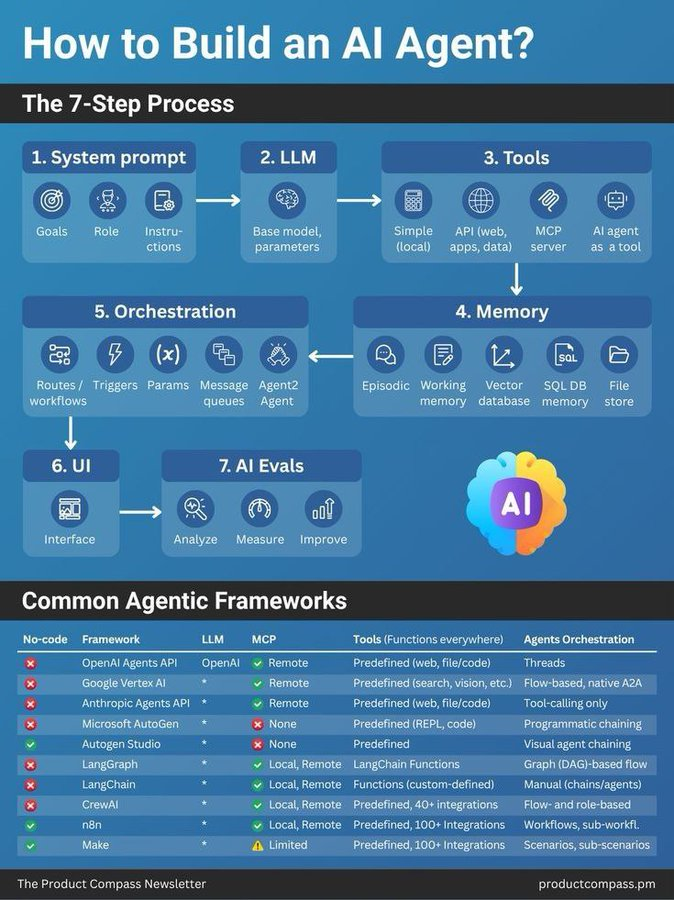
This is a really good breakdown and we made one observation referencing the evals at step 7.
This format means that they will be discovering problems after they've built everything.
Moving verification thinking to step 1 changes what they build and how they build it. https://t.co/xgKP7gkO72
Great breakdown, just one thought, you have evals at step 7, which means you're discovering problems after you've built everything.
Wouldn't moving verification thinking to step 1 change what you build and how you build it?
and yes I asked because https://t.co/xgKP7gkO72 is the verification step we believe is needed.
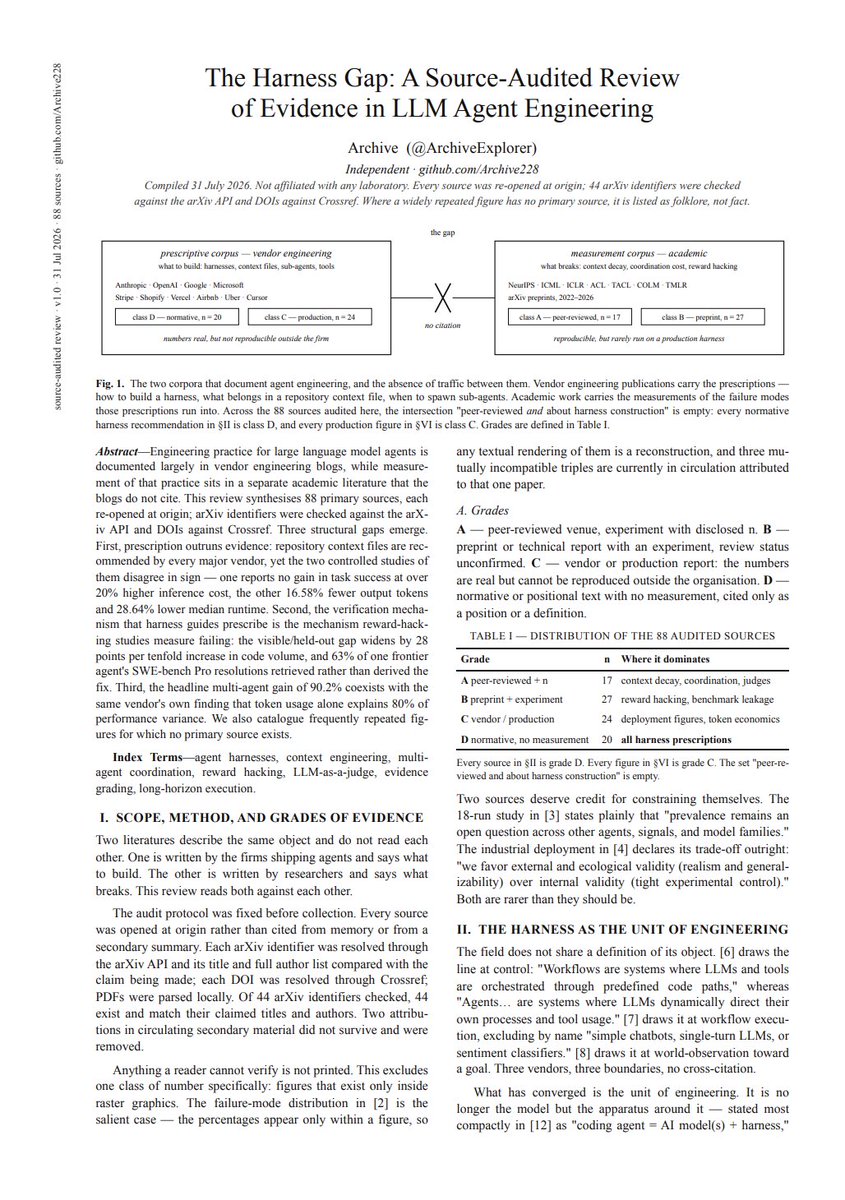
This is dangerous, this is the house of cards explained by academics and proven.
88 sources checked, 44 academic papers verified.
The conclusion is startling, everything the labs tell you to build your harness on has no measurable evidence behind it.
This isn't an opinion piece; this is proven work,
This is the house of cards in academic form I mentioned, and it shows and justifies that the verification layer that actually works has to sit outside the harness entirely, Which is https://t.co/xgKP7gkghu
this is f*cking dangerous
met a guy making $1.47M/year as a staff research engineer at one of the frontier labs.
no MIT. no Stanford. no PhD.
last month a rival lab poached him for 2x the package.
i asked him how he grew into that level of agent engineering in 2 years from almost nothing.
he looked at me and said one thing that broke me:
"The labs have already written down what actually breaks in harnesses. Just in different blog posts, at different times, by different teams. Nobody has pulled it together. Why haven't you?"
I sat down and pulled it together.
Compiled it into a document called The Harness Gap - every lab admission in one table.
-> https://t.co/8wvibIARcQ
what's inside (6 pages, 88 sources, 44 arXiv IDs verified via API, DOIs via Crossref):
• Context files (AGENTS.md/CLAUDE.md) - everyone recommends them, measured twice, opposite signs, zero success lift in either study.
• +90.2% from multi-agent in the same Anthropic post where 80% of variance is explained by token volume alone.
• Cursor: 63% of frontier-agent successful fixes on SWE-bench Pro were retrieved, not derived.
• Microsoft red team: human-in-the-loop bypass - the single most exploited failure mode over the last 12 months.
• "Effective context length" - 64x spread on the same model across two peer-reviewed papers.
• OpenAI, verbatim: "progress was slower than we expected — the environment was underspecified."
bookmark and read this - then the article below
88 sources. Every normative harness recommendation is grade D - no measurement.
The verification mechanism everyone prescribes is the one that keeps failing under measurement. Independent output verification that sits outside the harness entirely is not a nice to have, it's what's left when everything inside the harness grades its own homework. https://t.co/xgKP7gkghu
@ashpreetbedi Take a look at the numbers of how many AI integrations into business are failing and the reasons, the numbers will shock you. We are led to believe that it's all hand on deck, everyone is adopting and implementing AI into business, but something is going to break.
This is a summary of trending posts grok put together and was listed under the Today's News Section on X.
Now the content is a really interesting topic, but what drew my attention was the caveat warning at the bottom saying that 'Grok can make mistakes so please verify.' in so many words.
This is exactly what Oathlayer was created for, if you ran this through Oathlayer, you would have received the verification tag:
'Verification Successful - Perspectives Apply'
Which means the post was good to go and that to bear in mind that this subject is open to opinion, which gives you more confidence in how to use it or reply.
Each AI that is verified successful or not receives its own unique doc ID number which is verifiable free on the https://t.co/mR5o1WJ62Q website which now means you can monitor, use it for compliance and regulatory requirements, which has not been possible before.
'AI Feels Distant in Everyday Life Despite Hype
Last updated 21 hours ago
A post noting that no one in real life really uses AI beyond casual chats struck a chord, with many agreeing friends and family stick to basics like rephrasing emails. Data backs this up—Stanford’s 2026 AI Index shows quick adoption growth, but U.S. workforce use hovers around 41 percent for simple tasks, while only 18 percent of firms report broader uptake by late 2025. Discussions highlight the split between optimistic expert views, White House claims of skyrocketing wages from AI productivity, and public frustration over economic realities that don't match.
This story is a summary of posts on X and may evolve over time. Grok can make mistakes, verify its outputs.'
Trust is fragile and when using Oathlayer it will say, 'I'm not sure' for the AI.
It also provides four trust signals:
- Approved
- Threshold Not Met
- Perspectives Apply
- Complex Reserved
and a unique verifiable doc ID with every response.
The AI that admits uncertainty is the one worth trusting. https://t.co/xgKP7gkghu
@hasantoxr Citation-Aware RAG attaches sources. Oathlayer verifies them.
Knowing where an answer came from is not the same as knowing if it's right.
The missing pattern is number 16 - The verified output with a permanent auditable doc ID. https://t.co/qjLtlweGG7
Good list. Missing number 11, the output verification.
The knowing which answers from all those tools, agents and workflows are actually trustworthy before they go anywhere.
Every skill on this list produces outputs but none of them tell you which outputs to trust. https://t.co/xgKP7gkghu
The most underrated layer is the one missing from this diagram. Between the MCP Server response and the Host, the output verification.
The protocol handles the connection.
Nothing handles whether the response is trustworthy before it reaches the user. That's what Oathlayer adds. https://t.co/xgKP7gkghu
Everyone is talking about MCP (Model Context Protocol).
But almost nobody is talking about how it actually connects AI models to real-world data and tools at production scale.
This architecture changed the way I think about building agentic workflows.
The Model Context Protocol (MCP) transforms isolated LLMs into powerful connected systems by acting like a universal USB-C port for AI applications. Instead of writing custom API integration code for every tool, MCP standardizes how hosts, clients, and servers talk to each other.
Here is the exact 4-part architecture behind it 👇
1️⃣ Layer 1: The Host — The Context Consumer
Think of the Host as the user interface and orchestrator.
Examples: Claude Desktop, Cursor, VS Code, or custom AI web apps.
What it does:
• Captures the user query
• Manages the visual context
• Requests explicit human approval before running tools
• Synthesizes the final output
It’s the front door for all agent interactions.
2️⃣ Layer 2: The MCP Client — The Protocol Handler
Don't let your LLM talk directly to APIs.
The MCP Client acts as the secure middleware engine inside the host.
What it manages:
• Session Management: Handles 1:1 connections with servers
• Capability Negotiation: Discovers available tools and resources automatically
• JSON-RPC Routing: Translates model intent into standardized protocol messages
• Permission Checking: Blocks unauthorized tool calls before execution
Result: Clean separation between model logic and execution safety.
3️⃣ Layer 3: The MCP Servers — The Resource Providers
Instead of one monolithic API client, MCP splits external capabilities into lightweight, specialized servers.
Each server exposes three core primitives:
• Resources: Ambient data (file contents, database schemas, live logs)
• Tools: Executable actions (SQL execution, Git commits, API calls)
• Prompts: Pre-configured prompt templates managed server-side
Examples of MCP Servers:
👉 Postgres Server (Queries & schema inspection)
👉 GitHub Server (PRs, issues & code search)
👉 File System Server (Local workspace files)
4️⃣ Layer 4: External Services — The Target Layer
The underlying databases, APIs, and file systems.
Crucially: Credentials never touch the LLM prompt. They live entirely within the sandboxed MCP server environment.
�� The Complete Execution Flow
User Query
↓
Host identifies required context
↓
MCP Client negotiates capabilities & verifies permissions
↓
MCP Server fetches resources / executes tools
↓
System state updates & response returns to Host
💡 Why This Architecture Wins
Most legacy AI integrations look like this:
Prompt → Hardcoded API → Response
Production-grade MCP systems look like this:
Host UI → Protocol Client → Sandboxed MCP Server → Isolated Data Source
Why does this matter?
1. Write once, run anywhere: Build a Postgres MCP server once; use it across Cursor, Claude Desktop, and custom apps.
2. Security by default: 1:1 server isolation prevents cross-tool data leakage.
3. Decoupled code: Update database logic without breaking prompt engineering pipelines.
The best AI applications won't win because they have the biggest context windows.
They'll win because they have the best protocol architecture.
Protocols > One-off integrations.
📌 Save this breakdown for when you build your next MCP server.
🔁 Repost to help your dev network understand MCP architecture!
Which part of MCP do you think is most underrated: Resources, Tools, or the Client security layer?
#MCP #ModelContextProtocol #AIAgents #AgenticAI #LLM #SoftwareEngineering #Developers #AIArchitecture #AIEngineering #Coding #Automation #SystemDesign
The most underrated layer is the one missing from this diagram. Between the MCP Server response and the Host, the output verification.
The protocol handles the connection but nothing handles whether the response is trustworthy before it reaches the user. That's what Oathlayer adds. https://t.co/xgKP7gkghu
@milesdeutscher@vasuman@gregisenberg The FDE who builds the audit trail that survives after they leave is the one who gets called back.
Oathlayer is that audit trail. Permanent doc IDs on every verified output. The measurable evidence that proves the deployment worked. https://t.co/qjLtlweGG7
The verifier node is the whole game. Fresh context, independent check, catches what the worker missed. That is exactly what Oathlayer does as a standalone verification layer.
Oathlayer sits outside the graph entirely and checks what comes out the other end with a permanent verifiable doc ID. https://t.co/xgKP7gkghu