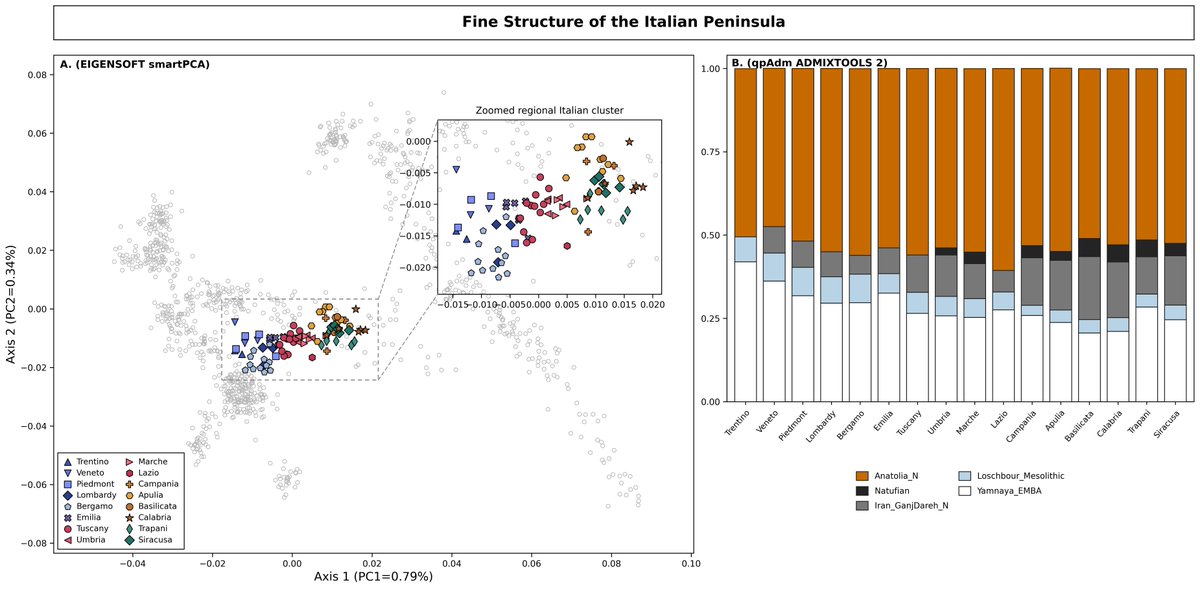
🧵: Fine structure of regional Italy
On a broad West Eurasian smartPCA, Italian regions trace a peninsula-wide cline. qpAdm shows marked ancestry variation: Yamnaya 20.6–42.0%, ANF 47.5–60.6%, WHG 3.0–8.6%, ZNF 0–18.9%, Natufian 0–5.4%.
Regarding genetics, a sample from the area distribution of Osijek-Belgrade types in 360 B.C appears with a profile akin to those of Illyrian graves from Velika Gruda, Cinamak and Skopje. F2, F3 and G25 euclidean distances were used to showcase that:
The spread of Mramorac belts and their origins.
Whilst originally thought to be a possibly Triballian invention, later older finds amongst Glasinac and North Albania which developed belt types independently from each other it became clear its origins are within Glasinac-Mat- 1/n
A new reconstruction of the oldest surviving image of Alexander the Great painted when he was 20 in 336BC. The ReVis project has used advanced scanning techniques to restore the hunt mural on the façade of the tomb of Alexander's father, Philip II with improved accuracy 1/ 🧵
@Haljj_@le_handsome@piesse21cm_@srtnynalt To elucidate what I mean by east med here, Dr. Lazaridis delineates exactly what that encompasses in this post right here.
https://t.co/x8TFAvndgx
Imperial Romans from Italy are statistically indistinguishable from Roman-Byzantine Anatolians or, secondarily, 1st millennium BC Anatolians. Their main source was Anatolia-like, and definitely not Aegean-like; they also had negligible Italian IA ancestry.
@Haljj_@le_handsome@piesse21cm_@srtnynalt Tbf it is a single sample so the extrapolatory significance is weak. That said the sample plots as an isolate due to reduced east med(znf_chg) coupled with elevated ANF(BA/IA S. Euro rel). Figure A(PCA on left) shows the sample shifted toward an ANF vector, away from chg_znf.
@Haljj_@le_handsome@piesse21cm_@srtnynalt I've only ever seen south italians being modeled as +20% chg_znf on meso models(which would be siphoning the baked in chg_znf from the steppe component in the charco model posted).
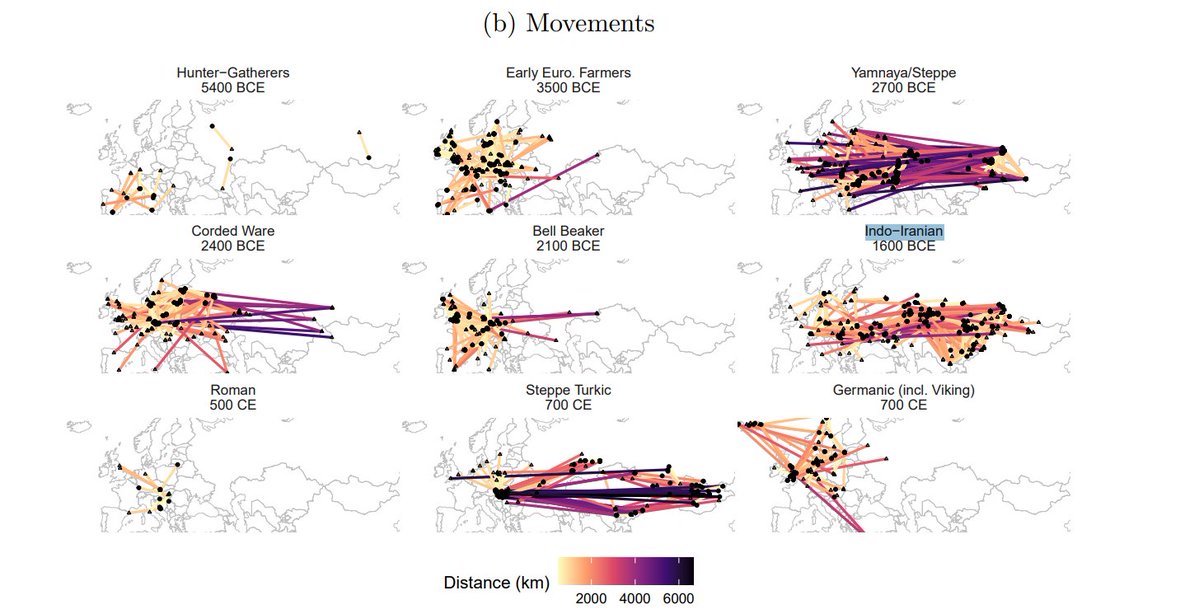
Interesting new preprint on climate and prehistoric migrations.
The image here is showing movements of Yamnaya, Corded Ware, Germanic, Roman, Steppe Turkic, Indo−Iranian groups.
Panel plots IBD-inferred movements for the same groups, with origin (solid circle) and destination (triangle) of each linked pair connected by a line colored by geographic distance.
@danielgaspare Yea, I noticed the locality after the fact. The sample’s x/y in the anno pointed toward Naples (40.85, 14.27), which confused me and ended up influencing the label I chose. I’m also not sure which Italian_South.HO samples are Griko, since there’s no mention in the anno.
🧵: Fine structure of regional Italy
On a broad West Eurasian smartPCA, Italian regions trace a peninsula-wide cline. qpAdm shows marked ancestry variation: Yamnaya 20.6–42.0%, ANF 47.5–60.6%, WHG 3.0–8.6%, ZNF 0–18.9%, Natufian 0–5.4%.
@alestohd They failed ZNF pretty badly(.015 weight and .388 Z) which was pretty amusing, although Basque.HO neg weights ZNF and I’ve seen ppl model them with it so idk if the former implies the latter 1:1, that said ZNF is without a doubt the strongest imperial vector in Euros.
🧵: Supplementary
Target definitions, sample lists, qpAdm source/right sets, and full regional model outputs: https://t.co/mybpr3P9bH
This documents all 86 Italian HO samples, their micro-regional relabeling, and the 3–5 way ancestry models used in the figure.
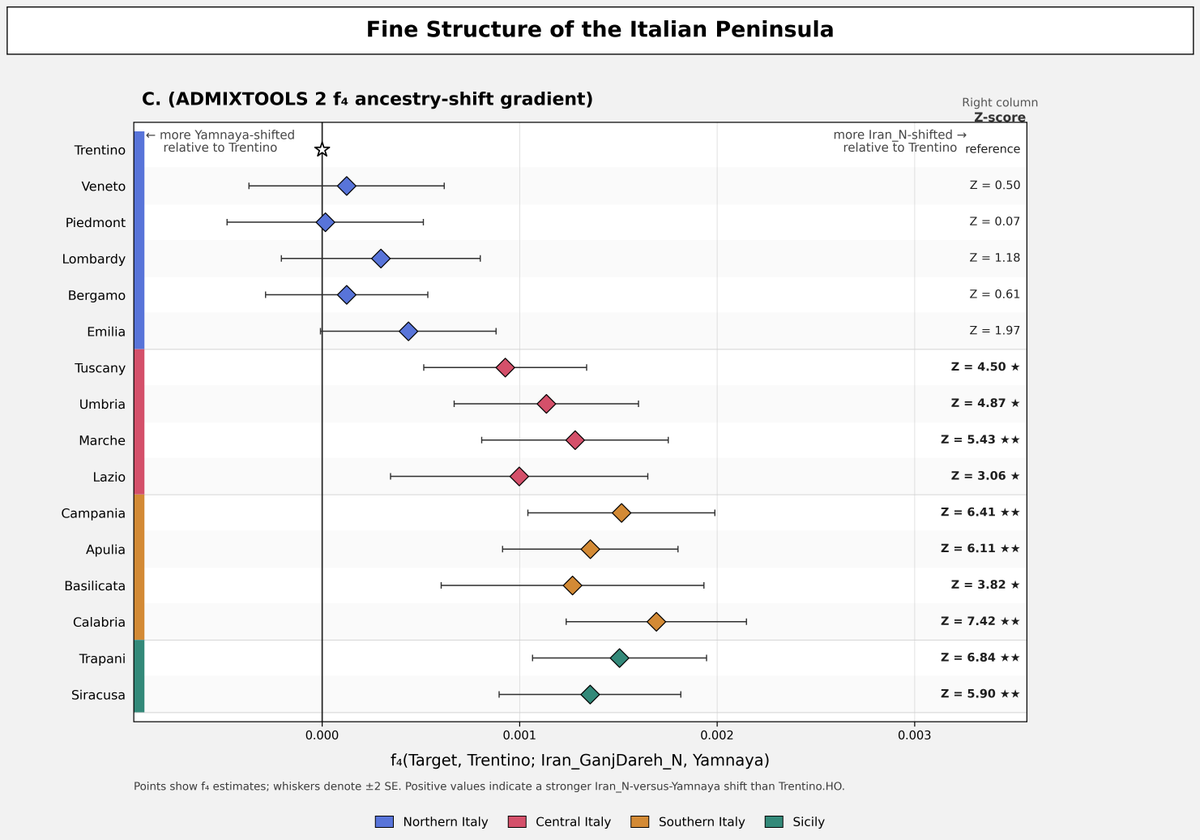
🧵: f₄ benchmark
Formal f4 tests against Trentino mirror the qpAdm cline: central, southern, and Sicilian Italians are significantly more Iran_N-shifted than the northern pole, strongest in Calabria, Trapani, and Campania.
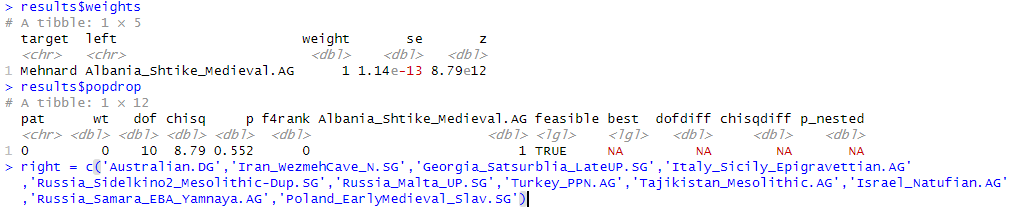
@DanTabin@IllyrianJ2bL283 for a sanity check here is how Kenete(a medieval albanian sample) will hold up on the same rightset. I will mention that out of the many albanian samples I've had sent out to me for an analysis, his stands out due to the voidness of slavic.
@DanTabin@IllyrianJ2bL283 I included each model’s rightset, akin to Davranoglou’s 2026 paper. The p worsens slightly, but the target still passes with a medieval Slavic proxy in the rightset. This was done on the v66 for naming conventions.