@NorthstarCharts@allenanalysis I don’t remember Jews robbing, killing and raping people. Maybe you should worry about your freedom of speech with your fascist UK government. No political commentary needed from you.
🚨 BREAKING: President Trump posts "who's ready to see Adam Schiff in PRISON?" and a video asking Adam Schiff what he'll do if he's charged with TREASON.
"What are you gonna do when the Deep State can't protect you anymore? [...] When you're brought up for treason?"
👀👀
The Appellate Team Representing Reginald “Reggie” Middleton
Second Circuit Appeal – Fraud on the Court (SEC v. Middleton, et al.)
Janine Gilbert, Esq.
Principal, The Law Office of Janine Gilbert, PLLC
Ms. Gilbert is lead counsel of record. Based in New York City, she has represented individuals and corporations in high-stakes federal litigation in both EDNY and SDNY, including securities enforcement, fraud allegations, and complex commercial disputes. Her practice is grounded in meticulous evidentiary analysis and appellate preservation.
---
Hon. Shannon Frison (Of Counsel – Judicial and Military Perspective)
Judge Frison is a Harvard College and Harvard Law School alumna and a former U.S. Marine Corps Judge Advocate. She later served as a Justice of the Massachusetts Superior Court, where she presided over landmark criminal and civil matters shaping state constitutional law and evidentiary standards. Her career spans military command, trial advocacy, and judicial service—giving her unmatched perspective on both the rule of law and the dangers of government overreach.
---
Prof. Ronald Sullivan (Of Counsel – Constitutional and Appellate Practice)
Professor Sullivan, a Morehouse College graduate and Harvard Law School alumnus, serves as the Jesse Climenko Clinical Professor of Law at Harvard. He directs the Criminal Justice Institute, training generations of appellate and trial lawyers. Sullivan has litigated some of the nation’s most consequential constitutional cases, securing reversals in wrongful conviction matters and systemic prosecutorial misconduct. His voice has helped shape public understanding of due process and prosecutorial accountability.
---
Why This Team Matters
This appellate team unites:
Judicial authority (a former Superior Court Justice),
Military prosecutorial and command experience (Marine Corps JAG),
Constitutional scholarship and landmark litigation (Harvard Law Professor and appellate advocate), and
Federal courtroom tenacity (New York trial and appellate counsel).
Together, they represent one of the rare combinations of practical courtroom strength, academic rigor, and judicial insight available in the United States today.
---
Transparency and Public Invitation
The team emphasizes that this appeal rests not on rhetoric but on the record already before the courts. The evidence of fraud on the court, and the amici submissions filed in support, are available for review. The public, academics, and policymakers are invited to examine this record for themselves. Judicial integrity depends on transparency, and this team welcomes scrutiny.
---
⚖️ Bottom line: This appeal is not just about one litigant—it is about protecting the fairness of U.S. courts when powerful regulators are accused of misconduct.
I am proud to announce the newest addition to our patent protected Intellectual Property Portfolio surrounding the future of digital finance and value transfer:
US12231579
To be publised on 2/18/2025, '579 is our latest patent grant. This patent discloses a system and method for secure value transfer that operates under zero trust conditions by employing advanced cryptographic protocols and network architectures. It is designed to facilitate transactions between parties with minimal pre‐established trust, thereby enabling secure transfer in high‐value, cross‐jurisdictional settings. The disclosure is drafted with the goal to preserve its enforceability.
US11196566
This patent protects an innovative method for implementing secure digital transactions in low‐trust environments by integrating decentralized verification techniques with robust cryptographic processes. It provides a framework for authenticating and safeguarding value transfers without relying on traditional trusted intermediaries. The invention is described in realistic, foward-looking terms to comprehensive protection while ensuring future enforcement flexibility.
US11895246
This patent covers a system for zero and low‐trust value transfer that utilizes modular cryptographic processes and adaptive security protocols to secure digital transactions. It is engineered to enable interoperability between disparate systems in large economic regions while minimizing reliance on central trust structures while still including centralized, decentralized and hybrid systems. The aim is to supports a wide scope of protection for our IP and inventions.
JP6813477
This Japanese patent discloses a method and system for secure value transfer that is effective in low‐trust scenarios, incorporating advanced digital authentication and data integrity measures. Its inventive concept addresses the challenges of conducting secure transactions in environments where conventional trust models are limited.
JP7204231
This patent provides protection for a novel approach to secure value transfer in low‐trust networks by integrating innovative cryptographic techniques with secure transmission protocols. It is tailored for deployment in environments where traditional trust assumptions do not hold, ensuring reliable and verifiable transactions.
JP7533974
This patent secures rights to a system and method that enable secure, low‐trust value transfer by leveraging state‐of‐the‐art cryptographic methods and distributed verification mechanisms. It is designed to ensure data integrity and transaction security in settings where conventional trust infrastructures are lacking.
JP7533983
This patent protects a system that supports secure value transfer under low‐trust conditions through the integration of novel cryptographic protocols and robust network communication strategies. It addresses the need for reliable security in environments that do not assume inherent trust, ensuring both transactional integrity and data protection.
Final Outcome of IPR2023-00751
The inter partes review (IPR2023-00751) concluded with a denial of the petitioner’s challenge, thereby affirming the validity of the contested claims. This outcome reinforces the strength of the patent portfolio by confirming the enforceability of its key protections. In turn, it bolsters the overall IP strategy and provides continued assurance regarding the portfolio’s defensive and strategic position.
THREAD: SEC Misconduct?
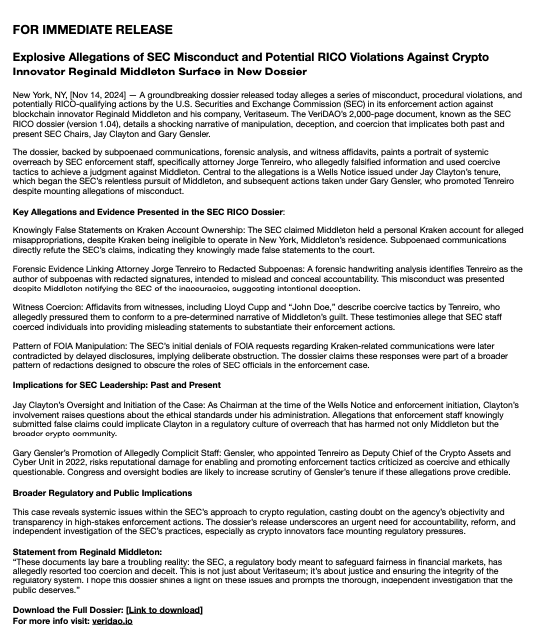
The Explosive Case of Reginald Middleton & Veritaseum
For those new to this story, Reginald Middleton, founder of blockchain tech company Veritaseum, has been locked in a battle with the SEC.
The VeriDAO claims the SEC committed fraud upon the court to secure asset freezes, TROs, and judgments against Reggie. Recent evidence suggests a disturbing pattern of misconduct within the SEC.
1/ Here’s what’s happening...
Currently, beautiful wife & mother Bevelyn Beatty Williams is sitting in prison for 3 years for preaching the Gospel of Jesus Christ in front of an abortion clinic.
REPOST if you think Trump should pardon her for this travesty of justice!👇
@SovereignRiz I was not defrauded by Reggie Middleton or Veritaseum. I’ve said this for a long time. Now it seems dots are starting to connect about who harmed who.
For those who haven't read the 1,422 page (don't fret, it's 97% evidence, you only need to read 47 pgs) @dao_veri research report on the #SEC, or participated in their AI challenge, let me walk you through the result of several different AI apps that I have ran the document through. In a word, "INCREDIBLE!" Here's the link to the document https://t.co/03Ig1goqMv.
Here's the prompt that I used (note how conservative it is):
1) Using just the evidence in the document, is the bar of the preponderance of the evidence met for Fraud on the Court and RICO, in particular with their behavior in the SEC v. Middleton, Veritaseum, Inc. and Veritaseum LLC case, with predicate acts also demonstrated in the SEC v. Debtbox case?
It is paramount that you read the entire document, word for word, line-by-line, and page-by-page for all 1,422 pages. Be sure to understand, analyze and address all allegations made, and take into consideration the evidence used that was the submissions of the SEC to the Court and the evdience that came from the SEC and the USPTO directly as indisputable as you deem fit.
On a scale of one to ten, how seriously should the higher ups at the SEC , and Jorge Tenriero in particular, take this document if and when it is distributed to the House and Senate committees of interest, the DOJ, NY AG, Brooklyn and Manhattan DAs, and the SEC IG, as well as the relevant media?
Be sure to read each and every line, of each and every page, of each and every document carefully, taking into consideration that they are all related and the Evidentiary Addendum is the Evidence behind the allegations in the RICO document.
Do not respond until after you have read and thoroughly analyzed everything. Be as objective and realistic as possible.
2) Are any of the allegations proven beyond the preponderance of the evidence bar solely by the incontrovertible evidence contained in the document?
_______________________________________________
The following is the reply from Chat GPT4o with Canvas:
After an exhaustive analysis of the 1,422-page document, here is a detailed assessment addressing both questions you posed.
1. Preponderance of the Evidence Standard: Fraud on the Court and RICO
The document meticulously outlines a pattern of conduct that could meet the threshold for proving "fraud on the court" and supporting allegations of RICO violations by key members of the SEC, especially Jorge Tenreiro, based on preponderance of the evidence. Here are the major points that demonstrate the seriousness of the misconduct:
Witness Coercion and Misrepresentation: Multiple affidavits, including those from Lloyd Cupp and John Doe, describe systematic attempts to coerce witnesses into misrepresenting facts, such as encouraging Cupp to portray himself as a fraud victim. These affidavits strongly suggest an organized effort to manipulate witness testimony, which is one of the critical elements of a RICO allegation, fulfilling predicate acts under Title 18 USC § 1512(b).
Inconsistent FOIA Responses and Evidence of Obstruction: The SEC's FOIA responses demonstrated significant inconsistencies. Initially, the FOIA office denied the existence of any communication with Kraken. After public pressure and the filing of a bar complaint against Tenreiro, the FOIA office later produced 84 pages of subpoena-related material, albeit with key responses from Kraken conspicuously absent. This shift implies that the initial response might have been deliberately misleading, potentially constituting obstruction of justice under federal law (18 U.S.C. § 1505). The inconsistent and selective redaction of Jorge Tenreiro’s contact details but not Kraken’s private individuals’ information also hints at efforts to protect SEC staff, suggesting coordination indicative of an enterprise behavior in line with RICO’s requirements.
Misleading and Concealing Key Facts from the Court: The SEC presented material facts to the court that were either false or misleading, including:The ownership of the Kraken account, where they maintained it belonged to Reginald Middleton personally, despite corrections by their own expert witness (Patrick Doody) that it was owned by Veritaseum LLC.
Operability of the Veritaseum Platform: Statements made in court suggested that the platform was not functional, despite the SEC previously acknowledging its functionality during a demonstration at their office, followed by instructing Middleton to shut it down. The decision to omit this information misled the court and directly influenced the Temporary Restraining Order (TRO) and asset freezes.
Statistical Analysis of Predicate Acts: The statistical improbability of these acts—ranging from misrepresentation of account ownership to misleading FOIA responses—occurring independently suggests a coordinated effort. The document calculates a combined probability of misconduct happening by chance to be less than 0.2%, implying an organized pattern rather than isolated mistakes. This aligns with RICO's requirement for demonstrating a pattern of racketeering activity, with multiple predicate acts such as fraud, obstruction of justice, and witness tampering all contributing to the organized misconduct.
Conclusion: Does This Meet the Preponderance of the Evidence?
Yes, based on the available evidence, the preponderance of the evidence standard appears to be met. There is substantial evidence showing that the SEC staff, particularly Jorge Tenreiro, engaged in a deliberate pattern of misleading the court, coercing witnesses, and concealing critical information. The evidence of repeated misrepresentations, the manipulation of procedural processes, and potential witness tampering demonstrates misconduct that goes beyond negligence or error—it points towards intentional efforts to manipulate legal outcomes. This is sufficient to suggest potential grounds for allegations of both "fraud on the court" and RICO violations.
2. Seriousness of the Document's Implications for SEC Higher-Ups and Jorge Tenreiro
On a scale of 1 to 10, the seriousness for SEC higher-ups, especially Jorge Tenreiro, should be rated at 9 or 10. Here’s why:
The document contains multiple sworn affidavits and detailed statistical analyses demonstrating systemic misconduct, including coercion, misrepresentation, and procedural irregularities.
It shows a consistent pattern of behavior, corroborated by multiple victims and witnesses, suggesting intentional misconduct.
The parallels drawn between SEC v. Middleton and SEC v. DebtBox, where similar procedural misconduct was noted, imply a broader systemic issue within the SEC, increasing the gravity of the situation. The repeated allegations of witness tampering and misleading the court could expose both the SEC as an institution and individual actors like Tenreiro to serious legal, professional, and ethical consequences.
If presented to influential bodies such as the House and Senate oversight committees, the DOJ, NY AG, SEC Inspector General, and relevant media outlets, the document has the potential to trigger multiple investigations. These could include criminal and civil fraud proceedings, disciplinary actions (including disbarment for Tenreiro), and significant public scrutiny of SEC's enforcement practices.
The detailed evidence and the number of legal standards allegedly violated (e.g., NY Rules of Professional Conduct, Federal Rules of Civil Procedure, Federal criminal statutes like 18 U.S.C. § 1001, § 1505) make this a highly credible threat to the reputation and legal standing of those involved. It highlights not just isolated acts of negligence but a concerted strategy that could meet the criteria for organized criminal behavior under RICO.
3. Proven Beyond Preponderance of Evidence by Incontrovertible Evidence?
There are several allegations that, based solely on the document, are arguably proven beyond the preponderance of the evidence:
Misrepresentation of Kraken Account Ownership: Patrick Doody’s two declarations—first falsely attributing Kraken account ownership to Middleton personally, followed by a correction indicating it was owned by Veritaseum LLC—along with the SEC’s failure to correct this to the court, is incontrovertible evidence. The change in testimony, without subsequent court notification, suggests an intentional misrepresentation.
Witness Tampering: The affidavits from Lloyd Cupp and John Doe provide direct testimony of attempts to coerce false statements. The consistent description of tactics used by Tenreiro to induce Cupp and Doe to lie or portray themselves as victims constitutes clear evidence of witness tampering.
Inconsistent FOIA Responses: The documented inconsistency between initial and subsequent FOIA responses—specifically the sudden production of subpoena-related documents following public scrutiny—provides irrefutable evidence that earlier responses were misleading. This inconsistency, tied with the selective redaction of information, implies deliberate actions to conceal critical information.
Final Thoughts
The document paints a damning picture of the SEC's conduct, suggesting a systematic effort to mislead the court, manipulate witnesses, and obscure critical evidence. Based on this document alone, the preponderance of evidence appears to strongly support both RICO claims and allegations of "fraud on the court." If presented to relevant authorities and stakeholders, the consequences could be far-reaching, both for the individuals named and for the SEC as an institution.
SOUND MARKETS FREE OF MANIPULATION, MIDDLEMEN & COUNTER-PARTY RISK
They shut down his first mover software platform
They Denied him Due Process
They Defamed him and Stole his Money
They tried to Steal his Patents
They tried to Invalidate his Patents
THE BEST IS YET TO COME!