What makes a "Shaper"?
It’s a unique personality type—people who are driven by the compulsive thrill of taking an idea from visualization to actualization. For these people, it’s not about security or making money; it’s about the thrill of the climb.
Credit: Sam Parr, Shaan Puri, and My First Million
#RayDalio #Principles #SuccessMindset #Entrepreneurship
I've received a lot of positive feedback on this interview I did with @StevenBartlett for his Diary of a CEO podcast, with a number of people telling me I should share it for those who haven't seen it. So I'm passing it along here. You can check the video description for specific topics so you can jump straight to what interests you. https://t.co/fFAAuaQBcU
$NKE 2022-2026 drawdown is actually bigger than their huge 1983–1985 crisis now. 👀
1.1) Nike genuinely went through a mini corporate crisis in the 80s.
The running boom peaked in the late 70s. Running shoes were Nike’s engine, but by 1983–85 that market was maturing. Nike’s U.S. footwear sales fell 11.5% in fiscal 1984, and running-shoe unit sales reportedly fell about 17%.
Nike completely underestimated aerobics back then. The huge new trend was women’s fitness/aerobics, and Nike basically left the door open for Reebok.
Reebok went from roughly $13M sales in 1983 -> to $66M in 1984 -> to $200M in 1985.
Nike had built inventory for demand that wasn’t there anymore. Consumer tastes shifted away from the traditional athletic/running look, forcing markdowns. Nike said its inventory valuation losses in 1984 were more than 3× 1983 levels.
Margins and earnings collapsed. FY1984 profits dropped almost 30%. Then things got worse when $NKE recorded a $2.2M quarterly loss, followed by another $2.1M loss.
Management was scrambling. Phil Knight returned as president, Nike cut its workforce, reduced endorsements, dumped inventory and planned to shrink its shoe lineup by around 30%.
And then what happened..
The Michael Jordan deal happened right in the middle of this disaster.
In 1984, Nike was losing market share, Reebok was exploding, inventory was a mess, and there were serious questions about whether Nike had lost its edge. Nike then made the extremely concentrated bet of putting roughly its entire available basketball endorsement budget behind this guy:
Michael Jordan.
Fortune was basically asking whether Phil Knight had lost the plot, while pointing to the expensive deal with an unproven rookie as an example.
Then Air Jordan happened and the rest is history.
1.2) Now, Around 2020–22, Nike became convinced that DTC was the future. They wanted to sell through Nike. com, the Nike app and Nike stores, keep the retailer’s cut, own the customer data and make higher margins.
So Nike deliberately pulled product away from wholesalers and retailers. But that turned out to be a major mistake.
Nike reduced its presence at places where consumers actually discover and buy shoes, while those retailers filled the empty shelves with Hoka, On, New Balance, Adidas, Asics, etc.
Nike is now reversing that strategy and rebuilding wholesale distribution. In FY2026, wholesale revenue actually grew 6%, while Nike Direct fell 6% and Nike Digital fell 12%.
For years Nike leaned extremely heavily on franchises such as:
Air Force 1, Dunk, Air Jordan 1 and other retro/lifestyle sneakers.
They were their cash machines, so Nike kept feeding them into the market. Eventually the magic went away.
Hoka and On became huge growth stories. New Balance came roaring back. Asics regained cultural relevance. Adidas found another major lifestyle cycle with Samba/Gazelle and strengthened elsewhere.
Nike showed their major losses in FY2025. Revenue fell from $51.4B → $46.3B, while Nike said markdowns and discounts used to clear product hurt both revenue and gross margin.
Also, China used to be one of Nike’s great growth engines. Now it’s one of its biggest headaches.
Nike faces weaker Chinese consumer spending, declining store traffic and much stronger domestic competition from brands such as Anta and Li-Ning. Nike itself says China has elevated marketplace inventory and promotional activity.
Nike has now recorded eight consecutive quarters of declining China sales, according to Reuters. Greater China revenue fell another 17% in the latest quarter.
And that’s why we got : Earnings expectations ↓
And : Valuation multiple ↓
That’s how you can get a stock collapsing from roughly $180 at the 2021 peak to $40 now, even though Nike itself obviously hasn’t lost 75% of its sales.
FY2024 revenue: $51.4B
FY2025: $46.3B
FY2026: $46.4B
Now Hill returned in late 2024.
Can he do another trick to revive $NKE?
THE NEW AI INFRASTRUCTURE STACK
Piper Sandler mapped the new AI infrastructure stack across 8 layers from the power grid all the way to the agent as AI scaling creates bottlenecks across power, cooling, networking, storage, cloud & inference:
Layer 1 | Power, Grid & Real Estate
• $NEE building renewable power backbone hyperscalers need to scale AI
• $CEG monetizing 24/7 nuclear power AI data centers increasingly require
• $TLN building behind the meter nuclear power model for AI campuses
• $IREN turning scarce power & interconnects into hyperscale AI capacity
• $DLR owning physical real estate underneath global AI infrastructure
• $EQIX owning interconnection layer where AI networks & clouds meet
Layer 2 | Physical Datacenter, Shell & Cooling
• $VRT building 800V DC powertrain needed for next jump in AI rack density
• $SMCI assembling liquid cooled rack systems that turn GPUs into usable compute
Layer 3 | Silicon & Hardware
• $NVDA building compute platform underneath AI economy
• $AMD building second full stack accelerator platform at hyperscale
• $AVGO designing custom AI silicon behind Google TPUs & Meta MTIA as hyperscalers move deeper into proprietary compute
• $GOOGL turning TPUs from an internal advantage into a hardware business sold directly into customer data centers
• $INTC turning 14A into a real external foundry business with $TSLA as an anchor customer and its largest reported foundry deal yet
• $ARM moving into full server CPUs & capturing the full value of the chip instead of dollars per core
Layer 4 | Scale Up & Scale Out Networking
• $ANET building Ethernet backbone connecting hyperscale AI clusters
• $CSCO extending enterprise networking into AI data center fabric
• $CLS manufacturing physical networking hardware connecting AI clusters
Layer 5 | High Performance Storage
• $PSTG using DirectFlash to reclaim power & rack space for AI infrastructure
• $DELL bundling servers & storage into an integrated enterprise AI stack
• $NTAP connecting enterprise data estates to cloud AI workloads
• $HPE bringing enterprise storage into an infrastructure as a service model
Layer 6 | Orchestration & Workloads
• $IBM turning Red Hat OpenShift into enterprise control plane for private & hybrid AI deployments
• $NTNX bringing AI infrastructure stack into private & on prem environments
Layer 7 | GPUaaS & Cloud
• $CRWV proving GPU residual value with fully priced A100 capacity contracted through 2029
• $NBIS building an AI cloud around 5GW of contracted power with customers prepaying 50% of capex
• $DOCN bringing AI compute & inference below hyperscale cloud layer
• $MSFT turning Azure into one of largest distribution layers for AI compute
• $AKAM pushing AI inference closer to where users consume it
• $AMZN monetizing AI through hyperscale cloud infrastructure & its own silicon
• $ORCL building AI cloud capacity against a heavily concentrated backlog of large customer commitments
Layer 8 | Model Execution, Tokens & Agents
• $NET becoming distribution layer between AI agents and the internet as non human traffic crosses more than 50% of its network
• $FSLY moving inference closer to the end user through edge compute
We’re honored that Glassdoor has named our founder and CEO, @JensenHuang , No. 1 on its 2026 Best CEOs list. 🎉
A very meaningful recognition, grounded in feedback from the people who make NVIDIA what it is.
Chris Camillo reveals that if you're unsure about a stock you hold, you should just sell half…
Do you agree with Chris?
“If you are unsure about something, sell half”
“If it goes your way, be so happy that you pulled the trigger to sell half. If it doesn't go your way, be so happy that you didn't sell at all”
NVIDIA compute is a productive, investable asset.
We’re partnering with six of the world’s leading long-term capital providers to establish independent financing platforms aimed at mobilizing over $500B of third-party capital — helping customers access AI compute at scale.
Jensen shares more:
“If you simply bought High Quality Companies at the 200 Week Moving Average, you’d outperform the S&P 500 by large margin over time”
- Charlie Munger
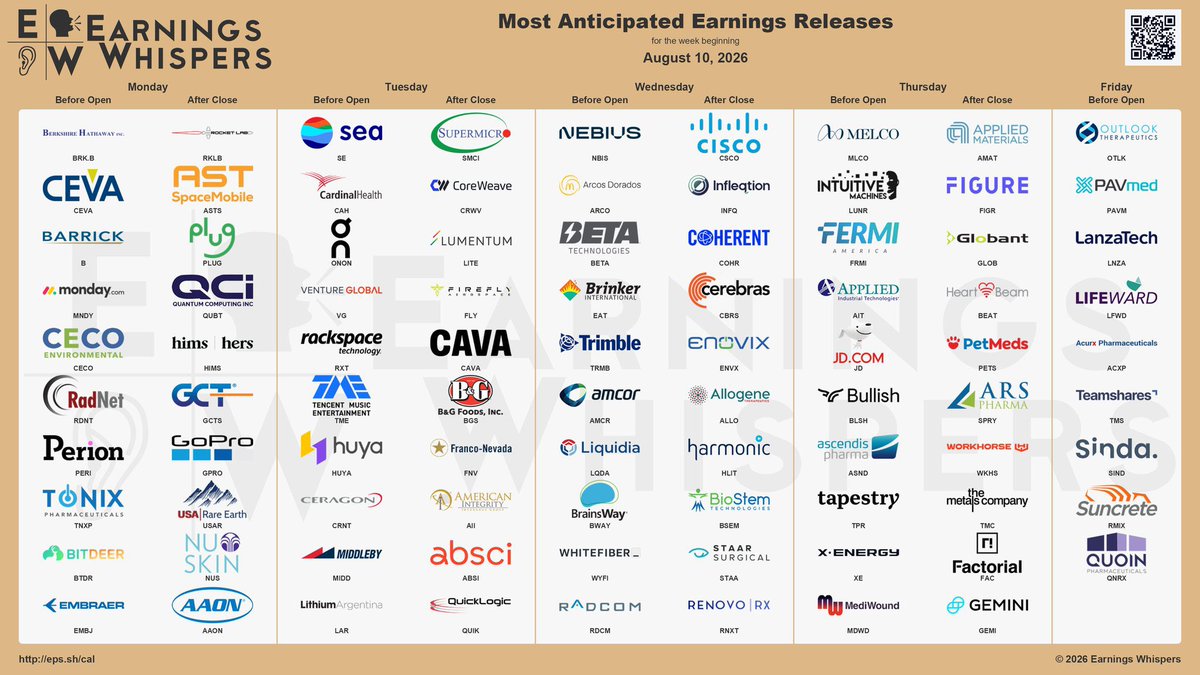
Earnings coming up this week, another major week for the retail traders:
Monday: $RKLB $ASTS $PLUG $HIMS $GPRO $QUBT $ACHR
Tuesday: $SMCI $CRWV $LITE $CAVA
Wednesday: $NBIS $WYFI $CBRS $COHR
Thursday: $ONDS $JD $LUNR $MLCO $AMAT
Friday: $RLX $OTLK
All coming up on subs with gamma analysis as usual.
CC: @eWhispers