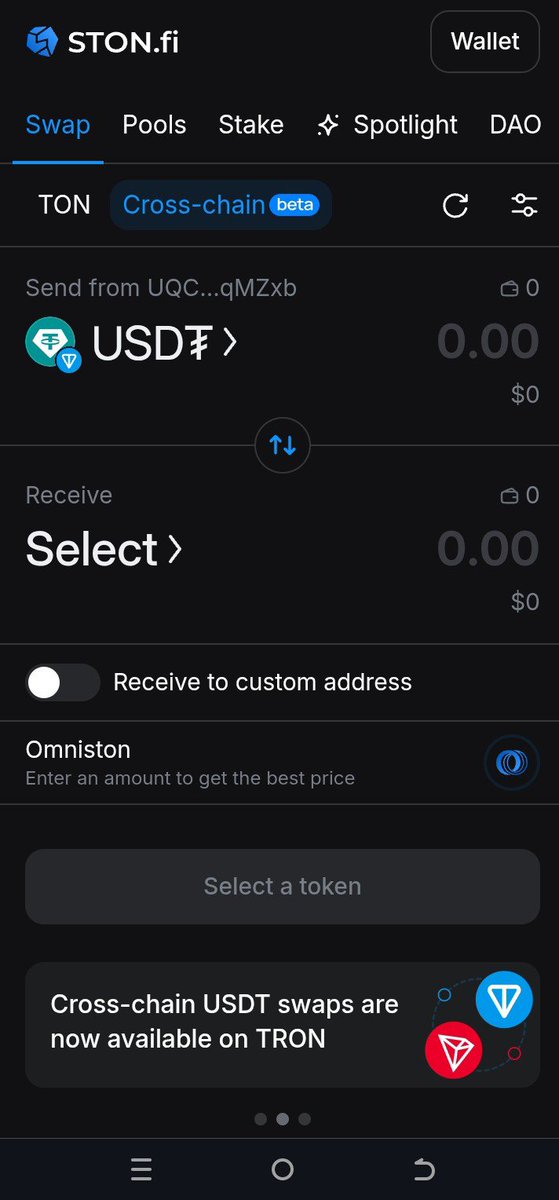
𝐈 𝐔��𝐄𝐃 𝐓𝐎 𝐒𝐄𝐄 𝐀 𝐋𝐈𝐐𝐔𝐈𝐃𝐈𝐓𝐘 𝐏𝐎𝐎𝐋 𝐀𝐍𝐃 𝐉𝐔𝐒𝐓 𝐀𝐒𝐒𝐔𝐌𝐄 𝐈𝐓 𝐖𝐀𝐒 𝐒𝐀𝐅𝐄 𝐓𝐎 𝐒𝐖𝐀𝐏
There was a time when I saw a token pair on a DEX and didn't think much about the liquidity behind it.
If the pair was there, I assumed I could swap.
I would choose my token, enter the amount, check the output, and move on.
But after paying more attention to my swaps on @ston_fi, I realised I was missing something important:
𝐓𝐡𝐞 𝐬𝐢𝐳𝐞 𝐨𝐟 𝐦𝐲 𝐭𝐫𝐚𝐝𝐞 𝐦𝐚𝐭𝐭𝐞𝐫𝐬.
A pool can have liquidity and still not be deep enough for the amount I want to swap.
So now, I check the pool before I hit Swap.
I START WITH THE POOL
When I open a https://t.co/bpfmyMYWc1 pool, I look at the TVL first. ( https://t.co/kO69FIWwge)
It gives me an idea of the pool's overall size.
But I don't stop there.
A good TVL doesn't automatically mean the pool has enough depth for my particular trade.
That's why I also look at the token balances.
I want to see how much of each asset is actually available in the pool because that is what my swap is interacting with.
THEN I LOOK AT MY TRADE SIZE
This changed the way I think about liquidity.
I stopped asking:
“Does this pool have liquidity?”
And started asking:
“How big is my trade compared with the liquidity available?”
A smaller trade can have a smaller effect on the pool.
A larger trade can interact with more of the available liquidity and increase the Price Impact.
That was the part I wasn't paying enough attention to before.
I was looking at the pool, but I wasn't looking at the relationship between the pool and my trade.
THEN I CHECK THE SWAP PREVIEW
Before confirming, I enter the amount I actually want to swap and check the preview.
This is where I pay close attention to Price Impact.
It helps me understand how my trade is affecting the price I am getting.
I also check Minimum received so I know the minimum amount I am prepared to receive before confirming.
Now the process is simple:
Check the pool → Consider my trade size → Preview the swap → Check Price Impact → Check Minimum received.
WHAT I LEARNED
I don't think every pool needs massive liquidity.
I just want to understand whether the liquidity available makes sense for the trade I am about to make.
For me, these three things are connected:
Pool liquidity ↔ Trade size �� Price Impact
That quick check has changed how I approach swaps on https://t.co/bpfmyMYWc1.
I no longer see a liquidity pool and automatically assume I'm good to go.
I take a few seconds to see what's actually behind the Swap button.
Sometimes, the most useful part of a swap happens before I press Swap.
If you've never paid much attention to the pool before swapping, try it yourself on https://t.co/bpfmyMYWc1.
Open a pool, check the liquidity, enter a trade, and look at the Price Impact before you confirm.
You might start looking at your swaps a little differently too.
Resources:
Official site: https://t.co/6sD40DrLDA
Omniston: https://t.co/meBUeQgsXV
Technical Documentation: https://t.co/kJfpn3CHpB
Analytics Dashboard: https://t.co/rzZnrhfjHf
Follow for more news: https://t.co/buhneE113N
Community chat: https://t.co/ZZugptOJ23
STONfi App: https://t.co/kO69FIWwge
#STONfi #TON #DeFi #DEX
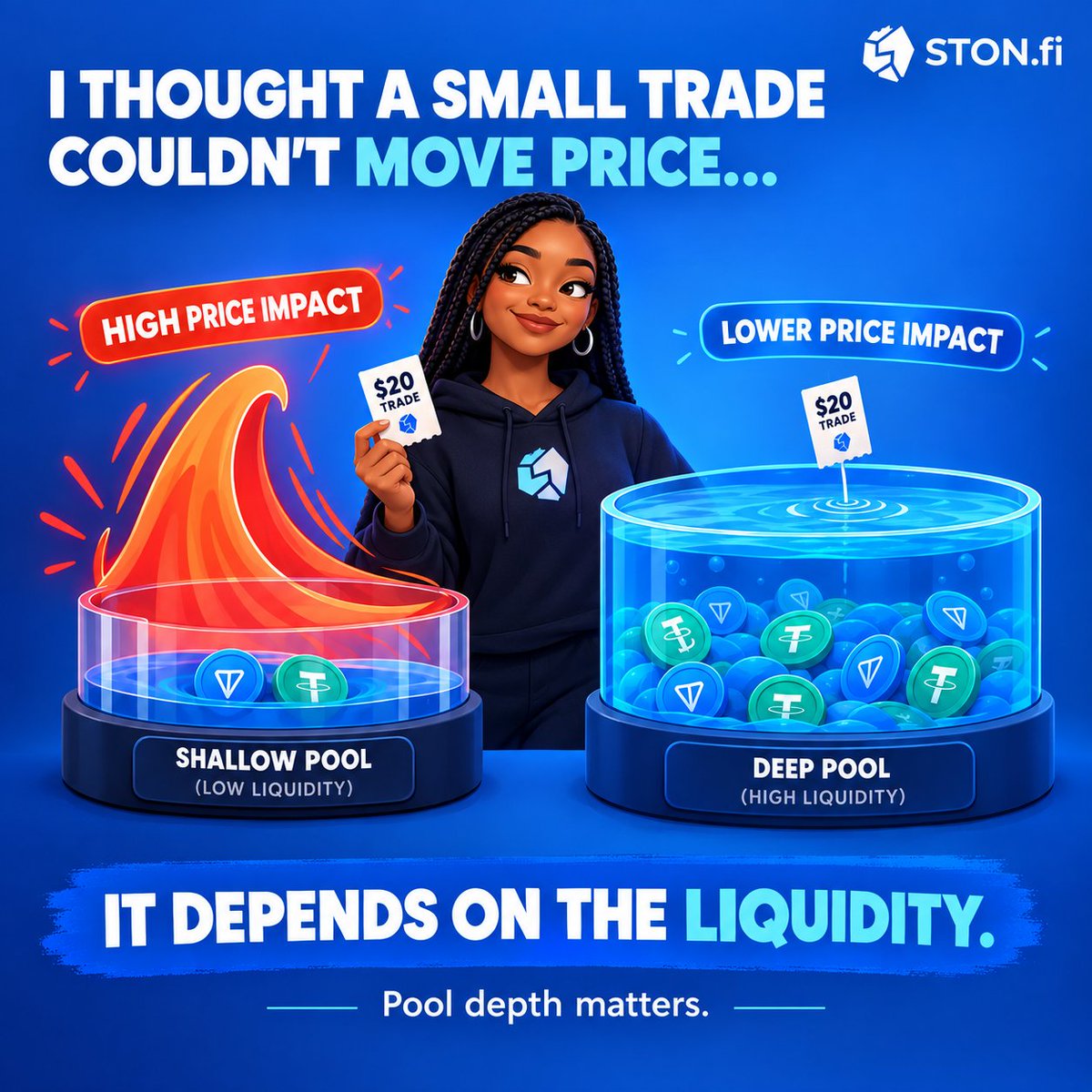
𝐈 𝐔𝐒𝐄𝐃 𝐓𝐎 𝐓𝐇𝐈𝐍𝐊 𝐀 𝐒𝐌𝐀𝐋𝐋 𝐓𝐑𝐀𝐃𝐄 𝐂𝐎𝐔𝐋𝐃𝐍’𝐓 𝐌𝐎𝐕𝐄 𝐓𝐇𝐄 𝐏𝐑𝐈𝐂𝐄 𝐌𝐔𝐂𝐇
I was wrong.
What matters isn’t only how much I’m trading.
It’s how much #liquidity is sitting behind the token.
I started paying closer attention to this when swapping on @ston_fi, & here’s what I learned.
THE POOL RATIO MATTERS
An AMM pool holds two tokens.
Let’s say a tiny pool has:
1,000 TOKEN
1,000 USDT
The starting ratio is roughly:
1 TOKEN = 1 USDT
When I swap, I’m taking one asset out and putting another asset into the pool.
That changes the ratio.
And the smaller the pool, the more noticeable that change can be.
SAME TRADE, DIFFERENT POOL
Imagine I swap 100 USDT.
In a shallow pool:
1,000 TOKEN
1,000 USDT
100 USDT is a big part of the pool.
Now compare that with:
10,000 TOKEN
10,000 USDT
That same 100 USDT is much smaller compared with the available liquidity.
So the same trade size can create very different Price Impact.
This is something I now check before swapping.
SMALL TRADE DOESN’T ALWAYS MEAN SMALL IMPACT
This was the part I had to understand.
A $10 or $20 trade might feel small to me.
But if the pool is tiny, that trade can still be significant compared with the liquidity available.
So I stopped looking at the trade amount alone.
I also ask:
How much liquidity is behind this pair?
That gives me a better idea of how my trade could affect the pool price.
PRICE IMPACT AND SLIPPAGE ARE NOT THE SAME
I used to mix these up.
Price Impact = how much my trade moves the pool price because of its size relative to liquidity.
Slippage = the difference between the price I expected and the price I actually get when the swap executes.
They are related, but they are not the same thing.
That distinction makes the swap details much easier for me to understand.
NOW I CHECK BEFORE I SWAP
Before confirming a swap on https://t.co/bpfmyMYomt, I don't just look at the amount I'm trading.
I check:
→ Estimated amount received
→ Price Impact
→ Minimum received
→ Fees
That small habit has changed how I approach swaps.
The lesson for me is simple:
Don't only look at the size of your trade.
Look at the liquidity behind it too.
Official Resources:
Official site: https://t.co/6sD40DrdO2
Omniston: https://t.co/meBUeQfV8n
Technical Documentation: https://t.co/kJfpn3C9A3
Analytics Dashboard: https://t.co/rzZnrheLRH
Follow for more news: https://t.co/buhneE0tef
Community chat: https://t.co/ZZugptObcv
#STONfi #DeFi #AMM #Crypto
𝐈 𝐒𝐭𝐚𝐫𝐭𝐞𝐝 𝐂𝐡𝐞𝐜𝐤𝐢𝐧𝐠 𝐏𝐫𝐢𝐜𝐞 𝐈𝐦𝐩𝐚𝐜𝐭 𝐁𝐞𝐟𝐨𝐫𝐞 𝐈 𝐒𝐰𝐚𝐩
I used to look at one thing before a DEX swap:
𝙃𝙤𝙬 𝙢𝙪𝙘𝙝 𝙖𝙢 𝙄 𝙜𝙤𝙞𝙣𝙜 𝙩𝙤 𝙧𝙚𝙘𝙚𝙞𝙫𝙚?
Then I noticed that the amount I was swapping wasn't the only thing affecting the result.
Sometimes a trade that didn't look particularly large could still show noticeable price impact.
That made me curious.
So before making a swap on @ston_fi, I started checking what was happening behind the quote.
The First Thing I Check Is The Pool
Price impact is connected to liquidity.
If there isn't much liquidity available for a particular swap, my trade represents a larger part of that available liquidity.
That can move the pool's price more.
So when I see higher price impact, I don't immediately assume the swap amount is the only reason.
I check the liquidity available for the pair first.
Then I Look At The Route
This was another thing I didn't pay enough attention to before.
The same token pair can have different liquidity sources available.
So the route used for a swap can affect the price I get.
This is where I find #Omniston interesting.
Instead of me manually checking different connected liquidity sources, Omniston can compare available quotes and routes across its connected liquidity sources.
That means the swap isn't necessarily limited to whatever liquidity I happen to find first.
I Also Check The Expected Output
Before I sign anything, I look at the numbers shown on https://t.co/bpfmyMYomt.
I check the:
✔️ Price impact
✔️ Swap rate
✔️ Minimum received
✔️ Blockchain fee
I want to know what I should receive and what conditions could affect that amount.
That has become a simple habit for me.
What About Splitting The Swap?
If a trade is large compared with available liquidity, splitting it into smaller transactions is another mechanical way to change the impact of each transaction.
But I don't treat this as an automatic fix.
More transactions can also mean more blockchain fees, so the total result still needs to be checked.
The same applies to routes.
If different liquidity sources are available, comparing the resulting quotes matters more than simply assuming one route will always be better.
What Changed For Me?
I don't just look at the number of tokens I'm entering anymore.
I look at the liquidity behind the swap, the route being used, the price impact, and the expected output.
And I check those things before signing.
That's probably the biggest lesson I got from paying closer attention to price impact on https://t.co/bpfmyMYomt.
The number isn't just a warning to ignore.
It can tell me something about what is happening with the liquidity and execution of my swap.
And with #Omniston comparing connected liquidity sources and routes, I can see the result of that aggregation through the quote instead of manually checking every source myself.
Quick Links
Main Resources:
Website: https://t.co/BT0XIlx5ct
Web App: https://t.co/bkKjHZKovz
User Guide: https://t.co/UajxwYzW0g
Blog: https://t.co/6u19aYHsTv
Omniston: https://t.co/TrJ55ml05L
Community:
Telegram: https://t.co/r3rpZymoqe
Discord: https://t.co/9RsjUBWrVU
Reddit: https://t.co/3LVdIhONjQ
LinkedIn: https://t.co/HxcuazeyyW
YouTube: https://t.co/LYC5K9Hh2m
CoinMarketCap Community: https://t.co/k6Rvc9ghq9
#STONfi #DeFi #TON #Liquidity #PriceImpact
𝐇𝐨𝐰 𝐭𝐨 𝐬𝐰𝐚𝐩 𝐔𝐒𝐃𝐂 𝐨𝐧 𝐄𝐭𝐡𝐞𝐫𝐞𝐮𝐦 𝐭𝐨 𝐔𝐒𝐃𝐓 𝐨𝐧 𝐓𝐎𝐍.
1/ The easiest way to think about a cross-chain swap is to start with the destination.
If I have USDC on Ethereum but actually need USDT on TON, why should the process necessarily end with USDC on TON?
That is the question @ston_fi makes interesting.
𝗙𝗿𝗼𝗺 𝗧𝗢𝗡 𝘁𝗼 𝗘𝘁𝗵𝗲𝗿𝗲𝘂𝗺: 𝗔 𝗦𝗶𝗺𝗽𝗹𝗲𝗿 𝗪𝗮𝘆 𝘁𝗼 𝗧𝗵𝗶𝗻𝗸 𝗔𝗯𝗼𝘂𝘁 𝗖𝗿𝗼𝘀𝘀-𝗖𝗵𝗮𝗶𝗻 𝗦𝘄𝗮𝗽𝘀
1/ I was testing a cross-chain swap from TON to Ethereum, and something caught my attention.
I expected to first think about which bridge to use, move my asset across, and then worry about swapping whatever asset I received.
But with @ston_fi's Omniston, I was looking at the asset I wanted to receive on @ethereum from the start.
That made the whole process feel different to me.
Instead of focusing on how to move the asset first, I was focusing on the final result.
That made me look into what was actually happening behind the swap.
🧵Here’s what I found. 👇
#STONfi #Omniston #CrossChain #DeFi #TON
One thing I’ve noticed with cross-chain swaps is that the swap itself is rarely what makes me nervous.
It’s what happens AFTER I click confirm.
I’ve had that moment where the funds leave the source chain and I’m left wondering:
“Did it go through?”
“Why haven’t I received it yet?”
“Is the amount I’m getting still the same?”
That uncertainty can make moving assets across chains feel much harder than it should.
This is why I find https://t.co/nCGUM8kMmN’s approach with Omniston interesting.
The idea of atomic execution means the swap is treated as one complete action: either it executes as quoted, or the funds return to me.
I also like that the resolver-signed quote shown before confirmation is the price that executes. I can see the destination asset and expected amount before I approve.
And instead of sending my assets to a CEX first, creating an account, completing KYC, and then withdrawing to another network, I can keep the process self-custodial through the @ston_fi dApp.
For me, this is what better cross-chain UX should look like:
Less guessing.
Less waiting anxiety.
Less unnecessary steps.
I still check the network, asset, fees and price impact before confirming. But I’d rather have the complicated execution handled in the background than have to figure everything out myself.
That’s the part of Omniston I’m paying more attention to now.
Check out the information: https://t.co/ItHf18Ighc
#STONfi #Omniston #TON
𝗗𝗜𝗗 𝗬𝗢𝗨 𝗞𝗡𝗢𝗪 𝗧𝗢𝗡 𝗖𝗔𝗡 𝗦𝗣𝗟𝗜𝗧 𝗜𝗧𝗦𝗘𝗟𝗙 𝗪𝗛𝗘𝗡 𝗧𝗛𝗜𝗡𝗚𝗦 𝗚𝗘𝗧 𝗕𝗨𝗦𝗬?
I recently came across something about @ton_blockchain that made me look at blockchain networks a little differently.
Imagine a road.
When there are only a few cars, one lane might be enough.
But when traffic suddenly increases, one lane can become a problem.
TON has a way of dealing with this.
When network activity increases, TON can split its blockchain into smaller sections called shardchains.
Instead of making everything happen in one place, the work can be divided across different sections.
And when the activity drops, those sections can merge again.
This is called Dynamic Sharding.
The interesting part is that this isn't something most users need to think about when using TON.
You simply interact with the network.
But underneath, TON can adjust how the workload is handled as activity changes.
For me, this is one of those things that makes @ton_blockchain interesting.
You don't just want a blockchain that works when only a few people are using it.
You want one that has a way to handle much more activity as more people start using it.
And that's where TON's dynamic sharding comes in.
Official Resources:
Official TON website: https://t.co/4zdM9oCAKx
Official STONfi site: https://t.co/uphDITineT
TON Doc : https://t.co/vw3FynD0hE
#TON #TheOpenNetwork #Blockchain #Web3 #STONfi
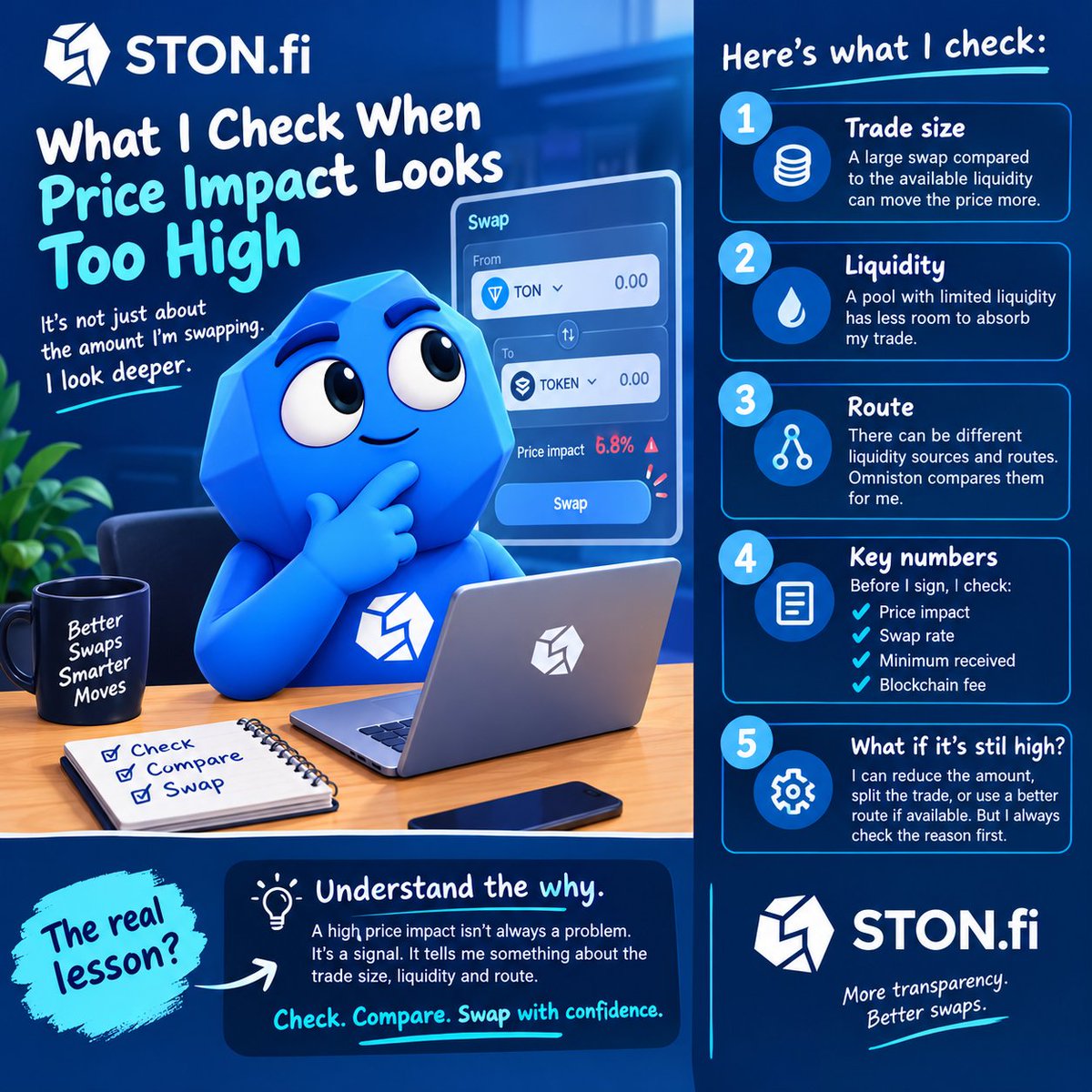
𝗪𝗵𝗮𝘁 𝗜 𝗖𝗵𝗲𝗰𝗸 𝗪𝗵𝗲𝗻 𝗣𝗿𝗶𝗰𝗲 𝗜𝗺𝗽𝗮𝗰𝘁 𝗟𝗼𝗼𝗸𝘀 𝗧𝗼𝗼 𝗛𝗶𝗴𝗵
I was about to make a swap on @ston_fi when I noticed something I had started paying more attention to lately:
the price impact was higher than I expected.
My first thought was that I was probably swapping too much.
But instead of just reducing the amount and moving on, I wanted to understand what was actually causing it.
So I started checking the swap more carefully.
First, I looked At The Trade Size
The amount I was trying to swap matters because the trade interacts with the liquidity available for that swap.
If my trade is large compared with the liquidity in the pool, it can have a bigger effect on the pool's price.
So the first thing I checked was whether my swap was simply too large for the available liquidity.
Then I Checked The Liquidity
This was the part that made the most sense to me.
A pool with limited liquidity has less room to absorb a trade.
So two swaps with the same amount can show different price impacts depending on how much liquidity is available.
That made me stop looking at price impact as just a number on the screen.
I started asking:
“What is this number telling me about the liquidity behind my swap?”
Then I looked at the route
This was where my understanding changed a bit.
The swap doesn't necessarily have to depend on one liquidity pool.
There can be different liquidity sources and routes available.
With https://t.co/nCGUM8kMmN's #Omniston, liquidity can be aggregated from connected sources, including different DEXs and resolvers.
So instead of manually checking every possible route myself, Omniston can compare available quotes and routes for the swap.
That matters because the route used for execution can affect the result I see.
I also stopped ignoring the numbers before signing
Before confirming the swap, I now check the fields shown in the https://t.co/nCGUM8kMmN interface.
I look at:
Price impact - the estimated effect of my trade on the pool price.
Swap rate - the rate for the swap.
Minimum received - the minimum amount of tokens I should receive based on my slippage settings.
Blockchain fee - the network fee involved in the transaction.
Looking at these together gives me much more context than just looking at the amount I'm swapping.
What If The Price Impact Is Still High?
There isn't one setting that fixes every situation.
If the trade is large compared with the available liquidity, reducing the trade size can change the impact.
A swap can also be split into smaller transactions as a mechanical approach, although that introduces additional transactions and fees, so it isn't automatically a better overall result.
And if there are multiple liquidity sources, the available route can matter.
That's one part I appreciate about Omniston.
I don't have to manually open different #DEXs and try to work out which route has the available liquidity.
It can compare connected liquidity sources and routes for the swap.
For me, the useful lesson wasn't simply “reduce price impact.”
It was understanding why the number was high in the first place.
Now when I see a price-impact warning, I don't immediately assume something is wrong.
➠ I check the trade size.
➠ I check the liquidity.
➠ I look at the available route.
➠ Then I check the expected output and minimum received before signing.
That small habit has made me much more comfortable with swaps on @ston_fi.
I'm not just clicking Swap and hoping for the expected amount anymore.
I'm actually looking at what is happening underneath the swap.
Check out STONfi official resources for more details 👇
Official site: https://t.co/uphDITineT
Omniston: https://t.co/wGxX0sC9Kl
Technical Documentation: https://t.co/9EAJA3qaE7
Analytics Dashboard: https://t.co/KtuUdE4ICH
Follow for more news: https://t.co/cM7qp8bGAk
Community chat: https://t.co/NgnuoXhZeV
#STONfi #omniston #TON #DeFi
1/ Moving $USDC from Ethereum to TON is not just a token swap.
You are changing two things at once: the network and the stablecoin.
That distinction is easy to miss, but it changes what actually arrives in your wallet.
@ston_fi gives you a way to request the destination asset directly instead of treating bridging as the only option.
🧵Let's dive into more details 👇
𝗧𝗵𝗲 𝗕𝗮𝗺𝗯𝗶𝘁𝘇 𝗦𝗼𝗻𝗴𝘀 𝗜 𝗞𝗲𝗲𝗽 𝗙𝗶𝗻𝗱𝗶𝗻𝗴 𝗠𝘆𝘀𝗲𝗹𝗳 𝗖𝗼𝗺𝗶𝗻𝗴 𝗕𝗮𝗰𝗸 𝗧𝗼
I honestly didn’t expect Bambitz tracks to become this regular in my music rotation.
At first, I was simply checking out the music because I wanted to understand what @BambitzRecords was building beyond the Web3 side of things.
Then I started playing the songs more.
“𝙒𝙚𝙡𝙘𝙤𝙢𝙚 𝙩𝙤 $𝘽𝘼𝙈” was one of the tracks that first caught my attention. Then I found myself going back to “𝘼𝙧𝙚 𝙔𝙤𝙪 𝙍𝙚𝙖𝙙𝙮?” 𝙖𝙣𝙙 “𝙒𝙖𝙠𝙚 𝙐𝙥 𝙒𝙤𝙧𝙡𝙙” 𝙩𝙤𝙤.
And somehow, they became part of my normal listening.
That’s the part I really like.
I’m not pressing play because I feel like I have to support a project. I’m pressing play because I actually enjoy what I’m hearing.
There are songs I discover and forget about after a day or two. Then there are songs that randomly come back into my head and make me want to play them again.
That’s where @BambitzRecords has surprised me.
I’ve had these tracks playing while I’m working, scrolling through X, taking a break, or just doing my own thing. Sometimes I’ll put one on without even thinking about the fact that it’s connected to a Web3 project.
It’s simply part of what I feel like listening to at that moment.
And for me, that’s a much stronger experience.
Because when I genuinely enjoy a song, I don’t need anyone to convince me to replay it.
The more I listen, the more familiar the tracks become, and the more I find myself appreciating the whole idea behind Bambitz.
It started with the music for me.
Then I became more curious about the community, the characters, the $BAM ecosystem, and how everything connects.
I think that’s one of the things Bambitz gets right.
It gives you something to experience before asking you to understand everything.
For me, this isn’t just about supporting a Web3 project.
I’ve actually found music here that I enjoy having in my rotation.
And honestly, seeing Bambitz tracks show up among the songs I keep coming back to feels pretty satisfying.
The music earned that spot.
That’s my experience with Bambitz so far.
⏯️ Keep streaming: https://t.co/KZlJL1kxS1
#Bambitz #Listen2Burn #Solana #Web3Music
𝗧𝗵𝗲 𝗕𝗮𝗺𝗯𝗶𝘁𝘇 𝗦𝗼𝗻𝗴𝘀 𝗜 𝗞𝗲𝗲𝗽 𝗙𝗶𝗻𝗱𝗶𝗻𝗴 𝗠𝘆𝘀𝗲𝗹𝗳 𝗖𝗼𝗺𝗶𝗻𝗴 𝗕𝗮𝗰𝗸 𝗧𝗼
I honestly didn’t expect Bambitz tracks to become this regular in my music rotation.
At first, I was simply checking out the music because I wanted to understand what @BambitzRecords was building beyond the Web3 side of things.
Then I started playing the songs more.
“𝙒𝙚𝙡𝙘𝙤𝙢𝙚 𝙩𝙤 $𝘽𝘼𝙈” was one of the tracks that first caught my attention. Then I found myself going back to “𝘼𝙧𝙚 𝙔𝙤𝙪 𝙍𝙚𝙖𝙙𝙮?” 𝙖𝙣𝙙 “𝙒𝙖𝙠𝙚 𝙐𝙥 𝙒𝙤𝙧𝙡𝙙” 𝙩𝙤𝙤.
And somehow, they became part of my normal listening.
That���s the part I really like.
I’m not pressing play because I feel like I have to support a project. I’m pressing play because I actually enjoy what I’m hearing.
There are songs I discover and forget about after a day or two. Then there are songs that randomly come back into my head and make me want to play them again.
That’s where @BambitzRecords has surprised me.
I’ve had these tracks playing while I’m working, scrolling through X, taking a break, or just doing my own thing. Sometimes I’ll put one on without even thinking about the fact that it’s connected to a Web3 project.
It’s simply part of what I feel like listening to at that moment.
And for me, that’s a much stronger experience.
Because when I genuinely enjoy a song, I don’t need anyone to convince me to replay it.
The more I listen, the more familiar the tracks become, and the more I find myself appreciating the whole idea behind Bambitz.
It started with the music for me.
Then I became more curious about the community, the characters, the $BAM ecosystem, and how everything connects.
I think that’s one of the things Bambitz gets right.
It gives you something to experience before asking you to understand everything.
For me, this isn’t just about supporting a Web3 project.
I’ve actually found music here that I enjoy having in my rotation.
And honestly, seeing Bambitz tracks show up among the songs I keep coming back to feels pretty satisfying.
The music earned that spot.
That’s my experience with Bambitz so far.
⏯️ Keep streaming: https://t.co/KZlJL1kxS1
#Bambitz #Listen2Burn #Solana #Web3Music
Another TON project has plugged into STONfi infrastructure — meet Stonks.
@stonksbots is an AI-powered launch ecosystem where teams can deploy, tokenize with custom bonding curves, seed liquidity or run a presale, and reach 12,000+ active users from day one.
With this integration, builders get a continuous liquidity path: from a token’s first bonding curve trade to a fully seeded STONfi pool, without stitching together separate tools.
Building your own DeFi product on TON? STONfi SDK + Omniston docs show how to plug into deep liquidity and optimized swap routing without starting from scratch.
Try Stonks — link in comments 👇
👀 Stonks is an independent app using STONfi infrastructure. STONfi is not affiliated with, and does not endorse or recommend it. DYOR and assess risks before use.
#STONfi #TON #Stonks #Omniston #DeFi #Web3
𝗛𝗢𝗪 𝗦𝗧𝗢𝗡.𝗙𝗜 𝗦𝗢𝗟𝗩𝗘𝗗 𝗖𝗥𝗢𝗦𝗦-𝗖𝗛𝗔𝗜𝗡 & 𝗕𝗥𝗜𝗗𝗚𝗘 ���𝗦𝗦𝗨𝗘𝗦
1/ Cross-chain swaps were one of the parts of DeFi I found most frustrating.
I had to think about which network my assets were on, which bridge to use, what asset I would receive, the fees involved, and whether everything would go through properly.
After exploring @ston_fi, I learned about Omniston, its cross-chain execution layer.
The idea is simple: instead of depending on a traditional bridge, Omniston can coordinate a cross-chain swap so I can receive the asset I actually want on another supported chain.
That immediately made the process easier for me to understand.
🧵Let's dive in for more details 👇
#STONfi #Omniston #DeFi #TON
𝗜 𝗪𝗮𝗻𝘁𝗲𝗱 𝘁𝗼 𝗧𝗿𝘆 𝗥𝗼𝗯𝗶𝗻𝗵𝗼𝗼𝗱 𝗖𝗵𝗮𝗶𝗻, 𝗯𝘂𝘁 𝗜 𝗗𝗶𝗱𝗻’𝘁 𝗪𝗮𝗻𝘁 𝘁𝗵𝗲 𝗨𝘀𝘂𝗮𝗹 𝗖𝗿𝗼𝘀𝘀-𝗖𝗵𝗮𝗶𝗻 𝗦𝘁𝗿𝗲𝘀𝘀
One thing I’ve learned from using DeFi is that moving assets across different networks can sometimes feel like too much work.
You have to check where your funds are, find the right bridge, make sure you are sending the correct token, calculate fees, and hope everything arrives as expected.
So when I found out that @ston_fi now supports cross-chain swaps into Robinhood Chain, I was genuinely curious.
I wanted to see how simple the process could actually be.
𝗪𝗵𝗮𝘁 𝗜 𝗙𝗼𝘂𝗻𝗱
The cross-chain process on https://t.co/nCGUM8kMmN is powered by Omniston.
#Omniston is the execution layer behind every https://t.co/nCGUM8kMmN cross-chain swap. Instead of making users deal with different steps manually, it helps coordinate the whole process into one swap flow.
From my point of view, that is what makes the experience interesting.
I can choose the asset I want to swap, select where I want it to go, and see the expected final amount before confirming.
Simple.
No need to think about handling every part of the cross-chain process separately.
𝗧𝗵𝗲 𝗡𝗲𝘁𝘄𝗼𝗿𝗸𝘀 𝗮𝗻𝗱 𝗔𝘀𝘀𝗲𝘁𝘀 𝗦𝘂𝗽𝗽𝗼𝗿𝘁𝗲𝗱
https://t.co/nCGUM8kMmN currently supports stablecoin liquidity from several networks:
• $USDT and $USDC on @ethereum
• USDT and USDC on @BNBCHAIN
• USDT and USDC on @base
• USDT and USDC on @avax
• USDT0 and USDC on @arbitrum
• PUSD and USDC on @0xPolygon
For @RobinhoodApp Chain, the destination asset is currently USDG.
This is something I think users should pay attention to. Before swapping, it is always important to understand exactly what asset you are sending and what asset you will receive.
𝗪𝗵𝗮𝘁 𝗦𝘂𝗿𝗽𝗿𝗶𝘀𝗲𝗱 𝗠𝗲 𝗠𝗼𝘀𝘁? 𝗧𝗵𝗲 𝗦𝗽𝗲𝗲𝗱
Cross-chain transactions are not always known for being fast.
That is why the estimated completion time caught my attention.
According to https://t.co/nCGUM8kMmN, most cross-chain swaps are completed within 15 to 40 seconds.
That makes a big difference to the overall experience.
At the moment, the swap volume is temporarily limited to $1,000 per transaction during the initial stage, so that is also something to keep in mind.
𝗪𝗵𝗮𝘁 𝗜 𝗔𝗹𝘄𝗮𝘆𝘀 𝗖𝗵𝗲𝗰𝗸 𝗕𝗲𝗳𝗼𝗿𝗲 𝗖𝗼𝗻𝗳𝗶𝗿𝗺𝗶𝗻𝗴
Even when the process looks simple, I never just rush into a transaction.
Before confirming a cross-chain swap, I check:
• Source network.
• Destination network.
• Token.
• Final amount.
• Fees.
• Price impact.
• Transaction limit.
These small checks can save you from making avoidable mistakes.
𝗠𝘆 𝗛𝗼𝗻𝗲𝘀𝘁 𝗧𝗵𝗼𝘂𝗴𝗵𝘁
What I like about this update is that https://t.co/nCGUM8kMmN is not just adding another network for the sake of it.
It is making access feel easier.
@RobinhoodApp is part of the growing onchain ecosystem, and @ston_fi now gives users a direct route to access USDG on the network from a familiar self-custodial interface.
For me, the biggest takeaway is Omniston.
The technology working behind a cross-chain swap can be complex, but the user experience does not always need to feel that way.
That is what I appreciate about using https://t.co/nCGUM8kMmN.
You choose what you want to swap, choose where it should go, check the details, and let the execution layer handle the process.
And honestly, that is how cross-chain DeFi should feel: simple enough for regular users to explore without getting lost in the process.
𝐎𝐟𝐟𝐢𝐜𝐢𝐚𝐥 𝐑𝐞𝐬𝐨𝐮𝐫𝐜𝐞𝐬:
Read more: https://t.co/iiJLgXck0x
Official site: https://t.co/uphDITineT
Technical Documentation: https://t.co/9EAJA3qaE7
Analytics Dashboard: https://t.co/KtuUdE4ICH
Follow for more news: https://t.co/cM7qp8bGAk
Community chat: https://t.co/NgnuoXhZeV
#STONfi #Omniston #CrossChain #DeFi