@LouseAesthetic Also really liked the clear method. Still have the feeling these clear descriptions are open to interpretation.
In note 2 they mention to exclude accounts that were classified to multiple groups, yet in the discussion mention NASA's ambigous classification
#digimediapublics2
Walter et al (2019) assumed that scientists would be approached by other actors. "The scientists as a ressoruce of knowledge?"
Instead scientists reach out to other way more often. Is this the picture of the "know-it-all scientist"? #digimediapublics2
@Hyazinth9 If only these filters would be adjustable "show me relevant things for not more than 20 minutes"
...
'I read through my entire Twitter today'
#digimediapublics2
Schrappe 2021 on Platformization. Intermediary platforms in media economy are nothing fundamentaly new (i.e. news agencies)
The novelty of digital platformization lies in the hight degree of automatization #digimediapublics2
@Hyazinth9 I guess they are often just what Turner&Kilian call "ecological influentials". Linking different groups together. Looking a bit more into the nature of the linked groups might be interesting #digimediapublics2
@LisaMarieMette Or maybe it‘s because traditional media‘s job is to take a complex issue and break it down so it becomes digestible?
I think social media often is confusing, messy, partial, and often sticks with complexity. (Or doesn’t resolve it) #digimediapublics
Ich bin entsetzt:
Wir haben ein Verfassungsgerichtsurteil zum #Klimaschutz erstritten. Die Regierung erlässt ein neues #Klimaschutzgesetz, das sie mit ihren Maßnahmen nicht einhalten kann und schließt im Gesetz Klagen dagegen aus. Was ist das für eine Demokratieverständnis?
After today’s class I would reconsider some of the wording in this tweet. I don’t think that solid vs fluid institutions is accurate. I guess it’s more about the development of our institutional landscape from solid to fluid. #digimediapublics
What do you think?
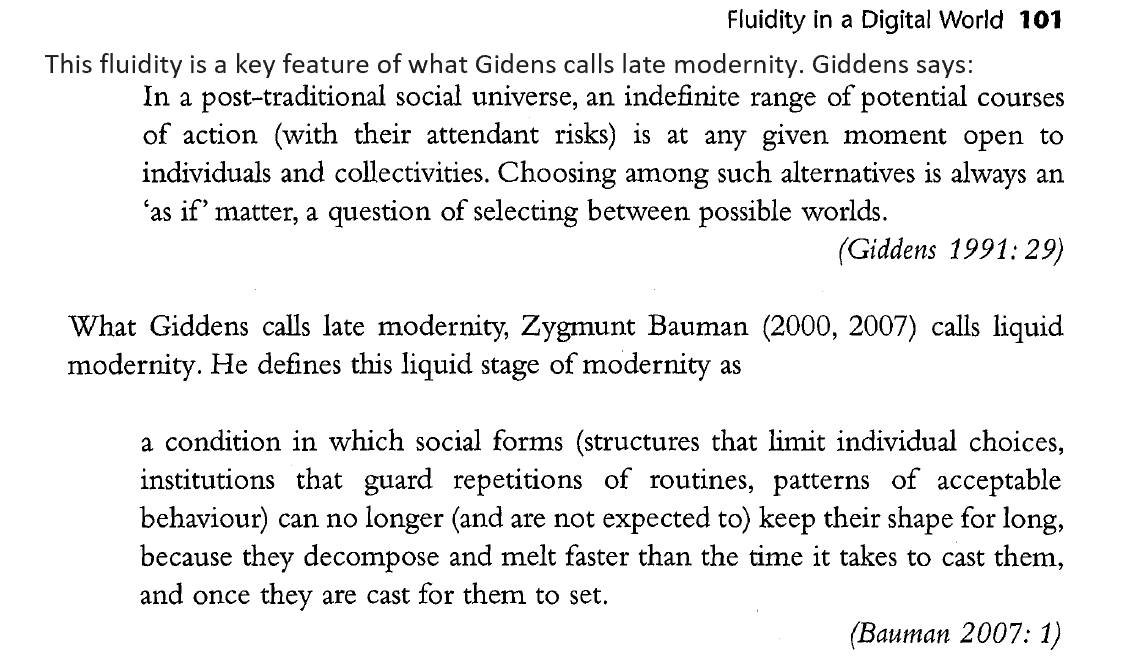
Ashley Hinck's (2017) essay "Fluidity in a digital World: Choice, Communities, and Public Values" deals with the issue of dissolving i traditional (solid) institutions (i.e. parties, church) and the emergence of more maleable (fluid) social institutions #digimediapublics
@Hyazinth9 I guess that was the point I tried to convey. :D
I think temporality is one characteristic among multiple that is affected by fluidity. However, I don't think that attachment to social institutions was "eternal" before (well maybe the curch if you believe in their version)
Has fluidity "created a world in which individuals are encouraged to abandon social groups in favor of increasing individualization." (Hinck, p.101)?
the horrors of neoliberalism.. Probably yes. not only though
Hinck offers us a different perspective on fluidity
#digimediapublics
Hinck grounds her analysis on concepts by Anthony Giddens (late modernity; a "social universe in which an indefinite range of potential courses are open) and Zygmnut Bauman (liquid modernity; "a conditionin in which social forms can't keep their shape for long")
#digimediapublics