Here is a beautiful list! 125 free math textbooks, written by the mathematicians who teach the courses and shared on their own university pages. No sign-up, no paywall, no pirated copies. From high school algebra to graduate analysis. 👇
https://t.co/RHYaBMiKF1
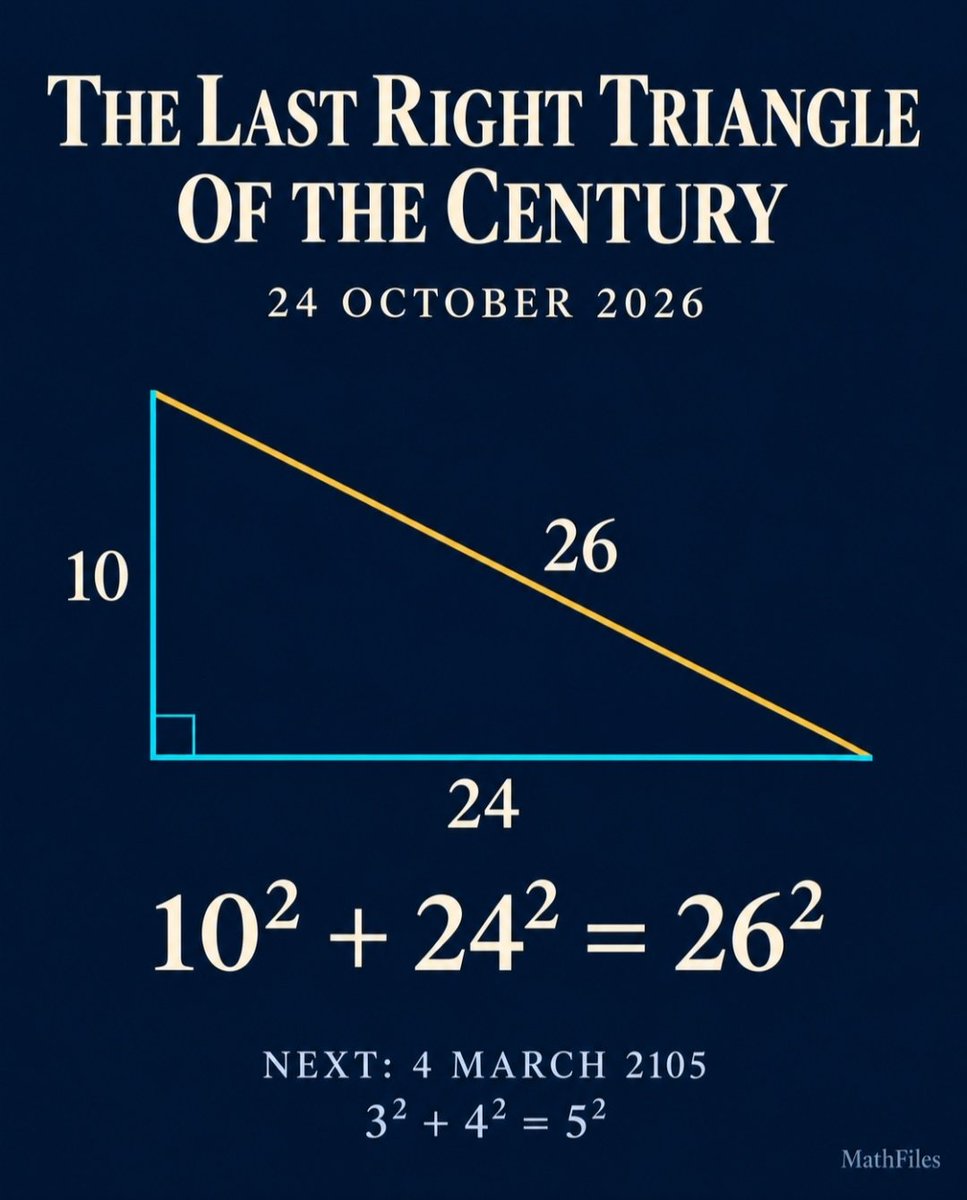
Today, the calendar makes a right triangle, for the last time this century.
This Saturday is October 24, 2026.
Write it as 10/24/26 or 24/10/26, and the same beautiful relationship appears:
10² + 24² = 26²
100 + 576 = 676
But here’s what makes today special.
There are infinitely many Pythagorean triples. Only a handful fit our calendar.
Using the rule
month² + day² = (last two digits of the year)²,
the month cannot exceed 12, and the day cannot exceed 31. Those small limits leave exactly 12 qualifying dates in this century.
Today is the last.
The next will be March 4, 2105:
3² + 4² = 5²
That is a wait of more than 78 years.
An infinite family of triangles. Just twelve appearances on a century’s calendar.
Happy Pythagorean Triple Day.
In 1974, Ernő Rubik built a wooden puzzle in his Budapest apartment to help his architecture students understand 3D geometry. He scrambled it. Then spent an entire month trying to solve it. He had just invented the best-selling toy in human history - and could not figure out how to undo what he built.
Fifty years later, Max Park solved the same puzzle in 3.13 seconds. The fastest human solve of 43,252,003,274,489,856,000 possible configurations ever recorded. A world record set in 2023 that most people cannot even comprehend watching in real time. Working Note No. 20 explains the exact mathematics that separates those two outcomes.
The number that makes every human brain shut down [Section 7] -
43,252,003,274,489,856,000. That is the total number of possible Rubik's Cube configurations written out in full. The document writes it as 4.325 × 10^19.
If you shuffled one new configuration every second since the Big Bang 13.8 billion years ago - you would have seen 0.00000003% of them.
What the formula that counts every state looks like [Equation 6] -
N = 8! × 3^7 × 12! × 2^11 divided by 12. Eight corner pieces, twelve edge pieces, six fixed centres. Every rotation is a permutation. Every permutation is a mathematical object. The entire cube is a group - called the Rubik's Group - with exactly 4.325 × 10^19 elements.
Rubik did not know this when he built it. He was an architect, not a mathematician.
How long random moves would take to solve it [Section 9] -
At 1 move per second: 1,370,000,000,000 years. At 1,000,000 moves per second: still 1,370,000 years. The universe is 13,800,000,000 years old. Random solving is not a strategy. It is a mathematical impossibility disguised as a game.
Max Park does not solve it randomly. He uses CFOP - a sequence of algorithms that exploits the group structure of the cube directly.
The theorem that took 35 years and Google's supercomputers to prove [Section 10] -
God's Number: every single scrambled Rubik's Cube on earth can be solved in 20 moves or fewer. Not 21. Not 25. Twenty. Maximum.
This was proven in 2010 by a team of mathematicians who borrowed computing power from Google. The proof required 35 CPU-years of calculation to check all 4.325 × 10^19 positions. It took humans 35 years after the cube's invention to confirm what the mathematics already guaranteed.
What a single face rotation actually does to the cube [Section 11] -
U = (e1 e2 e3 e4). One clockwise turn of the top face cycles four edge pieces through four positions. Repeating this exact move four times returns every piece to its original location. U^4 = I. The identity. The math closes perfectly.
This is why speedcubers like Max Park can solve 43 quintillion possible states in 3.13 seconds. They are not memorizing solutions. They are executing permutation sequences that group theory already proved must work.
The quote Ernő Rubik gave about the moment he first solved his own cube -
"It was wonderful to see how, after all the thought I had put into building it, it still had secrets to reveal to me."
He spent a month discovering what Working Note No. 20 proves in 12 pages of group theory and combinatorics.
Working Note No. 20, September 2026
Discrete Mathematics, Permutations and Algorithmic Transformations Series
save this
🩺🇨🇺 Cuba desarrolla un CANDIDATO VACUNAL ÚNICO en el mundo contra el cáncer
El hallazgo científico representa una esperanza para el tratamiento de múltiples enfermedades oncológicas en sus diferentes etapas.
https://t.co/q3ix4Os9MA