Like with many complex concepts, neural networks are easier to understand when you build one yourself.
Here, Eva breaks down neurons, weights, biases, activation functions, gradient descent, and backpropagation, then puts them together in Python.
You'll learn all this by building an XOR network from scratch with NumPy, and then you'll recreate it with PyTorch.
https://t.co/dHwJC1A9iU
🔥 6 Pandas Tricks Every Data Wizard Should Know!
If you use Pandas for data analysis, these 6 tricks can make your code cleaner, faster, and more powerful.
Swipe → to learn them all.
1️⃣ assign() — Create multiple columns
2️⃣ query() — SQL-style filtering
3️⃣ explode() — Split lists into rows
4️⃣ value_counts(normalize=True) — Get percentages
5️⃣ nlargest() / nsmallest() — Quick rankings
6️⃣ melt() — Reshape wide data into long format
Save this for your next Pandas project. 🐼
GitHub has a GitHub Actions certification exam.
And if you're a developer, DevOps, or automation lover, this course can help you study.
In it, @andrewbrown covers runners and commands, advanced workflows, publishing and deployment, and lots more.
https://t.co/UyA7ycPxzc
1/10
🐍 9 Modern Python Libraries You Should Know in 2026
Python isn't just about NumPy and Pandas anymore.
Here are 9 modern tools worth knowing if you want to level up your Python skills.
🧵👇
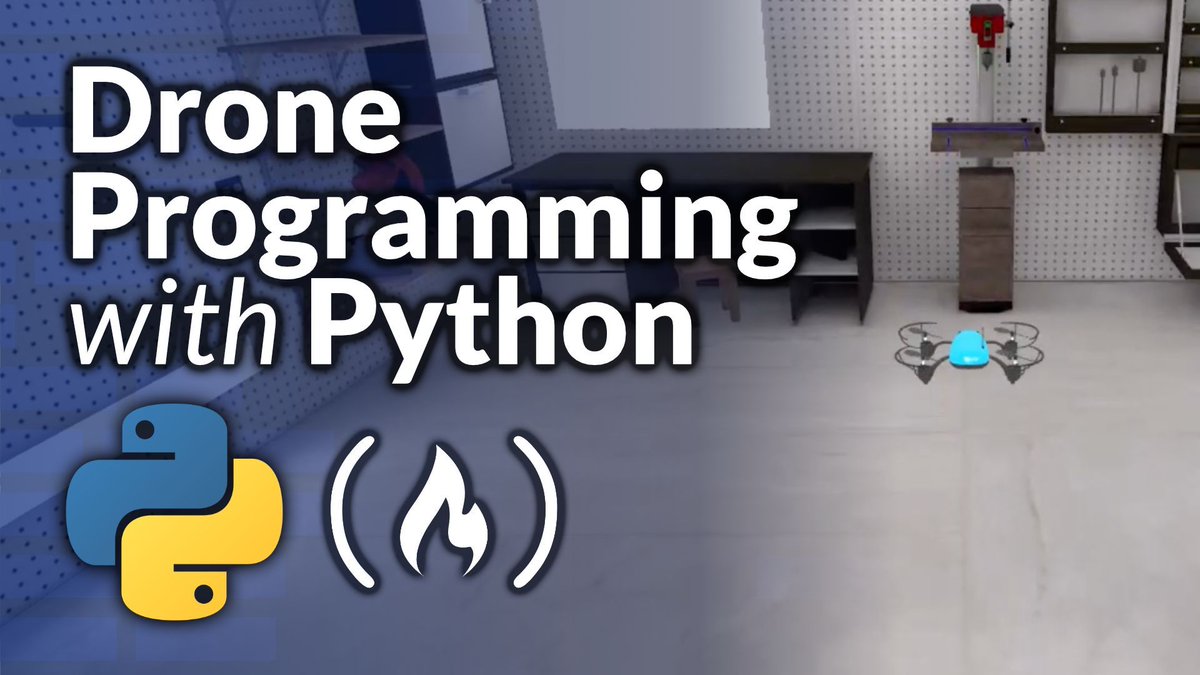
Programming drones with AI is a great way to learn about computer vision and automation.
In this course, @beaucarnes helps you program a drone using Python and complete missions in a simulator.
You’ll learn about 3D movement, computer vision, gesture control, and autonomous navigation.
https://t.co/BN5kpN816m
Programming drones with AI is a great way to learn about computer vision and automation.
In this course, @beaucarnes helps you program a drone using Python and complete missions in a simulator.
You’ll learn about 3D movement, computer vision, gesture control, and autonomous navigation.
https://t.co/BN5kpN816m
Graphics programming can help teach you how code, memory, and pixels really work.
In this course, Gustavo shows you how to build a low-level software renderer from scratch in C using SDL3.
You'll learn all about frame buffers, pixel manipulation, memory layout, event handling, frame timing, and lots more.
https://t.co/RyQE0aQaPx
GPS can give wearables precise location and movement data, but that accuracy comes at a cost to battery life.
In this guide, Shradha explains how GPS works in smartwatches and fitness trackers, and why it consumes so much power.
You'll learn about positioning, GPS chipsets, accuracy challenges, and techniques wearables use to extend battery life.
https://t.co/J71661cWSG
LLMs can write market commentary, but they can also sound confident without using any real data.
Here, Nikhil teaches you how to use MCP + Python to build a financial assistant that computes the numbers from real market data deterministically.
You'll also learn how to generate a single-ticker brief, compare a watchlist on volatility and drawdown, and more.
https://t.co/aLwNzvszld
Databases work best when they're designed for integrity, performance, and growth from the start.
In this tutorial, Feranmi teaches you the basics of database system design, including database components, major database types, and the main stages of design.
You'll also learn how normalization works and see a practical library system example from start to finish.
https://t.co/2ivccaR6kp
Hugging Face is a popular platform for building and sharing AI models.
In this course, you'll learn how to work with the Hugging Face ecosystem, including Transformers, Diffusers, and multimodal models.
You'll also learn how to deploy real AI apps, from speech and audio pipelines to image generation and cloud-hosted model interfaces.
https://t.co/70i52Oo84X
Backend Web Development involves managing user data, authentication, and database communication.
And in this course, you'll learn how to build a back end using the popular tools Node.js, Express, and MongoDB.
You'll set up the server, DB, and code structure, learn how to work with APIs for authentication, how CRUD operations work, & more.
https://t.co/BUB3AzptjK
Claude Code can do more than chat. It can read files, run terminal commands, and help you build agentic workflows from the terminal.
In this course, @andrewbrown teaches you how to install and use Claude Code on Windows, Linux, and Mac, and how the agentic loop works.
You'll also learn session management, how to track API usage and costs across providers, and more.
https://t.co/XeVVRGAQm8
Production ETL pipelines need to keep running reliably, even when data is messy or APIs fail.
In this handbook, Brooklyn shows you how to build a production-grade ETL pipeline in Python using real flood data.
You'll learn about incremental loading, type coercion, deduplication, idempotency, and other patterns for building reliable data pipelines.
https://t.co/NF40cUpS8X
Anthropic's Claude Certified Architect exam focuses on practical AI engineering, not just theory.
In this course, Andrew helps you prepare by building real-world agent workflows with Claude, MCP, and the Claude Agent SDK.
You'll learn about agent orchestration, tool design, prompt engineering, context management, and multi-agent architecture.
https://t.co/zA9wWu6puu
Redacting sensitive information from PDFs involves more than simply drawing a black box over it.
In this tutorial, @allinonetools shows you how to build a browser-based PDF redaction tool with JavaScript.
You’ll learn how to select redaction areas, map browser coordinates to PDF pages, process files locally, and verify the final output.
https://t.co/JLKU8MKII9
Internal developer platforms can help teams ship faster without managing infrastructure by hand.
In this guide, Ayobami teaches you how to build one with Backstage, ArgoCD, and Crossplane.
You’ll learn how to connect these tools into a self-service platform for deploying apps and provisioning infrastructure.
https://t.co/94wcTz7GiS
Most AI agents only work after you ask them to do something - which works for many use cases.
But here, Darsh shows how to build a local AI assistant that runs on a schedule.
You'll use Python, Ollama, Qwen, LangChain, cron, and Task Scheduler to run daily agents for common recurring tasks.
https://t.co/Rihxdh7Hr3
Building a game is a great way to improve your programming skills.
It makes you consider things like performance, user input, and structure while getting creative with your problem-solving.
In this guide, @manishmshiva walks you through some of the key skills game dev helps you sharpen.
https://t.co/rKNXJS7o3i