Get Your Own Personal Health Agent with https://t.co/EEnYCebb7y. Leverage your medical records to build a personalized WittyAI Health Agent. You can upload your reports and scans to get guidance for discussing with your doctor. Try it FREE today at https://t.co/fGvGAn69u0
Part Four: The Outing & Exit
By early 2026, the daily volume of media coverage portraying the FDA under Prasad’s oversight as chaotic, arbitrary, and hostile to patients had become a significant institutional problem. Someone — the identity remains undisclosed — appears to have decided that the solution was to allow Prasad to speak to reporters off the record, specifically about the UniQure situation, in an effort to get the scientific counternarrative into the coverage.
The theory was that if reporters understood the actual science — why the external control comparison was invalid, why the placebo requirement existed, what UniQure’s own randomized data showed — they might write a more balanced story.
The theory was wrong.
Within twenty-four hours, Adam Feuerstein, writing for STAT News, published a piece about the FDA’s senior official handling the case that included details referencing that official’s prior career as a practicing hematologist-oncologist who missed his clinic, his teaching, his podcast, and speaking freely. Feuerstein did not print Prasad’s name. He didn’t need to. There was one senior FDA official with that background. Feuerstein then posted a link to the story on social media with a hint embedded in the framing: curious readers might find out who the official was.
This was not inadvertent. It was a choice. And it was, by any reasonable standard, a serious breach of journalistic ethics.
The foundational obligation when a source speaks on condition of anonymity is not simply “don’t print the name.” It is don’t publish information that makes the person identifiable. The SPJ Code of Ethics, the AP Stylebook, and every major newsroom’s published standards say this clearly. There is a reason for it: the protection exists so that officials can speak candidly without fear that the speaking itself becomes a weapon against them. Journalism ethics boards and courts have long recognized what is sometimes called functional identification — the principle that publishing details that uniquely identify someone constitutes unmasking them regardless of whether the name appears in the text.
Feuerstein can accurately say he never printed Prasad’s name. What he cannot say is that he didn’t know exactly what he was doing. The identifying details were selected and placed to make Prasad recognizable to anyone paying attention — which, in the biotechnology industry and the rare disease advocacy community, meant everyone who mattered.
The ethical path, if Feuerstein believed the source was improperly using an off-record briefing to advance a regulatory position — a defensible concern — was to go back to the source, tell him he intended to identify him, and give him the opportunity to go on record or decline. There is no evidence that happened. What happened instead was that the identifying details ran, the social media hint ran, and the story Prasad was trying to prevent became the story that ran in his place. That is not whistleblowing on an abusive official. That is punishing a source for giving you a framing you dislike.
This matters beyond the individual episode because it reveals something about the media environment Prasad was operating in. A significant fraction of the reporters covering the FDA and pharmaceutical industry have developed, over years of access journalism, a set of relationships and sympathies that align them more closely with the companies they cover than with the regulatory mission they are ostensibly evaluating. Many of them also harbor a deep institutional antipathy toward the Trump administration and view their coverage, at some level, as participation in a larger contest. A principled FDA official holding the line against companies with failed products is not the story they want to write. A chaotic rogue bureaucrat destroying a promising therapy is.
Prasad couldn’t survive the combination. The rare disease advocacy community is not small, and it is not politically passive. The pharmaceutical companies funding the stories are not without influence. And the media infrastructure covering the beat has little institutional incentive to examine the science carefully when the goal is to take scalps of the enemy.
On the same day the Feuerstein piece ran, FDA Commissioner Marty Makary announced that Prasad would be leaving the FDA at the end of April. Prasad did not respond to press requests. Makary framed the departure as the orderly conclusion of a planned one-year leave from his faculty position at UCSF — the kind of thing that was always going to happen, nothing to see here. Whether that is true, or whether it is the version of events a Commissioner tells the press when he needs the story to go away quietly, is a question the timing makes difficult to answer charitably.
He came to Washington trying to do the job a regulator is supposed to do. The machine he ran into had been built, over many years, precisely to prevent that.
Blown away that the @AmericanCancer society has added blood based test (@GuardantHealth shield) as an option for colon cancer screening for “individuals who decline or do not complete preferred screening tests”
(Preferred test is colonoscopy / stool based test)
Why? 1/n
Thank you for this insightful article. I have personally interacted a few times with Dr. Vinay Prasad during my digital health venture. He is just an impeccable no-nonsense clinician. I was excited when he was appointed to the FDA. It is a big loss to patients worldwide!
@sgodofsk Man. I understand that people are profoundly affected by prices, but subjecting animals to this kind of horrendous torture to save $.25/lb if that is just absolutely horrific to me.
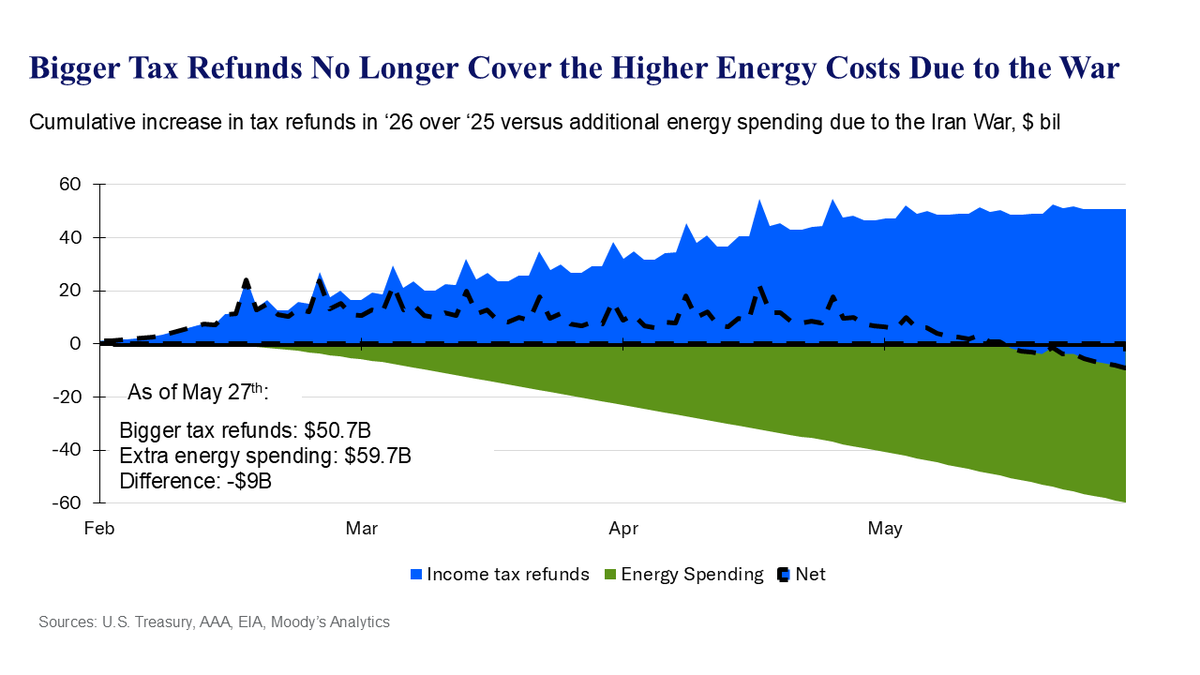
$100 billion. That’s our estimate of the cost of the Iran War to American households. That’s nearly $750 per household. This includes the additional U.S. military costs and the higher energy and other prices resulting from the war. This is a big economic blow, but deficit-financed tax cuts have cushioned it. Until now. As of May 16th, the bigger tax refunds Americans have received this year no longer cover the higher costs of gasoline, diesel, and jet fuel caused by the war. The financial pressure is thus mounting quickly, particularly on already hard-pressed middle and lower-income households. With the saving rate about as low as it ever goes, unless the war ends soon and energy prices come down, they will have little choice but to rein in their spending, weighing further on the already sagging economy.
Sanjay Mehrotra isn’t well known but he cofounded Sandisk (now worth ~250B), then left a decade ago, became CEO of Micron (now ~$1T).
The US denied Sanjay’s visa 3 times before he got in.
Here a mother elephant with twine, as seen in Corbett.
Twins in elephants are not just rare; they are a fascinating lesson in population dynamics.
In ecology, scientists often describe species using two reproductive strategies: r-selected and K-selected. These terms come from population growth equations.
“r” represents the intrinsic rate of population growth - how fast a species can multiply.
“K” represents the carrying capacity of an ecosystem - the maximum population that the environment can sustainably support.
Species that follow the r-strategy focus on rapid multiplication. They produce many offspring because survival chances are low. Think of insects, frogs or many fish. Their formula is simple: more babies = better chance that some survive.
Elephants belong to the opposite category; K-selected species. These animals live near the carrying capacity (K) of their habitat, so competition for resources is high. Instead of producing many young, they invest heavily in very few.
For elephants:
Pregnancy lasts nearly 22 months
Usually only one calf is born
Mothers and herds spend years protecting and raising that calf
Population growth is naturally slow
That is why twins in elephants are so extraordinary. In a species evolutionarily designed for “few offspring, high investment,” producing two calves at once is almost an exception to the rule.
In r-selected animals, twins or multiple young are common.
In elephants, even one calf is a major biological investment. Two together become a remarkable event in the story of life history and population dynamics.
Treasury yields have jumped in big part due to the Iran War and the resulting increase in inflation expectations, but also to the ballooning federal budget deficit and surge in Treasury securities issuance necessary to finance it. Gross Treasury issuance of T-bills, T-notes, T-bonds, and TIPS topped a monthly record of $3 trillion in March. While issuance has since fallen back a bit, it is on track to increase by 10% this year, with monthly issuance equal to a stunning almost 10% of GDP.
While Treasury supply is surging, it is increasingly unclear where the new Treasury demand will come from, at least at current interest rates. The Fed is no longer aggressively expanding its Treasury holdings, banks have been more circumspect buyers since their bond portfolios were turned upside down when the Fed jacked up interest rates a few years ago, and big global investors such as the Japanese and Chinese are less avid buyers for obvious reasons. That leaves highly leveraged, capricious hedge funds as the dominant new buyers.
Interest rates go up, and down, and all around…but cutting through the volatility, the direction of travel for rates is higher.
@chuminhua432 Interesting! But the data are still single-arm PoC data. Questions 1) whether it can beat docetaxel in IO-resistant squamous NSCLC, 2) whether its first-line chemo combination can outperform pembrolizumab-chemo in a randomized setting.
@mcuban Significant number of patients either forego or defer treatments because of high deductible. Not sure what percentage of high deductible plan patients do it though!
How are clinical trial leaders picked?
No one can or will hand you a principal investigator role on a platter. You have to work for it.
Some things you can do if you are interested in leading a clinical
trial.
1) Become a disease expert. Really understand the disease well. When you speak or write colleagues should recognize your talent and depth. The more you speak and write the more you will be noticed and sought out. Social media helps raise your visibility but it has no value if others think you are superficial. You must be credible. This is the most important step. There are no short cuts except to really understand the disease, what is known, and what remains to be known. It’s hard work.
2) Volunteer to be co-investigators on trials and help with trial design, development, and accrual.
3) Network. Most senior investigators will be more than happy to help you succeed.
4) Study trial protocols in depth to understand the elements and how it’s formatted. Better still write out protocol concepts and protocols. Clinical trial workshops help. There is an awful lot of detail.
5) Identify important questions that others are not thinking of. The question should be original, authentic, and important. If you have a great question, and you are credible, you are on your way to leading a trial. (The process from that point on is still very long and arduous — see second tweet in thread. But you have made it to being the PI).
Clinical trial leadership is not transferable. When you are asked to be a lead investigator it’s not in your power to hand it over. If you don’t want it, that spot will go to the next most credible person not the one you anoint. As it should be.
Or replicate it and amend to your needs - I think Cuban is just demonstrating a model. Physicians have a generational opportunity to go direct to employers, or work collaboratively to create narrow networks, or go direct to the consumer.
The good news for physicians is there’s only 1.1 million of you (at best - probably much less) and 400 million people living in this country that needs/wants healthcare.
The math could not be more favorable to do something new and different. Especially when you consider that the number of independent physicians is only about 200K +/- 10K or so (and that number will rapid decline over the next five years due to retirements).
The world is your oyster!
@pHequals7 Here is a complementary article. One area where India has competitive advantage is technically qualified human workforce. https://t.co/nLqTr2Bj3H
AI inference cost (which we pay in dollars) may rival our oil import bill and blow up our current account deficit. Great post on that below.
What is the solution? I believe that high developer productivity can be achieved without the high AI inference bill. We have to invent our way out of trouble. Stay tuned.
Before Striking Iran (again): Defining Achievable and realistic Objectives or Washington Keeps Repeating the Same Mistake on Iran
Calls in Washington and Jerusalem to resume military escalation against Iran are growing louder once again. The logic is familiar: intensify pressure, weaken Tehran, strip away its leverage, and force the regime back to the negotiating table in a diminished position.
But there is one major problem with this theory: we have already tested it, repeatedly, and Iran did not capitulate.
This is not because sanctions, covert operations, or military strikes failed to inflict pain. They clearly did. Iran’s economy has suffered enormously over the years. Its regional network has been degraded. Its leadership has faced unprecedented pressure. Yet none of this produced the strategic surrender many policymakers predicted.
The reason is rooted in a basic misunderstanding of how the Islamic Republic views itself.
For the Iranian regime, concessions on its missile program, proxy infrastructure, nuclear capabilities, or even strategic waterways like the Strait of Hormuz are not viewed as negotiable policy tools. They are seen as ideological pillars of the regime’s identity and survival. From Tehran’s perspective, giving them up is not compromise — it is surrender.
That distinction matters.
It explains why even prolonged military confrontation failed to move Tehran meaningfully away from the red lines it established before the fighting began. And it explains why another round of escalation designed to extract those same concessions is unlikely to succeed either.
As long as the current regime remains intact, it is highly unlikely to voluntarily dismantle what it considers the foundations of its deterrence doctrine. The leadership in Tehran may absorb severe economic damage, regional isolation, military losses, and domestic hardship before it accepts terms that could be interpreted internally as ideological defeat.
This creates an uncomfortable reality for Washington and its allies: if regime change is not the objective, then pressure alone is unlikely to fundamentally alter Iran’s strategic posture.
That does not mean pressure is meaningless. Sanctions can constrain resources. Military operations can degrade capabilities. Deterrence still matters. But there is a difference between weakening Iran and forcing the Islamic Republic into unconditional strategic surrender. Too often, policymakers blur the line between the two.
The result is a recurring cycle: escalation produces retaliation, retaliation produces further escalation, regional instability deepens, oil markets react, shipping lanes come under threat, and eventually diplomacy returns under conditions not dramatically different from those that existed before the crisis began.
In other words, tactical successes repeatedly fail to produce strategic transformation.
This is why expectations must be calibrated carefully. If the objective is neither a negotiated framework that acknowledges at least some of Iran’s core strategic demands nor a serious effort to remove the regime itself, then another campaign of “maximum pressure”, even in a more aggressive or sophisticated form, is unlikely to change the underlying equation.
Instead, it risks producing the worst of both worlds: a more unstable Middle East, a more militarized confrontation, and a prolonged cycle of escalation without resolution.
Iran’s leadership has shown for decades that it is willing to endure extraordinary costs to preserve what it sees as the ideological foundations of the Islamic Republic. Ignoring that reality does not make it disappear. It only increases the likelihood that Washington once again enters a confrontation expecting coercion to produce capitulation, and discovers, too late, that the regime was prepared to absorb far more pain than anticipated.
#IranWar
#iran
Is there new data to show that donanemab (50k £ per year) produces accelerated slowing down of functional impairment in mild Alzheimers dementia in the years after amyloid removal?
The sustained improvement in the Trailblazer study seems trivial and clinically meaningless