$ENA : Review 📜
What if a dollar didn't need a bank, a vault, or a single dollar of cash to hold its peg?
Meet Ethena, issuer of USDe, the synthetic dollar that reached the third spot among all dollar tokens by holding its peg with derivatives instead of a vault of cash. The product works, the yield is real, and the institutions are arriving. The token, so far, is a different story.
Let's explore the widest gap between protocol and token in DeFi. 👇
⚪ Ethena at a Glance
Marketplace Insight: this is the widest protocol-versus-token split in the market. USDe is one of the most successful products crypto has shipped this cycle, now integrated into BlackRock's Aladdin and partly backed by BUIDL, while ENA trades at a 95% drawdown because it captures almost none of the protocol's $250M-plus in cumulative revenue. The clean contrast is that both sentences describe the same protocol. USDe is a triumph and ENA is a disappointment, and the hinge between them is a single governance vote, the fee switch, that has not yet flipped.
⚪ Mission
Ethena's mission is to build crypto-native money that does not depend on the banking system: a scalable, censorship-resistant dollar, plus a dollar-denominated savings instrument that pays a real yield. The thesis is that a synthetic dollar backed by hedged collateral can deliver both stability and yield in a way reserve-backed stablecoins structurally cannot, since those hold their backing in cash that earns the issuer, not the holder.
🔵 A Brief History
Ethena grew out of a widely shared idea for a delta-neutral synthetic dollar, which Guy Young turned into a company in 2023 after a career at credit and private-equity firm Cerberus Capital Management. The pitch was direct: take crypto collateral, short an equal amount of perpetual futures against it, and the combined position holds a stable dollar value while throwing off yield from staking and funding.
USDe went live in early 2024, and the ENA token launched via Binance
Launchpool on April 2, 2024, peaking at $1.52 nine days later. Growth was explosive, with USDe supply climbing past $14B at the height of the cycle on the strength of double-digit sUSDe yields. The raise history was equally heavy, roughly $182.5M across rounds from Delphi, Lightspeed, Brevan Howard, Pantera, and YZi Labs, capped by a $100M private sale in February 2025 to fund Converge, an institutional settlement chain built with Securitize.
The retrace was just as sharp. As funding rates cooled, sUSDe yields fell, USDe supply contracted toward $4.5B, and the token bled through 2025 and into 2026 under constant unlock pressure. 2026 then split into two opposite narratives. Institutions arrived in force, with BlackRock adding USDe to Aladdin, BUIDL becoming the reserve for a white-label product, and Janus Henderson and Coinbase Ventures investing. Regulators pushed back just as hard, with Germany's BaFin barring USDe from the EU under
MiCA days before the July 1, 2026 enforcement deadline.
🔵 Ecosystem Narrative
The organizing idea is that a yield-bearing synthetic dollar can become base money for DeFi, and every integration widens that base.
➛ USDe, the synthetic dollar. Collateral is held and delta-hedged with short futures, so the combined position tracks a dollar. The peg is defended by mint-and-redeem arbitrage plus a Reserve Fund backstop.
➛ sUSDe, the Internet Bond. Staking USDe earns a yield sourced from staking rewards and perpetual funding, the product that drove the protocol's growth and the one most exposed when funding turns negative.
➛ Institutional rails. The BlackRock Aladdin integration, BUIDL reserves, a $100M liquidity facility through Securitize, and custody with Anchorage push USDe toward institutional balance sheets.
➛ USDtb and the white-label stack. A separate BUIDL-backed stablecoin plus a stablecoin-as-a-service offering let other firms issue branded dollars on Ethena's infrastructure, now deployed as far as Sui.
➛ Deep DeFi integration. USDe and sUSDe sit across Pendle, Aave, Morpho, and a USDe-margined perps venue on Hyperliquid, embedding the synthetic dollar as collateral throughout the ecosystem.
➛ Converge and RWA diversification. An institutional settlement chain and a $250M allocation to tokenized AAA CLOs aim to diversify USDe's backing beyond pure crypto funding trades.
⚪ Token Utilities
$ENA is a governance token today, with real value accrual still pending the fee switch.
➛ Governance: holders vote on risk parameters, collateral, and treasury decisions, including the reserve and buyback design.
➛ Staked ENA (sENA): locking the token earns points and is slated to receive protocol revenue once the fee switch activates.
➛ Pending value accrual: a governance-approved fee switch would route a share of protocol revenue to sENA stakers and open-market buybacks, the mechanism meant to close the protocol-to-token gap.
➛ Collateral and incentives: the token anchors ecosystem incentive programs and the Sats points campaigns that drive USDe adoption.
⚪ Key Features
➛ Synthetic-dollar design: a dollar that holds its peg through hedged derivatives rather than bank reserves.
➛ Native yield: sUSDe pays a funding-and-staking yield, a savings instrument reserve-backed stablecoins cannot match.
➛ Transparency: real-time backing dashboards and third-party attestations of collateral and custody.
➛ Off-exchange custody: collateral held with custodians and settled to exchanges, reducing but not removing counterparty exposure.
➛ Multi-chain reach: USDe deployed across Ethereum and additional chains, with a white-label stack for third-party issuers.
➛ Reserve Fund: a protocol-owned buffer that absorbs negative funding periods to defend the peg.
🔵 Meet the Team
Ethena runs a split structure. Ethena Labs builds the protocol, an Ethena Foundation stewards governance and the token, and a Reserve Fund backstops the peg, which matters because the peg defense and the regulatory posture live in different places than the code. CryptoRank confirms a current core of six.
▶️ Core Members:
➛ Guy Young [ @gdog97_ ] - Founder & CEO | Built Ethena in 2023 after a career at Cerberus Capital Management, one of the larger credit and private-equity firms. Leads strategy, institutional partnerships, and the protocol's regulatory positioning, and has been the public face of the BlackRock and BaFin developments.
➛ Elliot Parker [ @ElliotP789 ] - COO + Head of Product Management | Owns product direction across USDe, sUSDe, and the expanding white-label and institutional stack.
➛ Conor Ryder [ @ConorRyder ] - Head of Research | Leads Ethena's research and data work, previously an analyst at crypto data firm Kaiko, and authors much of the protocol's public analysis on funding, yield, and reserves.
➛ Brian Grosso - Head of Engineering | Runs protocol engineering, including the minting client that converts collateral into USDe and manages the delta-hedging positions.
➛ Seraphim Czecker - Head of Growth | Drives growth, integrations, and risk-adjacent strategy, having previously led risk and growth at the lending protocol Euler Finance.
➛ Zach Rosenberg - General Counsel | Owns legal and regulatory strategy, a load-bearing role given the MiCA bar and the securities questions that follow a yield-bearing dollar.
➛ Reserve Fund and Ethena Foundation | The peg backstop and the governance steward. The Reserve Fund absorbs negative-funding periods to hold the peg, and the Foundation administers token governance and the pending fee switch.
🔵 Ratings
➛ Use Case: ★★★★✦ (4.5/5). Ethena created and still leads the yield-bearing synthetic-dollar category, with USDe reaching the third spot among all dollar tokens, industry-leading sUSDe yields, and integrations spanning Binance, Aave, Pendle, Morpho, and Hyperliquid. The 2026 institutional wave, BlackRock's Aladdin, BUIDL reserves, Janus Henderson, Coinbase Ventures, is genuine validation most stablecoin projects never reach. The 0.5-point deduction is structural fragility and access. The model's yield and peg depend on positive funding rates and staked-ETH returns, so the use case weakens exactly when markets do, and the BaFin bar under MiCA closes off the entire EU, capping the addressable market for the boring, regulated dollar Europe actually wants.
➛ Tokenomics: ★★★✦ (3.5/5). The foundation is genuinely strong: a fixed 15B max supply, no active inflation today, and a large, verifiable base of protocol revenue (over $250M cumulative) waiting to be routed to the token through the pending fee switch. That combination is why this clears a flat 3. The 1.5-point deduction is that the value accrual is not yet live and the distribution carries weight. ENA remains governance-only until the fee switch activates, so the token captures little of what the protocol earns today, while 30% to core contributors and 25% to investors keeps cliff unlocks running into 2028, and a smart-contract parameter technically permits up to 10% annual inflation later. A 95% drawdown reflects that gap. Flip the fee switch and turn the buyback real, and this moves to 4.
➛ Audits: ★★★★ (4/5). The code-audit stack is deep and named: Zellic on v1, Quantstamp and Spearbit in 2023, Cyfrin and a repeat Quantstamp in 2024, an architecture and economic-risk review led by former MakerDAO lead engineer Kurt Barry at Spearbit, plus a public Code4rena contest, with no critical or high vulnerabilities reported across any of them. The 1-point deduction is that the protocol's real risk is not in the Solidity. Delta-neutral execution depends on centralized-exchange venues for the short leg, so custody counterparty exposure and funding-market mechanics sit beyond what any code audit can certify, which is also why this does not reach the 4.5 tier reserved for a verified top-tier score or named formal verification.
➛ Community: ★★★✦ (3.5/5). Ethena has scale and reach: a large holder base from the Binance Launchpool origin, heavy CEX support, and one of the more active integration ecosystems in DeFi. The 1.5-point deduction is the nature and mood of that base. Much of it assembled around Sats points farming and sUSDe yield rather than protocol conviction, governance participation is thin relative to the holder count, and sentiment has cratered alongside the token, with "is the project dying" now a recurring question rather than a fringe one.
🔵 Conclusion
Ethena built something rare, a crypto-native dollar that scaled to billions and earned a place among the largest stablecoins in the market, then backed it up with the kind of institutional validation most protocols only pitch. USDe on BlackRock's Aladdin, BUIDL as a reserve asset, and asset managers like Janus Henderson putting capital directly into the ecosystem are not vanity metrics. They are the clearest signal yet that a hedged synthetic dollar can sit on institutional infrastructure.
The risks are real and worth naming. The peg and the yield both lean on positive funding rates and staked-ETH returns, so the whole machine runs hardest when markets are calm and strains when they are not. USDe supply has already contracted roughly 70% from its peak, the BaFin bar shuts Ethena out of the EU, and the token has captured almost none of the protocol's revenue while unlocks run to 2028.
But the bull case is clean. If synthetic dollars are a real category, and Ethena is the protocol that proved they scale, then a fee switch that finally routes $250M-plus of demonstrated revenue to the token would close the exact gap that defines ENA today. Ethena proved the product. What it has not yet proved is that the token is more than a claim on a promise. USDe already reads like infrastructure. $ENA, for now, reads like an IOU on a vote that has not happened.
Ethena is partnering with @Securitize as a strategic tokenization partner, with the integration of STAC, the Securitize Tokenized AAA CLO Fund, into USDe's backing.
This expands USDe's institutional-grade RWA exposure beyond existing Blackrock BUIDL collateral.
The integration was approved by the Ethena Risk Committee following independent due diligence, evaluated against the same four criteria: liquidity, credit quality, drawdown profile, and pricing transparency.
The state of Ethena, USDe, and ethereum:0x57e114b691db790c35207b2e685d4a43181e6061
I'd call @ethena in the "Upgrading" stage.
Been a while since the new USDe model announcement, so decided to write a deep dive with personal thought:
Let's start with sUSDe yield.
The current sUSDe APY is 4.5%. This is better than average APR during Q1-Q2 around 3.5% and will start to get more attention if it enters the 5-7% range.
The source of yield has now improved. They've made a right decision pivoting away from crypto basis trades which only generates 0.6% APY (well we're living in a bear so crypto funding rate arb is dead).
I think the team focus is trying to allocate more from "Liquid Stables" (basically T-Bills + idle for redemption) into RWA portion. Ethena recently partnered with @centrifuge and allocated $250M into Centrifuge's tokenized JAAA fund which generates yield from institutional credit.
Their key focus next is to allocate more and increase APY for sUSDe.
There are several options I can think of:
1. Centrifuge has another higher yield option (8.18% APY) which is tokenized Apollo's corporate credit fund. Allocating capital from "Liquid Stables" into this will make capital more efficient and generate higher APR.
2. Basis trading on CME market. There are still some RWA assets that they can do basis trading and generate more yields. This is an interesting area to explore too.
Lastly, the current state of Ethena
ENA is in the low range at the time of writing. I won't call this the bottom but it's worth putting it back into your watchlist.
The sequence of ENA flywheel is simple:
> (Done) Introduce new model
> (In progress) Building robust RWA yield infra
> Add incentives into sUSDe
> More TVL, more attention
> People back on bullish ENA
Still long way to validate and see. But the best time to entry is where you read between the news headline and create your own thesis.
NFA. DYOR.
Ethena has partnered with Janus Henderson, a $480 billion asset manager, to allocate and support the distribution of their liquid high-quality CLO tokenized funds.
As part of the partnership Janus Henderson has made a strategic investment into Ethena's governance token, will allocate into USDe as part of their treasury cash management, and is also exploring avenues to distribute USDe to their client base via exchange traded instruments.
The @RoyalBelgianFA Royal Belgian Football Association is going onchain. 🇧🇪
The federation has selected The Chiliz Group to power their digital fan ecosystems and launch their official $BELG National Team Fan Token™.
National Fan Token™ teams partnered with @Chiliz/@socios include $ARG, $ITA, $POR, $SAFA, and $SFA.
🇦🇷 $ARG, 🇵🇹 $POR, 🇿🇦 $SAFA, and 🏴 $SFA will be represented at the 2026 FIFA World Cup in June 🌍⚽.
For us we just can't wait for June to come 🫴🗓️🏆⚽.
.@PSG_English and @Arsenal will face off in Saturday's European final.
Starting today, $PSG and $AFC square off onchain as well, powered by Arrakis Pro with deep, actively managed liquidity.
The first @Chiliz fan tokens on @base. Live on @AerodromeFi.
$PSG Fan Token™ is now live on @Base.
The official @PSG_inside Paris Saint-Germain Fan Token™ is now listed on @AerodromeFi.
The $PSG / $USDC pool is available on Aerodrome.
2 weeks left till World Cup 2026!
If you don’t have a token playlist ready for the biggest football event, here’s my personal radar:
> @Chiliz | $CHZ: Layer 1 blockchain built for SportFi and the leading fan token launch platform in the world.
> @Sportfun | $FUN: The hottest on-chain fantasy sports platform rn. Trade and own digital athlete NFTs whose value moves with real-world performance.
> @ADIChain_ | $ADI: a L2 blockchain focused on stablecoins, and compliant tokenization, becoming the first official prediction market partner in FIFA history
> Fan Tokens: $ARG, $POR, $SNFT (up to you)
> Memecoins: $WorldCup
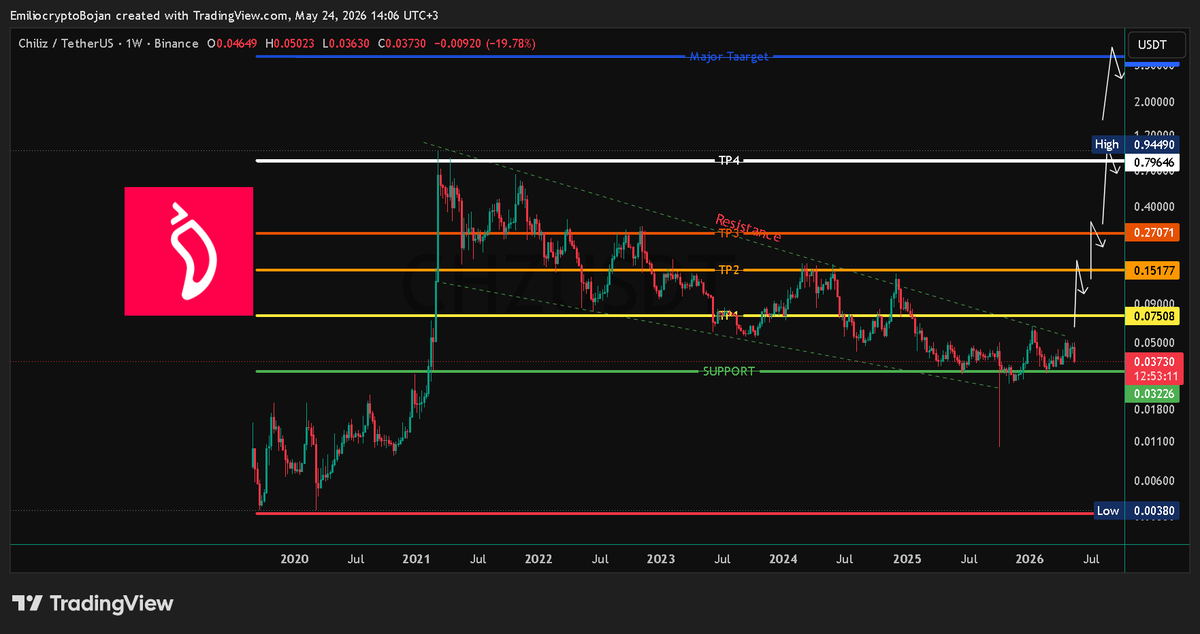
ethereum:0x3506424f91fd33084466f402d5d97f05f8e3b4af is yet to break out of the bullish wedge like we discussed in our stream, however there is some progress visible.
Chiliz is grinding towards resistance and away from support after the most recent bounce. That is a good sign.
Fundamentally, ethereum:0x3506424f91fd33084466f402d5d97f05f8e3b4af is in World Cup 2026 preparation mode. 🇿🇦 South Africa and 🏴 Scotland national team Fan Tokens launched this week. Kayen Finance DeFi went live on Chiliz Chain with DEX, staking and lending.
10% of Fan Token revenue now goes to ethereum:0x3506424f91fd33084466f402d5d97f05f8e3b4af buybacks and burns. Vision 2030 is expanding to Solana, Base and the 🇺🇸 US market.
Entry: $0.033 to $0.038
TP1 $0.07508
TP2 $0.15177
TP3 $0.27071
TP4 $0.79646
Major target under perfect conditions of exploding OI volume and more token burns: $3.92
SL $0.03
#CHZUSDT
$CHZ Yatay destek kırılmadıkça yukarıya tepki ihtimali masada dursun, 0060$ kırılımı gelecek olursa fiyatlama pozitif ve fan tokenlere likidite akışını tetikler. #Chiliz yürümeden fan tokenlere para akması zor. Alex kaldırır mı parası bitince kaldırır tabi.
$chz #chz#crypto#uclfinal CHZ sitting at just $0.37 with the Champions League final in 5 days and the World Cup starting in two weeks? That's wild. Biggest sports crypto before the biggest sports events… feels like something's off.
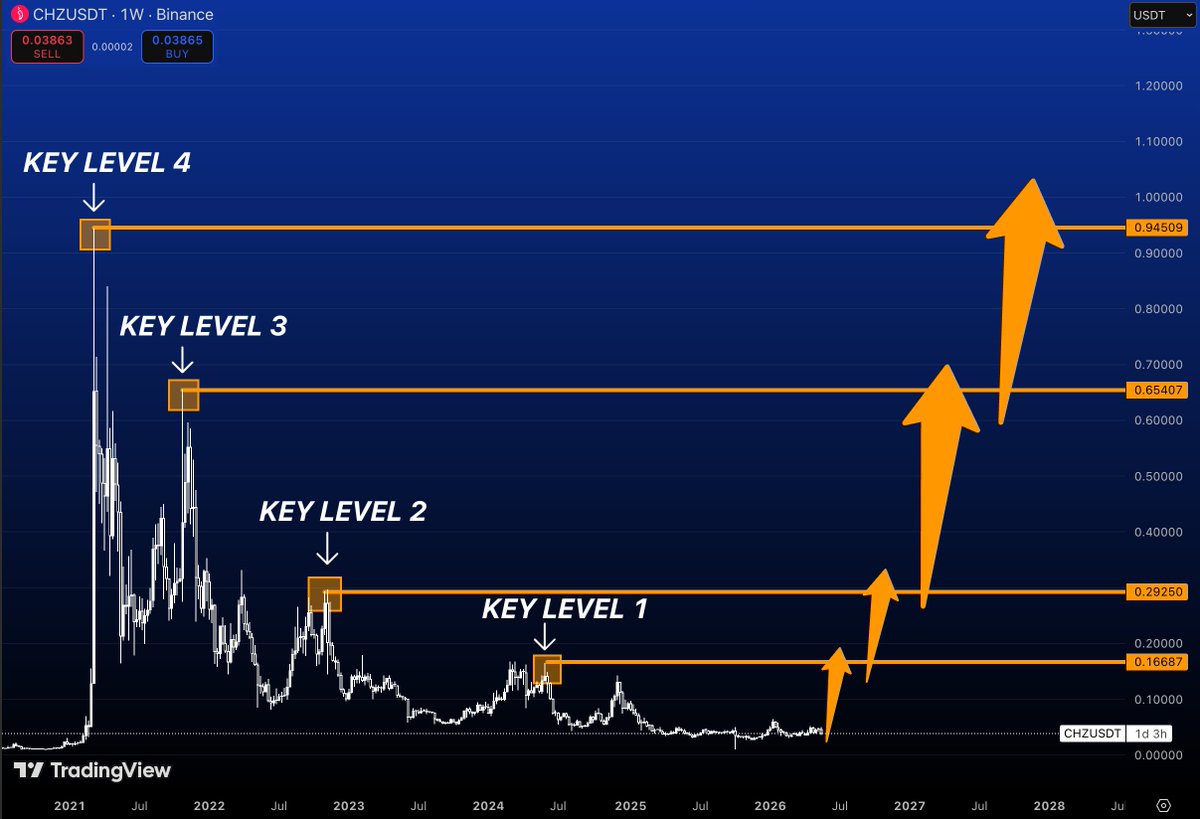
$CHZ has one of the cleanest long-term level structures in crypto right now
Every major expansion phase historically stopped at a very specific liquidity zone:
$0.16 → first breakout level
$0.29 → trend confirmation
$0.65 → euphoric acceleration zone
$0.94 → macro resistance / cycle target
What stands out is how compressed price became after years of decline
That type of compression usually precedes violent expansion once momentum returns
The chart is essentially showing a stair-step market structure:
reclaim one level → consolidate → expand into the next liquidity pocket
And because $CHZ trades heavily on narrative and retail momentum, moves can become exponential once the higher resistance bands break
The most important area right now is the first key level around $0.16
If price reclaims and holds above it on higher timeframe closes, the probability of a full trend reversal increases dramatically
At that point, the market stops viewing CHZ as a dead alt
And starts repricing it as a returning cycle asset again


![0xchainink's tweet photo. $ENA : Review 📜
What if a dollar didn't need a bank, a vault, or a single dollar of cash to hold its peg?
Meet Ethena, issuer of USDe, the synthetic dollar that reached the third spot among all dollar tokens by holding its peg with derivatives instead of a vault of cash. The product works, the yield is real, and the institutions are arriving. The token, so far, is a different story.
Let's explore the widest gap between protocol and token in DeFi. 👇
⚪ Ethena at a Glance
Marketplace Insight: this is the widest protocol-versus-token split in the market. USDe is one of the most successful products crypto has shipped this cycle, now integrated into BlackRock's Aladdin and partly backed by BUIDL, while ENA trades at a 95% drawdown because it captures almost none of the protocol's $250M-plus in cumulative revenue. The clean contrast is that both sentences describe the same protocol. USDe is a triumph and ENA is a disappointment, and the hinge between them is a single governance vote, the fee switch, that has not yet flipped.
⚪ Mission
Ethena's mission is to build crypto-native money that does not depend on the banking system: a scalable, censorship-resistant dollar, plus a dollar-denominated savings instrument that pays a real yield. The thesis is that a synthetic dollar backed by hedged collateral can deliver both stability and yield in a way reserve-backed stablecoins structurally cannot, since those hold their backing in cash that earns the issuer, not the holder.
🔵 A Brief History
Ethena grew out of a widely shared idea for a delta-neutral synthetic dollar, which Guy Young turned into a company in 2023 after a career at credit and private-equity firm Cerberus Capital Management. The pitch was direct: take crypto collateral, short an equal amount of perpetual futures against it, and the combined position holds a stable dollar value while throwing off yield from staking and funding.
USDe went live in early 2024, and the ENA token launched via Binance
Launchpool on April 2, 2024, peaking at $1.52 nine days later. Growth was explosive, with USDe supply climbing past $14B at the height of the cycle on the strength of double-digit sUSDe yields. The raise history was equally heavy, roughly $182.5M across rounds from Delphi, Lightspeed, Brevan Howard, Pantera, and YZi Labs, capped by a $100M private sale in February 2025 to fund Converge, an institutional settlement chain built with Securitize.
The retrace was just as sharp. As funding rates cooled, sUSDe yields fell, USDe supply contracted toward $4.5B, and the token bled through 2025 and into 2026 under constant unlock pressure. 2026 then split into two opposite narratives. Institutions arrived in force, with BlackRock adding USDe to Aladdin, BUIDL becoming the reserve for a white-label product, and Janus Henderson and Coinbase Ventures investing. Regulators pushed back just as hard, with Germany's BaFin barring USDe from the EU under
MiCA days before the July 1, 2026 enforcement deadline.
🔵 Ecosystem Narrative
The organizing idea is that a yield-bearing synthetic dollar can become base money for DeFi, and every integration widens that base.
➛ USDe, the synthetic dollar. Collateral is held and delta-hedged with short futures, so the combined position tracks a dollar. The peg is defended by mint-and-redeem arbitrage plus a Reserve Fund backstop.
➛ sUSDe, the Internet Bond. Staking USDe earns a yield sourced from staking rewards and perpetual funding, the product that drove the protocol's growth and the one most exposed when funding turns negative.
➛ Institutional rails. The BlackRock Aladdin integration, BUIDL reserves, a $100M liquidity facility through Securitize, and custody with Anchorage push USDe toward institutional balance sheets.
➛ USDtb and the white-label stack. A separate BUIDL-backed stablecoin plus a stablecoin-as-a-service offering let other firms issue branded dollars on Ethena's infrastructure, now deployed as far as Sui.
➛ Deep DeFi integration. USDe and sUSDe sit across Pendle, Aave, Morpho, and a USDe-margined perps venue on Hyperliquid, embedding the synthetic dollar as collateral throughout the ecosystem.
➛ Converge and RWA diversification. An institutional settlement chain and a $250M allocation to tokenized AAA CLOs aim to diversify USDe's backing beyond pure crypto funding trades.
⚪ Token Utilities
$ENA is a governance token today, with real value accrual still pending the fee switch.
➛ Governance: holders vote on risk parameters, collateral, and treasury decisions, including the reserve and buyback design.
➛ Staked ENA (sENA): locking the token earns points and is slated to receive protocol revenue once the fee switch activates.
➛ Pending value accrual: a governance-approved fee switch would route a share of protocol revenue to sENA stakers and open-market buybacks, the mechanism meant to close the protocol-to-token gap.
➛ Collateral and incentives: the token anchors ecosystem incentive programs and the Sats points campaigns that drive USDe adoption.
⚪ Key Features
➛ Synthetic-dollar design: a dollar that holds its peg through hedged derivatives rather than bank reserves.
➛ Native yield: sUSDe pays a funding-and-staking yield, a savings instrument reserve-backed stablecoins cannot match.
➛ Transparency: real-time backing dashboards and third-party attestations of collateral and custody.
➛ Off-exchange custody: collateral held with custodians and settled to exchanges, reducing but not removing counterparty exposure.
➛ Multi-chain reach: USDe deployed across Ethereum and additional chains, with a white-label stack for third-party issuers.
➛ Reserve Fund: a protocol-owned buffer that absorbs negative funding periods to defend the peg.
🔵 Meet the Team
Ethena runs a split structure. Ethena Labs builds the protocol, an Ethena Foundation stewards governance and the token, and a Reserve Fund backstops the peg, which matters because the peg defense and the regulatory posture live in different places than the code. CryptoRank confirms a current core of six.
▶️ Core Members:
➛ Guy Young [ @gdog97_ ] - Founder & CEO | Built Ethena in 2023 after a career at Cerberus Capital Management, one of the larger credit and private-equity firms. Leads strategy, institutional partnerships, and the protocol's regulatory positioning, and has been the public face of the BlackRock and BaFin developments.
➛ Elliot Parker [ @ElliotP789 ] - COO + Head of Product Management | Owns product direction across USDe, sUSDe, and the expanding white-label and institutional stack.
➛ Conor Ryder [ @ConorRyder ] - Head of Research | Leads Ethena's research and data work, previously an analyst at crypto data firm Kaiko, and authors much of the protocol's public analysis on funding, yield, and reserves.
➛ Brian Grosso - Head of Engineering | Runs protocol engineering, including the minting client that converts collateral into USDe and manages the delta-hedging positions.
➛ Seraphim Czecker - Head of Growth | Drives growth, integrations, and risk-adjacent strategy, having previously led risk and growth at the lending protocol Euler Finance.
➛ Zach Rosenberg - General Counsel | Owns legal and regulatory strategy, a load-bearing role given the MiCA bar and the securities questions that follow a yield-bearing dollar.
➛ Reserve Fund and Ethena Foundation | The peg backstop and the governance steward. The Reserve Fund absorbs negative-funding periods to hold the peg, and the Foundation administers token governance and the pending fee switch.
🔵 Ratings
➛ Use Case: ★★★★✦ (4.5/5). Ethena created and still leads the yield-bearing synthetic-dollar category, with USDe reaching the third spot among all dollar tokens, industry-leading sUSDe yields, and integrations spanning Binance, Aave, Pendle, Morpho, and Hyperliquid. The 2026 institutional wave, BlackRock's Aladdin, BUIDL reserves, Janus Henderson, Coinbase Ventures, is genuine validation most stablecoin projects never reach. The 0.5-point deduction is structural fragility and access. The model's yield and peg depend on positive funding rates and staked-ETH returns, so the use case weakens exactly when markets do, and the BaFin bar under MiCA closes off the entire EU, capping the addressable market for the boring, regulated dollar Europe actually wants.
➛ Tokenomics: ★★★✦ (3.5/5). The foundation is genuinely strong: a fixed 15B max supply, no active inflation today, and a large, verifiable base of protocol revenue (over $250M cumulative) waiting to be routed to the token through the pending fee switch. That combination is why this clears a flat 3. The 1.5-point deduction is that the value accrual is not yet live and the distribution carries weight. ENA remains governance-only until the fee switch activates, so the token captures little of what the protocol earns today, while 30% to core contributors and 25% to investors keeps cliff unlocks running into 2028, and a smart-contract parameter technically permits up to 10% annual inflation later. A 95% drawdown reflects that gap. Flip the fee switch and turn the buyback real, and this moves to 4.
➛ Audits: ★★★★ (4/5). The code-audit stack is deep and named: Zellic on v1, Quantstamp and Spearbit in 2023, Cyfrin and a repeat Quantstamp in 2024, an architecture and economic-risk review led by former MakerDAO lead engineer Kurt Barry at Spearbit, plus a public Code4rena contest, with no critical or high vulnerabilities reported across any of them. The 1-point deduction is that the protocol's real risk is not in the Solidity. Delta-neutral execution depends on centralized-exchange venues for the short leg, so custody counterparty exposure and funding-market mechanics sit beyond what any code audit can certify, which is also why this does not reach the 4.5 tier reserved for a verified top-tier score or named formal verification.
➛ Community: ★★★✦ (3.5/5). Ethena has scale and reach: a large holder base from the Binance Launchpool origin, heavy CEX support, and one of the more active integration ecosystems in DeFi. The 1.5-point deduction is the nature and mood of that base. Much of it assembled around Sats points farming and sUSDe yield rather than protocol conviction, governance participation is thin relative to the holder count, and sentiment has cratered alongside the token, with "is the project dying" now a recurring question rather than a fringe one.
🔵 Conclusion
Ethena built something rare, a crypto-native dollar that scaled to billions and earned a place among the largest stablecoins in the market, then backed it up with the kind of institutional validation most protocols only pitch. USDe on BlackRock's Aladdin, BUIDL as a reserve asset, and asset managers like Janus Henderson putting capital directly into the ecosystem are not vanity metrics. They are the clearest signal yet that a hedged synthetic dollar can sit on institutional infrastructure.
The risks are real and worth naming. The peg and the yield both lean on positive funding rates and staked-ETH returns, so the whole machine runs hardest when markets are calm and strains when they are not. USDe supply has already contracted roughly 70% from its peak, the BaFin bar shuts Ethena out of the EU, and the token has captured almost none of the protocol's revenue while unlocks run to 2028.
But the bull case is clean. If synthetic dollars are a real category, and Ethena is the protocol that proved they scale, then a fee switch that finally routes $250M-plus of demonstrated revenue to the token would close the exact gap that defines ENA today. Ethena proved the product. What it has not yet proved is that the token is more than a claim on a promise. USDe already reads like infrastructure. $ENA, for now, reads like an IOU on a vote that has not happened.](https://pbs.twimg.com/media/HMZgirsaMAA4NqC.jpg)