Agree but we need to define what makes "politically selected" firms worse those merely selected for entropic reasons. What kind of nation can emerge from the maximum power principle alone? What social contract are you proposing now that we may soon have nothing in common with one another beyond an ancient origin?
Ideology is game theory when done right. Even if it is always reductive, Ideology can be true or false, good or evil. The ideology of ants serves them quite well and is good for them.
Space launch was a clear case where there was a large difference in efficiency between what was possible and what was done in practice before SpaceX. A large part of that was due to everything being locked in to what (just barely) already worked, with huge risk aversion. WIth national prestige or a half billion dollar geosync satellite on the line, speculative engineering ideas that might result in a public debacle were not welcome.
When failure is not an option, success can stay very expensive. You need to experiment to improve, and that fundamentally means being comfortable with failure. If you know it is going to work, it isn’t an experiment.
I have long believed that nuclear power today is in precisely the same state as space launch two decades ago, but the even more pressing question now is if semiconductor fabrication might also be.
On the one hand, Moore’s Law has been a sequence of heroic miracles of technology at the wafer fabrication level, grinding out hundreds of compounding small improvements.
On the other hand, fabs are “too big to fail”, and there are elements of extreme conservatism at play. Intel’s “Copy exactly!” fab development exemplifies that mindset – instead of every new building being an opportunity to explore and optimize processes, it was deemed more valuable to just replicate.
While each individual machine may be straining against physical limits of technology, it is possible that the systems orchestrating them all together could be far from optimal.
The explore / exploit axis is fundamental to all decision making, but human risk avoidance probably biases away from optimal exploration.
Now that I’m out of government, I can finally respond for myself: Get bent, soyboy. We didn’t do this for “Silicon Valley . . . companies.” We did this for you, for your family, your community, your state, your nation, and your species.
Nuclear energy provides the safest, highest density, reliable power available on our planet. My career colleagues at DOE and NRC inspired me to think about nuclear as a way to forge American steel and electrolyze aluminum without releasing particulate matter, to desalinate water in the Middle East and save humanity from resource wars. By rejecting the false narratives and Cold War hysteria, we can secure the next American century while raising whole countries out of poverty.
Do you really think I left an incredible career at Kirkland, paid out of pocket for an apartment in DC and dozens of cross-country trips, and left my family on the west coast because I wanted to enrich people I never met before taking this job? I came to D.C. to do something that mattered, to satisfy a driving curiosity (more on that later), and, most importantly, to serve.
As I learned more about nuclear energy and its history, I developed a conviction that one nuclear’s biggest issues was a culture of cynicism: nothing new or exciting could happen because it would end in disappointment, and that militated against rocking the boat even a tiny bit. The career staff in government and their industry counterparts lived through dark winters before and stopped believing that warm springs could bloom into summers.
I have two core philosophies. First, I believe in ruthless optimism. Rational decision making requires detached risk analysis. But we also cannot win if we believe we can lose. Merging the two requires orienting teams around driving missions. That way, when a real opportunity presents itself, you can take a huge swing.
If I take credit for anything—honestly, almost all of the success belongs to the incredible and dedicated people at @ENERGY and @NRCgov—it’s countering the cultural rot and morass that risked forfeiting American excellence. My colleagues and I gave cover to the scientists and engineers, which freed them up to focus on delivering safe power. And, as success materialized, they started to dream again. That’s why the pilot program succeeded, and why I feel confident about the future of NLICs and NRC reform. Nobody needs me anymore because they can innovate on their own.
My second core philosophy is to assume positive intent. Avi, I know that you heard about my real motivations from multiple people you interviewed when preparing your hit piece on me. Rather than telling that story, one which could help inspire another generation of people to use their talents for the greater good, you ignored them. Instead, you implied that Peter Thiel recruited me for nefarious purposes. (I’ve never met him, but, @peterthiel, if you’re reading this, I’m a huge fan!)
Nuclear regulation starts and ends with safety. I promised everyone I worked with that I would resign before doing or pushing for anything that could compromise public safety. But I also distinguished between real safety and performative bullshit. That’s what the careers came to embrace, too. We love nuclear, why would we do anything that could risk threatening its future?
America faces a crossroads. We can either trod a road of cultural decay or hike our way back to the peak of global innovation. Join me on the latter path. Correct the fear mongering and conspiracies and tell the story of America’s great reindustrialization. Tell the story of our public servants, our great entrepreneurs, our scientific dominance. Tell the real story about how DOGE went nuclear.
Ancient horse genomes might contain some really good genes which have been lost. I would claim its worth looking for a fossil of a Nisean horse or some of the other great extinct lineages to see if theres anything special in those genes that can be recovered!
https://t.co/V0hVSjtnLy
Sometimes company building feels like stepping on a series of Wiley Coyote cartoonish land mines
*KABOOM* *YEOUCH*
Then the blast launches you into the stratosphere and at the apogee you relish in the serenity of the vast horizon
Then you fall and hit another cartoon land mine
In medieval times, within the arms race of ever more demonic torture devices, some sadistic genius came up with the idea of the Little Ease.
This was a prison cell built so small in every dimension that a grown man could not stand upright in it nor lie down at full length nor properly sit.
The pain is relentless and without relief and inflicted by one's own body. Prisoners were known to go insane within a few days. A stay at the Little Ease was considered even more cruel than the rack, the thumbscrew, and the other ghoulish machinery of the Tower of London.
A breeding pig will spend her whole life in a version of that box.
These are social, roaming creatures (more intelligent than dogs) who will never leave this corset of steel.
They have been selectively bred to be bigger than their frames can support. Yet we put them in cells so confined that they cannot comfortably sit, and their attempts to do so (for example, by sneaking their limbs into adjacent stalls) reliably lead to fractures and sprains.
They cannot sweat, yet have nothing to roll around in to cool themselves off. Except their own manure, which (contrary to the common misconception) they are so averse to (thanks to their strong sense of smell) that new sows will often suffer from constipation to avoid soiling the space from which they eat and sleep.
Here is how the writer Matthew Scully described what saw at one of Smithfield’s “gestation barn”:
> “Sores, tumors, ulcers, pus pockets, lesions, cysts, bruises, torn ears, swollen legs everywhere. Roaring, groaning, tail biting, fighting, and other “Vices,” as they’re called in the industry. Frenzied chewing on bars and chains, stereotypical “vacuum” chewing on nothing at all, stereotypical rooting and nest building with imaginary straw. And “social defeat,” lots of it, in every third or fourth stall some completely broken being you know is alive only because she blinks and stares up at you … creatures beyond the power of pity to help or indifference to make more miserable, dead to the world except as heaps of flesh into which the [insemination] rod may be stuck once more and more flesh reproduced.”
—
The Save Our Bacon Act is trying to unroll the few state protections we have against this barbaric cruelty - for example California’s Prop 12 - which banned the sale of pork from pigs kept in gestation crates.
It’s incredibly important we don’t end up with this sort of federal preemption.
SOB will not only kill the most important animal welfare related laws in the US of the past decade, but more importantly, it will also restrict ALL future legislative progress (aka how the animal welfare movement has gotten its biggest wins).
The Senate is currently deciding whether to add the SOB Act to the Farm Bill.
With relatively little money now, we can discourage the most pivotal senators in the Ag committee from backing this amendment.
Defeating this bill is even more important given the amount of philanthropic funding I expect to come online in the next year or two.
It will plausibly be over 10x more expensive to repeal SOB than to prevent it from passing in the first place.
All that money that could be spent transforming our society's relationship to mass animal suffering will instead have to be spent just getting us back to where we are right now.
That's why money spent now fighting this bill (and I mean right NOW) is so effective.
If you’re in a position to donate six figures, please DM me.
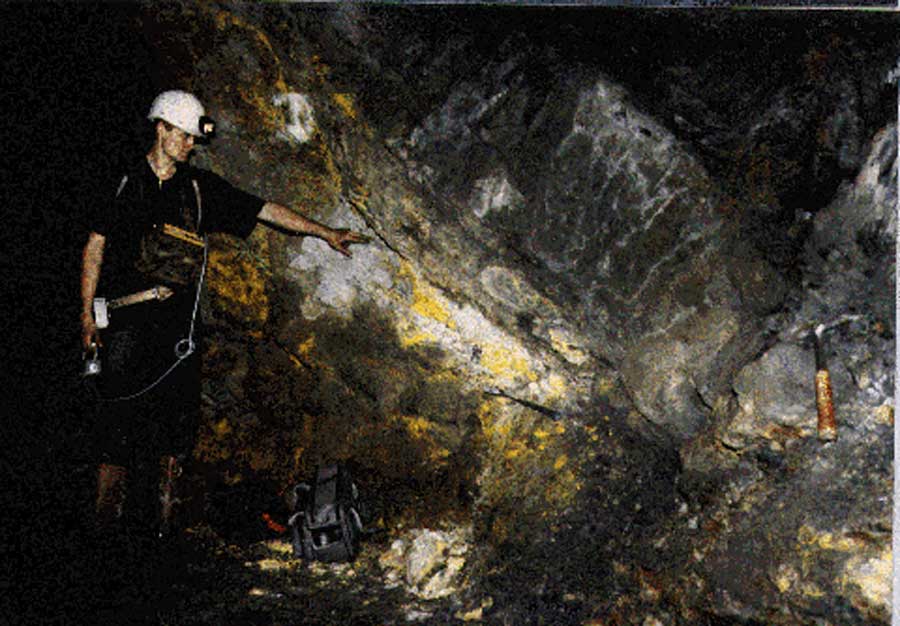
2 billion years ago, a nuclear reactor geologically self-assembled and turned itself on.
No humans were involved. Only rock, groundwater, & natural uranium.
It ran intermittently for hundreds of thousands of years.
Here's the story of Oklo (not the company, but the place!):🧵