New to JustinsMorningCoffee?
Film student?
Just curious?
I’d say start with the 7 Basic Plots Lectures
It’s like a free film course where you can think along with me as I attempt to go upstream & understand the story archetypes
The Seven Basic Plots
https://t.co/nYPF92YJH0
Whenever I have students who worry about whether or not they are being “original” I think about this idea.
If stories are a kind of food for the soul, which you metabolize and then inadvertently embody, then it isn’t always about originality. It’s about getting the right ingredients in the right combination to satisfy the craving of (and ultimately nourish) whoever needs it at that moment.
Three kinds of story-meals:
1. Martin Shaw style (re-telling something passed down to you by word of mouth)
2. Rex McDaniel style (telling a short story about your life to a group of people, e.g. The Moth Story Hour)
3. Fiction Writing (crafting a story such as a novel or screenplay)
To my way of thinking, all three are ways to prepare a meal for the soul.
Sometimes you want a classic dish, told in the most faithful way possible.
Sometimes you want to have a little at-home meal, remeniscent of the classics but prepared with ingredients you have around the kitchen.
Sometimes you want to go out to a restaurant and have the works.
Just imagine how he would hit today, when the league as a whole is better at pitching.
He wouldn’t hit .300
He hit .080 vs Norm Charlton. Every team has 5 Norm Charltons today.
He hit .083 against Kevin Brown, .167 vs Pedro Martinez, .185 vs Rick Sutcliffe .103 vs Randy Myers
See, when he was up against higher quality pitching, he didn’t fare nearly as well. Now imagine the whole league has that super high quality pitching. Every bullpen has several guys throwing over 100, every team has multiple guys with wipe-out sweepers and sliders.
In his day, a guy throwing 89-90mph fastballs was considered “a power pitcher” - nowadays 90mph can be considered off-speed.
.250 vs. Randy Johnson, .286 vs Tom Galvin, .215 vs. David Cone, .286 vs. Denis Martinez, .239 vs Maddox, .239 vs Andy Bennes, .128 vs Mulholland, .267 vs Jamie Moyer, .211 vs John Smiley, .260 vs. Tom Browning, .259 vs Kevin Appier
So that’s the difference. He wants to criticize today’s players, but the fact of the matter is, he’d strike out too, he’d struggle to reach .300 for sure.
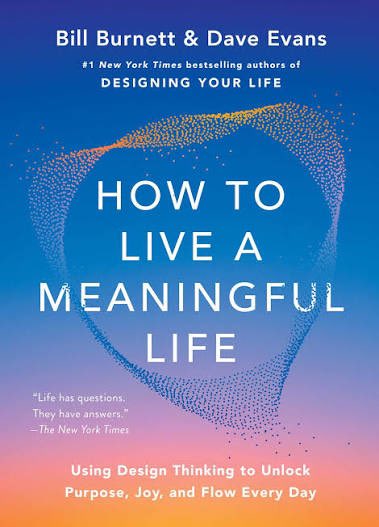
Wonder
Coherency
Flow
Community
- the four key components of meaning-making
I’m excited for this book (which I’ll be reading in any spare moments I find over the next couple of months)
Sometimes I wonder if so many of the problems in our lives can be boiled down to just simple impatience.
Here’s the quote that floored me the other day.
“Your job is to be wrong quickly and right slowly.”
Cut your losses quick if you find you’ve gotten off the path, or when you realize your thesis has been wrong, and spend a lot of time (more time than you think you should) researching the right way to go.
You have time; that’s what I’ve learned recently, you always have time. So you can take your time when making big decisions knowing that these things are not supposed to be rushed.
P.s. I THINK this was from Warren Buffet, but I can’t verify that.
@klwong43 I’m still plugging away over here, trying to hike upstream to find the high mountain source.
Right now, I’m testing the new code to see if it works. But when I’m ready, I’d be happy to contribute an essay or two on the subject.
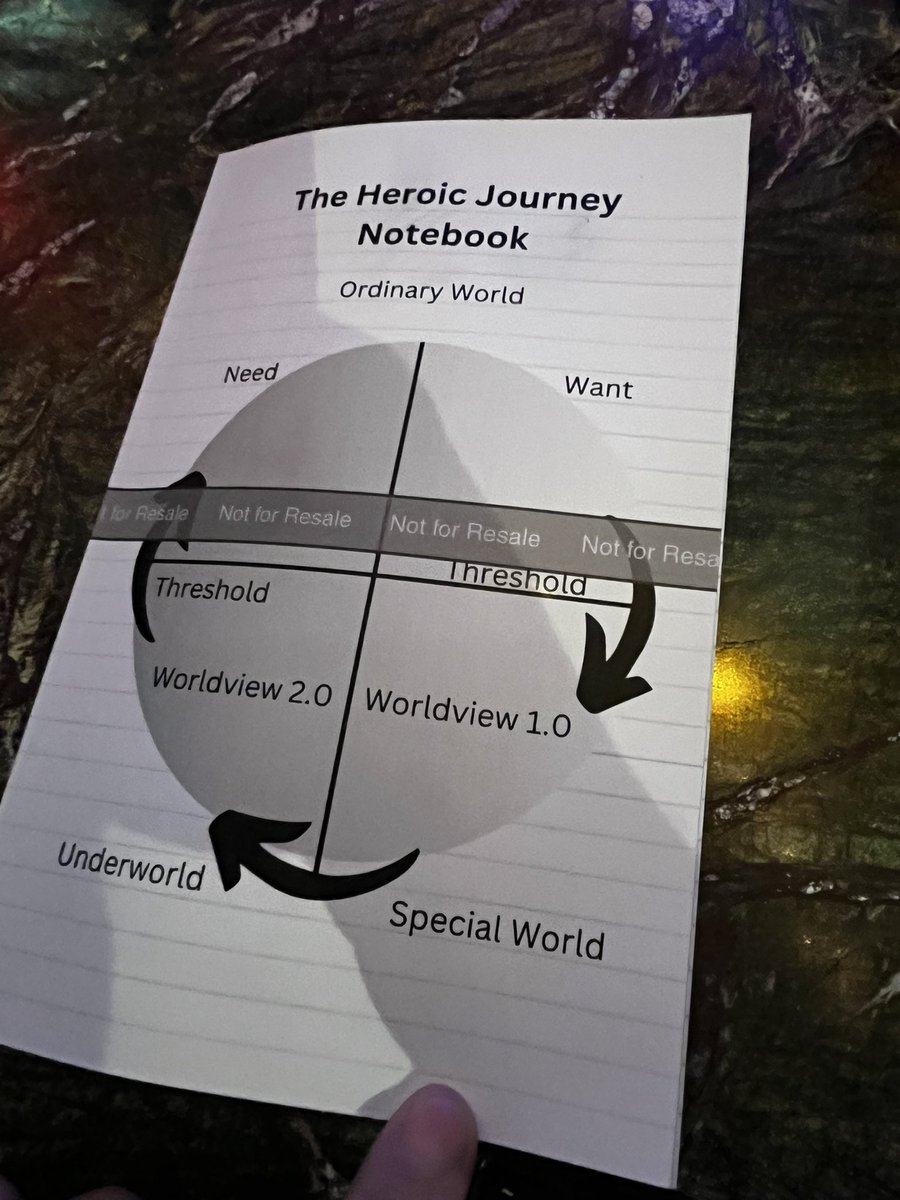
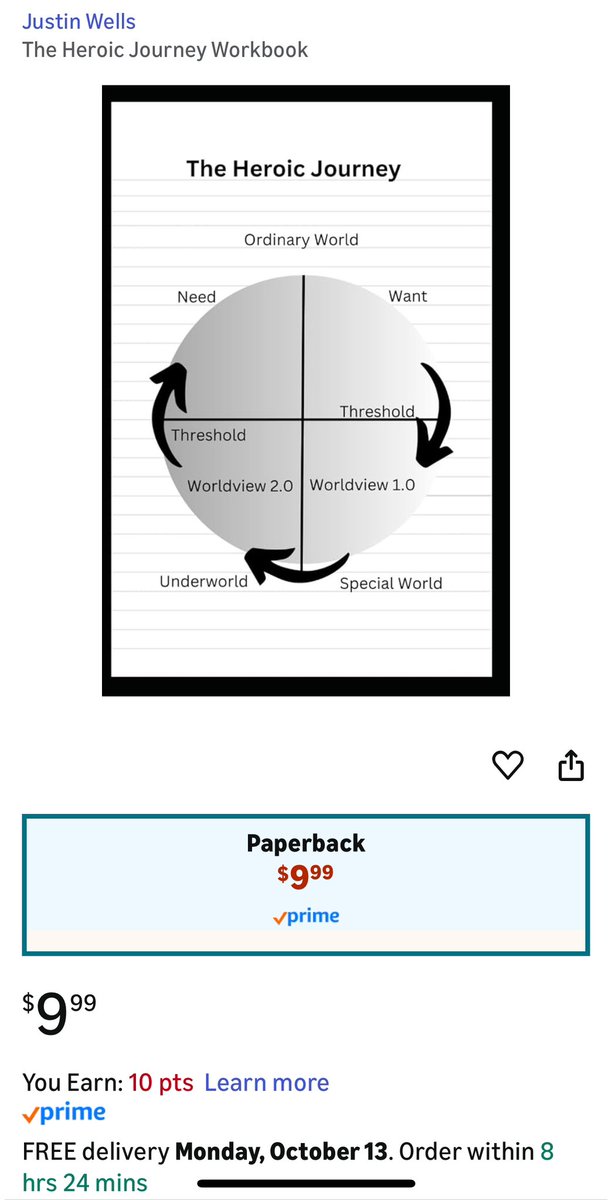
I’m plugging away on the Heroic Journey Notebook - my little movie watching notebook.
I keep self-publishing it, having a copy delivered to my house: using it to map some movies, and seeing how it works, updating it, filling in the gaps, re-publishing and having another author copy delivered, and repeat.
It’s a lot of what I got from the Story Grid system, with some modifications by yours truly, but tailored for movies rather than novels.
I’m close to the point where I’ll start giving it out to the screenwriting folks I know to road test it.
If anyone has seen House of Dynamite, I NEED to know how that movie made you feel.
I have a theory about it: I think it illustrates a very, very important lesson in storycraft.
@TheCosmicMuffet House of Dynamite is an example of a story that makes a very, very critical (technical) error. I just want to see if anyone else spotted it.
It’s going to have be paired with some YouTube lectures so that people can understand how to map the movie. I’ve been doing it myself with a hard copy of the notebook.
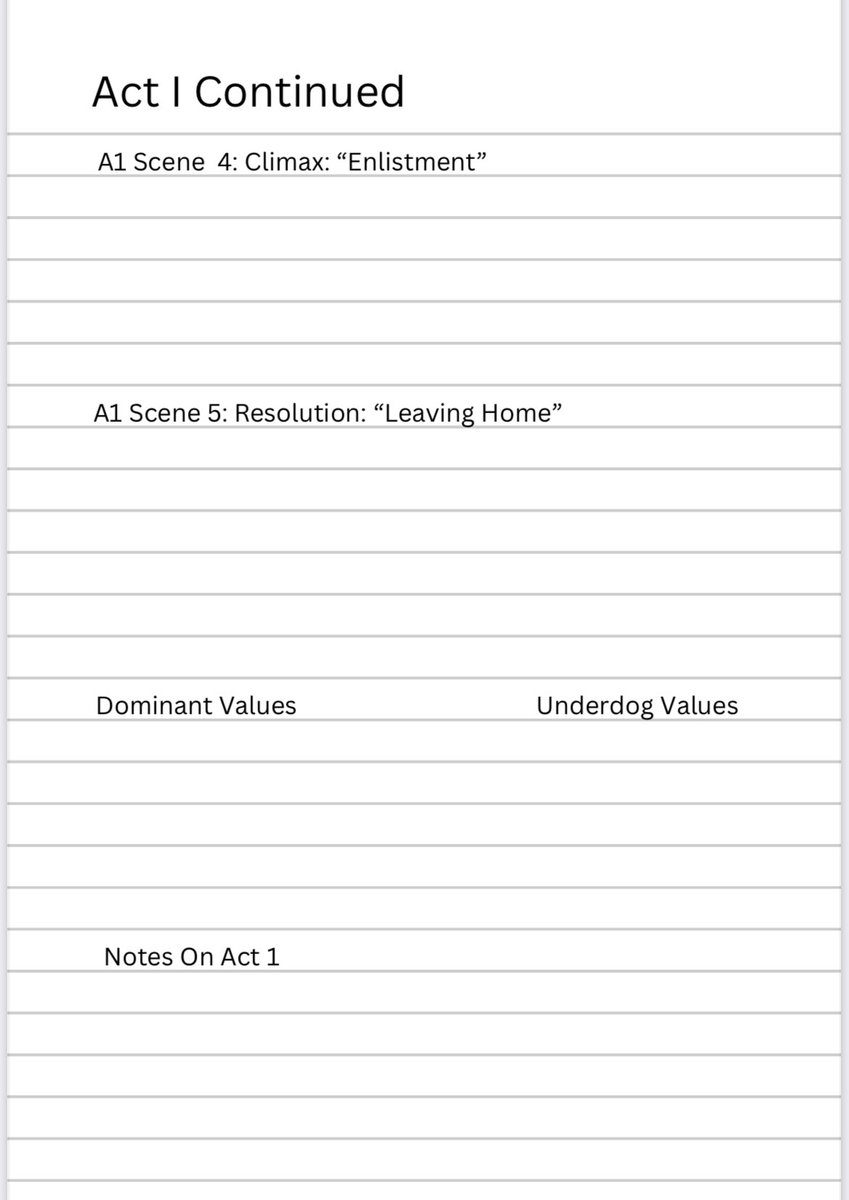
The most difficult part is distinguishing between the CORE scenes and either setup (pre) or metabolizing (post) scenes.
In other words, each core scene will have one or several pre-scenes (setups), and usually one or several post-scenes (metabolizing/processing).
So when you first start doing this you well need to do it in pencil and get a good eraser because you’ll find that you are going to have to develop your intuition.
——————————
THEN, after you have mapped, let’s say, 10 of your favorite movies, your skillset at recognizing core events should be sufficiently developed, such that you can just flip the page and start filling it out for one your own movie ideas.
The notebook will, ideally, become a repository of outlines which you can use for your future screenplays.
Additionally, when you get stuck writing, you’ll have a resource/quick guide, where you can go back and look at how your favorite movies have navigated any specific part of the terrain you are now navigating with your story.
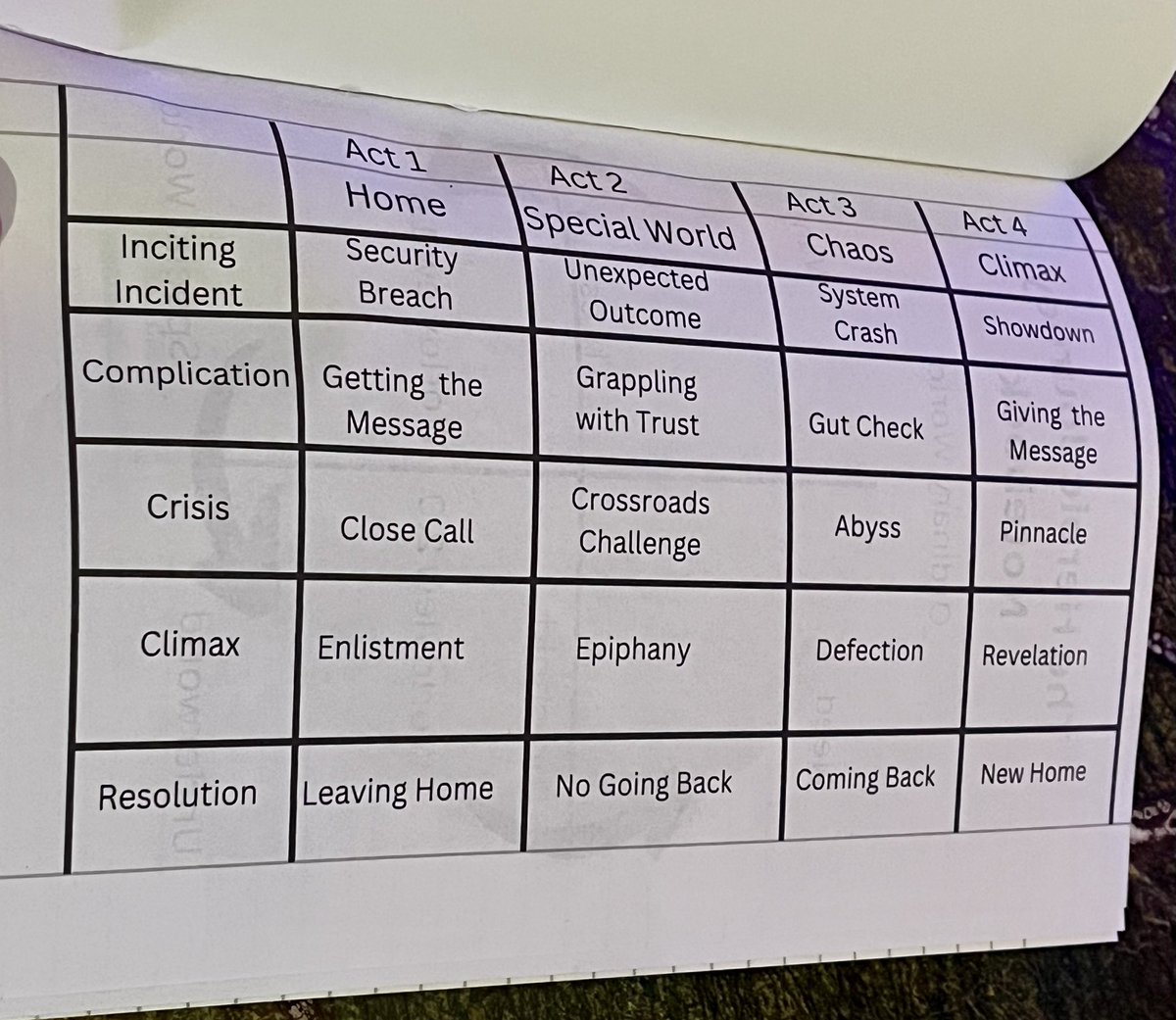
Say for example, you get stuck at the “Epiphany” moment.
Simply flip back through your notebook and look at the epiphany scene in every movie that you have mapped (I recommend putting in the timestamps too so you can quickly watch the scenes if you want to).
(I am deeply indebted to Story Grid (Shawn Coyne and Tim Grahl and all the wonderful novelists over there) for these insights)
It’s still an experiment but I feel like I’ve made so much progress.
So my little movie watching notebook will look something like this.
The idea is: you have it in front of you while you watch the movie, and you fill in the core scenes.
In the Black Mirror and Alien Earth, as well as that kind of cheesy one “Upload” - the presupposition is that if you take a human consciousness, replicate it as an AI and upload it into a synthetic body - while it may not “technically” be that person’s consciousness, it IS conscious.
And the dramatic question becomes: what about the *rights* of that consciousness?
Are the synthetic entities with AI brains going to be turned into slaves, in other words? (We are meant to feel empathy for them)
To my thinking, this isn’t the way to go.
Why should we assume consciousness can be transferred?
No, instead, we should assume that the person died when the upload happened. The “transhuman” seems like a conscious entity from the outside, but it is in fact, only a machine with an LLM brain who looks and sounds like the original person.
Here’s the story:
The politician encourages everyone to upload into synthetic bodies so they can live forever. But secretly he’s got a patch of code he’ll run right before the election which will allow him to influence the vote.
A ragtag underground group of “organics” have not upgraded, because - well some of them are ideologues, sort of like the Amish, who willfully go for the harder, shorter lives out of principle, some simply can’t afford it, and some are just old fashioned crazy conspiracy theorists.
Well when the code patch is run, and this band of misfits finds themselves the last of the real humans, what will they do?
Some of the best artists in the world learned their craft by copying the masterworks.
I’m currently working on a notebook which you can use to plot out the core scenes in your favorite movies as you watch.
The theory is this:
The more practice you get pulling out the core scenes of your favorite films, eventually you will be able to fill out a sheet with all the core scenes for one of *your* ideas.
Now, I’m still tweaking the notebook, (getting a lot of help from my courses with Story Grid) but it’s close to being done.