Modern physics discovers that the Big Bang may not have been the beginning of everything. 🤣🤣🤣🤣
Sanātana Dharma: "You're only a few thousand years late."
Roger Penrose suggests our universe may have emerged from a previous cosmic cycle.
Meanwhile, Vedic cosmology has been describing for millennia that the material universes are repeatedly created, maintained, and dissolved. One day of Brahmā lasts 4.32 billion years. His full lifespan extends to 311 trillion years. At the end of that cosmic cycle, all universes are withdrawn into Mahā Viṣṇu. Galaxies, stars, space, time, matter—everything collapses into Him. Then, with His next exhalation, countless universes emerge once again, each with its own Brahmā, planetary systems, and cosmic history.
So while some physicists are celebrating the possibility of one universe before the Big Bang, the Vedic sages were discussing an endless succession of universes appearing and disappearing with the breathing of Mahā Viṣṇu.
Not bad for a civilization that supposedly didn't know cosmology.
The more science advances, the more it seems to be rediscovering footnotes from the Vedas.
USA is seeing rise of REAL Christianity
MAGA women are rallying to give up their right to vote because men are heads of the household.
They believe this would usher in the foundation of a truly Christian nation and this isn’t a fringe opinion either
https://t.co/B1IFvdhpRB
Spine always grows in the back that is against the wall. America denied us crucial LOX/LH₂ cryogenic engine technology. We developed it indigenously and using it we now send American satellites into space.
India can remain sovereign only if it has a sovereign AI. @narendramodi
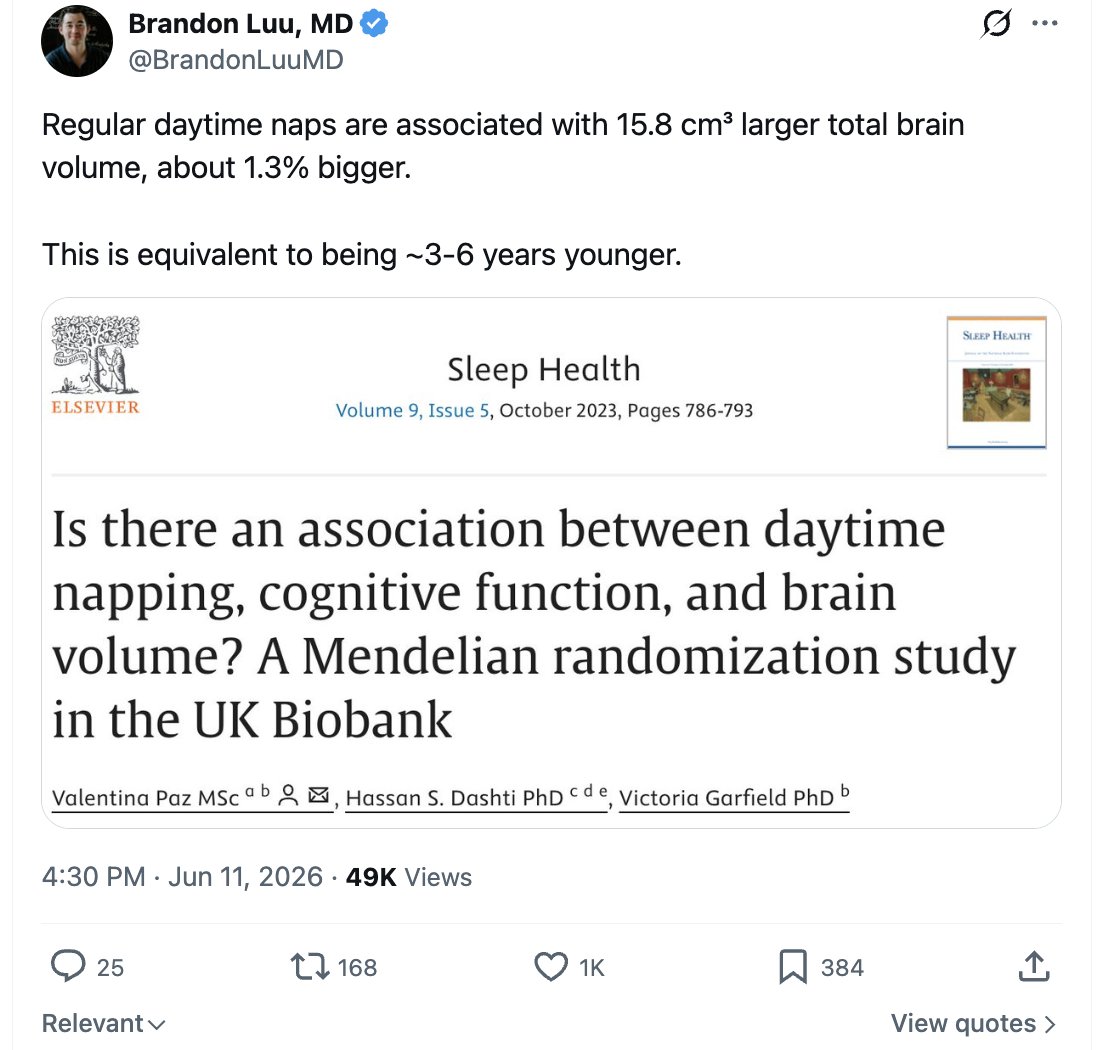
Modern sleep studies show that if a daytime nap exceeds 20-30 mins, we enter deep, slow-wave sleep. Waking up from this causes sleep inertia, leaving us groggy, destroying our night sleep & messing up our insulin sensitivity.
Ancient India prevented this through a mandatory post-lunch ritual called Vama-Kukshi.
Vama means left & Kukshi means womb/side. The protocol mandates that after a midday meal, we must lie down specifically on our left side for a short duration (traditionally calculated as the time it takes to take 8 to 16 deep breaths, ~15-20 mins).
Lying on our left side keeps the stomach below the esophagus, preventing acid reflux. More importantly, it activates the Pingala Nadi (the right nostril breathing channel, connected to the sympathetic nervous system), which stimulates digestion, while keeping the brain in a state of light, restorative rest rather than letting it plunge into a deep, heavy slumber.
The Sushruta Samhita explicitly warns that long, heavy sleeping during the day destroys metabolic health (causes Kapha & Meda/fat accumulation). But a short Vama-Kukshi, a quick, left-sided power nap was prescribed to restore mental clarity, relieve stress & preserve vitality (Ojas).
It is the exact ancient counterpart to the modern 15 min "power nap."
Yes, comparing Modi era with Nehru’s is right. Not to do so would be injustice to millions who suffered because of Nehru.
For example, Hindu Bengali refugees. Their children, grandchildren must never forget that their people were abandoned and thrown to the wolves by Jawaharlal Nehru before, during and after Partition.
Nehru despised dark-skinned Hindu Bengali refugees, among them my father, his siblings, their widowed mother and grandmother, fleeing rapacious and murderous Muslim League mobs in East Bengal; he did not want them to seek shelter in India.
Nehru wrote to CM BC Roy, instructing him not to let Hindu Bengali refugees enter West Bengal. Push them back from the border, Nehru said, don’t let them in.
Nehru insisted Hindu Bengalis of East Bengal / East Pakistan were coming to India for free-loading at the expense of Indians. He cut back Central funds for West Bengal to stop the meagre refugee assistance by way of a couple of kilos of inedible worm-infested rotten rice for Hindu Bengalis.
Hindu Bengali refugee women and children separated from their families, or widowed and orphaned in the Noakhali genocide and subsequent Partition Massacre of Hindus, rummaged in garbage bins and pitifully begged for morsels of food.
Hindu Bengali refugee children in rags with dark large sad eyes greedily licked on used banana leaves dumped on the streets by eateries, also known as ‘pice hotels’ in Kolkata parlance, of which there was a profusion in the post-War years. Emaciated babies and rickety children of Hindu Bengali refugees huddled with stray dogs on pavements.
Many Hindu Bengali refugees lived on ‘rice water’ or ‘fan’ (the starchy water that is thrown away after boiling rice) collected from homes of compassionate Bengalis who had little food to share.
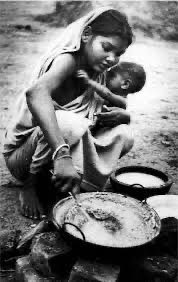
In the morning and evening there were pheriwallahs hawking their wares; in the afternoon there were Hindu Bengali refugee women in tattered sarees that barely covered their bodies and naked children with battered and bruised aluminium pots going from house to house, begging for ‘rice water’: “Ma, fan daao Ma…”
Those voices of has hunger were to haunt Hindu Bengali refugees like my parents for long, often till death.
Driven by hate for Hindu Bengali refugees, Nehru ordered horrifyingly, nauseatingly squalid and disease-ridden refugee camps to be named ‘Permanent Liability Camps’ or PLCs — PLC 1, PLC 2… — reminiscent of the ‘Permanent Solution Camps’ of the Nazis.
When despite his best efforts Nehru failed to push back the Hindu Bengali refugees to be slaughtered in East Bengal/East Pakistan, Nehru brought his devastating Freight Equalisation Policy which collapsed industry in West Bengal. Tens of thousands of jobs were destroyed and the Hindu Bengali was rendered jobless: Those who lost their jobs and businesses began turning on Hindu Bengali refugees just as Nehru had hoped.
Yet Nehru could not break the spirit of the Hindu Bengali refugees who were grateful to Bharat and determined to help rebuild this great nation savaged by invaders and colonisers especially John Company.
Through generations we Hindu Bengali refugees toiled, we built, we paid taxes, we sacrificed for the Nation, our Nation, we succeeded in establishing ourselves as dutiful, law-abiding, loyal citizens of India. Having lost our home and hearth, we had no other home but India.
We Hindu Bengali refugees were hived off to malaria-infested inhospitable Dandakaranya and we cleared forests and made the soil fertile. We were packed off to Andaman and we rebuilt our lives there. When we tried to set up home at Marichjhapi we were slaughtered: the estuaries turned red with our blood.
We grieved, we got up, we overcame that setback.
We lived with dignity and honour, we earned our food, we were not freeloaders. We were poor but we were honest: we had integrity.
Cut to 2026.
So who have proved to be India’s ‘Permanent Liability’ cadging off the state and living on unearned money? Nehru Dynasty.
Yes, Britain famously transferred wealth to India. When British arrived in India its share of the world economy was 4%. When they left in 1947, they had taken it to 23%, roughly equal to all of Europe combined.
On a serious note.
The Indian railways were financed entirely by bonds sold on the London Stock Exchange. British investors were guaranteed a return of 5% per annum by the colonial government. A guaranteed return, in an era when no other safe investment in Britain offered anything close. And who guaranteed those returns? Indian taxpayers. Indians paid for the construction. Indians paid the guaranteed profits to British shareholders. Indians paid for the equipment, which was manufactured exclusively in Britain and shipped to India at inflated prices. One mile of Indian railway cost twice what the same mile cost to build in Canada or Australia, because the guaranteed return meant there was no incentive to control costs. The more it cost, the more British investors and suppliers earned.
And what were these railways designed to do? Move raw materials from India’s interior to ports. Cotton from the Deccan to Bombay. Jute from Bengal to Calcutta. Coal from Bihar to wherever the Empire needed it. Tea from Assam to London’s drawing rooms. The routes connected mines and plantations to harbors. Not cities to cities. Not people to opportunities. Raw materials to ships. The Indian public’s transportation needs were, as Shashi Tharoor put it, entirely incidental.
Oh, and the railways also moved troops. Very efficiently. So that when Indians protested being looted, the British could deploy soldiers to shoot them. That was the other “infrastructure investment.”
But wait, there is more. Before the railways, India had the world’s finest textile industry. The British smashed the looms, broke the weavers’ thumbs (this is not metaphor, this is documented history), imposed tariffs on Indian cloth, and shipped raw cotton to Manchester to be manufactured into garments that were then sold back to Indians. India went from being the world’s largest textile exporter to an importer of British cloth within a generation.
The Bengal Famine of 1943 killed an estimated 3 million people. Churchill diverted food supplies from Bengal to already well-supplied British troops and European stockpiles. When informed of the famine, his response, on the record, was to ask why Gandhi had not died yet. This is the “infrastructure investor” Musk is defending.
India contributed 2.5 million soldiers to fight in two World Wars on Britain’s behalf.
So let us summarize the colonial “investment” in India. They took a 23% global economy and left it at 4%. They destroyed the world’s finest textile industry. They built railways with Indian money, for Indian resources, generating British profits. They engineered famines that killed millions. They drained an estimated $45 trillion in today’s value over 200 years.
That’s some unprofitable adventure.
Comparisons are futile but for me one of India's greatest engineering achievements remains the 217 feet tall shadowless Brihadisvara Temple built by Raja Raja Chola I in 1010.
Crafted with giant interlocked stones and crowned by an 81 ton kumbam, it was built within six years.
One of the most powerful symbols of India’s unbroken civilizational continuity!
Discovered at Mohenjo-daro in undivided India this steatite seal, about 4,300-year-old, shows a seated figure in yogic posture (widely seen as Shiva-Pashupati) seated in Mulabandhasana, surrounded by animals.
While ancient sites may lie across modern borders, India remains the living custodian of this heritage. The yogic posture, Shaivite symbolism, and spiritual ethos seen in the Pashupati Seal continue to thrive in India’s temples, daily worship of Shiva, yogic traditions, and cultural life even today.
From the Vedic period to contemporary Bharat, this civilizational thread has remained alive and unbroken — deeply embedded in our philosophy, rituals, and collective consciousness.🇮🇳
#PashupatiSeal #IndusSaraswatiCivilization #LivingIndianHeritage
Rubio is visiting the Missionaries of Charity in Kolkata. Sergio Gor was there just days ago, reflecting on Mother Teresa's "legacy of service." It is a good time to revisit what that her legacy actually was.
Christopher Hitchens spent years investigating Mother Teresa. He wrote a book about it, "The Missionary Position," testified as devil's advocate in her beatification, and produced a documentary called "Hell's Angel." YouTube link in next post.
His central conclusion: "Mother Teresa was not a friend of the poor. She was a friend of poverty."
She glorified suffering rather than alleviating it. Her facilities in Kolkata were called houses of the dying, not houses of the curing. Patients with treatable conditions were not given proper medical care. Needles were reused without sterilization. Pain medication was withheld or barely administered. As Hitchens documented, she told a patient suffering unbearable pain from terminal cancer: "You are suffering like Christ on the cross. So Jesus must be kissing you."
The money was never the issue. Hitchens pointed out that she had immense quantities of money and material at her disposal. Millions flowed in from donors across the world. Where did it go? Not into medical equipment. Not into painkillers. Not into training. The conditions in her facilities remained deliberately austere while the donations piled up.
And the donors themselves tell a story. Hitchens documented that she accepted over a million dollars from Charles Keating, the savings and loan fraudster who was later convicted for swindling elderly investors out of their life savings. When Keating went to trial, she wrote to the judge asking for clemency. The prosecutor wrote back, politely explaining that the money Keating gave her was stolen, and asked her to return it. She never replied. She never returned the money.
She praised Haiti's Duvalier dictatorship, a regime responsible for the torture and murder of thousands, and accepted their Legion d'Honneur. She endorsed Albania's Enver Hoxha. As Hitchens put it, she was "a friend to the worst of the rich"
Then there was the conversion apparatus. Former nuns from the Missionaries of Charity described being instructed to secretly baptize the dying, asking patients if they wanted a "ticket to heaven" and wiping their foreheads with a wet cloth that doubled as baptismal water, whispering the words of the sacrament. Hindus and Muslims were baptized without informed consent on their deathbeds.
Hitchens summed it up: she spent her life "opposing the only known cure for poverty, which is the empowerment of women and the emancipation of them from a livestock version of compulsory reproduction."
None of this is bigotry. This is not an attack on Christianity or on faith. Jesus, as the Gospels record him, drove money lenders out of the temple. He railed against the wealthy and the hypocritical. He healed the sick. He did not tell them their suffering was beautiful. He did not take money from fraudsters and appeal on their behalf. The criticism of Mother Teresa is not a criticism of Christ. If anything, it is a defense of what Christ actually taught.
In today's world, she would have been exposed. The conditions in her facilities would have been filmed and uploaded as Insta reels. The financial secrecy would have triggered investigations. The secret baptisms would have been a scandal. She would have been compared to the evangelical faith healers and god men who promise miracles while collecting donations from the desperate.
But she operated in an era before that kind of scrutiny existed, and the mythology is set in stone. Hitchens was one of the few who did. He paid for it with public outrage. But the record he assembled remains unanswered.
Rammohun Roy the so called Sati reformer, hated the fact that his widowed mother Tarini Devi was a devout Hindu who contributed money for "idol worship" in Pujas. When he refused to pay his share from the family's land for contributions to Hindu ceremonies, his mother filed a case through his nephew, which Rammohun easily won due to his links with the British administrators. After winning the case against his mother, Rammohun took over all the property and kicked her out on the streets. His mother had to seek refuge in the temple of Jagannath Puri and died there in wretched conditions in 1822. When Roy's sister in law, Durga Devi also filed a case to recover back some money from family properties - Rammohun again ensured that his influence helped him win the case. He then forced his widowed sister-in-law out on the streets.
This is the man who is touted as the savior of widows - but himself ensured that the two widows in his own family were thrown out on the streets and forced to live in wretched poverty after taking over all their property - all in the name of his hatred against "idol worship".
Kolkata is Maa Kali’s Kshetra.
The name Kolkata is derived from Kalikshetra (Sanskrit) or Kalikkhetrô (Bengali), meaning ‘Place of Maa Kali.’ It’s a sacred Hindu land, an ancient teerth kshetra.
Anyone not getting the feeling of joy from Maa Kali’s kshetra, should leave immediately.
This title ‘City of Joy’ was a misnomer. The title was arbitrarily forced on Kolkata, taken from the novel written by Dominique Lapierre in 1985, which depicted hellish slum life, based on the area around Pilkhana in Howrah. It was a white man’s way to insult the poor browns, and say how they need saving by white missionaries!
The title has nothing to do with the actual essence of Kolkata/Calcutta!
Here’s a little story about @AmitShah, Bengal and me.
Sometime after 2021 elections, I don’t recall what the occasion was, but there was a media meeting where Amit Shah was present.
I got up and asked him about Bengal and the plight of Hindus. This was the first time I was speaking to him. I had never met him before.
Before I could complete my question, he said, “I know what you went through in Bengal. Sab hoga. Main janta hu”.
A similar meeting happened a couple of years later. I asked and got a similar answer.
This time, I sat down and hid my face because I couldn’t control my tears.
@smitaprakash was there right next to me. No words were needed and she held my hand.
Today, Amit Shah delivered. He said no more. No more. “Main janta hu. Sab hoga”. That’s all. And he delivered today.
They don't attack your faith head on.
They mock it first.
A Tilak becomes a Joke,Your traditions become outdated ,your Guru becomes something to be ashamed of __while another man's Scripture gets quoted with reverence.
This is not accidental,this is a pattern and a tragedy.Most Hindus hand them the weapon,desperate to seem modern,desperate to fit in,they surrender without a fight
Ask the average corporate Hindu about their own Darshanatheir lineage,they will look at you like you are speaking a dead language,but they will quote someone else's prophet without blinking.
Ignorance is not innocent,it is exploitable.
While we sleepwalked through our own civilizational inheritance
Know your rootsprotect what your ancestors died to preserve.
The war was never on the battlefieldit has always been in the mind.
Lenskart is yet to apologise for informing employees they are permitted to wear a hijab but not a bindi. Open challenge to @peyushbansal to inform employees they are permitted to wear a bindi but not a hijab.
You won’t have a head left to lodge your @Lenskart_com frames on.