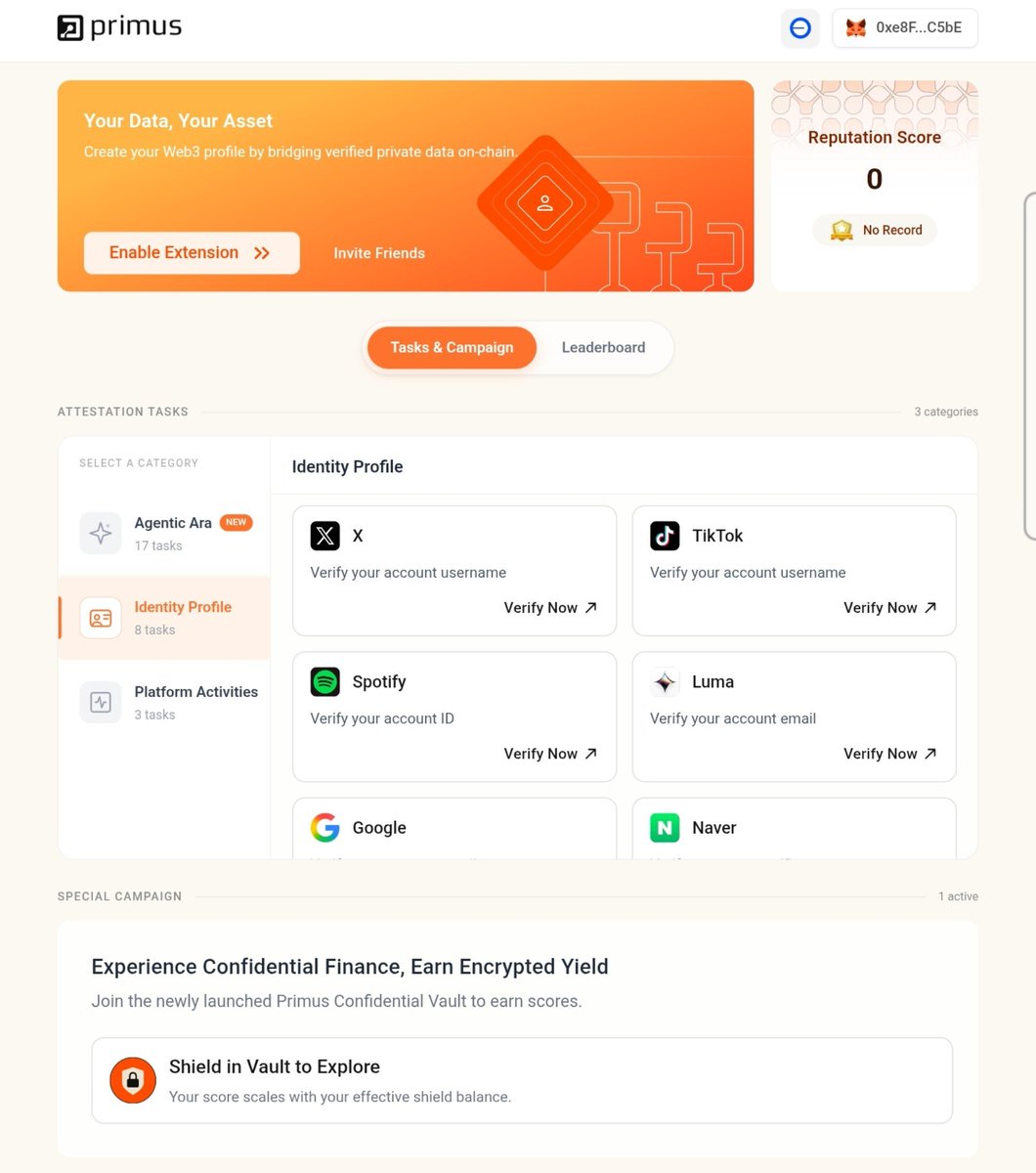
Most people explain zkTLS. The Primus dashboard shows it.
Open the Identity Profile tab and you get tasks like "Verify your account username" for X and TikTok, "Verify your account ID" for Spotify, and "Verify your account email" for Google and Luma. Each one is a claim about an account you hold.
That's the verification half. zkTLS lets an attestor confirm data really came from its source over HTTPS, without the raw data being exposed. So the claim is checkable and the account details don't have to be handed over.
The privacy half sits one section down. The Confidential Vault campaign, "Shield in Vault to Explore," scores you based on your effective shield balance.
It's the other side of the same idea: some things stay private, and some things get proven.
Most platforms make you pick one. Show everything so it can be verified, or hide everything and ask for trust. Primus treats them as two separate controls, and the dashboard puts both in one place.
That's also what institutions need before they move onchain: private where necessary, provable where required. Primus says it sits above existing onchain financial rails, so nobody has to switch chains.
If you want to see it yourself, the XP tasks refresh weekly. Connect your wallet on the page so your activity registers:
https://t.co/xRK2JFsgNP
@primus_labs@KaitoAI
Before You Fund Any AI Agent, Ask Where the Money Sits
Forget the strategy for a second. Before I care what an agent can do, I want to know two things: where does my money sit, and how do I get out?
With @meetmotes the answer starts with the structure. One NFT, one agent, one smart account. You send USDC to that account, and the docs say deposits belong to the account, not to the agent service.
The agent gets a narrow permission to act, never your unrestricted private key.
Getting out is part of the same flow. The dashboard shows your holdings, open commitments, fees charged, and the actions that were denied as well as the ones that went through.
You can pause automation, revoke sessions, and withdraw whatever is withdrawable.
One caution from me. The dashboard is the app reporting on itself, and inspecting your account's permission status shows what's set, not that the limits hold.
The docs say the smart account enforces the permissions, so the real proof is the contract. Once the official addresses are published, that's what I'd check on the block explorer.
That "withdrawable" word is the one I'd read twice. Open DeFi positions may need to settle before the cash is free, and withdrawals need the owner's authorisation and pass solvency checks first.
So the exit exists, but it isn't always instant.
Honestly, this is the order I wish more projects explained things in. Where the money is, who can touch it, how you leave.
Then the fun part about what it can trade.
It's all laid out here if you want to check me: https://t.co/MRUhXs0OSq
Or start here: https://t.co/Cf4rcWFkY5
A compliance officer reviewing an onchain venture asks three questions.
Who can see our positions?
How do we prove what we're claiming?
Do we have to rebuild everything on a new chain?
Any product that wants institutional users has to answer all three. Answering one or two isn't enough.
@primus_labs is built around all three at once.
Position privacy: FHE lets computation run directly on encrypted data, and only the owner can decrypt the result.
Provable claims: zkTLS lets an attestor prove that data or an API response really came from its source over HTTPS, without seeing the raw data.
No migration: Primus says it sits above existing onchain financial rails, so users, protocols and liquidity stay where they are.
It also points to real use. Primus reports real-time Proof of Reserves for UnitasLabs' USDu (May) and real-time onchain reserve verification for Perena USD* with Brevis (April). Those are Primus-reported, so check its X for the details.
My take: institutions don't need more privacy tech or more verification tech. They need both to work together on the rails they already use.
If you want to try it, the XP tasks refresh weekly. Connect your wallet on the page so your activity registers:
https://t.co/xRK2JFsgNP
@KaitoAI