Ontos has joined the @NVIDIA Inception Program.
This is a significant step forward as we build interoperable, general-purpose intelligence for machines of every kind and task type.
excited to share that i’ve started a new role as head of global marketing at @OntosRobotics
Ontos is building the next frontier of physical intelligence and advancing general-purpose intelligence for robotics:
Ontos Research is publishing Prediction, Memory, and Motor Adaptation, a paper proposing a neuroscience-informed approach to robot control.
The research examines how robots can predict movement, use memories of previous failures, and adapt their actions across different physical bodies.
We present the proposed architecture and experiments to evaluate it.
Read: https://t.co/J5v4QjWT3Z
how P37 Neuro works
> You describe the robot in URDF, MJCF or OpenUSD. P37 reads its joints, limits, actuators and sensors, and one shared brain learns across all of those bodies.
> The learned part is split in two. A task policy picks the next subgoal, and a motor policy turns it into joint commands for the body it's running on.
> Those commands are requests. Each one passes through a deterministic C++20 safety runtime before anything moves:
→ joint position limits
→ velocity and torque limits
→ watchdogs and e-stop integration
> If a command breaks a limit, it gets rejected. The network never touches the motors directly.
> Where it stands: the platform path from P37-E0 to E6 is built and tested. Learned capabilities are still in validation, and we're testing with partners.
We've spent much of this week in conversations with our partners.
No new version releases this week, our focus has been on understanding what teams need from our technology and where we should direct our engineering efforts next.
A quick look at what we're building at Ontos:
P37 Neuro: Shared robot intelligence designed to work across different robot bodies.
Sense: Real-time machine context that helps systems understand a robot's current state and capabilities.
Ontos Verify: Verifies evidence of completed robot tasks before payment is released.
We've published a short overview of each product, including what they do and how they work.
https://t.co/45mifxhVAu
New AI models can effectively predict what happens next in a scene. These are called world models.
For robots, what happens next depends on the robot's body. An arm and a humanoid can't make the same moves.
P37 Neuro tells the AI which robot it is controlling: its joints and how far each one can move. We're building it in the open at @OntosWorld
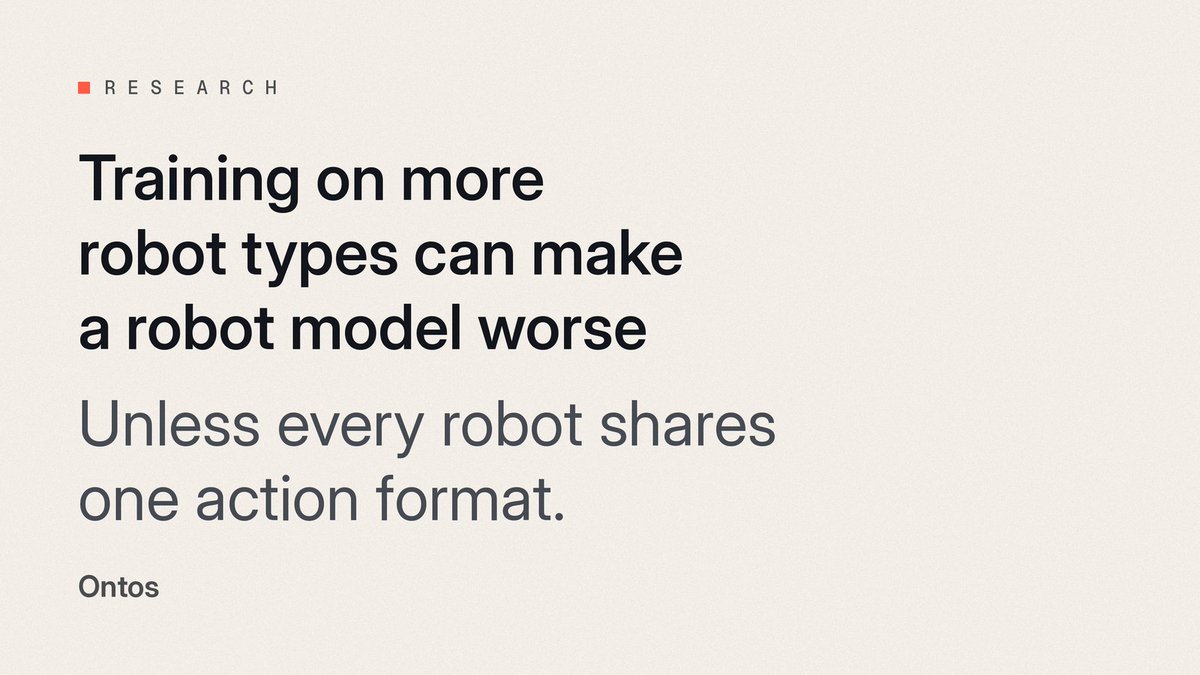
Can adding more robot types to a training set make a robot model worse?
In a new paper from researchers at Stanford and Meta FAIR, it did. When each robot's actions were encoded in its own format, results got worse as more robot bodies were added to pretraining.
Where it stands: the software platform is implemented and tested, including a trainable baseline model built to handle robots with different body structures. The current work is training at scale and testing on robot bodies the model never saw in training. We don't have those results yet, and held-out bodies are the test we'll hold it to.
Can adding more robot types to a training set make a robot model worse?
In a new paper from researchers at Stanford and Meta FAIR, it did. When each robot's actions were encoded in its own format, results got worse as more robot bodies were added to pretraining.
This is the problem we're building P37 Neuro around.
We come at it from the body side. Each robot is described as structured data: its joints, limits, actuators, sensors and kinematics. A high-level policy outputs the task as intent that isn't tied to one body, like reach or grasp. A separate low-level policy turns that intent into motor commands for the specific robot.
The goal is that a new robot body shouldn't automatically need a new model.