Every startup needs 3 bank accounts:
1️⃣ Primary checking account that covers all operating expenses
2️⃣ Money-market account to earn interest on excess cash
3️⃣ Secondary account with a different bank in case of emergencies
CJ’s newsletter is one of the few I read religiously. Highly recommend reading the below + subscribing.
TLDR on this post - Don’t chase rabbits while expecting elephant-level retention to justify a deer-sized CAC payback time
@alexiskold You need a good bookkeeping & tax firm at pre-seed
You need a fractional CFO after seed, before Series A
You need a full-time CFO or VP finance around Series B-C
Redecorating houses is fun, but not critical
Fixing plumbing & HVAC issues is annoying, but essential
For startups, accounting & taxes are like plumbing & HVAC. You’d rather get new wallpaper than hire someone to look behind the drywall, but you’ll regret it if a pipe bursts.
If you didn’t pay much attention to your startup’s income tax filing this year, read the below post 🔽
… then drop us a note so we can help you next year 🤝
Here’s why taxes matter when your startup isn’t profitable:
1) your future self doesn’t want to fight IRS notices or pay penalties
2) certain tax policies are supposed to carry over - today’s choice impacts tomorrow’s bill
3) you cannot miss R&D tax credit opportunities
I created a free GPT for founders who need realistic benchmarks for financial metrics, fundraising milestones, and equity/comp packages
The bot is fed with my favorite online resources, plus some internal knowledge from @OpStartGrowth
Check it out: https://t.co/peJqVyHuHA
As the holiday season concludes, it’s important to remember that bonuses are usually taxed at a higher rate than salary in the US. Give raises, not bonuses.
Happy new year!
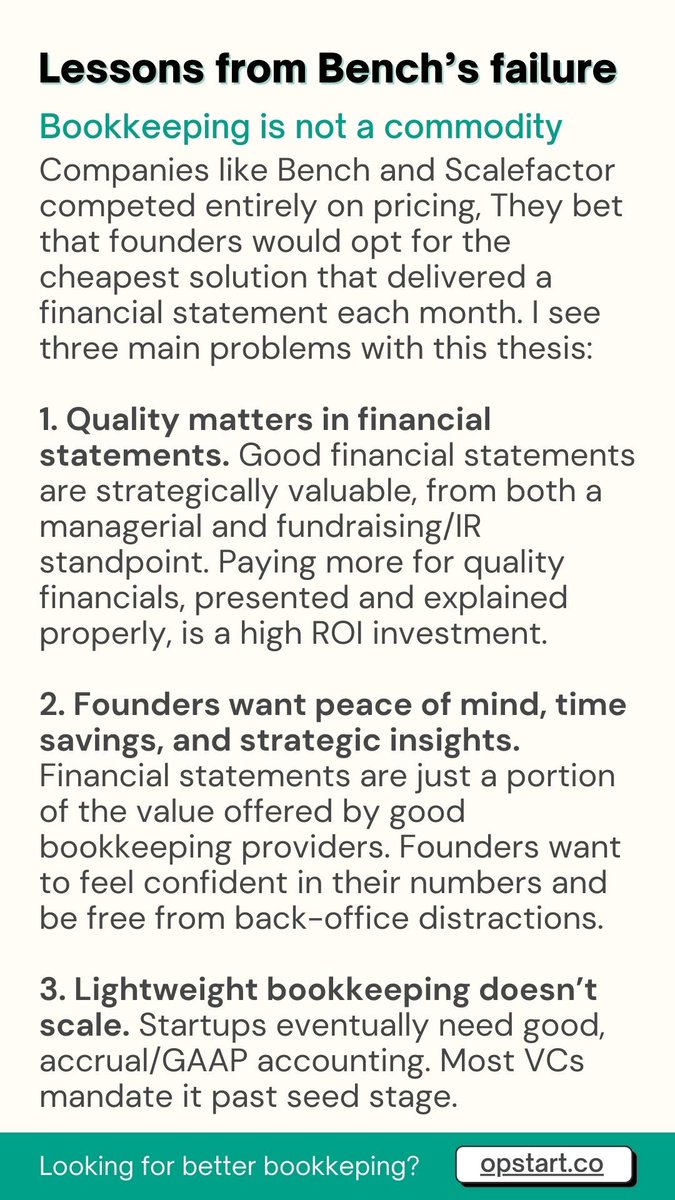
Since many founders are rethinking bookkeeping & tax options this week, I thought I’d share my honest assessment of the competitive landscape.
DM me if you have more specific questions, will do my best to recommend the right provider.
There are two things almost every VC-backed startup can do to earn “free money”:
1) Earn interest on excess cash
2) Take advantage of R&D tax credits
Here is what founders need to know 🔽
Having clean financials before you raise helps to facilitate easier VC conversations and unlock higher valuations.
Also, this VC was a little rude but at least they were straightforward. Better than a “too early” or ghosting.
Founders and VCs: what metric do you equate with Burn? 🔥
We talk about “Burn” all the time, but there is no standard formula to calculate it. I find these four accounting metrics are used most commonly, but sound off in the replies if you do something different.
TLDR:
1) Each funding round should be its own line item
2) Same for each debt facility (incl SAFEs). Breakout between short- and long-term liabilities.
3) Monitor AR closely. If it’s always growing you have a problem.
4) Know whether R&D / product dev expenses are capitalized
Struggling with your balance sheet? We’ve got you covered!
Our new blog explains everything in simple terms. From equity to liabilities, learn how to read your balance sheet and keep your business on track.
Read the entire article here: https://t.co/riex5ldSrY
🌟Metrics and Reports Every SAAS Startup Should Be Tracking🚀
Join our interview with Paul Anthony, the CEO of Opstart, to discover the critical KPIs that speed up deal closing and help expand your firm X2.
Date: May 28
Time: 2 PM EST
Register: https://t.co/MVocNRa0XF
Tip for VCs: pay close attention to accounts receivable (AR) on a startup’s balance sheet.
AR is technically an asset (customer owes you money!), but a high/growing balance is a big red flag for me. Here’s why:
Tip for VCs: pay close attention to accounts receivable (AR) on a startup’s balance sheet.
AR is technically an asset (customer owes you money!), but a high/growing balance is a big red flag for me. Here’s why: