A peer-reviewed acoustic localization framework just hit sub-5-meter precision using low-cost GPS recorders — and our research found that number intersects directly with consumer GPS watch accuracy in a way that has real field implications.
Freeland-Haynes et al. published the framework May 9, 2026 in Communications Biology (doi: 10.1038/s42003-026-09949-5). The pipeline is fully automated and open-source, built on synchronized GPS-AudioMoth recorders. In loudspeaker field tests, 99% of broadcast calls were localized to within 5 meters. The system resolves multiple simultaneous sound sources, rejects error without manual review, and was demonstrated at scale — an array of over 60 recorders surveying birds across a forest site. Code is on GitHub. Audio test data is archived on Zenodo.
The team at University of Pittsburgh, led by Louis Freeland-Haynes with co-authors Sam Lapp, Chapin Czarnecki, Lauren Chronister, Joe Begley, Alex Rogers, Peter Prince, Andy Hill, and Justin Kitzes, addressed a persistent bottleneck: acoustic localization has historically been constrained by hardware cost and effort-intensive manual analysis. This pipeline removes both barriers simultaneously.
Our research found the cross-domain connection worth stating plainly: 5-meter acoustic localization accuracy is directly comparable to the positional precision of consumer-grade GPS sport watches. That is not a coincidence to file away — it is a structural match. Wildlife survey grids built on this pipeline could be co-registered with recreational trail GPS tracks, meaning any hiker, trail runner, or backcountry traveler carrying a GPS watch is already operating at the spatial resolution required to serve as a reference node in a passive acoustic monitoring network. Documented evidence suggests this makes opportunistic citizen-science localization networks technically feasible right now, using hardware that already exists in the field.
The strange part: the limiting factor for large-scale passive monitoring of unidentified vocalizations in remote terrain was never the recorders. It was the analysis pipeline. That barrier is now gone. An investigator could deploy a grid of inexpensive AudioMoth units in a documented anomalous-activity zone and receive precise spatial origin data on every vocalization — with no one on site.
What do you know about this?
https://t.co/98vTOfr2DM 😸 Wildlife will not need to look both ways when crossing across one of Asia's largest wildlife elevated corridors standing at average of 7 meters/23 feet high.
The National Highway Authority of India (NHAI) collaborated with the Wildlife Institute of India to make an underpass on the Delhi–Dehradun Economic Corridor using 29 @openacoustics Audiomoths.
😸 Wildlife will not need to look both ways when crossing across one of Asia's largest wildlife elevated corridors standing at average of 7 meters high.
The National Highway Authority of India (NHAI) collaborated with the Wildlife Institute of India to make an underpass on the Delhi–Dehradun Economic Corridor using over 40 @openacoustics Audiomoths.
The 20-km-long stretch between Ganeshpur and Asharodi features a total of 10.97km of animal underpass designed specifically to facilitate unobstructed animal movement. The area of the study covered flat riverbed, hilly terrain and mixed stretches of Sal Forest in the Shivalik Himalayan range, through a 40-day monitoring programme using 150 high-tech camera traps and 29 AudioMoth acoustic recorders.
The study documented a total of 111,234 images of humans, domestic animals, and wildlife. Among these, 40,444 were attributed to 18 unique wild species utilising the underpass, including various carnivores, herbivores, ungulates, pheasants and primates. The golden jackal was the most frequently captured, followed closely by nilgai, sambar and spotted deer.
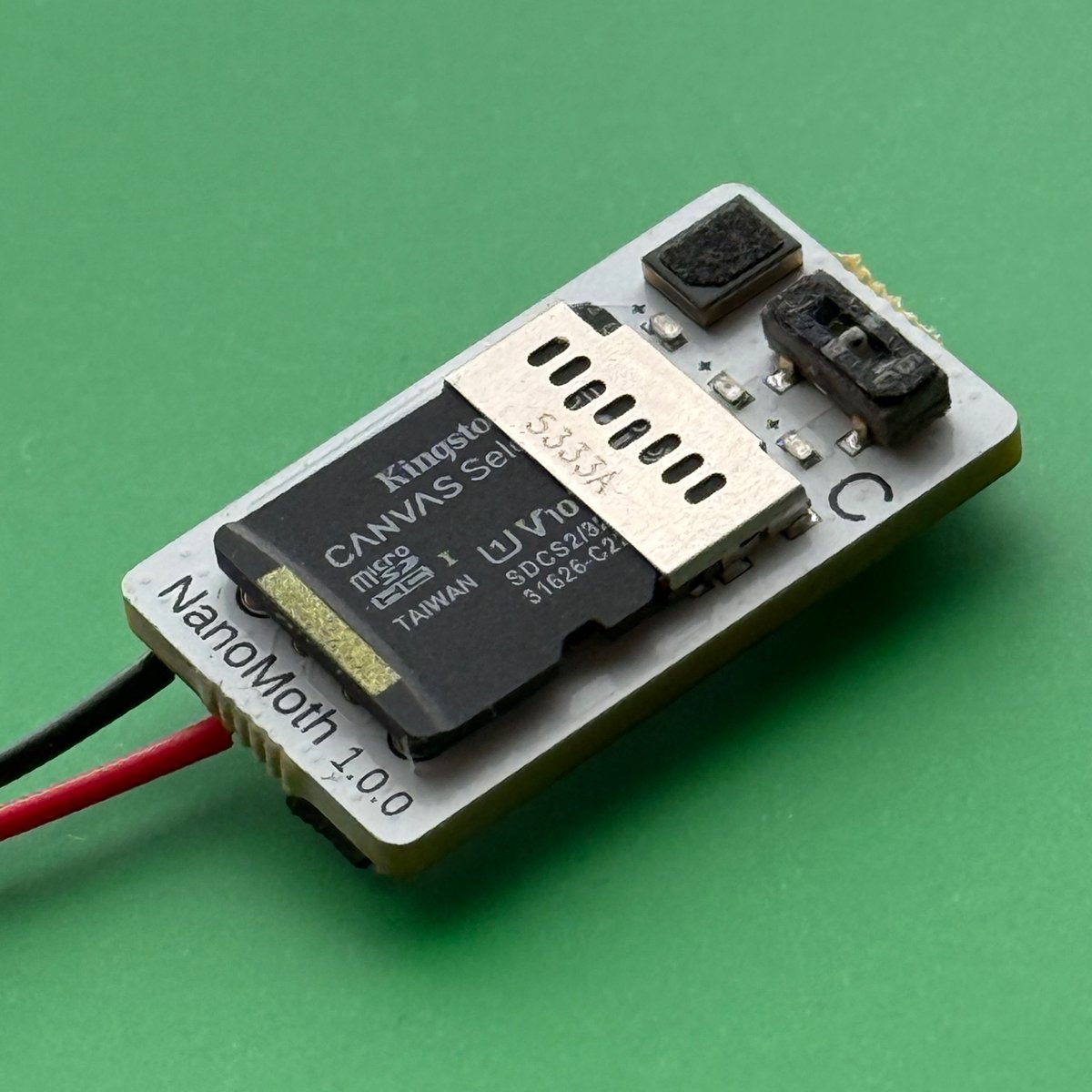
Our prototype NanoMoths are going out for field trials this week. Weighs just 6g including a 150 mAh Li-Ion battery and not much bigger than a micro SD card. Supports all the features of standard AudioMoth up to 192 kHz sampling rate.
🎂 Happy 110th Birthday to the National Park Service! 🎉
In 2022, a team of volunteers and scientists from the @NatlParkService Chihuahuan Desert Inventory and Monitoring Center set up pilot projects to deploy acoustic equipment including the @OpenAcoustics Audiomoth within the Chihuahuan Desert, Fort Davis National Historic Site & Big Bend.
https://t.co/2DKVadtS6b
https://t.co/Ni6Ch6GlRY 👂 We know you listen when Sir David Attenborough has something to say!
In 2024, @WildlifeTrusts and Northumberland Wildlife Trust secured part of the Rothbury Estate, with a vision to restore it at the heart of a 40‑mile nature corridor stretching across northern England, from the coast to Kielder. Time is running out!
@UniofOxford with members of the Rothbury community, have installed a network of 20 @OpenAcoustics AudioMoths to monitor birds and bats as well as other species including small mammals and insects in the area.
Great paper describing how HydroMoth can be calibrated to provide SPL measurements accurate to 1–3 dB across a frequency range of 100 - 1000 Hz.
https://t.co/yTXTSWk98D
Happy World Listening Day! The World Listening Project invites artists around the world to submit media that draws attention to sonic environments as sites of meaning, memory, and care.
There are plenty of scientists and artists that utilized the @OpenAcoustics AudioMoth & HydroMoth throughout the year such as Marco Barotti's Coral Sonic Resilience installation: https://t.co/4NSawJiClq
#worldlisteningday
The last update to the AudioMoth standard firmware (1.12.1) reduced the typical energy consumption of large SD cards. See our recent application note for more details:
https://t.co/rdZ0roHkuA
If you use the AudioMoth GPS Board or GPS Hat to synchronise recordings, you can now select between interpolation or nearest neighbour resampling algorithms when generating the final GPS-synchronised recordings.
Introducing the 2026 WILDLABS Awards winners! 🎉
This year, 16 grantees were selected from 523 applications, our largest cohort yet. Huge thanks to our partners @Arm for helping bring game changing conservation tech ideas to life.
Meet the awardees: https://t.co/3txhMAddbp
The heat wave has provided a good test of our satellite-connected AudioMoth which uses an Arribada @arribada_i SMD Argos module to transmit live status information from anywhere on the planet.
We are experimenting with connecting other sensors to AudioMoth to detect elephants. Two promising solutions are an SM-24 geophone and a buried piezo contact microphone. This is what they record when repeatedly dropping a bowling ball from a height of 1.5m at a distance of 100m.
The AudioMoth Configuration App version 1.12.1 is out now!
If you previously downgraded to 1.11.1, don't forget to update and regain access to the GPS synchronisation features.
https://t.co/nNCY5dxBfQ
@RinglerMax@and1hill@ZSLWhipsnadeZoo@WILDLABSNET Getting closer. The first production batch of cases has arrived but we're looking at an issue with the crimping of the connector. Hopefully, it will be resolved in a couple of weeks.
Testing the latest AudioMoth infrasonic developments for the WILDLABS Awards 2024 with the elephants @ZSLWhipsnadeZoo today. For project updates check out @WILDLABSNET https://t.co/uWFWRtuc3b
We've discovered a bug in AudioMoth Configuration App 1.12.0. If you've updated to this version and plan to use the frequency trigger feature, we advise downgrading to version 1.11.1:
https://t.co/nNCY5dy95o
Everything else works as expected and we'll release a fix soon!
@Guy__Bennett @ZSLWhipsnadeZoo@WILDLABSNET The case is designed to take for the AudioMoth Dev but could possibly be used with the AudioMoth 1.2 PCB with some modification.
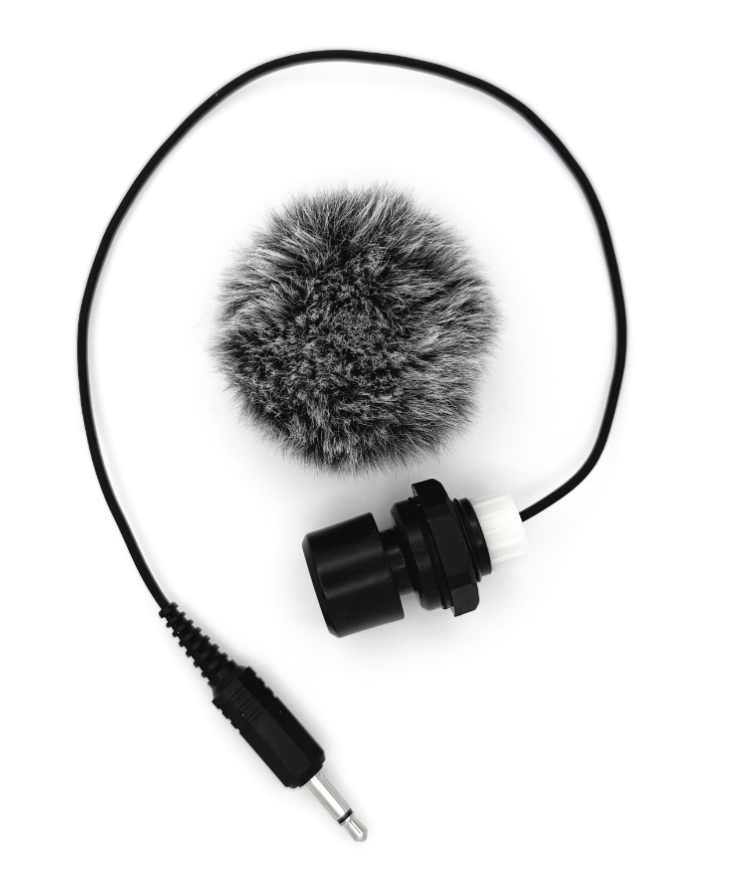
@Guy__Bennett @ZSLWhipsnadeZoo@WILDLABSNET This is a Primo electret capsule with a custom mount that we'll hopefully be able to supply next year. An external microphone tends to be lower noise and also have better low-frequency response than the internal MEMS microphone.