Podcasts. Ideas. Discussions.
Follow us for all things #IndianDiplomacy & #Geopolitics
Since 2018.
Supported by @IndianSocietyAI.
Co-host - @adityajakki.
You can find us wherever we are.
YouTube: https://t.co/GgdXU4fmWz
Spotify: https://t.co/XjX1hmQ9iU
Website: https://t.co/TnRq70LVms
This tweet is powered by @adityajakki, host for #Glocalise.
After 10 months of wait and 1 year of efforts, I am glad to announce that https://t.co/HSwf5I6zZn Rules, India's First AI-specific Dispute Resolution Framework, are now available for pre-order on Amazon: https://t.co/cppvXbto6y
Vishwam Jindal and I wrote these Rules because disputes involving AI systems need procedures designed for them.
The book sets out 16 Rules that form the basis of these AI-specific ADR rules.
The additional four annexures in these Rules add (1) model dispute resolution clauses, (2) a catalogue of AI use cases in proceedings, (3) implementation protocols that keep AI tools under strict human oversight, and (4) the https://t.co/cHg029y3Sz Dispute Classification Matrix, which matches each category of AI dispute to a suitable mechanism.
I am grateful to Adv. Pallavi Pratap and Dr Sushant K. Srivastava, Professor-In-Charge, Centre for Development and Educational Technology, Indian Institute of Technology (Banaras Hindu University), Varanasi for their forewords, and to Prof. Dr Cristina Vanberghen for the introduction and rich feedback to the first version of the Rules.
Their confidence in this work means a great deal.
Early readers have been generous.
Ratnesh Pareek called the Rules "practical, balanced, and simple," and Tushar Behl described them as "an encouraging step towards standardization in the future of technology dispute resolution."
We are also grateful for the gracious comments of Ankit Raj Srivastava, Raymond Sun, Arletta Gorecka, Tushar V Sharma, PhD, Shirsha Ray Chaudhuri, Kevin Misener and Mridutpal Bhattacharyya as the early readers of these Rules.
We acknowledge the feedback we had received from Manohar Samal, MCIArb (Ratan Samal Associates), Animesh Bordoloi (Asian International Arbitration Centre), Mohit Mokal (Mohit Mokal Mediation) and Dr. Ish Jain (Regius Legal) for their feedback on the https://t.co/HSwf5I6zZn Rules.
We are launching the Rules at an event on November 28, 2026, and we at Indic Pacific, an AI Governance Lab would be glad to see you there.
You can register here: https://t.co/LtXzKZgKzB
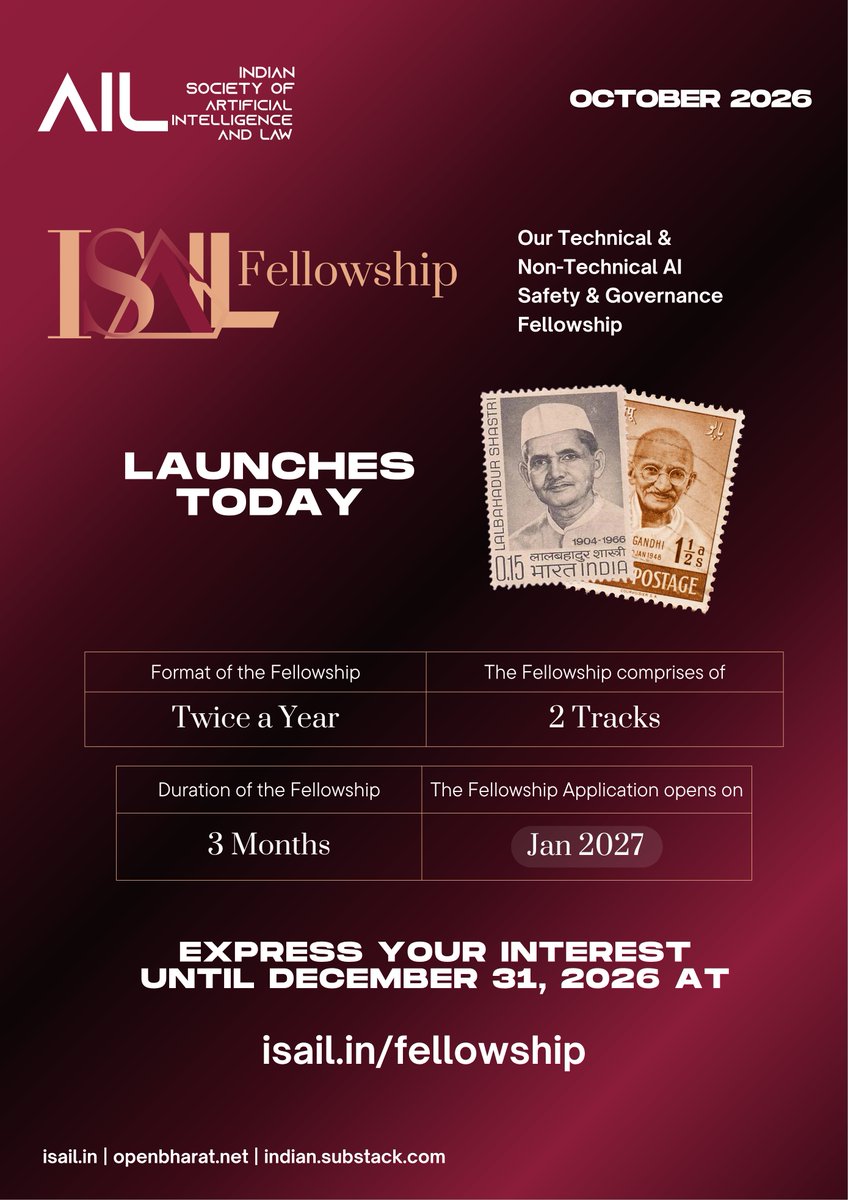
This Gandhi Jayanti & Shastri Jayanti, we launch the ISAIL Fellowship - a special programme dedicated to high-end technical and non-technical AI safety and governance research issues in DeepTech, GreenTech and CivicTech.
Express your interest at https://t.co/hueSesMvqB.
@cvkrishnan The " in house LLM" is the laziest trope. Direct fine-tuning is rather straightforward. It's the data that's hard to get. And no company will directly hand over data just like that. And fine tuning being easy means that in house teams will do it faster than IT companies.
There maybe better reasons for why IT services Industry may bounce back like AI implementation but - “its hard to keep half a million people down” is not a worthy point.
Madhya Pradesh set to emerge as a major nuclear power hub in country.
MP should’ve been a natural choice for industrialisation for a decade now. Even if our strategic industries had come up MP would’ve been on a different growth trajectory by now. https://t.co/IExF5pYm1L
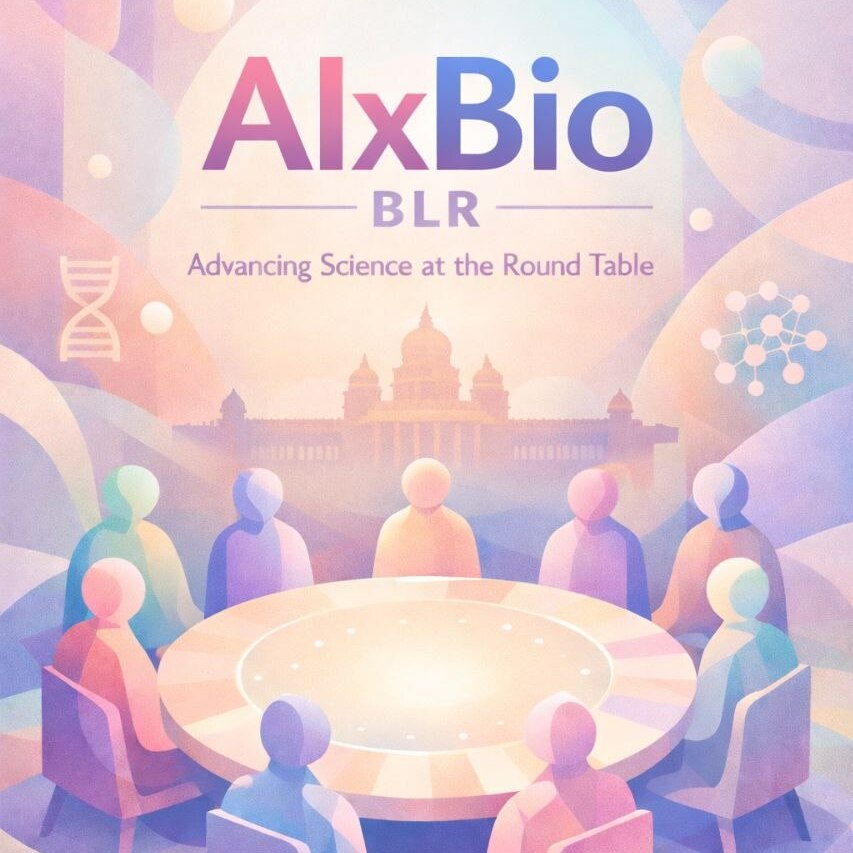
Are you interested/building in AIxBio? Are you in Bangalore?
Me, @anaturalist and @vinayprabhu are organising "AIxBio BLR" at IISc this Saturday, April 25th at 11:30 AM. The goal? Build the community that is missing and help each other in any way possible.
We have Founders, PhDs, Faculty, PostDocs attending the event. If you are building something in the space or have a unique expertise, we would love to have you.
Register on the link below.
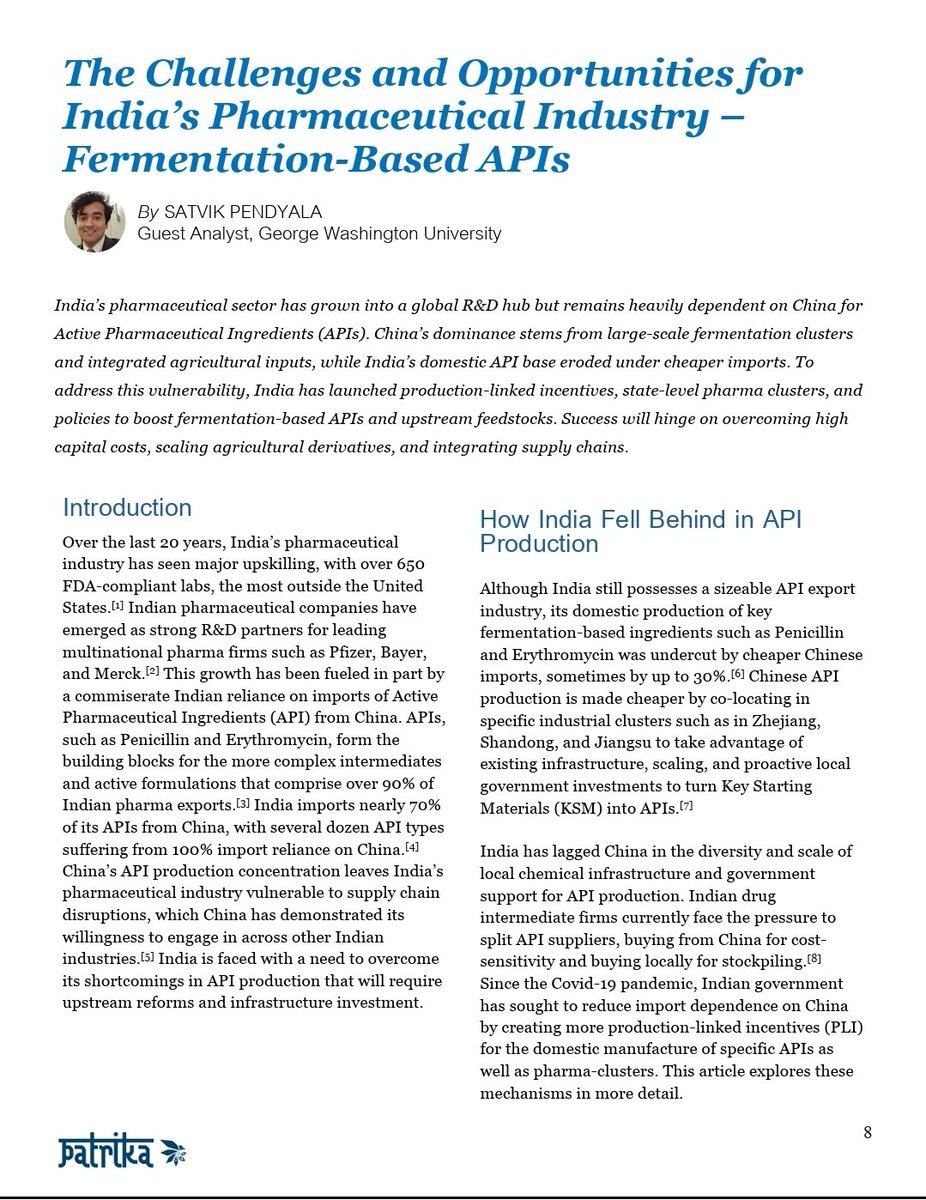
Wrote an article on how India can take the next step in climbing the pharmaceutical API supply chain.
Agriculture reforms, reduced capital costs, and infrastructure investments are needed to break into fermented APIs!
@wforumindia
"India joining the CP-TPP would contribute to reduced dependency of both India and other CP-TPP members on both the U.S. and China. The Modi administration can take a cue from the leadership of one of the earliest Indo-Pacific champions, the late former Japanese Prime Minister Shinzo Abe, when he went ahead and led the formation of the CP-TPP after the U.S. backed out. As a soon-to-be third-largest world economy, it is imperative for India to show similar leadership to leverage the CP-TPP to the advanatge of a larger Indo-Pacific trade architecture."
I write for @ISDP_Sweden@jppjagannath1 ... link below
🚢 India is quietly building something BIG in the shipping insurance world...
A move that could reshape how Indian ships sail, trade, shield its shipping sector from global sanctions and reduce dependence on foreign insurers.
Here’s what the Govt is upto & why it matters ⚓️🧵
World Leaders are already involved in AI diplomacy.
ISAIL President @IndusThink explains this in a session for the Indian Forum for Public Diplomacy. Check the latest video on @BharatPacific YouTube Channel.
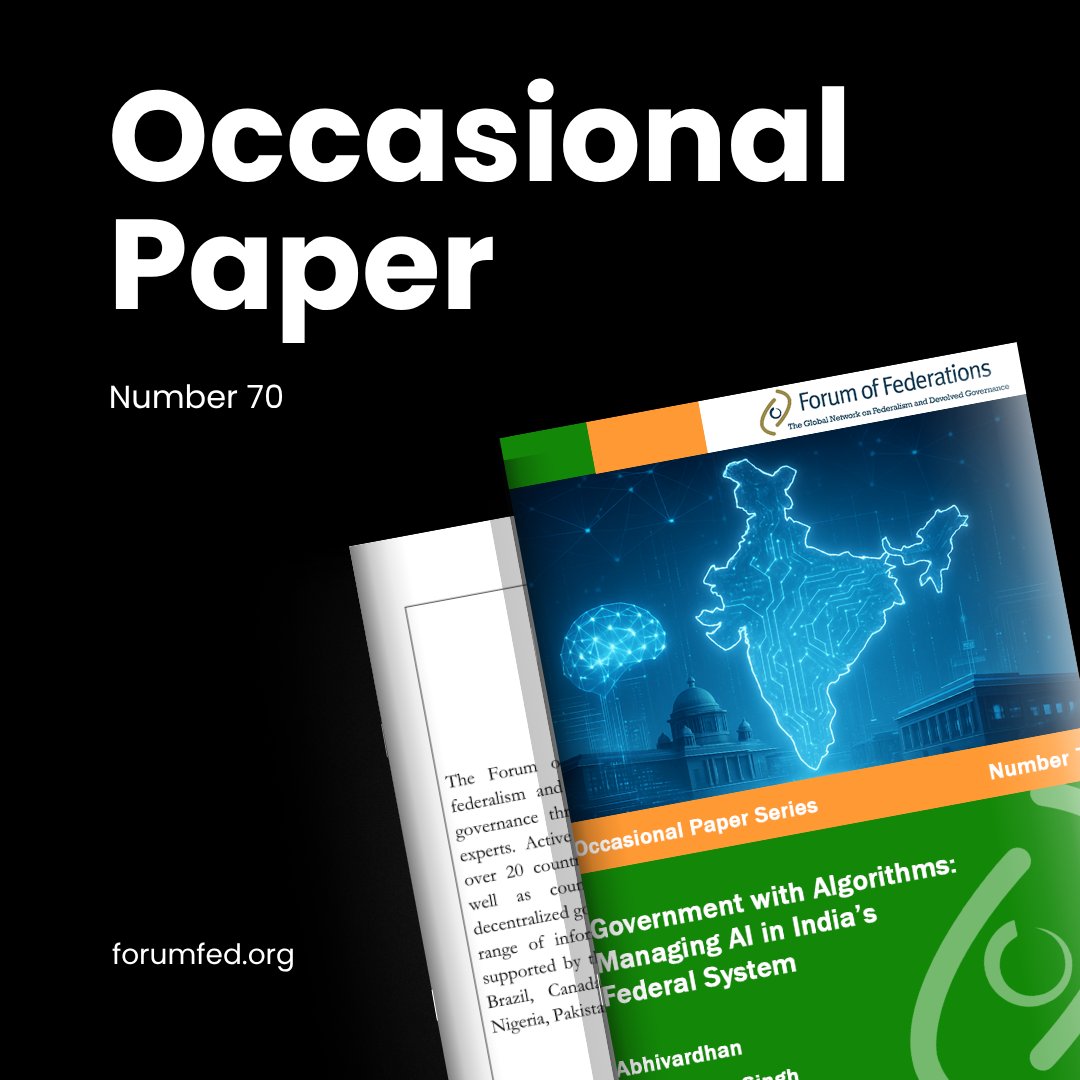
How has AI been adopted and governed in India’s federal system?
Read this new Forum OP to understand how AI governance has evolved in India in recent years, and how interactions between central policy making, state-level implementation, and sector-specific adaptations shape the current landscape.
🔗 Read it here: https://t.co/XAzssmYT3S
This sentiment seems to concede Southeast Asia as a region of Chinese influence they India won't even try to contest. Just so many things wrong with this
- Modi publicly corrected Trump
- First big discomfort between Modi and Trump admin after 2017-18 trade war episode
- Not sure if it will impact trade deal; think it will happen as Trump likes wins
- However, Trump just fucked up F-35 sale if there was any chance of it happening