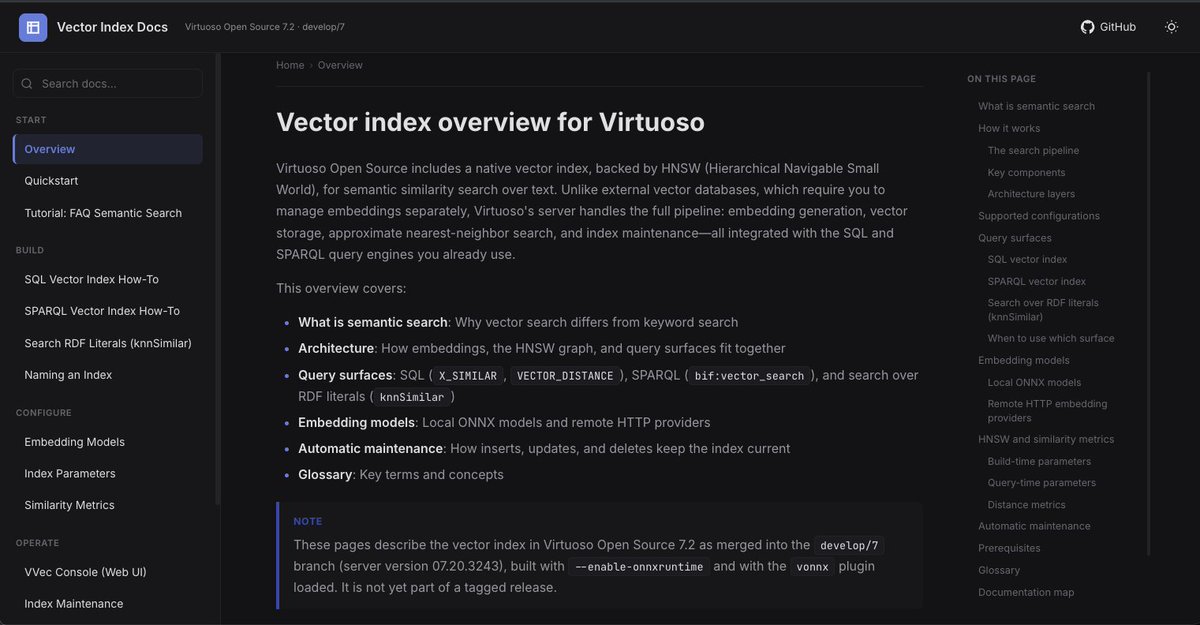
Vectors, meet Virtuoso. Native HNSW vector indexing just landed in the Virtuoso Open Source develop/7 branch, with ONNX text embeddings and optimizer tuning alongside. Similarity search across native relational tables via SQL and RDF graphs via SPARQL, one engine. Enjoy!
Why does your AI agent give confident but wrong answers? It's only as smart as the context it can reach. Virtuoso gives it live access to the data, information, and knowledge in your existing systems of record and engagement, without copying any of it. From $99.99.
Can you query Progress OpenEdge from your Mac without worrying about performance, security, or cost? Yes.
Our Multi-Tier ODBC-to-JDBC Bridge fronts OpenEdge's own JDBC driver: fast, secure, fine-grained access control. No rip and replace.
$499.99 for up to 5 concurrent users.
A faceted browser for any CORS-enabled SPARQL endpoint, built over a weekend with AI agents and shipped as an Agent Skill. Open standards and loose coupling are what let agents and apps work with data wherever it lives, without lock-in.
Faceted search and browsing over entity-relationship graphs is challenging to implement. It requires both support for open standards and the right declarative query language—one that can work with fine-grained relationships in many forms. Fortunately, we’ve had SPARQL for years; what we lacked were LLM-powered tools to help with the grunt work.
Here’s a SPARQL-based faceted browser we put together last weekend. It brings faceted search and browsing to SPARQL endpoints that support CORS, while remaining loosely coupled to them.
See the comments for a live demo and repo links.
Agents that act for people need their own identities, plus a verifiable On-Behalf-Of (OBO) link back to the principal. That's how an agent can shop, query or transact through Virtuoso and OPAL with every action traceable to who authorized it.
Slowly but surely, people are beginning to recognize the importance of distinct identities for principals and agents—and the On-Behalf-Of (OBO) relationship that connects them.
OBO is the next big thing!
Here's a news update page that provides more details about the new HSNW vector indexing and related features enhancements.
https://t.co/0aUhRjDuAI
Even better news, there much more to come!
Vectors, meet Virtuoso. Native HNSW vector indexing just landed in the Virtuoso Open Source develop/7 branch, with ONNX text embeddings and optimizer tuning alongside. Similarity search across native relational tables via SQL and RDF graphs via SPARQL, one engine. Enjoy!
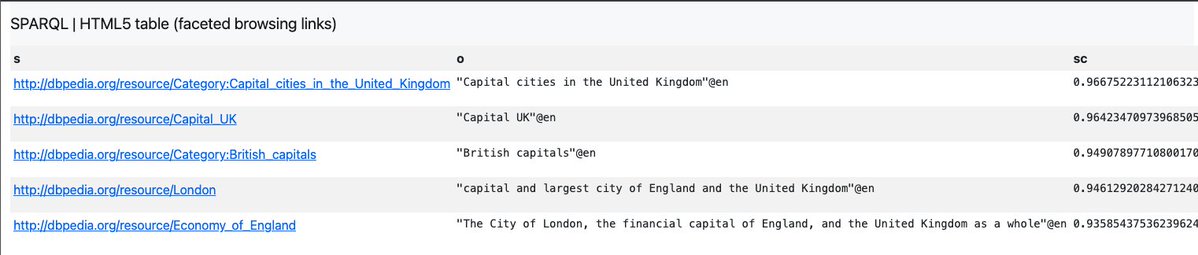
Another query, this time showcasing the impact on DBpedia i.e., vectors have been generated for literal objects in a DBpedia knowledge graph.
https://t.co/IBhQVgvOJI
#VectorSimilarity#DBpedia#SPARQL#VirtuosoRDBMS#HowTo#AI
Vectors, meet Virtuoso. Native HNSW vector indexing just landed in the Virtuoso Open Source develop/7 branch, with ONNX text embeddings and optimizer tuning alongside. Similarity search across native relational tables via SQL and RDF graphs via SPARQL, one engine. Enjoy!
Agents that act on email for a business have to tell a genuine instruction from a forged one. Digitally signed email gives them that check, and it matters even more once agents start placing orders and handling payments.
Another reason why Agents with email access MUST support sending and reading of digitally signed emails. In addition to that, modern practices of not blindly following links.
Hyperlinks let anyone access, mix and mesh content from many sources. The URIBurner Weblog shows AI agents doing exactly that on OpenLink Virtuoso: HTML docs in a WebDAV filesystem, loosely coupled to the knowledge graphs underneath.
The ability to access, mix, and mesh content from a variety of sources identified by hyperlinks, at Internet scale, is one of the most remarkable features of the communications medium created by the Web.
AI agents are exceptionally effective tools for harnessing the architecture and open standards underpinning the Web.
For instance, I can seamlessly incorporate a video presentation into a previously published article without changing the hyperlink that identifies it.
That's the power of hyperlinks, loose coupling, and the Web's enduring architecture.
Virtuoso Open Source (VOS) vs. QLever: 105 DBLP queries using the Sparqloscope benchmark.
Same machine. Documented configurations. Open results.
Reproducible and objective benchmarking.
https://t.co/DIX0BBgah9
People curate. Agents buy. Payments flow back. Every lap makes the next one faster. That's Linked Open Agentic Commerce (LOAC).
https://t.co/u1ysU5aCgQ
#AgenticCommerce#LOAC
Your AI Agents do not need a messy central copy of everything. Start with Virtuoso's virtualization layer: it harmonizes databases and filesystems on the fly into one context layer for AI Agents.
https://t.co/aRtaivtnBh
#CDO#CAIO#DataSpaces#VirtuosoRDBMS
Your AI Agents do not need custom middleware to reach legacy databases. Start with Virtuoso: every record gets a URI and is served over HTTP as machine-computable data that authorized agents follow.
https://t.co/3L6DwKcg0c
#CDIO#KnowledgeGraph#RDF#SQL