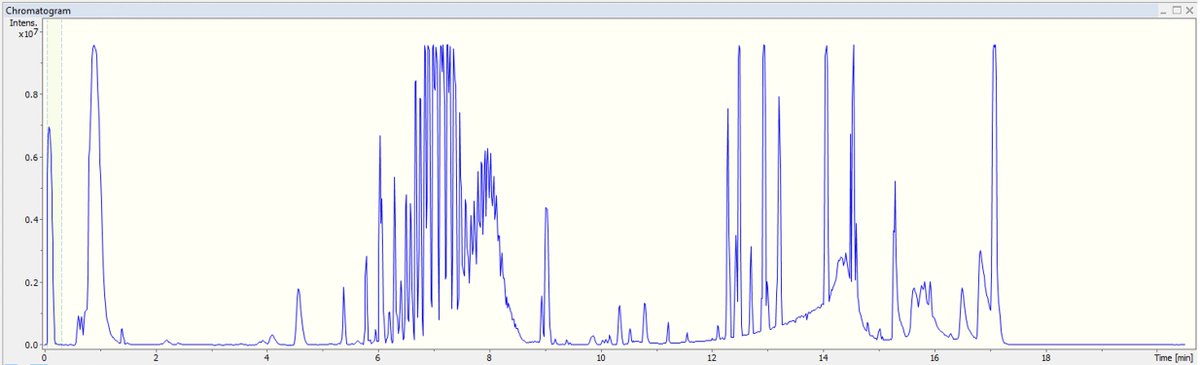
Our study on FDR estimation bias in top down proteomics (TDP) proteoform ID is published in Proteomics! Errors in precursor mass determination is frequent in TDP and the false proteoform IDs from them are not well controlled via target decoy!
https://t.co/Td239JjvsW. .
And as the name implies, it is very fast!! If you want to check the accurate proteoform abundance in no time, e.g., for your large scale studies, FLASHQuant should be your choice!
FLASHQuant reports the area of the LC-MS features corresponding to each monoisotopic mass, i.e., each proteoform mass. It also disentangles the shared features between different proteoforms, using shape fitting and signal decomposition.
Preprint alert!! Our new MS1-level label-free quantification tool for top-down proteomics FLASHQuant is presented in BioRxiv!! As a part of OpenMS @OpenMSTeam, FLASHQuant is freely available and open source! Check out: https://t.co/EymoTCie6t
Folks! We have created a survey to better understand users' experience with OpenMS. The survey is short, and we would love to hear your opinions on what's good and bad! Please share your thoughts
https://t.co/Jxikor5gmJ
#proteomics#metabolomics#lipidomics#TeamMassSpec#PhD
Recent version 1.1.0 of quantms is now out. You can now perform DIA using DIA-NN, DDA-TMT, DDA-LFQ, and Phospho localization analysis. Everything is based on standard file formats including mzML, SDRF, mzTab. Great collaboration with @DemichevLab@OpenMSTeam@nf_core teams.
Worried about not having data to show at the next group meeting? Make interactive plots to distract/impress!😆PyOpenMS lets you interface with python packages to make interactive MS data. Here, we used it to zoom on an ion mobility trace
#TeamMassSpec
Doc: https://t.co/a6Q2b9R7La
Massive collaboration with @OpenMSTeam and @DemichevLab to allow Quantitative MS-based data analysis distributed and in the cloud. quantms allows analyzing DDA-LFQ, DIA-LFQ, DDA-ISO (TMT) proteomics data.
We are looking for additional technical writers for our Google Season of Docs 2022 proposal! Great opportunity for students to get involved in computational #MassSpec! Reach out to us on Gitter/Discord for questions!
#GSoD#opensource#WriteTheDocs
https://t.co/Cy99BzDTDf
Join us at #ISMB2022#CompMS to learn about the latest advances in computational mass spectrometry. https://t.co/nhgvzQ374P
Keynote speakers: @Ge_Lab_UW, @briansearle, @Smith_Chem_Wisc, @gjpattij.
Abstract submission deadline: April 21, 2022 !
https://t.co/T9rA27yJiB
It really is free and less than 2 weeks away. Register now for the EuPA and EPIC-XS workshop and webinar on Computational Proteomics https://t.co/r42wuNgN8E
As part of the @iscb ISCBacademy series hosted by #CompMS, @Yue_Qin_SysBio and @leah_v_schaffer will present their work on integrating protein images and interactions.
Join us on Tue March 29 at 11:00AM ET to hear about this exciting research! https://t.co/bKtUPxc3tq
We are participating in Google Summer of Code 2022! We have 5 proposed projects to choose from. This is a great opportunity for you to gain knowledge about the field of bioinformatics/computational mass spectrometry! https://t.co/Pi6JvAatQB
#GSOC#GSoC2022#MassSpec#opensource