Was talking to someone today and he wanted to know where I work, I said big is relative and the the second biggest bank in the country then he said the second biggest non government bank in the country. This was to me a story about reframing to position…
Indomie didn't conquer Nigeria by being better.
It conquered by arriving when 6 million women entered the workforce and traditional starch cooking became unaffordable.
The market didn't exist until the labor supply changed. Then it was instantly dominant.
An Indonesian company entered Nigeria with two containers of instant noodles and collapsed the country's starch-food hierarchy in 37 years.
In 1988, Nigerian women were entering the workforce at scale. Traditional starch cooking took hours they no longer had.
Tope Ashiwaju, PR Manager at Dufil Prima Foods, described the entry: "It wasn't part of our menu in Nigeria. We looked at it and said this is something we would want to compare favorable with the stable food like rice, beans, yam, bread."
A single serving cost 10 cents. No Nigerian staple came close to the price-speed combo.
By 1995, Indomie built the largest instant noodle factory in Africa.
Today it controls 74% of Nigeria's market. Three factories produce 8 million packets per day.
The Indomie Fan Club runs in 3,000+ primary schools. 100,000 members who grew up thinking this was theirs.
Indonesian Trade Minister Enggartiasto Lukita noted the final indicator: "In Nigeria, there are 10 Indomie factories. So they claim Indomie came from Africa."
A foreign brand so embedded it lost its country of origin. That's category capture.
The Indomie model: identify the structural gap (labor supply change → demand for time-saving food), enter before competitors can frame it, build supply chain faster than anyone can follow.
That's not better marketing. That's reading the inflection point before it's visible.
The toolkit maps this exact sequence.
I made a free toolkit breaking down 100+ mental models used by history's greatest thinkers — the same frameworks that help you see patterns like this before everyone else.
5,000+ downloads. 113 five-star reviews.
Click below for a free copy to unlock your genius thinking:
https://t.co/u2q1uUm9vD
If you're new here, @GeniusGTX is a gallery for the greatest minds in economics, psychology, and history. Follow along for more similar content.
There is this parable used in negotiation classes, often linked to the logic behind BATNA. The term comes from Best Alternative to a Negotiated Agreement, a concept popularised by Roger Fisher and William Ury in GETTING TO YES.
The Green Man and the Orange Man: The Million-Dollar Split Tale:
Two negotiators, the Green Man and the Orange Man, are asked to divide $1 million.
Each is given a confidential brief.
The Green Man’s instruction is clear and rigid:
He must secure at least $900,000, or he gets nothing.
The Orange Man’s instruction is different:
He must ensure the Green Man receives no more than $100,000, otherwise he also gets nothing.
They sit across from each other.
The Green Man opens aggressively:
“I’ll take $900,000. You can have $100,000.”
The Orange Man rejects it immediately:
“That violates my mandate. I can’t accept.”
They go back and forth. Each pushes harder. Each becomes more entrenched. Each believes the other is simply being unreasonable.
Eventually, the negotiation collapses. They both walk away with zero.
What is really being taught?
The lesson is not about arithmetic. It is about hidden constraints and BATNA blindness.
Each negotiator is rational within their brief, but irrational within the shared outcome. They are negotiating positions without understanding constraints.
The tragedy is this:
1. There was money on the table
2. There was willingness to deal
3. But there was no alignment of mandates.
The deeper insight is that negotiation failure often comes not from hostility, but from misaligned internal instructions that are never surfaced.
The BATNA layer:
If either party had paused to ask: “What happens if we don’t reach an agreement?”
They would have realised their BATNA was zero. At that point, a different conversation might have emerged:
1. Can mandates be reframed?
2. Can principals be consulted?
3. Can value be restructured beyond the simple split?
The institutional takeaway:
In real-world deals, especially in markets like ours, this parable translates cleanly:
Negotiations fail not because parties cannot agree, but because:
a) They are over-constrained by unseen instructions
b) They do not interrogate each other’s boundaries
c) They mistake stated positions for actual flexibility
And the quiet cost is this:
Value is destroyed in the presence of willing counterparties.
#Lessons
Are you a young graduate interested in international relations? Are you curious to learn more about work of a diplomatic mission and how the EU Delegation represents EU interests and values in Nigeria?
EEAS https://t.co/kJbGPojzYF
OpenAI is searching for 26 students or recent graduates (18 - 25, based in the US or Canada) who have used AI in meaningful ways
Selected applicants receive $10,000 grant, access to their best technology, trip to OpenAI headquarters & meeting with the team
Deadline: March 30
Nomination form: https://t.co/rBeChe4dfp
14 Chief HR Officers leading AI transformation gathered to discuss navigating the human-AI era.
Key lessons:
• Secure buy-in from leadership and employees
• Know where AI adds value (where humans matter)
• Measure AI’s ROI long term
If interested, Deloitte is offering a six-week free training in Salesforce Consulting/Salesforce Development
Link to apply if interested: https://t.co/T7q1LVZ4UJ
Apply before March 30th
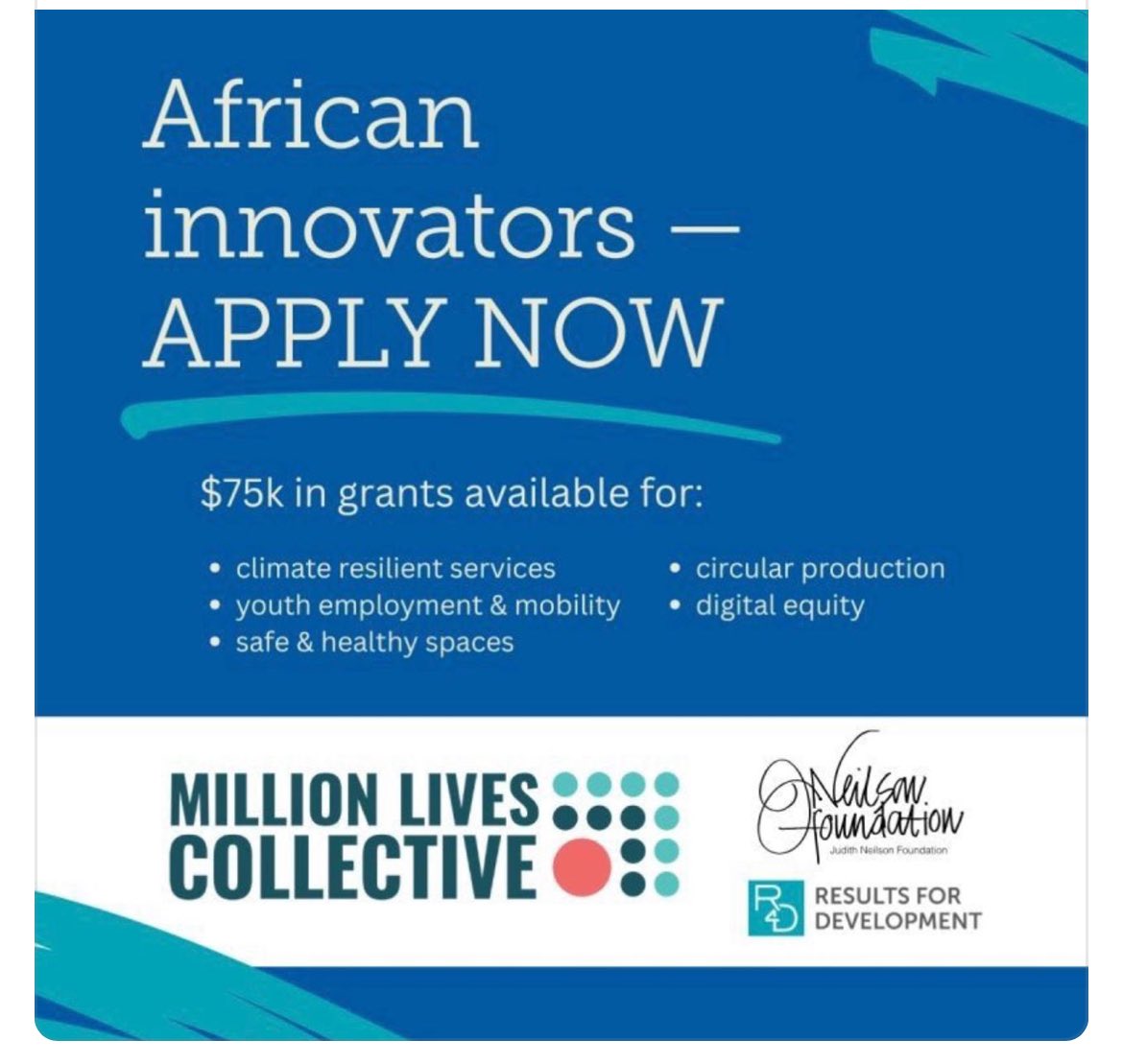
African Cities Innovation Fund – Grants Up to $75,000 for African Innovators.
Are you working on solutions to urban challenges in Sub-Saharan Africa? The #African Cities #Innovation Fund is supporting collaborative innovations that build smart, healthy, equitable, and resilient cities.
✨ Key Benefits
1. Grant funding of up to $75,000
2. Support for collaborative, scale-ready urban innovations
3. Focus on climate resilience, digital equity, youth employment, and healthy urban spaces
4. Opportunity to pilot impactful solutions for low-income urban communities
📅 Applications open: Early 2026
🔗 Learn more & apply:
https://t.co/GUtSb4iFEE
#AfricanOpportunities #GrantsForAfrica #UrbanInnovation #AfricaFunding #OpportunitiesForYouth