Thoughts I've shared with new investors:
1. View the stock market as a savings account that you keep adding to. Regularly invest money you don't foresee needing for at least 3 years, and ideally that you'll keep invested for much longer.
Is AI a bubble? I asked Barry @ritholtz.
His answer starts with a question of his own, and he makes the case that investors should be watching the “Magnificent 493.”
(He also shares the startup pitch he called “the single dumbest idea” he’d ever heard.)
https://t.co/j1cBLKpD7x
@desidividend@buylowersellhih Yeah, I think I agree, $GOOG seems the stronger all around put-writing candidate. As long as you don't mind more AI-adjacent exposure.
A short update on the put options open targeting income (or more shares, but typically income):
10/23 $NOW $135 puts, on track to expire
10/30 $NVDA $235 puts
11/06 $DELL $560 puts
11/20 $NVDA $235 puts (rolled from $237.50)
11/27 $DELL $555 puts
Some in-the-money puts on volatile stocks, finally, after months of relative ease. Looking elsewhere for some new ones, while continuing to let these run.
I didn’t get assigned yet; I said I’d be okay with that, though. The answer depends on your objective. Just want to keep an income position going? Then write calls that target net profits on the whole. (Or do consider selling the shares and writing puts again.) Long-term owner? Then be more careful on call strikes, of course. And perhaps hope for more recovery first.
@buylowersellhih I need to look over last night's results from NFLX. But perhaps, you would think. It's of course down quite a bit the past year, and it was getting inexpensive even before today. As long as the core business remains healthy.
$NVDA & $AMKR are planning to expand advanced packaging capacity by over 300% by 2028 while Nvidia's other partners target 15x more optical-engine capacity.
Nvidia is also putting $1.1B upfront to secure additional chip testing capacity as Jensen Huang says "demand is extraordinary."
If the Nasdaq or S&P falls 30%, it isn’t going to change my life at all.
Have a portfolio and a life that are indifferent to declines, because they happen.
$DELL has declined enough in two days that I just plan to accept more shares via the short puts mentioned below. Rolling currently isn’t much different than taking shares, but you could roll some weeks or of course months ahead for more credit if preferred. I view the severe decline in semi and ai-related stocks as, well, par for the course with young technologies. If you’re an investor who concentrates in tech, as I largely have since the 90s, you know it comes with extreme volatility at times. It can give a lot, and then take a lot back; investing in anything of course works best over many years. Non-AI stocks lately are doing well when AI stocks fall, so being diversified continues to help, of course. Keep your put exposure reasonable — to the same degree of stock exposure you want.
All right. Options written for income that expire for full gains today, or are on track to:
$DELL $545 and $547.50 puts
$NOW $135 puts
(Thanks again to @TweetTheMarket for mentioning NOW as an idea -- hidden in plain sight.)
Need to roll:
Today's $NVDA $237.50 puts will be rolled (same strike most likely) forward enough to collect a decent net credit. Even a week can do that.
Short puts still open:
10/16 $DELL $555 puts
10/23 $DELL $560 puts
I'll be looking to restart NOW while keeping these others going, and likely adding more DELL again.
Now, it's early in the day, and anything could change here, but this is how it looks right now. Over and out for me here, though.
I’ve found Muse has the best handle on options so far. It hasn’t made a mistake yet. Co-Pilot this morning kept saying the opposite of the truth. But I find Co-Pilot excellent for many topics.
Be careful with Co-Pilot or Gemini when it comes to options analysis. I find they still make completely incorrect assumptions. Even AI doesn't understand short (or even long!) options much of the time.
TSMC $TSM reported Q3 revenue of $46.72 billion, up 41.1% YoY and beating estimates for $45.7 billon.
For Q4, TSMC guided for revenue to be $52.3-$54.3 billion, up 58% YoY and above estimates for $50.5 billion.
$NVDA $AMD $AVGO $AAPL
$TSM TSMC CEO sees no AI demand slowdown and expects growth above its previous ~55% CAGR forecast.
"all I can say right now is the demand is extremely robust. We did not see any sign of slowdown. Whether it is a high 50 CAGR, it does not matter. It probably will be higher."
$ADI has strong gross, operating and FCF margins. Along with twenty-nine consecutive years of positive FCF, and twenty-two years of dividend increases (every year since the payment started). The dividend has increased by 9.8% annualized the last decade. AI-related sales, now around 20% of the total, are lately helping to lift margins.
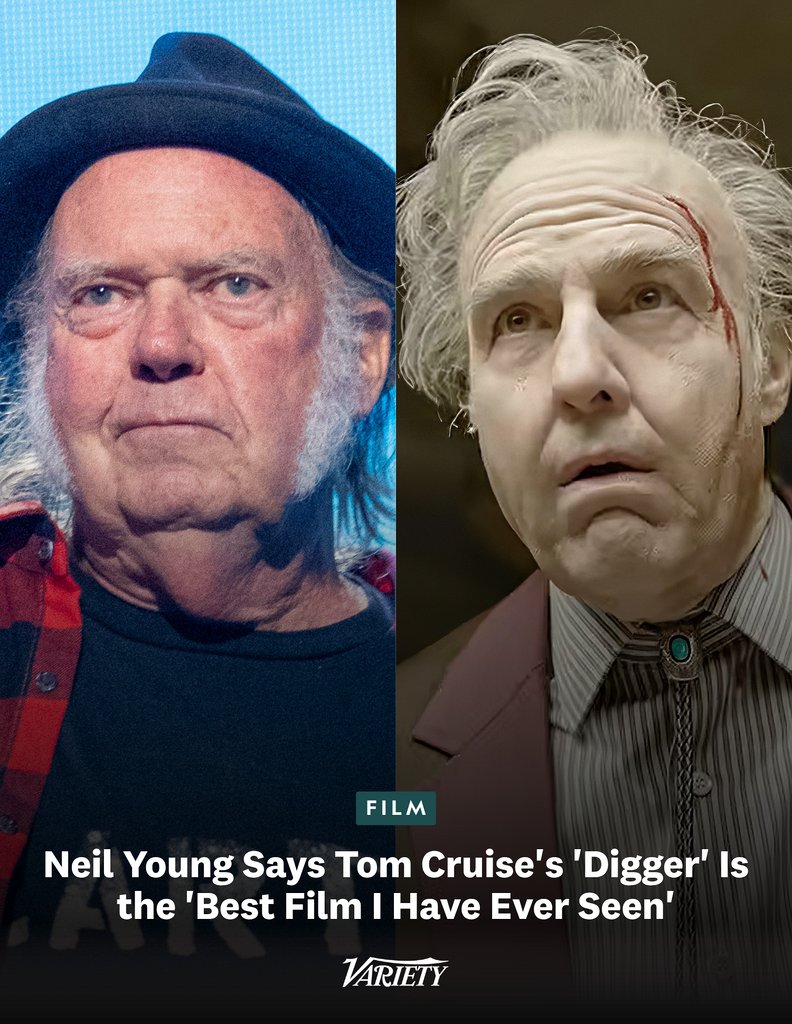
Neil Young says Tom Cruise's "Digger" is "the best film I have ever seen."
"None of the reviews I have read describe this film adequately, in my opinion," Young wrote. "They seem to miss the overall effect and most of them are negative. This film lives in a world of art. It is its own best review. Don't read any other reviews and forget this one before you see 'Digger.' It cannot be seen as a Tom Cruise film - that would be misleading. I would describe it as a film of our times... I do not view this film as a commercial venture. Rather it is an artful film of our times. The things that are said in 'Digger' are a direct reflection of today's political and social world. The film is so full of artful expression and radical change ups, that it may be too much to take in for those expecting a commercial film like we are used to today."
https://t.co/d2WnYhY0av