Most Filipinos know Alex Eala as the face of Philippine tennis.
But here’s a piece of sports trivia many have forgotten: decades before Eala was born, the Philippines already had two tennis stars who regularly battled the world’s best on the biggest courts.
Their names were Felicisimo Ampon and Raymundo Deyro—a golden tandem that helped make the Philippines one of Asia’s tennis powers during the 1940s and 1950s.
At a time when international travel was far more difficult than today, the two Filipinos journeyed across Europe and North America to compete in Grand Slam tournaments against some of the sport’s greatest legends.
Ampon, nicknamed the “Mighty Mite,” became an international sensation because of his remarkable size. Standing just around five feet tall and weighing barely 115 pounds, he routinely defeated much larger opponents using speed, precision, and relentless court coverage.
His résumé remains one of the finest ever assembled by a Filipino tennis player. He reached the quarterfinals of the French Open in both 1952 and 1953, advanced to the fourth round of the US Championships four times, won the prestigious Wimbledon Plate in 1948, and captured the 1950 Pan American Tennis Championship after defeating American star Bill Talbert.
Over nearly three decades, Ampon also became the Philippines’ greatest Davis Cup player, finishing with a national record 40 overall victories.
Deyro, meanwhile, was every bit as accomplished. The steady baseliner reached the fourth round of the French Open in 1953 and the third rounds of both Wimbledon and the US Championships. He represented the Philippines in a record 37 Davis Cup ties and remained a mainstay of the national team until he was 43 years old.
The pair produced one of Philippine sports’ greatest moments at the 1958 Asian Games in Tokyo.
Deyro defeated Ampon in an all-Filipino men’s singles final to win the gold medal, guaranteeing the Philippines both gold and silver. They then reunited in doubles to capture another gold, completing one of the country’s most dominant performances in Asian tennis history.
Together, they even defeated Japanese stars Kosei Kamo and Atsushi Miyagi in Davis Cup competition—the same duo that would later become US National Championships doubles champions.
Despite these remarkable achievements, both men gradually faded from public memory as Philippine tennis declined during the professional Open Era. As tennis became increasingly expensive and globalized after 1968, the country struggled to produce players capable of consistently competing at the highest level.
Today, Alex Eala is deservedly inspiring a new generation of Filipino tennis fans.
But perhaps her greatest contribution is reminding the nation that she isn’t writing the first chapter of Philippine tennis history.
She’s writing its long-awaited sequel—a story first begun by two forgotten Filipino heroes who proved, decades ago, that the Philippines belonged on the world’s biggest tennis stage.
(✍️: Top Dagohoy)
#radarPHLifestyle #radarPHMost Filipinos know Alex Eala as the face of Philippine tennis.
But here’s a piece of sports trivia many have forgotten: decades before Eala was born, the Philippines already had two tennis stars who regularly battled the world’s best on the biggest courts.
Their names were Felicisimo Ampon and Raymundo Deyro—a golden tandem that helped make the Philippines one of Asia’s tennis powers during the 1940s and 1950s.
At a time when international travel was far more difficult than today, the two Filipinos journeyed across Europe and North America to compete in Grand Slam tournaments against some of the sport’s greatest legends.
Ampon, nicknamed the “Mighty Mite,” became an international sensation because of his remarkable size. Standing just around five feet tall and weighing barely 115 pounds, he routinely defeated much larger opponents using speed, precision, and relentless court coverage.
His résumé remains one of the finest ever assembled by a Filipino tennis player. He reached the quarterfinals of the French Open in both 1952 and 1953, advanced to the fourth round of the US Championships four times, won the prestigious Wimbledon Plate in 1948, and captured the 1950 Pan American Tennis Championship after defeating American star Bill Talbert.
Over nearly three decades, Ampon also became the Philippines’ greatest Davis Cup player, finishing with a national record 40 overall victories.
Deyro, meanwhile, was every bit as accomplished. The steady baseliner reached the fourth round of the French Open in 1953 and the third rounds of both Wimbledon and the US Championships. He represented the Philippines in a record 37 Davis Cup ties and remained a mainstay of the national team until he was 43 years old.
Ampon and Deyro shared the greatest rivalry in Philippine tennis history. Their frequent career battles included Ampon winning the 1951 Swedish Hard Court Championship and Deyro taking the 1953 Oslo International title.
But the pair produced one of Philippine sports’ greatest moments at the 1958 Asian Games in Tokyo.
Deyro defeated Ampon in an all-Filipino men’s singles final to win the gold medal, guaranteeing the Philippines both gold and silver. They then reunited in doubles to capture another gold, completing one of the country’s most dominant performances in Asian tennis history.
Together, they even defeated Japanese stars Kosei Kamo and Atsushi Miyagi in Davis Cup competition—the same duo that would later become US National Championships doubles champions.
Despite these remarkable achievements, both men gradually faded from public memory as Philippine tennis declined during the professional Open Era. As tennis became increasingly expensive and globalized after 1968, the country struggled to produce players capable of consistently competing at the highest level.
Today, Alex Eala is deservedly inspiring a new generation of Filipino tennis fans.
But perhaps her greatest contribution is reminding the nation that she isn’t writing the first chapter of Philippine tennis history.
She’s writing its long-awaited sequel—a story first begun by two forgotten Filipino heroes who proved, decades ago, that the Philippines belonged on the world’s biggest tennis stage.
(✍️: Top Dagohoy)
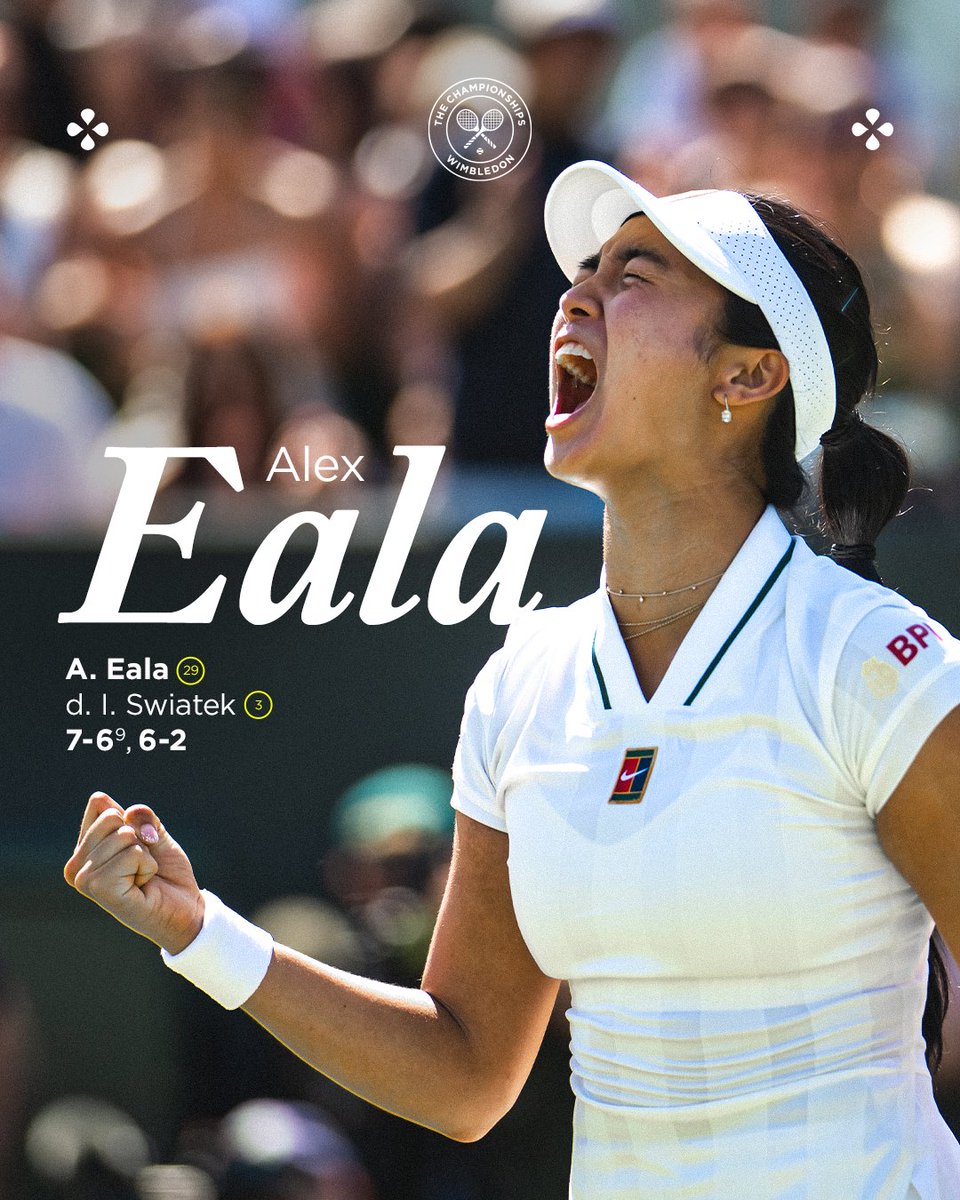
Alex Eala speaking through tears after beating Iga Swiatek to become the first Filipino player in the Open Era to reach the 2nd week of a Slam at Wimbledon.
“How does it feel to be standing here after just defeating the defending champion on Centre court?”
Alex: “I don’t know how to describe it. I’m in the 2nd week of a slam. It’s amazing for me. Iga is a phenomenal player and a really nice person. I’m really grateful to be able to share Centre court with her at Wimbledon. I’m really emotional. Maybe for someone like Iga who’s won so many slams or someone like Serena or Venus, this achievement may seem small.. but for someone who grew up in the Philippines…” 🥹
*Alex begins to cry*
“I went to train with my brother and grandfather every day after school with my ruffled socks and shoes and my chubby cheeks. To her, this is everything.”
🇵🇭🥹🥹🥹🥹🥹
1. Sa original version ni Kiko, 12 ang MACR.
2. Sa proposed individual amendment ni Miriam, 18 ang MACR.
3. After mag-usap ni Joker (sponsor) at Miriam, winithdraw ni Miriam 'yung amendment at bilang compromise, ginawa ng committee na 15 ang MACR, citing studies from CWC and PLM.
The one to beat. Alex Eala said it best. She has defeated world no. 2 Elena Rybakina to get to the quarterfinals of the Berlin Open!
Upset of the tournament but not taking away from Alex’s performance - the return of serve against the world’s best server, making her own aces as well, and stellar defense and tenacity rallying from 1-4 down in the first set.
Labaaann Alex!!! 🇵🇭 💪🏼
🚨₱332 Billion Later: The Price of Falling on Deaf Ears
I wrote about this before; but now, there is a video from 7 years ago about House Majority Leader Rolando Andaya Jr’s expose.
This whole mess went down during the Duterte administration, but the warnings completely fell on deaf ears.
Despite the massive red flags brought to light by Andaya Jr., the Duterte admin did nothing and the issue was swept under the rug.
1. Andaya exposed that ₱75 billion was secretly added to the 2019 DPWH budget.
A DPWH official testified under oath that this money did not come from their agency; it only appeared after the budget went through the DBM.
2. Out of that insertion, ₱14.5 billion went to flood control.
In total, the government allocated a staggering ₱332 billion for flood defenses in just three years (2017 to 2019).
Yet, heavily hit flood-prone areas continued to suffer.
3. While areas devastated by Typhoon Usman received virtually no help, over ₱385 million was funneled into six specific flood and drainage projects in Casiguran, Sorsogon — the hometown of the politically powerful Hamor family.
✳️ The Casiguran breakdown:
Himaoyon Flood Control (₱75M)
Lungib Seawall (₱80M)
Somal-ot Seawall (₱100M)
Cagpagol River Control (₱45M)
Suji River Control (₱25M)
Poblacion Drainage System (₱60M).
4. The main contractor landing these deals was Aremar Construction Corporation.
Corporate records revealed a massive conflict of interest: one of Aremar’s main incorporators was married to the daughter of then-DBM Secretary Benjamin Diokno.
5. To bypass scrutiny, a firm called C.T. Leoncio Construction allegedly acted as a conduit.
They won around ₱2 billion in Bicol infrastructure projects but secretly passed the actual work and profits over to Aremar.
6. Andaya produced actual deposit slips proving that over ₱70 million (including a single transfer exceeding ₱11.4 million) was moved directly into Aremar's bank accounts, which major anti-money laundering questions for the banks involved.
🔸What happened to Andaya after:
Following this intense expose, Andaya faced heavy political backlash and survived multiple assassination attempts, including separate incidents where his vehicle was shot at in 2018 and 2021.
Tragically, before his findings could ever lead to any real accountability, he was found dead from a gunshot wound to the head at his residence in June 2022.
🔸Where it stands today:
Because everything fell on deaf ears back then, absolutely nothing happened.
No final court ruling ever established criminal liability, and those accused denied any wrongdoing.
But the core question remains: if the government spent ₱332 billion back then, why are Filipinos still drowning in floods today?
Video source: https://t.co/ivVh4xrNs7
Maraming Salamat po, Sec @sonnyangara, for noticing our situation. I hope our children and teachers will get the immediate help they need. Moving forward, I pray they will finally have a more conducive learning environment and enough learning resources. God bless your leadership!
@jbenitezph@sonnyangara@bamaquino@stgatchalian Salamat sa reply, Cong Javi. Bale my my 2 classrooms na gna patindog cong. Kag ok na lang gali cong. Nakulbaan akon sister ky basi ma sanction xa ky gn share ko na ga donate kami and ang picture man. Indi daw na pwede. Ang sweldo na lang tani kung, kung mapataasan.
@sonnyangara@jbenitezph@bamaquino@stgatchalian Additional Support for basic classroom needs would be appreciated, sec. The table they just built themselves, chairs are uncomfortable. Electric Fans. Extension cords, Potable water, electricity and learning materials--- as teachers usually cover some the cost for them.
@sonnyangara@jbenitezph@bamaquino@stgatchalian Salamat sa response, Sec. Murcia National High School - Tumpok Annex po. Grade 7-11, 54 Students meron sila, sec, 4 regular teachers and 3 Volunteer literacy Teachers. Currently Sec, they are bldg 2 classrooms. Since last year Sec my sister is conducting class sa DIY Shack.
@jesusfalcis Sa amin din Atty Jes, sa Murcia Negros Occidental. Pasukan na ulit pero ganito pa rin situation kung saan nagtuturo kapatid ko. 5,000 lang sweldo niya. Abuno pa kami parati kasi ang hirap din ng mga students.