Formal verification is crucial to the security of decentralized protocols, especially for financial products like cross-chain bridges. We've prioritized the security of our bridge @Orbiter_Finance since day one.
We're excited to share our collaborative research with Prof. Feng (@captain8299) and his team from UCSB(@ucsantabarbara) and Kyle(@kcharbo0) from PSE(@PrivacyScaling) and Luke(@lukejdpearson) from Polychain(@polychain) where we developed a novel formal verification model to evaluate the mainstream cross-rollup bridges including Orbiter Bridge protocol!
Check out the work-in-progress paper:
https://t.co/jqNqOPI9Hm
Articles/threads
• ZK Hack Montréal Recap | ZK Hack
https://t.co/oUGpYmHbnP
• The Elegant Foundation: Plonkish Arithmetization | Psycho Virtual
https://t.co/P3YLrMJqh7
• What Does It Mean To Know? | Samuel Spitz
https://t.co/RGWNiWPJ8b
• Glue and Coprocessor Architectures | Vitalik Buterin
https://t.co/Ahx4OCNda6
• Hashing It Out: coSNARKs at TACEO | TACEO
https://t.co/4DfrU8agxK
• Web Proof, Make More Data Verifiable | @samoyedali
https://t.co/bfnI36Ia7l
• Ova: A Slightly Better Nova | Benedikt Bünz
https://t.co/4yp8W20c69
• The (Zero-Knowledge Proof) Singularity Is Near | Coindesk
https://t.co/kCwGtZsd6n
• Turbocharged Zero-Knowledge Proofs for Mobile | Reclaim Protocol
https://t.co/SnlKWRIk2d
• Introduction to Interactive Proofs and Mina | Psycho Virtual
https://t.co/cqDxH8Onhk
• Cracking Proofs: The Benefits of ZKPs and Fraud Proofs | Lagrange
https://t.co/RjCoYAwAMV
• Cracking ZK Coprocessors: Scaling Onchain Computation | Lagrange
https://t.co/Q1PXkdh37x
• The Hitchhiker's Guide to Scaling Bitcoin with STARKs | Omar Espejel
https://t.co/3WKzyD9CTK
• Solving Reproducibility Challenges in Deep Learning and LLMs: Our Journey | Ingonyama
https://t.co/Gb5nbWLHhO
• Data as a New Asset Class | Zap
https://t.co/OtncTMvN7M
• (Re)Introducing Kimchi: How the Berkeley Upgrade Transformed Mina's Proof System | o1Labs
https://t.co/3pmqwchAcf
• Plonk: A Mathematical Overview of this Proof System | Aligned
https://t.co/JnGtUXAjCl
• RISC-V ZKVMs: the Good and the Bad | Argument
https://t.co/eL4PdNDa7q
• Provable Watermark Extraction | Ingonyama
https://t.co/vTBO7BtnpQ
• Fake GLV: You Don't Need an Efficient Endomorphism to Implement GLV-like Scalar Multiplication in SNARK Circuits | Youssef El Housni
https://t.co/7TPB01UsA6
• Introduction to Polynomial Commitment Schemes (PCS) | Aligned
https://t.co/1wFOwg25BC
• Binius: Surfing on Binary Fields | Taiko
https://t.co/8IPGlhSxz7
• The Acceleration of zkEVM Prover | Orbiter Finance
https://t.co/6v8pkAcrxw
Some controversial (or not very) opinions:
- preconfirmations are not finality
- 1ms latency is bullshit
- ETH is not money
- Solana shouldn't shorten block times
- MEV is unlikely to ever represent a large percentage of the value accrued
- synchronicity is overrated
In our quest to run ZK Rollup provers on more cost-effective hardware while maintaining the timeliness of ZK proofs, we've conducted a fascinating and comprehensive trade-off study. We're excited to serve up the results of our research – a smorgasbord of innovations we've been cooking up just for you!
https://t.co/neyKfSSD8i
#ZKRollup #Blockchain #Innovation
@gakonst What we really need is a flexible and extension friendly on instruction-level evm model sir….. we have been suffering from expensive Poseidon hash on evm🥹🥹🥹
We should try to build decentralized systems on math-based security assumptions rather than centralized license-based ones. Don't take any unnecessary risks.
Intel HW is too complex to be absolutely secure! After years of research we finally extracted Intel SGX Fuse Key0, AKA Root Provisioning Key. Together with FK1 or Root Sealing Key (also compromised), it represents Root of Trust for SGX. Here's the key from a genuine Intel CPU😀
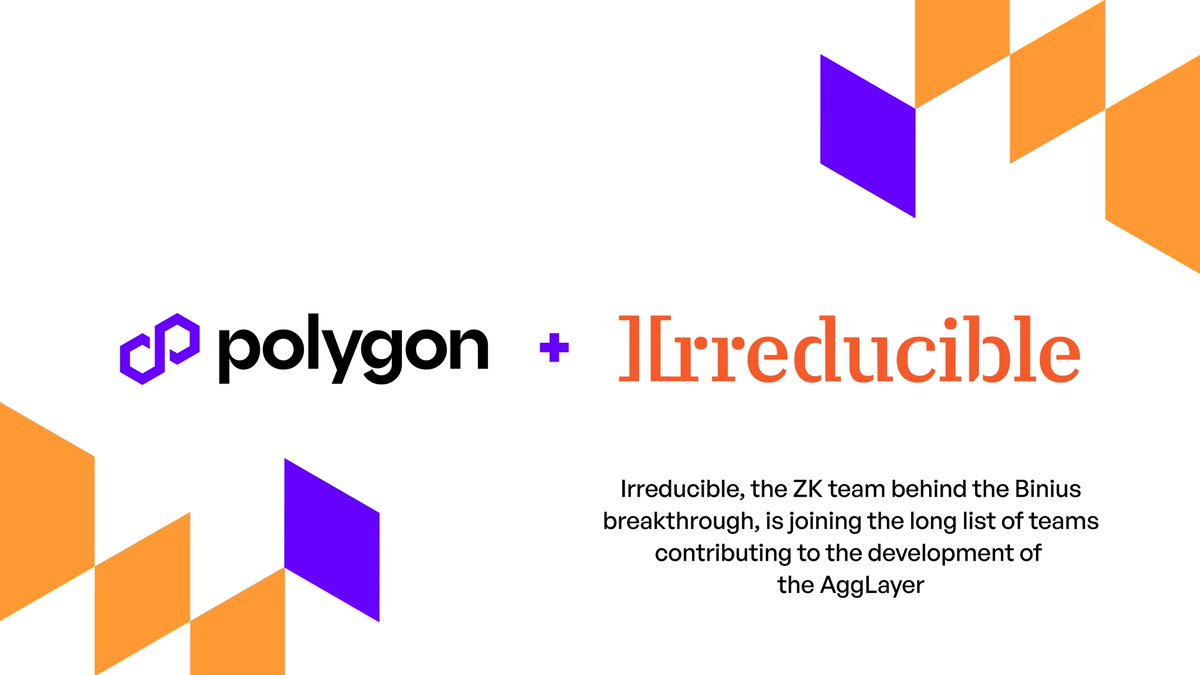
Irreducible has joined the list of contributors developing the AggLayer 🌊
Polygon Labs and @IrreducibleHW are building a production-grade zkVM based on Binius, bringing the breakthrough properties of binary fields to the problem of verifiable, offchain computing.
Big congratulations to the Mina community on the Berkeley Update! This marks a new era for Mina Protocol, where Proof of Everything sets sail.
Proof of Everything is a game-changer. At @Orbiter_Finance , we're focused on providing a seamless experience across Ethereum ecosystems with our innovative @Vizing_L2 solution. While we operate in different domains with unique goals, our shared passion for Zero-Knowledge #ZK technology unites us. Mina's lightweight 22KB blockchain showcases the beauty and immense potential of ZK.
Recently, Vizing launched the interoperability of our omnichain services, powered by ZK technologies. We're also tackling data availability, integrity, and scalability challenges within #Ethereum ecosystems. We look forward to more opportunities to collaborate and contribute to the ZK community in the future. Together, we're shaping the future of blockchain!
#Mina #Vizing #ZeroKnowledge #ZK #Orbiter
A new paradigm— do you see it?
From the beginning, Mina Protocol was designed differently.
The mainnet launch in 2021 introduced a brand new lightweight blockchain that eliminates bloat, paving the way for low operating costs and unprecedented decentralization at scale.
This was thanks to a breakthrough in zero knowledge cryptography: a blockchain with its entire state inside a tiny proof of just a few kilobytes, that anyone could download and verify in milliseconds.
Now, the recent Berkeley upgrade extends these revolutionary ZK features to real-world applications. It empowers developers to build off-chain and verify on-chain for scale, customizability, cost-efficiency, and optional privacy.
Beyond scalability and privacy, Mina now can serve as a global database of verified statements that seamlessly interact with one another— a ‘Proof of Everything.’
More than just attesting to individual statements of facts, Mina’s true potential will be realized by those who use it to harness the power of one massive collaborative computation.
So, what will you build?
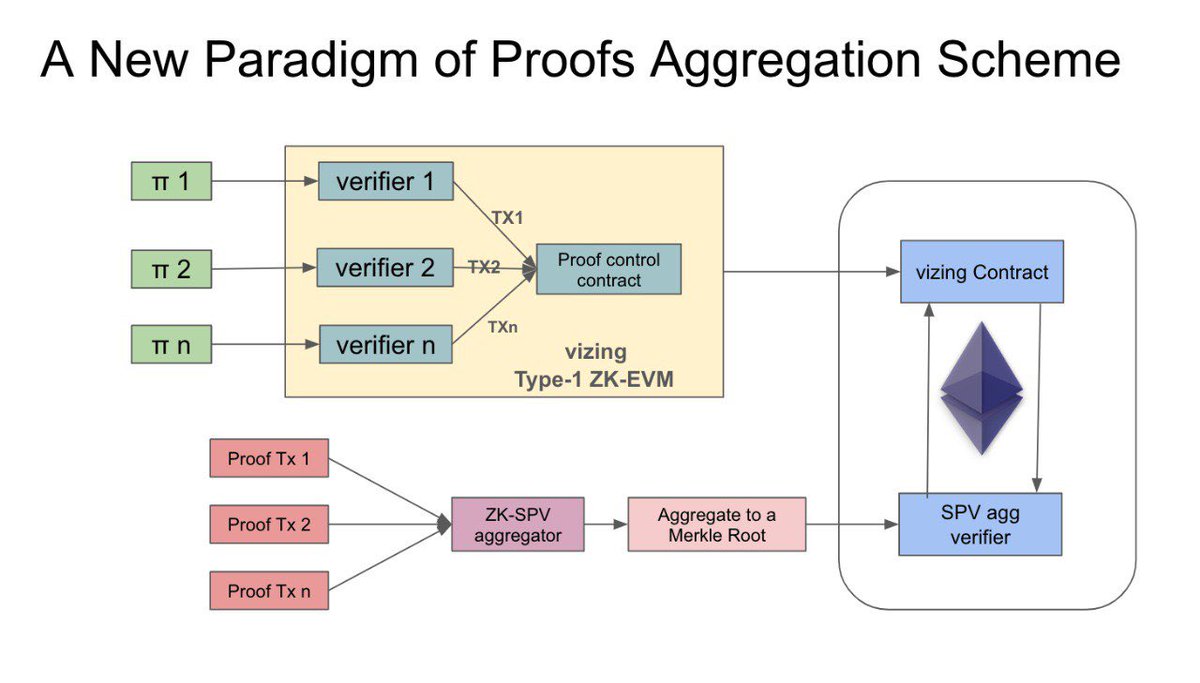
We may add another solution which is by utilizing Type1 ZKEVM, that means most stable/existing zk application can seamless migrate their proof verification (solidity verifier) without lost security. Morden CPU and GPU will effective enough to reduce the latency.
Why all the proof aggregation solutions will use RISC-V zkVMs
The development of RiscV proving vms like @RiscZero, @SuccinctLabs, @a16zcrypto, and @lita_xyz will transform how we work with zk. For example, aggregation layers will use them to perform recursion efficiently.🧵
1/
Yahoo!! After two weeks, we achieved 6X improvement in proving a batch of 20 ECDSA signatures, reducing the proving time from 72.4s to 11.4s 🚀. The time for computing wire commitments in the prover, accelerated by a 4090 GPU and involving a Merkle tree with 2^24 leaves and a leaf size of 136 Goldilocks, has a 22X improvement (29.1s to 1.3s). We extend our gratitude to the ZK community, especially the teams at @0xPolygon and @the_matter_labs , from whom we have learned a great deal!